The Answer Starts With No
This is the hardest question we answer anywhere on this site, so we will not soften the opening: most Western governments advise against all travel to Afghanistan. Not "reconsider travel." Not "avoid certain regions." All travel, the entire country, at the highest warning level they publish.
If you are hoping this post will argue the advisories wrong, it will not. What follows is an account: what the warnings actually say, what they mean in practice, what women travelers specifically face, who goes anyway, how experienced local partners run those trips, and who should not go at all. We keep a general framework for judging frontier risk in a separate guide; everything below is about Afghanistan alone.
What the Advisories Say, Unsoftened
The U.S. State Department holds Afghanistan at Level 4, Do Not Travel, and its stated reasons include terrorism, wrongful detention, and kidnapping. The UK Foreign Office advises against all travel to the whole country. Canada, Australia, and most European governments publish the same position. There is no mainstream Western government that treats Afghanistan as a destination its citizens should visit.
These are not theoretical cautions. In 2024, an attack in Bamiyan killed foreign tourists in one of the calmest districts in the country. Attacks on public places have continued in the years since the war ended. Foreign nationals, including people who entered as tourists, have been detained, and releases have taken months of negotiation through intermediaries. We list these facts not to be dramatic but because any honest answer has to carry them.
The practical consequences stack up fast. Standard travel insurance is void, so a specialist policy that names Afghanistan is mandatory. Most Western embassies in Kabul closed in 2021 and have not reopened, so consular help ranges from minimal to nonexistent; several governments state outright that they cannot assist their citizens inside the country. If something goes seriously wrong, no one is coming from your capital to fix it. The plan is your operator, your insurer, and the arrangements made before you flew.
And Yet People Go
Here is the part that confuses observers. Since the war ended in 2021, the day-to-day security picture inside the country changed in ways nobody predicted. The frontlines of a twenty-year conflict are gone. Roads that were undrivable for decades, Kabul to Bamiyan among them, carry ordinary traffic. Foreign visitors returned in small numbers, measured in the low thousands per year rather than the millions of a normal destination, and most come home reporting calm days, overwhelming hospitality, and almost no other travelers anywhere.
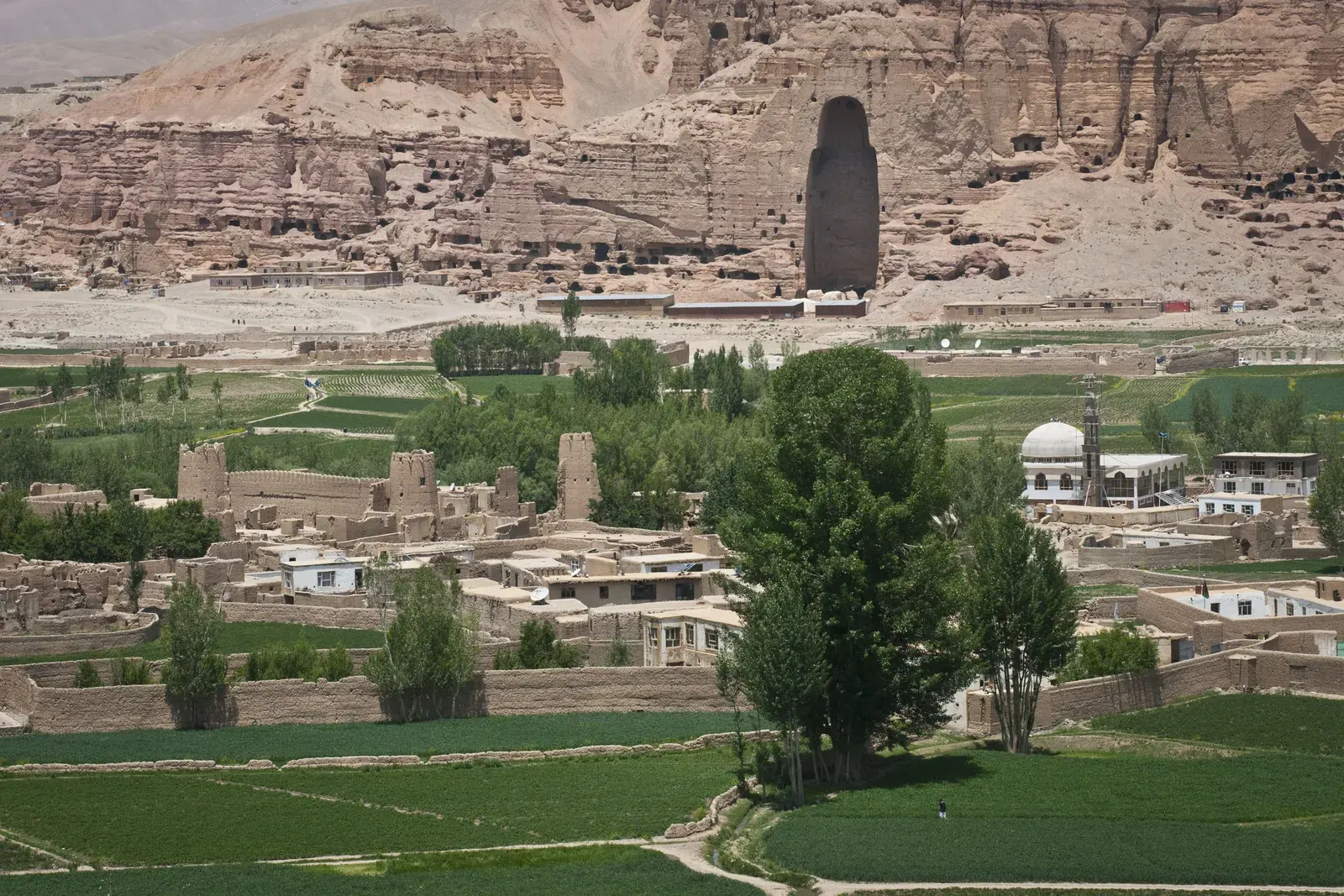
What draws them is not adrenaline. It is the Bamiyan Valley, where the empty niches of the Buddhas have watched the road for fourteen centuries. It is Band-e-Amir, the country’s first national park, six cobalt lakes held back by natural travertine dams at 3,000 meters. It is the Blue Mosque at Mazar-e-Sharif in its haze of turquoise tiles and white doves, and Balkh, one of the oldest cities on Earth, where Rumi was born. As a crossroads of civilizations, Afghanistan has almost no equal, and right now almost no witnesses.
Both pictures are true at once, and the resolution matters: a calm day in Afghanistan is not evidence of safety. The risk profile here is low-frequency and high-consequence. Nothing happens, and nothing happens, and then something happens. Every honest decision about this country starts from that shape.
For Women Travelers, Stated Plainly
Under the current authorities, women must cover their hair and dress conservatively in public. Access to certain sites and some forms of movement can be restricted, and the rules can change at short notice and without explanation. These are conditions of being in the country; they are not negotiable once you are there. Women do travel this route, accompanied throughout by guides who understand exactly what is and is not currently possible, and we brief every woman traveler in detail before she decides, so the decision is made with facts rather than assurances.
One wider fact belongs in this section, stated respectfully and without theater: the restrictions a visitor navigates for a week are a fraction of those Afghan women live under permanently, including exclusion from most education beyond primary school and from much public life. Some travelers conclude that this settles the question of visiting, in one direction or the other. We do not make that judgment for anyone; we state the facts and let each traveler weigh them.
How Experienced Local Partners Run Trips
What makes travel here possible is not bravado. It is administration, done by people who live in the country and answer for it daily. In practice that means:
- Permits, registrations, and checkpoints handled end to end by the local partner, with a letter of invitation provided for the visa application
- A route confined to the heartland corridor (Kabul, Bamiyan, Band-e-Amir, then Mazar-e-Sharif and Balkh) chosen for its current conditions, not its convenience
- No road travel after dark, and an internal flight from Mazar-e-Sharif back to Kabul that removes a long, unnecessary day on the highway
- Accommodation in the best available hotels and guesthouses, selected for location and security rather than stars
- Continuous monitoring of district-level conditions, with the standing decision to reroute or postpone rather than push through
- Proof of specialist insurance covering Afghanistan required from every guest before departure
Our own version of this trip is a 7-day expedition with a maximum of 5 guests, run with local partners who have managed every permit, route, and night’s lodging since we began operating there. The full route, conditions, and plain-language safety notes are on the Afghanistan expedition page, including the parts that are inconvenient to say.
Who Should Not Go
More people should say no to this trip than yes, and we would rather lose the booking than pretend otherwise. Do not go if this would be your first journey beyond routine tourism. Do not go if the consular vacuum unsettles you, because it should unsettle you, and going anyway requires having truly accepted it. Do not go if your family cannot absorb the worry, if you cannot follow in-country rules you may personally disagree with, or if you plan to work as a journalist on a tourist visa, which is a genuinely dangerous idea here. And do not go if you need the itinerary you booked to be the itinerary you get; flexibility is not a preference in Afghanistan, it is the operating system.
There is no shame in any of these. The niches at Bamiyan have waited fourteen hundred years; they will wait for a version of this country that your government does not warn you against.
The Honest Bottom Line
So, is it safe to travel to Afghanistan in 2026? No. Not by any definition your government, your insurer, or your family would recognize. What exists is a managed, non-zero risk that a small number of well-prepared travelers choose to accept, with expert local partners, specialist insurance, and eyes fully open, in exchange for standing at one of the great crossroads of human history while almost no one else on Earth is there. If you recognize yourself in that sentence, we will tell you everything we know, including the parts that argue against going. If you do not, the honest answer is the one this post started with.
Frequently Asked Questions
Do any Western governments say Afghanistan is safe to visit?
No. The United States, United Kingdom, Canada, Australia, and most European governments all advise against all travel to Afghanistan at their highest warning levels, citing terrorism, detention risk, and the absence of consular assistance. Any decision to go is made against that unanimous guidance.
Can women travel to Afghanistan?
Yes, women do travel the main tourist route, accompanied throughout. They must cover their hair and dress conservatively in public, some sites and movements can be restricted, and rules change at short notice. We brief every woman traveler in detail before she decides so the choice rests on facts.
Is Bamiyan safe to visit?
Bamiyan is widely considered one of the calmest regions in the country, and the 2024 attack that killed foreign tourists happened there anyway. That is the honest shape of Afghan risk: no region is exempt, which is exactly why continuous monitoring and a flexible itinerary are conditions of travel rather than extras.
What happens if conditions deteriorate during the trip?
The local partner decides early and conservatively: reroute around the affected area, hold in place at secure accommodation, or exit by the nearest viable route. The itinerary is built with that flexibility from the start, and no segment is ever forced through against the daily picture.
How do I get an Afghan tourist visa?
Through a designated Afghan embassy or consulate abroad, with a letter of invitation from the operator; we provide the letter and step-by-step guidance for the most reliable application route for your nationality. Allow generous lead time, because procedures change.
Is it ethical to visit Afghanistan right now?
Travelers disagree in good faith. Visitor spending reaches drivers, guesthouses, and bazaars directly, and some believe presence and witness matter; others conclude that visiting is not defensible under the current authorities, particularly given the restrictions on Afghan women. We state the facts, including the uncomfortable ones, and respect either decision.
Weighing Afghanistan?