The Least-Visited Country in Europe
Moldova is the least-visited country in Europe. Not the least visited in Eastern Europe. In all of it. Ask a well-traveled friend what they know about the place and you will usually get a pause, then something vague about wine, then silence. Both of those instincts are correct: nobody goes, and the wine is serious.
The country sits landlocked between Romania and Ukraine, a strip of rolling vineyard country that empires passed through and guidebooks pass over. Under the vineyards, quite literally, lie some of the largest wine cellars on Earth. Above ground, a cliff monastery has been carved into a river bend for the better part of a millennium. And along the eastern edge, across a river and a checkpoint, sits Transnistria, a country that does not officially exist: its own army, currency, and passport, recognized by no member of the United Nations.
This is the most accessible frontier trip we run, and we mean that in both senses. Direct flights reach Chisinau from a dozen European cities, no visa is needed for most Western passports, and our four-day expedition starts at $720 USD, the lowest price in our portfolio. Accessibility is not the same as ordinariness. Few places this easy to reach feel this far away.
Chisinau: Lower Your Expectations, Then Watch Them Rise
Chisinau will not seduce you from the airport taxi. The capital was largely destroyed in World War II and rebuilt in Soviet style: wide boulevards, monumental public buildings, apartment blocks that repeat to the horizon. Stay a day and the place softens. The parks are green and full, the Cathedral of Christ's Nativity anchors a walkable center, and the National History Museum tells the story of a borderland that has been Roman, Ottoman, Russian, Romanian, and Soviet within a handful of centuries.
The real conversion happens at the table. The Centru district is quietly reinventing Moldovan cooking: placinte pastries, mamaliga with sheep cheese, slow-cooked rabbit, and wine lists that read like a national manifesto. Dinner for two with a very good bottle costs what a starter costs in Zurich. Arrive hungry and reserve a table or two in advance.
The Wine: Cities Under the Vineyards
Milestii Mici
Beneath the southern edge of Chisinau, the cellars of Milestii Mici run for around 200 kilometers of limestone tunnels, of which a portion is in active use. You tour it by car, driving underground streets signed with vintages instead of names, past niches holding over two million bottles. Guinness World Records lists it as the largest wine collection on the planet. The scale stops being a statistic somewhere around the third underground intersection, when you realize the cellar has traffic rules.
Cricova
Cricova, just north of the capital, is the second underground city and the more theatrical of the pair: galleries dressed like tasting salons, a cinema deep in the rock, and a private cellar long maintained for visiting dignitaries, still holding bottles labeled with Brezhnev's name. The house specialty is sparkling wine made by the classical method, aged in the constant cool of the tunnels. Taste it at the source, sixty meters under the vineyards, and the bottle you bring home will never taste quite as good.
Orheiul Vechi: The Cliff That Prays
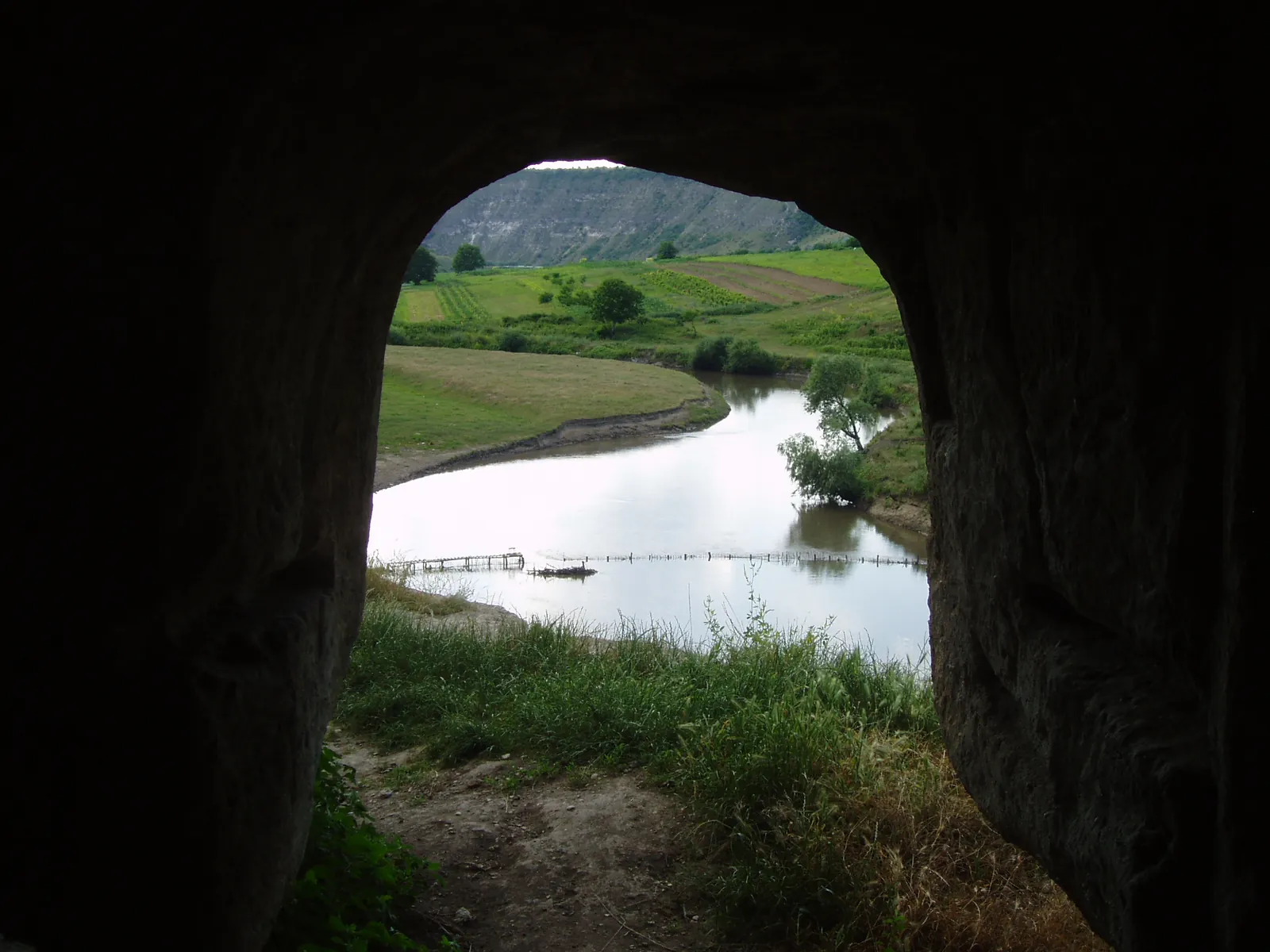
An hour from Chisinau, the Raut River makes a long horseshoe bend around a limestone ridge, and every civilization that passed this way left a layer in the rock: Bronze Age settlements, medieval fortifications, and a cave monastery dug into the cliff face itself. A small community of Orthodox monks still keeps the monastery alive, with cells, church, and refectory all carved from stone, and a bell tower poking through the ridge above the river.
Come in the late afternoon when the tour buses (all four of them) have gone. The valley goes quiet, the light rakes across the bend, and you understand why people have considered this ground holy for three thousand years.
Transnistria: A Day in a Country That Does Not Exist
In 1990, as the Soviet Union came apart, a sliver of land between the Dniester River and the Ukrainian border declared independence from Moldova. A brief war followed in 1992, then a ceasefire that froze everything in place. Three decades later, Transnistria still runs its own government, army, border posts, and currency, the Transnistrian ruble, accepted nowhere else on Earth. No UN member state recognizes it. On paper it is Moldova. On the ground it is somewhere else entirely.
Crossing in takes about an hour from Chisinau. At the checkpoint you receive a registration slip stating your purpose and duration, no stamp, no visa, and from there the twentieth century reasserts itself. Tiraspol's main boulevard runs from a Lenin monument to the House of Soviets, past a tank from the 1992 war mounted on a plinth. Hammer-and-sickle crests top government buildings. The kvass is sold from wheeled barrels in summer. It is not a theme park; around half a million people live here, shop here, and wait for buses here, which is exactly what makes walking through it so strange.
On the way back, the fortress at Bendery is worth the stop: a 16th-century Ottoman stronghold on the Dniester that has been besieged by most of the region's empires at one point or another. Then you hand back the registration slip, recross the line, and are quietly astonished to be back in a country that officially exists.
Honesty requires two notes. First, most Western governments fold Transnistria into their broader Ukraine-adjacent travel cautions, and you should read your own government's current advice before booking. Second, the territory is calm and tightly policed, and for organized visitors it has been consistently unusual rather than dangerous: the frozen conflict has stayed frozen since 1992. Our guide handles every interaction at the border, and we monitor conditions continuously.
Practicalities: Visas, Money, Timing
Moldova is refreshingly simple. EU, UK, US, Canadian, and most Western passport holders enter visa-free for up to 90 days. Chisinau's airport has direct connections to a dozen European hubs, and Bucharest is about two hours from the Romanian border by road, which makes Moldova an easy add-on to a wider European itinerary. The currency is the Moldovan leu, cards work almost everywhere in the capital, and prices are among the lowest in Europe.
Transnistria runs on its own ruble. Exchange a small amount in Tiraspol for lunch and souvenirs, and spend it before you leave, because no bank outside the territory will touch it. Romanian is Moldova's official language, Russian is widely spoken on both sides of the river, and English gets you surprisingly far in Chisinau's restaurants and nowhere at all in a Tiraspol bus station, which is part of the fun.
Timing: May through October is the comfortable window. Late September and early October are the sweet spot, harvest season, when the vineyards turn gold and wine festivities take over the country. The cellars themselves hold a constant cool temperature all year, so a winter visit loses less than you would think.
How We Run It
Our Moldova and Transnistria expedition is four days based in Chisinau: Milestii Mici and Cricova with tastings at both, Orheiul Vechi, and a full guided day across the border in Tiraspol and Bendery, with a licensed local guide and private vehicle throughout. At $720 USD it is the most affordable expedition we run, capped at five guests like everything we run outside the cruises, Antarctic camps and the Battle Abbey lodge in British Columbia. One transparency note: this itinerary once included a day in Odessa, and that leg is suspended while the war in Ukraine makes it unsafe. A day at the medieval fortress town of Soroca stands in until we can responsibly bring Odessa back, at no extra cost to booked guests when it returns.
We put Moldova on our list of the best frontier travel destinations for 2026 for a simple reason: nowhere else in Europe delivers this much strangeness for this little money, logistics, or risk. If you have been curious about frontier travel but hesitant to start with the deep end, this is the trip we point to first.
Moldova at a Glance
| Location | Eastern Europe, between Romania and Ukraine |
| Capital | Chisinau |
| Best time to visit | May to October; harvest season in early autumn |
| Getting there | Direct flights to Chisinau from major European hubs |
| Visa | Visa-free up to 90 days for most Western passports |
| Transnistria entry | Registration slip at the checkpoint; no visa, no stamp |
| Currency | Moldovan leu; Transnistrian ruble across the border |
| Languages | Romanian official; Russian widely spoken |
| Typical expedition length | 4 days |
| Group size | Capped at 5 guests |
Frequently Asked Questions
Is Transnistria safe to visit?
For organized visitors, Transnistria is unusual rather than dangerous. The territory has sat in a stable frozen conflict since 1992, it is tightly policed, and crime against tourists is very rare. That said, most Western governments fold it into their broader Ukraine-adjacent cautions, and the border with Ukraine is closed to visitors. Read your government's current advice, go with a guide who handles the border formalities, and the day runs smoothly.
Do I need a visa for Moldova or Transnistria?
Moldova is visa-free for EU, UK, US, Canadian, and most Western passport holders for stays up to 90 days. Transnistria issues a registration slip at its checkpoint rather than a visa; you state your purpose and duration, keep the slip, and hand it back when you leave. No stamps go in your passport on either side.
What money is used in Transnistria?
The Transnistrian ruble, a currency accepted nowhere else on Earth. Moldovan lei and small US dollar or euro notes can be exchanged locally in Tiraspol. Change only what you plan to spend on lunch and souvenirs, because you cannot convert it back once you leave, though a plastic commemorative coin makes a fair souvenir on its own.
Is Chisinau worth visiting in its own right?
More than its reputation suggests. The capital was rebuilt in Soviet style after World War II, but the parks are green, the Cathedral of Christ's Nativity anchors a pleasant center, the National History Museum is genuinely good, and the Centru district is quietly reinventing Moldovan cooking. Give it an evening and arrive hungry.
When is the best time to visit Moldova?
May through October is the comfortable window. Late September and early October are the charm offensive: harvest season in the vineyards, golden light, and wine festivities around the country. The cellars at Cricova and Milestii Mici hold a constant cool temperature year-round, so the wine itself has no season.
Start at the Strangest Border in Europe