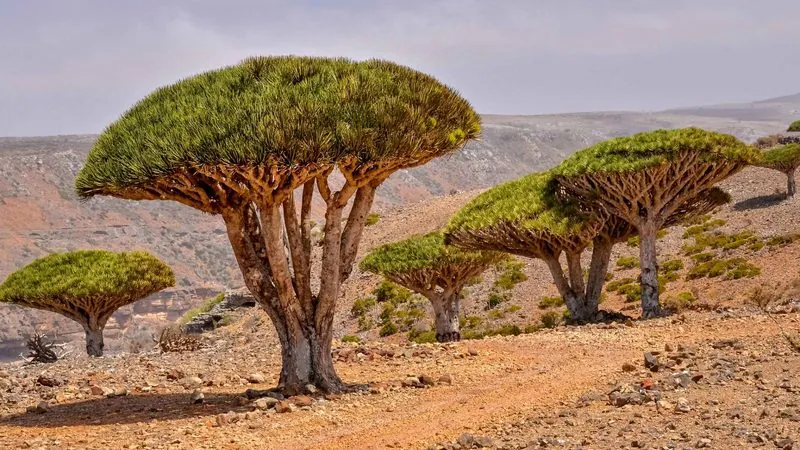
The Island That Looks Like Another Planet
Some places make you wonder if you've accidentally left Earth. Socotra is definitely one of them.
Picture dragon blood trees with their bizarre umbrella canopies, bottle trees with bloated trunks that look like cartoon drawings, and cucumber trees sprouting directly from bare rock. Add beaches so empty they feel like your own private discovery and a coastline hammered by monsoons that kept this place cut off from the world for months at a time, for centuries.
Socotra sits in the Arabian Sea, about 240 kilometers east of the Horn of Africa and roughly 350 kilometers south of the Arabian Peninsula. It belongs to Yemen, which immediately raises the question most travelers ask: is it safe? The answer isn't simple, and we'll dig into it. But here's the short version: Socotra has stayed largely separate from Yemen's mainland conflict, and small-group expeditions have been running there consistently with careful logistics and experienced local partners.
What draws people to Socotra isn't thrill-seeking for its own sake. It's the biological weirdness of the place. About 37% of Socotra's plant species, 90% of its reptile species, and 95% of its land snail species exist nowhere else on Earth. UNESCO made the Socotra Archipelago a World Heritage Site in 2008. Scientists call it the "Galápagos of the Indian Ocean," and that comparison works. Both islands evolved in near-total isolation, creating life that looks like it belongs to a different evolutionary timeline.
Here's what you need to know before going: when to visit, how the logistics work, what makes the island worth the effort, and why traveling with a specialist expedition is really your only viable choice.
Why Socotra Is Unlike Anywhere Else
The Biology
Twenty million years of isolation creates some wild evolutionary experiments. When Socotra broke away from the Arabian Peninsula, it carried a fragment of ancient life with it. Cut off from everything else, that life kept changing on its own terms.
The dragon blood tree (Dracaena cinnabari) is the island's most recognizable inhabitant. Its name comes from the dark red resin that bleeds from its bark when cut, historically used as medicine, dye, and incense. Stand beneath a grove of them on the Dixam Plateau and you'll feel like you've wandered onto an alien planet. Those flat, outstretched canopies aren't just for show. They're fog catchers, evolved to funnel moisture down to the roots in a place where rain is more rumor than reality.
The desert rose (Adenium obesum socotranum) looks like nature's practical joke: a bloated, pale trunk with barely a leaf in sight, then suddenly bright pink flowers exploding from the top. It grows straight out of limestone rock, storing water in its swollen base, apparently never having learned that plants need soil.
The island also supports 192 bird species. Forty-four breed here, and six exist nowhere else on the planet. The coastal waters are equally rich. The coral reefs around the archipelago rank among the least disturbed in the entire Indian Ocean, which is saying something.
The Culture
The Socotri people have their own language, Socotri, which was traditionally unwritten and passed down entirely through storytelling, songs, and conversation. An Arabic-based alphabet was developed in 2014 by researchers, but the language still exists primarily in spoken form across generations. It belongs to the Modern South Arabian language family. Around 70,000 people live here, most clustered in or around Hadibo, the capital.
Step outside the city and you'll find small fishing and herding communities living much as their ancestors did. Hospitality here feels genuine and unhurried. Locals encounter small numbers of visitors, not tourist hordes, which changes every interaction. This isn't a destination where locals have been worn down by volume. It's a place where being a visitor still means something.
When to Visit Socotra
Timing your visit isn't optional. It's essential. The island's weather patterns are extreme, and the monsoon season doesn't just make travel uncomfortable. It makes it impossible.
The Best Window: October to April
Most expeditions run during the dry season, roughly October through April. Temperatures hover between 25°C and 32°C (77°F to 90°F), warm but bearable. Winds calm down, seas settle, and the island's interior becomes accessible.
Here's how each part of the season feels:
October to December means fewer crowds and landscapes still green from the monsoon. Parts of the island stay damp, and the vegetation is at its most vivid. January to March is the sweet spot. Weather stays stable, dragon blood tree forests are fully accessible, and the light is perfect for photography. Most organized expeditions aim for this window, so book early.
April pushes the edge of the season. You can still travel, but weather starts getting unpredictable and you'll need to stay flexible.
What to Avoid: May to September
The southwest monsoon pounds Socotra. Winds hit 40 knots or higher. Seas turn violent. Flights get canceled or suspended for weeks. The island essentially shuts down to visitors. Some years, Hadibo airport closes completely for extended periods.
This isn't a "travel at your own risk" situation. It's genuinely inaccessible. Planning around the monsoon isn't a preference; it's a requirement.
How to Get to Socotra
Getting to Socotra is where many travelers hit their first wall. There's no simple, bookable route. The logistics are real, and they require either deep local knowledge or a reliable operator who handles them.
Flights
The only practical way to reach Socotra is by air. The island has one airport: Socotra Airport (SCT) in Hadibo. Flight options shift from season to season and should always be confirmed with your operator. In recent seasons the Abu Dhabi route previously operated by Air Arabia has been suspended; confirm current routings before you book. Current access routes include:
- Jeddah (Saudi Arabia): weekly direct flights via Yemenia Airways; currently the most practical gateway for international travelers
- Cairo (Egypt): periodic connections via Yemenia with a stop on the Yemeni mainland
- Sana'a (Yemen): technically possible but complicated by the mainland situation
Seats are limited and schedules change. You can't decide on a Tuesday that you'd like to be there by the weekend. It doesn't work that way.
Seasoned operators manage these flight complications as part of their service, securing seats, coordinating connections, and padding schedules for the inevitable delays that come with Socotra travel.
Entry Requirements
Socotra follows Yemeni visa requirements, which means advance planning for most nationalities. Some nationalities face additional restrictions beyond the standard visa process.
The situation on the ground is managed by the UAE-backed administration in Socotra, which has maintained relative stability and continues to facilitate tourism. But the paperwork and permissions aren't straightforward, and they change. This is another area where working with a specialist operator isn't just convenient; it's the only reliable way to ensure you're cleared to enter.
On the Ground
Once you're on the island, you need a local guide. This is a legal requirement, not a suggestion. Independent travelers can't simply rent a car and explore. All visitors must be accompanied by a licensed Socotri guide, and movement around the island requires coordination with local authorities.
The road network is limited. Many of the most significant sites, including the Dixam Plateau, Detwah Lagoon, and Homhil Protected Area, require 4WD vehicles and drivers who know the terrain. Some areas are only accessible on foot or by boat.
What to See and Do on Socotra
Three to four weeks wouldn't be enough to exhaust Socotra. Most expeditions run between 7 and 10 days, which covers the highlights without rushing; our own runs 8 days.
The Dixam Plateau and Dragon Blood Tree Forests
The plateau in the center of the island is where the dragon blood trees grow in their densest concentrations. The drive up from the coast is remarkable on its own: limestone cliffs, sudden drops, views that open up without warning.
At the plateau, the trees cluster in groves that look like something from a fantasy novel. The canopies interlock overhead. The light filters through differently every hour. Early morning and late afternoon are the best times to be there, for the quality of light and the relative cool.
This is the image most people associate with Socotra, and it delivers. But it's worth arriving with patience rather than a checklist. The plateau rewards time spent in it, not just photographs taken of it.
Detwah Lagoon
On the western tip of the island, Detwah Lagoon is one of the most visually striking coastal landscapes in the Indian Ocean. A narrow strip of white sand separates the turquoise lagoon from the open sea. Flamingos wade in the shallows. The water is calm, good for kayaking or swimming, and the dunes that wrap around the lagoon are worth an hour of wandering on foot.
What catches you off guard is the quiet. Some afternoons, there's genuinely no one else there. No other boats, no other footprints. Just the lagoon, the dunes, and the particular stillness that comes from being somewhere most people will never go. It's one of those moments where Socotra's scale and its emptiness stop being abstract ideas and become something you actually feel.
Homhil Protected Area
Tucked into the northeast of the island, Homhil manages to pack a lot of what makes Socotra remarkable into a single area: dragon blood trees, frankincense trees, natural pools fed by mountain springs, and long coastal views that make it hard to leave. It's one of those places that earns its protected status just by existing.
The pools are fed by springs that filter down through the rock, making them some of the only places on the island where you can swim in fresh water. After days of heat and dust, that's not a small thing. Most people who visit Homhil end up staying longer than they planned.
Qalansiyah and the Western Coast
The town of Qalansiyah sits near Detwah Lagoon and serves as a base for exploring the western coast. The fishing community here is one of the most welcoming on the island, and the evenings sitting near the water, watching boats come in, are the kind of travel moments that don't photograph well but stay with you.
The western coastline is also where some of the best snorkeling and diving opportunities exist. The reefs are healthy, visibility is good, and marine life is genuinely rich. Sea turtles are common. So are reef sharks, if you're looking.
Hadibo and the Market
Hadibo is the capital and largest settlement on the island, with a population of around 8,000. It's not a beautiful city, but it's a real one. The market is worth a morning. Frankincense and myrrh are sold openly, along with dried fish, honey (which Socotra produces in quantity and which is considered among the finest in the region), and local crafts.
The market is also a good place to understand the texture of daily life on the island: the mix of Socotri, Yemeni, and East African influences that makes the culture here genuinely distinct.
Beaches
Socotra has beaches that most travelers will never see, on an island that most travelers will never visit. Arher Beach on the northeast coast sits below sand dunes that rise straight from the water, an unusual pairing that photographers can't resist. Shoab Beach, reachable only by boat, earns its reputation through word of mouth from visitors who struggle to describe what makes it so striking.
The praise isn't travel-writer hyperbole. It comes from people who've seen plenty of coastlines and still find themselves surprised by what Socotra offers.
What to Expect on a Socotra Expedition
Socotra isn't a resort destination. It's not somewhere you book a hotel room, land independently, and work out the rest on arrival. Knowing what you're actually getting into is half the preparation.
Accommodation
Most expeditions combine camping with basic guesthouses. Camping is the better option by most measures: skies with almost no light pollution, mornings that open up slowly in landscapes that look different every hour. Guesthouses in Hadibo and a handful of other locations offer beds, showers, intermittent electricity, and meals.
The overall experience sits somewhere between glamping and genuinely roughing it. Comfortable enough that you'll sleep well, basic enough that you're actually in the environment rather than insulated from it.
Food
Socotri food is simple and good. Fish is the foundation of most meals: grilled, fried, or cooked in broth. Rice, flatbread, and vegetables round things out. The honey is exceptional and shows up at breakfast. Tea is constant.
If you have dietary restrictions, communicate them clearly in advance. Vegetarian is manageable. Vegan requires planning. Severe allergies require serious advance coordination.
Health and Safety
Socotra has limited medical infrastructure. There's a hospital in Hadibo, but it's not equipped for serious emergencies. Travelers should carry comprehensive travel insurance that includes medical evacuation, and should be in reasonable health before going.
Vaccinations worth discussing with a travel health clinic before departure include hepatitis A and B, typhoid, tetanus, and depending on your history, rabies. Malaria isn't currently a significant risk on Socotra, but this can change. Check current guidance close to your travel date.
The security situation deserves honest discussion. Socotra has been under UAE-backed administration since 2018 and has remained largely stable relative to mainland Yemen. Organized expeditions have operated continuously, with local partners who monitor conditions closely. That said, this isn't a destination where you should travel without an experienced operator who has current, on-the-ground intelligence. The situation is stable but not static.
Connectivity
Mobile coverage exists in Hadibo and a few other areas. Outside of those, you're offline. Satellite communication devices are worth considering for longer expeditions. Most travelers find the disconnection to be one of the better parts of the experience, but it's worth knowing before you go.
Why Socotra Requires a Guided Expedition
This isn't a sales pitch. It's practical reality.
Independent travel on Socotra is legally restricted. All visitors require a licensed local guide. The permit and visa process is complex and changes without notice. Flights are limited and require advance booking through channels that aren't accessible via standard booking platforms. The road network requires local knowledge and appropriate vehicles. Medical and emergency logistics need to be pre-arranged.
But logistics are just the beginning. What you actually experience on Socotra depends entirely on who's showing it to you. A guide who knows the dragon blood tree ecology transforms those forests from pretty scenery into living systems. Someone with genuine relationships in coastal communities can open doors that otherwise stay locked. Getting into certain protected areas isn't about showing up with a permit; it's about who made the phone call first.
The best expeditions to Socotra are built around small groups: small enough to move efficiently, access restricted areas, and have genuine interactions with local communities. Large tour groups change the dynamic entirely. A handful of travelers with a specialist guide and strong local partnerships is a fundamentally different experience from a coach tour; we cap ours at five.
Is Socotra Right for You?
Socotra attracts a specific type of traveler. You don't need to be an ultramarathoner or rock climber. The physical demands are real but manageable. What matters more is being someone who values genuine remoteness over reliable comfort, who gets excited by biological oddities as much as beautiful scenery, and who can roll with logistical hiccups when the destination justifies them.
Show up expecting hotel amenities, reliable Wi-Fi, and schedules that stick, and you'll be miserable. Show up ready to wake under dragon blood trees, swim in empty lagoons, and spend evenings with Socotri fishing families who've never met anyone from your country, and this could be the trip that ruins all other trips for you.
The travelers who return most satisfied share one trait: they arrived curious and stayed flexible when plans shifted. And on Socotra, plans always shift. What you get back from the island depends largely on how much control you're willing to surrender.
Practical Information at a Glance
| Location | Arabian Sea, part of Yemen |
| Capital | Hadibo |
| Best time to visit | October to April |
| Avoid | May to September (monsoon) |
| Getting there | Fly via Jeddah (current main gateway); routes change seasonally |
| Currency | Yemeni Rial (USD widely accepted) |
| Language | Socotri (local), Arabic (official) |
| Guides | Required by law |
| Accommodation | Camping + basic guesthouses |
| Typical expedition length | 7–10 days |
| Group size | Capped at 5 guests |
Before You Go: A Short Checklist
- Travel insurance with medical evacuation coverage (non-negotiable)
- Vaccinations reviewed with a travel health clinic at least 6–8 weeks before departure
- Visa and permit arrangements confirmed through your operator
- Flights booked well in advance (seats are limited)
- Cash in USD; ATMs are unreliable or nonexistent outside Hadibo
- Lightweight, breathable clothing for heat; a layer for cool plateau evenings
- Good walking shoes, not hiking boots necessarily, but something with grip
- Offline maps downloaded; don't rely on connectivity
- A satellite communicator if you plan any independent walks
- Realistic expectations about comfort, and high expectations about everything else
Plan Your Socotra Expedition
Socotra is one of the last places on Earth that genuinely earns the word "undiscovered." Not because no one has been there, but because so few people have, and the island has remained almost entirely unchanged by the ones who did. The dragon blood trees don't care about tourism trends. The Detwah Lagoon doesn't know what Instagram is. The Socotri language has survived for millennia and will survive long after you've gone home.
What you bring back from a trip like this isn't a tan or a souvenir. It's a shift in perspective, the kind that comes from standing somewhere genuinely ancient and strange and realizing the world is far weirder and more alive than your daily routine ever lets on.
Ready to Start Planning?