The Most Underrated Country in Asia
Here is a country of about 170 million people, the eighth most populous on Earth, holding three UNESCO World Heritage Sites, the densest river network on the planet, and the world's largest mangrove forest. It sits directly between India and Southeast Asia, the two most traveled regions in the hemisphere. And it receives fewer foreign tourists than a mid-sized European city sees in a holiday weekend.
Bangladesh is not off the map because it lacks things to see. It is off the map because nobody ever put it on. There is no banana-pancake trail here, no tour bus circuit, no souvenir street. What there is: a medieval river city running at full volume, tea gardens rolling to the horizon in seven shades of green, the only apes on the subcontinent whooping across a rainforest canopy, and an overnight boat journey that belongs on any serious list of the world's great travel experiences.
And the people. Travelers who come home from Bangladesh all tell the same story, of being invited to tea by strangers, waved at from rice paddies, and treated as an honored guest rather than a walking wallet. In a region where tourism has professionalized every interaction, Bangladesh still runs on genuine curiosity. That alone justifies the trip.
Old Dhaka: The River at Full Volume
Start at Sadarghat, the great river terminal on the Buriganga, where triple-decked launches stack against the bank and the water is a moving traffic jam of ferries, barges, and slim wooden boats sculling between them. Cross the river in one of those small boats, a few taka for the ride, and watch the shipyards on the far bank, where workers rebuild ocean-going hulls with hand tools and scaffolding lashed from bamboo. It is one of the great urban river scenes anywhere, and it has no equivalent left in Asia.
Behind the waterfront, Old Dhaka layers century upon century: Lalbagh Fort, the unfinished Mughal stronghold of the 1600s; Ahsan Manzil, the Pink Palace of the city's former merchant princes; the Dhakeshwari Temple, the city's Hindu heart; and Hindu Street, where conch-shell bangles are still carved the old way. Everything moves by cycle rickshaw, hundreds of thousands of them, hand-painted like fairground art. Dhaka is loud, close, chaotic, and completely alive. Nobody comes home indifferent to it.
The Train East: Sreemangal and the Tea Country
From Dhaka, a morning train runs east through emerald rice country to Sreemangal, the tea capital of Bangladesh, in the low green hills of the Sylhet region. The ride itself is half the point: chai sellers working the aisles, paddies and palm groves scrolling past, the country unspooling at window height.
Sreemangal is walking country. Tea gardens roll in every direction, picked by families who have worked these slopes for generations, alongside pineapple orchards, rubber estates, and lemon groves. The local invention is the seven-layer tea, poured so that seven distinct bands of color and flavor sit stacked in one glass; the recipe is guarded, the result is better than it needs to be, and trying it at the source is obligatory. Around the gardens live the Khasia, an indigenous community whose villages and betel-leaf cultivation predate the tea estates entirely.
Lawachara and the gibbons
Just outside town, the Lawachara rainforest holds the western hoolock gibbon, the only ape native to the Indian subcontinent. Arrive at dawn and you hear them before anything else, a whooping duet swinging through the canopy while the forest wakes up around you. Between the gibbons, the langurs, and the birdlife, Lawachara packs a remarkable amount of wild into a morning's walk.
The Night Boat South: Launches and Floating Markets
For a century, the way south from Dhaka was the Rocket, a fleet of paddle-wheel steamers that worked the delta routes long after the rest of the world retired theirs. The paddle-wheelers have mostly gone, but the tradition survives in the launches, big working riverboats that leave Sadarghat at dusk with the whole southern delta as their destination. We book a private cabin on a reputable one: a bed, an en-suite, and a door that opens onto the moving river.
You slide out of the city as the lights come on, and you wake somewhere else entirely: flat silver water, mist, the delta at dawn. In Barisal's backwater country the floating markets are already trading, boats heaped with guava and vegetables, every transaction conducted gunwale to gunwale. No stage management, no entrance fee, not another visitor in sight. If one morning explains why Bangladesh rewards the people who bother, it is this one.
Bagerhat, Sonargaon, and the Abandoned Street
West of Barisal lies Bagerhat, the 15th-century mosque city founded by the warrior-saint Khan Jahan Ali and now a UNESCO World Heritage Site. Its centerpiece, the Sixty Dome Mosque, is the largest historic mosque in the country, a forest of stone columns under a roof of (count them, the name lies) seventy-seven domes, with moss softening every line.
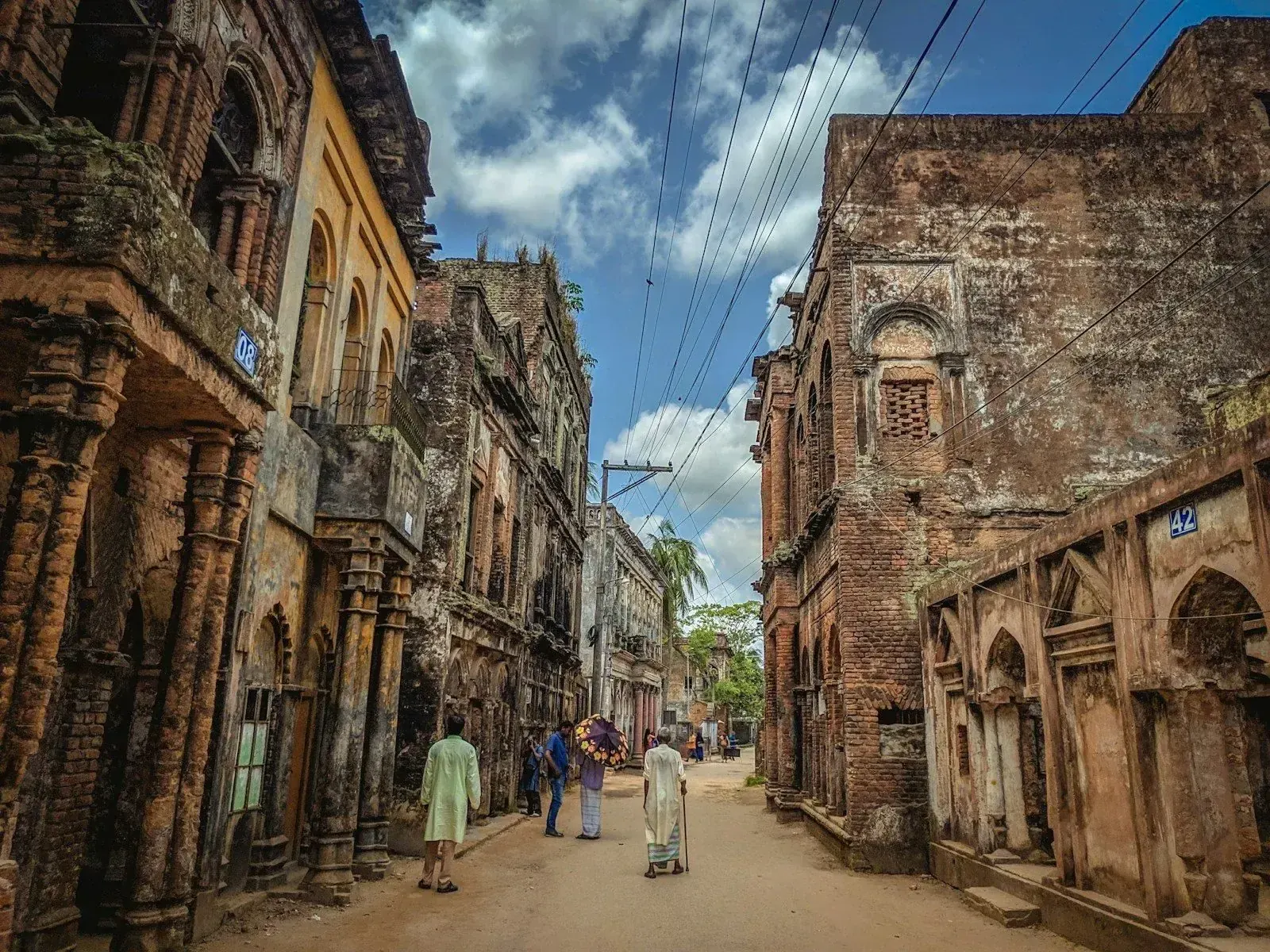
Back toward Dhaka, Sonargaon served as the medieval capital of Bengal, trading muslin so fine that legend claims a full bolt could pass through a ring. Its neighbor Panam Nagar is the eerie one: a complete 19th-century merchants' street, abandoned in the twentieth century and left standing, mansion after mansion slowly going back to the jungle. A sunset boat ride on the Meghna River closes the circle the way this country should always be seen, from the water.
What About the Sundarbans?
The Sundarbans, the largest mangrove forest on Earth and home of the Bengal tiger, spreads across the country's southwest corner. Our seven-day route does not reach it, honestly, because it cannot be done justice in a day; the forest demands several nights aboard a boat, moving with the tides. Since every itinerary we build is bespoke, guests with more time regularly add a Sundarbans leg, and we will tell you plainly whether your dates and the season make it worthwhile.
Practicalities: Timing, Visas, Money, Manners
Go between November and March, the dry, cool season: Dhaka days around 25 degrees, the tea gardens at their greenest, rivers calm for boat travel. The monsoon, June to September, swells the rivers and drowns the roads. Most nationalities can obtain a visa on arrival at Dhaka's airport for about 50 US dollars, or an eVisa in advance; we provide the invitation letter and walk you through the paperwork.
The currency is the taka. Cards work at better hotels in Dhaka; carry cash everywhere else, in small notes. Dress modestly, shoulders and knees covered, and bring slip-off shoes for mosque and temple visits. Expect to be photographed, often, by delighted strangers whose entire agenda is a selfie with a foreign visitor; expect invitations to tea you do not have time to accept; and expect the food, dal and bhuna and river fish, especially the beloved hilsa, to be far better than the country's zero-Michelin-star reputation suggests.
How We Run Bangladesh
Our Bangladesh expedition is seven days: Old Dhaka and the Buriganga, the train to Sreemangal and the Lawachara gibbons, the overnight launch to Barisal's floating markets, the ruins of Bagerhat, and Sonargaon with a Meghna sunset to finish. $1,750 USD covers all accommodation including the private launch cabin, air-conditioned train tickets, a private vehicle and small-boat charters, every entrance fee, and a licensed English-speaking guide throughout, with the group capped at five guests, as on all our trips outside the cruises, Antarctic camps and the Battle Abbey lodge in British Columbia.
We keep a running argument in the office about which of our destinations is the most underrated, and Bangladesh wins it more often than anywhere on our list of the world's most remote destinations. Remote is not always about distance. Sometimes it is about attention, and no country this rich in life gets less of it.
Bangladesh at a Glance
| Location | South Asia, on the Bay of Bengal |
| Capital | Dhaka |
| Best time to visit | November to March, dry and cool |
| Avoid | June to September (monsoon) |
| Getting there | Fly to Dhaka (Hazrat Shahjalal International) |
| Visa | Visa on arrival for many nationalities (~$50 USD) or eVisa |
| Currency | Bangladeshi taka; cash outside Dhaka |
| Language | Bengali; English common in cities |
| Typical expedition length | 7 days |
| Group size | Capped at 5 guests |
Frequently Asked Questions
Is Bangladesh safe for tourists?
Bangladesh is one of the most welcoming countries in South Asia and among the safest in the region for foreign visitors. Violent crime against tourists is essentially unheard of, and petty theft is rare. The real hazards are mundane: intense traffic in Dhaka and summer heat. With a guide and driver throughout, both are managed for you.
Why does Bangladesh get so few tourists?
Habit, mostly. Bangladesh sits beside India, Nepal, and Thailand, three of the most heavily marketed destinations on Earth, and it has never built a tourism industry of its own. The result is circular: no crowds, so no infrastructure, so no crowds. For travelers, that circle is the entire opportunity.
When is the best time to visit Bangladesh?
November through March, the dry and cool season. Dhaka days sit around 25 degrees Celsius, the tea gardens are at their greenest, and the rivers are calm for boat travel. Avoid the monsoon months from June to September, when the rivers swell and many roads become difficult.
Do I need a visa for Bangladesh?
Most nationalities need one, and it is straightforward: many passports qualify for visa-on-arrival at Dhaka's airport for around 50 US dollars, and an eVisa is available in advance. We provide the invitation letter and supporting documents and brief every guest on the current requirements before travel.
What is the overnight river boat like?
A working Bangladeshi launch, not a cruise ship. We book a private cabin with a bed and en-suite on a reputable vessel; it departs Dhaka in the evening and arrives in the southern delta at dawn. It is rustic rather than luxurious, and it is one of the great overnight journeys left on Earth.
Go Before the Word Gets Out