The Kingdom of Bhutan exists in defiance of the modern world. While neighboring countries court mass tourism, this Himalayan nation deliberately limits visitors to preserve what money cannot buy: authenticity, tranquility, and a culture untouched by the homogenizing forces of globalization.
Tucked between Tibet and India, Bhutan measures success not by GDP but by Gross National Happiness. Prayer flags flutter across mountain passes where the air is thin and sacred. Monks in crimson robes walk ancient paths between dzongs that have stood for centuries. Here, the last Shangri-La isn't marketing hyperbole. It's a living reality you can still experience.
But visiting Bhutan requires more than booking a flight. The kingdom's "High Value, Low Impact" tourism policy means every journey must be carefully planned, thoughtfully executed, and respectfully conducted. This isn't a destination you stumble into. It's one you earn.
Understanding Bhutan's Unique Tourism Model
Bhutan doesn't want your average traveler. The kingdom deliberately constructed barriers to entry that filter out anyone seeking cheap thrills or Instagram moments. Instead, they've created a system that attracts exactly the kind of explorer who will appreciate what they're protecting.
The Sustainable Development Fee
Every adult visitor pays a Sustainable Development Fee of $100 USD per night; children from age 6 until their 12th birthday pay half, and under-6s pay nothing. This isn't a tax: it's an investment in preserving Bhutan's culture, environment, and way of life. The fee funds free healthcare and education for Bhutanese citizens, monastery restoration, and environmental conservation.
Think of it as the price of admission to a country that has remained carbon negative while the rest of the world burns fossil fuels. Bhutan absorbs more carbon dioxide than it produces, thanks to a constitution that mandates 60% forest coverage. You're not just visiting a destination; you're supporting a living experiment in sustainable development.
Guided Travel Requirements
Since September 2022 you no longer have to book through a tour operator, but every visitor must travel with a licensed Bhutanese guide. This isn't bureaucratic overreach. It's cultural protection. Your guide becomes your cultural interpreter, ensuring you understand the significance of what you're experiencing rather than simply consuming it.
The best operators work with local experts who grew up in the valleys you'll explore. They know which monasteries welcome visitors during morning prayers, where to find the clearest views of Jomolhari peak, and how to navigate the complex etiquette of Bhutanese society without causing offense.
When to Visit Bhutan
Bhutan's seasons shape more than weather. They determine which experiences become possible.
Spring (March–May): Festival Season
Spring brings Bhutan's most celebrated festivals, known as tsechus. The Paro Tsechu in March or April draws thousands of Bhutanese dressed in their finest ghos and kiras to witness sacred cham dances performed by monks in elaborate masks. The Thimphu Tshechu in autumn offers similar spiritual theater against the backdrop of the capital's largest dzong.
These aren't tourist performances. Bhutanese families travel for days to attend, believing that witnessing the dances purifies negative karma. The energy is electric, reverent, and utterly authentic.
Weather during spring is mild and clear, perfect for trekking and mountain views. Rhododendrons bloom across the hillsides in explosions of pink and white.
Autumn (September–November): Peak Trekking Season
Autumn delivers Bhutan's most reliable weather. Skies clear after the monsoon, revealing the full majesty of the Himalayas. This is prime time for serious trekking, including the legendary Snowman Trek.
Temperatures are comfortable for hiking, and the air is crisp enough to see distant peaks with startling clarity. Rice terraces turn golden across the valleys, creating a landscape that seems painted rather than photographed.
Winter (December–February): Solitude and Spirituality
Winter brings fewer visitors but deeper experiences. The high passes close, limiting trekking options, but lower valleys remain accessible and temperatures rarely drop below freezing. This is the season for cultural immersion: longer conversations with monks, unhurried exploration of temples, and the rare privilege of having sacred sites nearly to yourself.
Winter light in Bhutan is extraordinary. The low angle of the sun illuminates the Himalayas in shades of gold and rose that photographers spend lifetimes trying to capture.
Summer (June–August): Monsoon and Meditation
The monsoon season sees the fewest visitors, which means the most intimate experiences. Rain typically falls in afternoon downpours rather than continuous drizzle, leaving mornings clear for exploration. The landscape explodes in green, waterfalls cascade from every cliff, and the air smells of earth and growing things.
This is the season for contemplation: for sitting in monastery courtyards listening to the rhythm of rain on ancient roofs, for understanding why Bhutanese culture values patience and presence over constant motion.
Essential Destinations in Bhutan
Paro Valley: Gateway to the Sacred
Most journeys begin in Paro, home to Bhutan's only international airport and some of its most significant sites. The valley feels like a living museum where traditional architecture isn't preserved. It's simply how people still build.
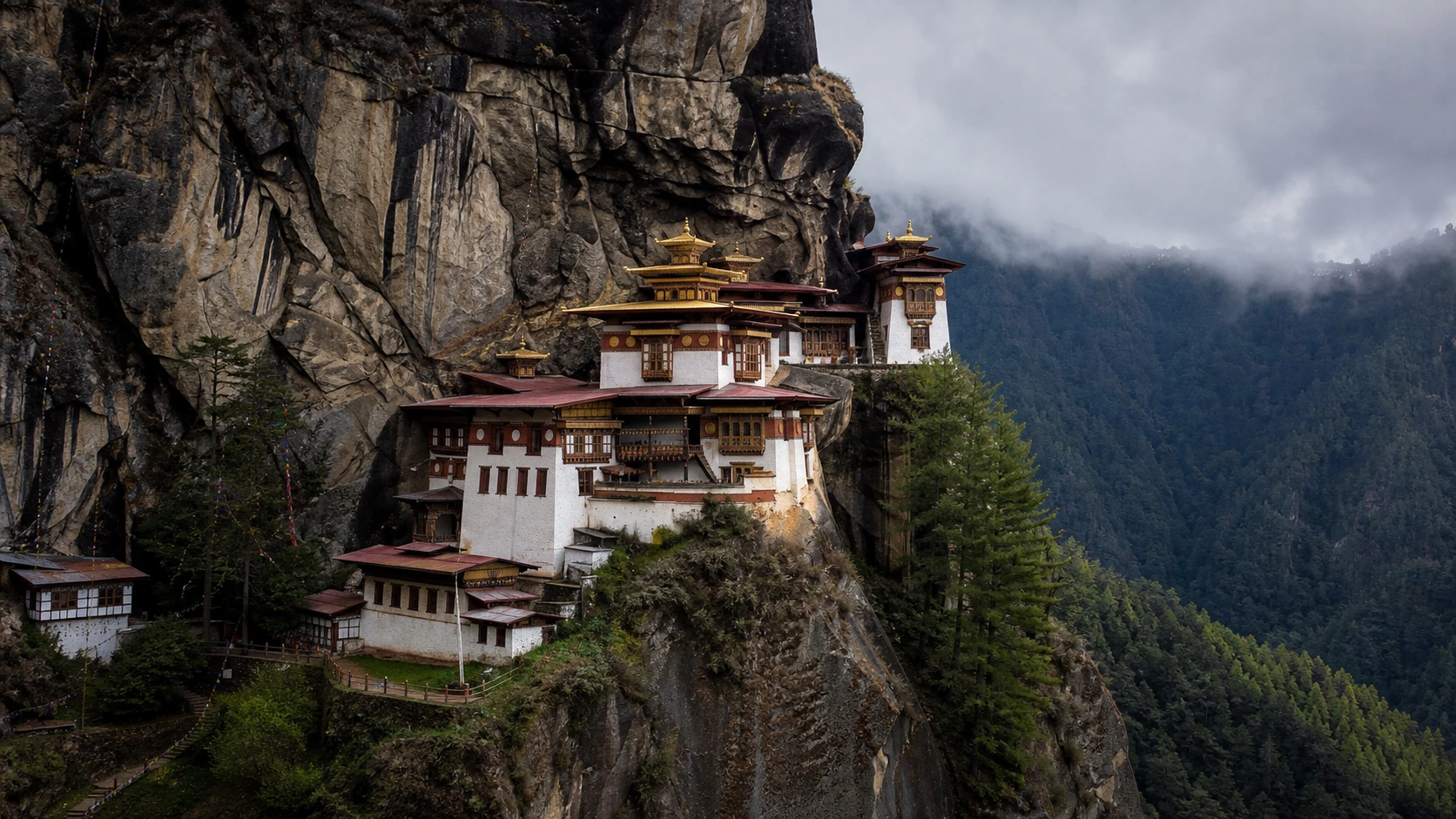
Paro Taktsang (Tiger's Nest Monastery) clings to a cliff face nearly 900 meters above the valley floor. The three-hour hike to reach it winds through pine forests hung with prayer flags. Guru Rinpoche, who brought Buddhism to Bhutan, reportedly meditated in the cave here for three years, three months, three weeks, and three days. The monastery built around that cave represents the spiritual heart of Bhutan.
The trek requires moderate fitness but rewards every step. As you climb, the valley spreads below like a green tapestry. Prayer wheels spin in the wind. The sound of distant chanting drifts from hidden temples.
Rinpung Dzong dominates Paro town: a fortress-monastery consecrated in 1646 that has guarded the valley for nearly four centuries. During festivals, its courtyards fill with masked dancers and the deep throb of long horns. On quiet days, you might encounter young monks practicing debates in the shadows of ancient walls.
Thimphu: Where Tradition Meets Modernity
Bhutan's capital city navigates the delicate balance between preserving culture and embracing necessary change. Traffic lights were installed then removed because Bhutanese preferred human traffic police. Traditional architecture is mandated by law, yet internet cafes operate inside buildings that look centuries old.
Tashichho Dzong serves as the seat of government and summer residence of the Chief Abbot. The massive structure, rebuilt in 1962 using traditional methods, demonstrates how Bhutanese craftsmanship adapts ancient techniques to modern needs. No nails were used in its construction: only wooden pegs and mortise-and-tenon joints.
Weekend Market reveals Bhutanese daily life beyond the tourist veneer. Farmers from surrounding valleys sell yak cheese, dried chilies, and vegetables you won't recognize. The market operates on trust: vendors often leave produce unattended while customers leave money in baskets.
Punakha: The Ancient Capital
Punakha served as Bhutan's capital until 1955 and remains the winter residence of the Chief Abbot. The valley sits at a lower elevation than Thimphu, creating a subtropical microclimate where rice grows and citrus trees flourish.
Punakha Dzong stands at the confluence of the Pho Chhu and Mo Chhu rivers, positioned according to ancient prophecies. The structure appears to float on water during monsoon floods, a testament to both spiritual vision and engineering skill. Inside, the throne room contains some of Bhutan's most sacred relics.
Chimi Lhakhang, the fertility temple, draws couples hoping to conceive. The temple honors Drukpa Kunley, the "Divine Madman" who used unconventional methods to teach Buddhist principles. Wooden phalluses decorate the temple as symbols of fertility and protection from evil.
Bumthang: Spiritual Heartland
Four valleys comprise the Bumthang region, considered the spiritual center of Bhutan. Ancient temples dot the landscape, many predating the unified kingdom. This is where Buddhism first took root in Bhutan, where the most sacred sites draw pilgrims from across the Himalayan region.
Jakar Dzong overlooks the main valley from a ridge that offers panoramic views of terraced fields and traditional farmhouses. The dzong's position allowed defenders to spot approaching armies from miles away while providing a commanding view of the valley's agricultural wealth.
Kurjey Lhakhang contains the body print of Guru Rinpoche, left when he meditated in a cave to subdue a local demon. Three temples now protect the site, each built in different centuries but harmoniously integrated. The complex represents the layered history of Bhutanese Buddhism.
Trekking in Bhutan: Beyond the Ordinary
Bhutan's trekking routes traverse landscapes that remain largely unchanged since the first Buddhist masters walked these paths. Unlike Nepal's crowded trails, Bhutanese treks offer genuine solitude and cultural immersion.
The Snowman Trek: Ultimate Himalayan Challenge
The Snowman Trek ranks among the world's most difficult treks, crossing eleven high-altitude passes over 25 days. The route traverses the remote Lunana region, home to some of Bhutan's most isolated communities. Only the most experienced trekkers should attempt this journey, but those who complete it describe it as life-changing.
The trek reaches altitudes above 5,000 meters, where oxygen is scarce and weather can change instantly. Yak herders guide you through landscapes of impossible beauty: turquoise lakes reflecting snow peaks, valleys where blue poppies (Bhutan's national flower) bloom in hidden meadows.
Lunana villagers live much as their ancestors did centuries ago, dependent on yaks for survival. They welcome trekkers with genuine warmth, sharing butter tea and stories around yak-dung fires. These encounters remind you why travel, at its best, connects rather than merely consumes.
Druk Path Trek: Accessible Highland Adventure
The five-day Druk Path Trek connects Paro and Thimphu via high ridges that offer stunning Himalayan views. This moderate trek suits reasonably fit travelers who want to experience Bhutan's wilderness without extreme altitude challenges.
The route passes pristine alpine lakes where trout rise to mayflies in the evening light. Ancient meditation retreats hide in rhododendron forests. Prayer flags mark high passes where the wind carries mantras across vast landscapes.
Camping under Bhutan's night sky reveals why ancient peoples saw divinity in the heavens. With minimal light pollution, the Milky Way appears as a river of stars flowing between mountain silhouettes.
Cultural Considerations for Trekkers
Trekking in Bhutan requires cultural sensitivity beyond Leave No Trace principles. Local communities maintain sacred sites along trekking routes. Your guide will explain which areas require special respect, where photography is inappropriate, and how to interact appropriately with locals you encounter.
Many trails pass active meditation retreats where practitioners spend years in solitude. Maintaining quiet and avoiding intrusion is a form of respect that Bhutanese appreciate and remember.
Cultural Immersion: Understanding Bhutanese Life
Buddhism in Daily Life
Buddhism in Bhutan isn't a weekend religion. It permeates every aspect of daily existence. Prayer flags flutter from every home, not as decoration but as active spiritual practice. The wind carries printed mantras across the landscape, accumulating merit for those who hung them.
Monasteries operate as living institutions rather than tourist attractions. Monks study philosophy, practice meditation, and maintain centuries-old traditions. Visitors who approach with genuine respect often receive informal teachings or invitations to observe daily rituals.
Meditation practices vary between different schools of Buddhism present in Bhutan. The Drukpa Kagyu school emphasizes direct experience over intellectual study. Visitors can learn basic meditation techniques from qualified teachers, though serious practice requires longer commitment than most travelers can offer.
Traditional Arts and Crafts
Bhutan maintains thirteen traditional arts and crafts, known as zorig chusum, through active practice rather than museum preservation. Artisans still create everything from hand-woven textiles to intricate wood carvings using techniques passed down through generations.
Textile weaving represents one of Bhutan's highest art forms. Women weave complex patterns on backstrap looms, creating fabrics that serve both practical and ceremonial purposes. The finest kiras (traditional dresses) require months to complete and command prices reflecting their artistic value.
Thangka painting transforms Buddhist teachings into visual form. Artists spend years learning to paint deities according to precise iconographic rules. Each color, gesture, and symbol carries specific meaning comprehensible to those trained in Buddhist philosophy.
Architecture and Sacred Geometry
Bhutanese architecture follows principles that blend practical construction with spiritual symbolism. Traditional buildings use no nails, relying instead on precisely cut joints that allow structures to flex during earthquakes while maintaining structural integrity.
Dzongs represent the pinnacle of Bhutanese architecture. These fortress-monasteries combine defensive capabilities with spiritual functions, creating spaces that feel both imposing and sacred. The proportions follow sacred geometry principles that create harmony between human-built structures and natural landscapes.
Traditional homes reflect the same principles on a smaller scale. Three-story structures house animals on the ground floor, families in the middle, and grain storage above. This arrangement provides warmth, security, and efficient use of space while maintaining spiritual purity through proper separation of functions.
Planning Your Bhutan Expedition
Choosing the Right Operator
Your choice of tour operator determines the quality of your entire Bhutan experience. The best operators combine logistical expertise with deep cultural knowledge, creating journeys that satisfy both practical needs and spiritual curiosity.
Look for operators who employ local guides with genuine expertise rather than just language skills. The difference becomes apparent when your guide can explain the philosophical significance of temple murals or identify medicinal plants used in traditional healing practices.
Small group sizes enhance the experience significantly. While Bhutan's regulations don't specify group size limits, the most rewarding journeys typically involve no more than five travelers. Smaller groups move more easily through cultural sites, create less impact on local communities, and allow for more personalized experiences.
Permits and Documentation
Visitors from most countries need a visa. You apply online and pay the SDF and the one-off $40 visa fee at the same time, and applications are reviewed within five working days. A tour operator or your hotel can apply for you, but you'll need a passport valid for at least six months and recent photographs.
Special permits are required for certain regions, including areas near the Tibetan border and some remote trekking routes. These permits require additional processing time and may involve security clearances.
Health and Safety Considerations
Bhutan's healthcare system provides excellent service in major towns but limited facilities in remote areas. Comprehensive travel insurance including emergency evacuation coverage is essential, particularly for trekking expeditions.
Altitude sickness affects some visitors, especially those flying directly from sea level to Paro airport at roughly 7,300 feet. Plan acclimatization days and recognize symptoms of altitude-related illness.
Water quality varies throughout Bhutan. Bottled water is available in towns, but trekkers should carry purification tablets or filtration systems. Your operator typically provides boiled or filtered water during organized tours.
Packing for Bhutan
Bhutan's diverse elevations and climates require versatile packing. Even summer visits may encounter cold temperatures at high altitudes, while lower valleys remain warm year-round.
Essential items include:
- Layered clothing suitable for temperature variations
- Waterproof jacket and pants for monsoon conditions
- Sturdy hiking boots broken in before travel
- Sun protection including hat, sunglasses, and high-SPF sunscreen
- Personal first aid kit with altitude sickness medication
- Respectful clothing for temple visits (covering arms and legs)
- Camera with extra batteries (charging opportunities may be limited)
Budgeting for Your Journey
Beyond the Sustainable Development Fee, budget for international flights, visa fees, and personal expenses. Most tour packages include accommodation, meals, transportation, and guide services, but personal purchases, tips, and alcoholic beverages typically cost extra.
Quality trekking expeditions require specialized equipment and experienced guides, reflecting higher costs than basic cultural tours. The investment ensures safety, comfort, and access to experiences unavailable through budget operators.
Responsible Travel in Bhutan
Environmental Consciousness
Bhutan's carbon-negative status results from deliberate policy choices that prioritize environmental protection over economic growth. Visitors can support these efforts by choosing operators committed to sustainable practices.
Minimize plastic waste by carrying reusable water bottles and shopping bags. Respect wildlife by maintaining appropriate distances and avoiding flash photography that might disturb animals. Follow designated trails to prevent erosion and vegetation damage.
Cultural Sensitivity
Bhutanese culture emphasizes respect, patience, and mindfulness. Dress modestly, especially when visiting religious sites. Remove shoes before entering temples and avoid pointing feet toward altars or religious images.
Photography requires sensitivity and often permission. Many Bhutanese prefer not to be photographed, while religious ceremonies may prohibit cameras entirely. Ask before photographing people and respect negative responses graciously.
Supporting Local Communities
Choose accommodations and restaurants that employ local staff and source ingredients locally. Purchase handicrafts directly from artisans when possible, ensuring fair compensation for skilled work.
Tipping practices vary, but modest tips for guides, drivers, and service staff are appreciated. Your tour operator can advise appropriate amounts based on local customs.
The Deeper Journey
Visiting Bhutan changes you in ways that extend beyond typical travel experiences. The kingdom's emphasis on happiness over wealth, community over individualism, and spiritual development over material accumulation challenges assumptions about what constitutes a successful life.
Many visitors describe a sense of peace that descends gradually during their stay. The absence of advertising, the prevalence of prayer flags, the sight of monks going about daily routines: these elements create an atmosphere where contemplation becomes natural rather than forced.
Bhutan doesn't reveal its secrets quickly. The country rewards patience, respect, and genuine curiosity. Surface-level tourism is possible but misses the profound experiences available to those who approach with appropriate humility and openness.
The kingdom's commitment to preserving its culture while selectively embracing beneficial changes offers lessons for a world struggling with globalization's homogenizing effects. Bhutan proves that development and tradition can coexist when guided by wisdom rather than mere economic incentive.
Your journey to Bhutan becomes part of a larger story: one where thoughtful travelers support a nation's efforts to maintain authenticity in an increasingly artificial world. The memories you create and the perspectives you gain represent more than personal enrichment; they become part of your responsibility to protect what remains precious and rare.
The last Shangri-La exists not as a destination to be conquered but as a teacher to be approached with respect. Bhutan offers its lessons to those ready to receive them, creating transformations that extend far beyond the duration of any single journey.
When you return home, you'll carry more than photographs and souvenirs. You'll carry the knowledge that places like Bhutan still exist, that different ways of living remain possible, and that some experiences transcend the ordinary boundaries of travel to become genuine encounters with the sacred.
For those seeking such encounters, for travelers ready to engage with destinations that demand respect rather than merely offering services, Bhutan awaits. The kingdom's doors open to those who approach with appropriate reverence for what they'll find beyond the threshold.
Ready to Start Planning?