Skip to content

Waypoint Journeys × West Africa

Ghana, Benin
& Togo

Voodoo, Castles & the Slave Coast

8 Days

8 days across three nations at the crossroads of history

8 DaysFrom $3,050 USDMax 5 guests

We reply within 24 hours

Three Countries, One Short Stretch of Coast

The Europeans who traded here named this part of the Gulf of Guinea by what they took from it: the Slave Coast in Benin and Togo, the Gold Coast in Ghana. For two centuries Ouidah was one of the busiest slaving ports on the Atlantic, and the castles at Cape Coast and Elmina still stand over the beach in Ghana. The same coast is where Vodun is practised openly and daily, in family compounds as much as in temples. And it belongs to people getting on with the present: the cloth traders of Lomé’s Grand Marché, the fishermen working their brush pens on Lake Nokoué, the musicians, designers and street cooks of Accra.

We spend eight days moving west through Benin, Togo and Ghana, and the order matters. You see Ganvié, a lake town founded by people escaping slave raids, and the palaces of Abomey, built by the kingdom that carried out those raids, before you walk the slave route in Ouidah and, at the end of the week, go down into the dungeons at Cape Coast and Elmina. It is a heavy week in places. With five guests at most, there is time to stop, ask questions and talk about what you have seen.

“In Ouidah the python temple and the cathedral face each other across the same small square. Plenty of families here keep faith with both.”
Benin Ganvie Stilt Houses
Stilt Village, Benin

What the Week Is Built Around

Vodun in Ouidah

Vodun is a religion with priests, shrines and obligations, practised by millions across West Africa and the diaspora. In Ouidah you visit the Sacred Forest and the Temple of the Pythons with a guide who can explain what you are looking at, and what not to photograph.

The Slave Route and the Castles

In Ouidah you walk the Route des Esclaves, the road captives were marched down to the sea, as far as the Door of No Return. In Ghana you go inside Cape Coast and Elmina Castles, the two most significant slave forts still standing on the African coast.

Ganvié on Lake Nokoué

About 35,000 people live in Ganvié, the largest stilt village in Africa, in houses, schools and shops raised over the water. You travel its channels by pirogue, which is how residents get to school, to market and to work.

The Palaces of Abomey

The Royal Palaces of Abomey, a UNESCO World Heritage Site, were the seat of the Dahomey kings, who built one of the most powerful states in pre-colonial Africa, much of it on captives sold through Ouidah.

Two Borders in Eight Days

Both crossings are by road, with our team handling the paperwork. The Fon traditions of Benin, the Ewe and Mina cultures of Togo and the Akan and Ga heritage of Ghana overlap in places and differ in others, and you notice it in food, cloth and language.

Markets & the Working Day

Lomé’s fetish market, where healers and practitioners buy their remedies; the Grand Marché; the Artisans Village; Makola Market in Accra. People come to these places to work and shop, so bring small notes, some patience and a question or two.

The Expedition

Eight days heading west along one coastline, from a lake village in Benin to the castles of Ghana’s Cape Coast.

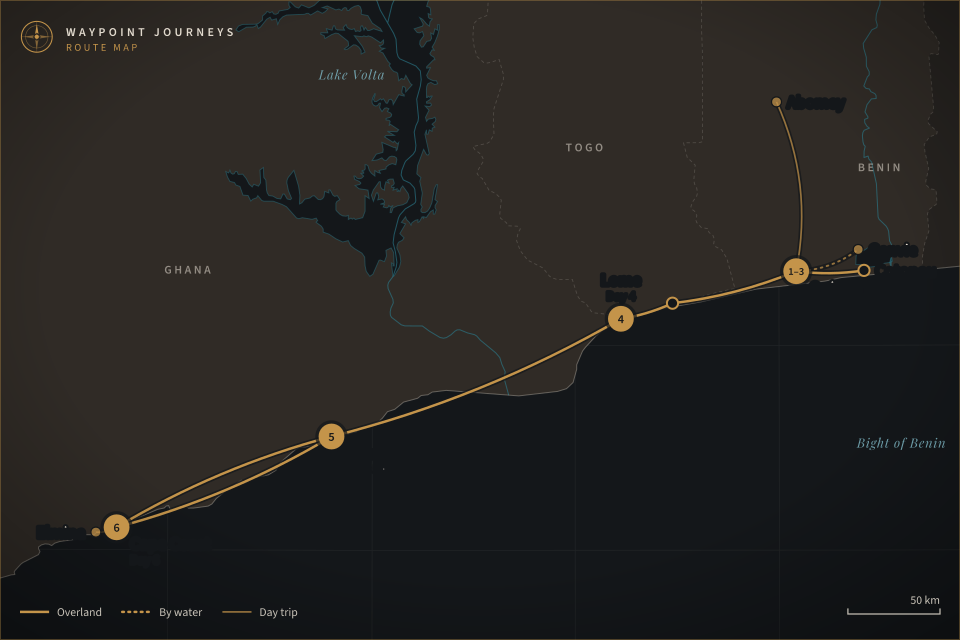
Route map of the Cotonou to Accra: Ouidah, Lome, Accra and Cape Coast.
The Route

Cotonou to Accra

Eight days west along the Slave Coast: three nights in Ouidah with day trips to Ganvie and Abomey, over the border to Lome, then Accra and the castles of Cape Coast and Elmina.

  1. Days 1–3Ouidah
  2. Day 4Lome
  3. Days 5 · 7–8Accra
  4. Day 6Cape Coast
Explore the route
Arrival in Cotonou
Day 1
Cotonou, Then Ouidah

Land at Cadjehoun Airport in Cotonou, Benin’s economic capital, and transfer west along the coast to Ouidah, a low, sandy town of old Afro-Brazilian merchant houses and roadside shrines. It is your base for the first three nights, which means one unpack and a quiet first evening before two full days out.

Ganvié & Abomey
Day 2
Lake Nokoué to the Palaces of Abomey

An early start and a long day in the vehicle. Ganvié sits on Lake Nokoué, and about 35,000 people live there in houses, markets and schools built on stilts. Its founders took to the lake to escape slave raids from Dahomey; you cross it by pirogue, past fishermen tending their pens. Then inland to Abomey and the Royal Palace Museum, a UNESCO World Heritage Site and the seat of the Dahomey kings, whose wealth came largely from that same trade. Before the drive back to Ouidah for the night, the underground village of Bohicon and the Chameleon Temple.

Ouidah: Birthplace of Voodoo
Day 3
Ouidah: Pythons, Forest & the Slave Route

A day in Ouidah itself, the spiritual centre of Vodun, a faith practised by millions. At the Temple of the Sacred Pythons, dozens of pythons are kept and revered, directly across from the town’s Cathedral. The Sacred Forest, where devotees gather for the annual Vodun festivals, is a short walk away. Later you follow the Route des Esclaves, the road captives were forced to march to the sea, to the Door of No Return: the memorial on the beach where more than a million enslaved Africans, about one in twelve of all those carried across the Atlantic, left these shores over two centuries.

Lomé, Togo
Day 4
Agbodrafo & Lomé, Togo

Out early for Togo: about ninety minutes to the border, then immigration. On the way in, stop at the preserved slave house in Agbodrafo. Lomé is an unhurried capital, and the morning covers Independence Square, the Artisans Village and the National Museum. After lunch comes the Fetish Market, the largest traditional medicine market in West Africa, where healers and Vodun practitioners buy dried herbs, animal parts and carved figures; ask before you photograph. Then the fishing harbour, Art Street and the Grand Marché, where much of the cloth trade is run by women. Overnight in Lomé.

Drive to Accra, Ghana
Day 5
The Coast Road to Accra

The Ghana border at Aflao is ten minutes from the hotel, so the day starts with passports rather than a drive. After immigration it’s about five hours on the coastal road to Accra, crossing the Volta on the way. You arrive in the afternoon with the evening free; the next two days are full.

Accra City Tour
Day 6
Accra, Then West to Cape Coast

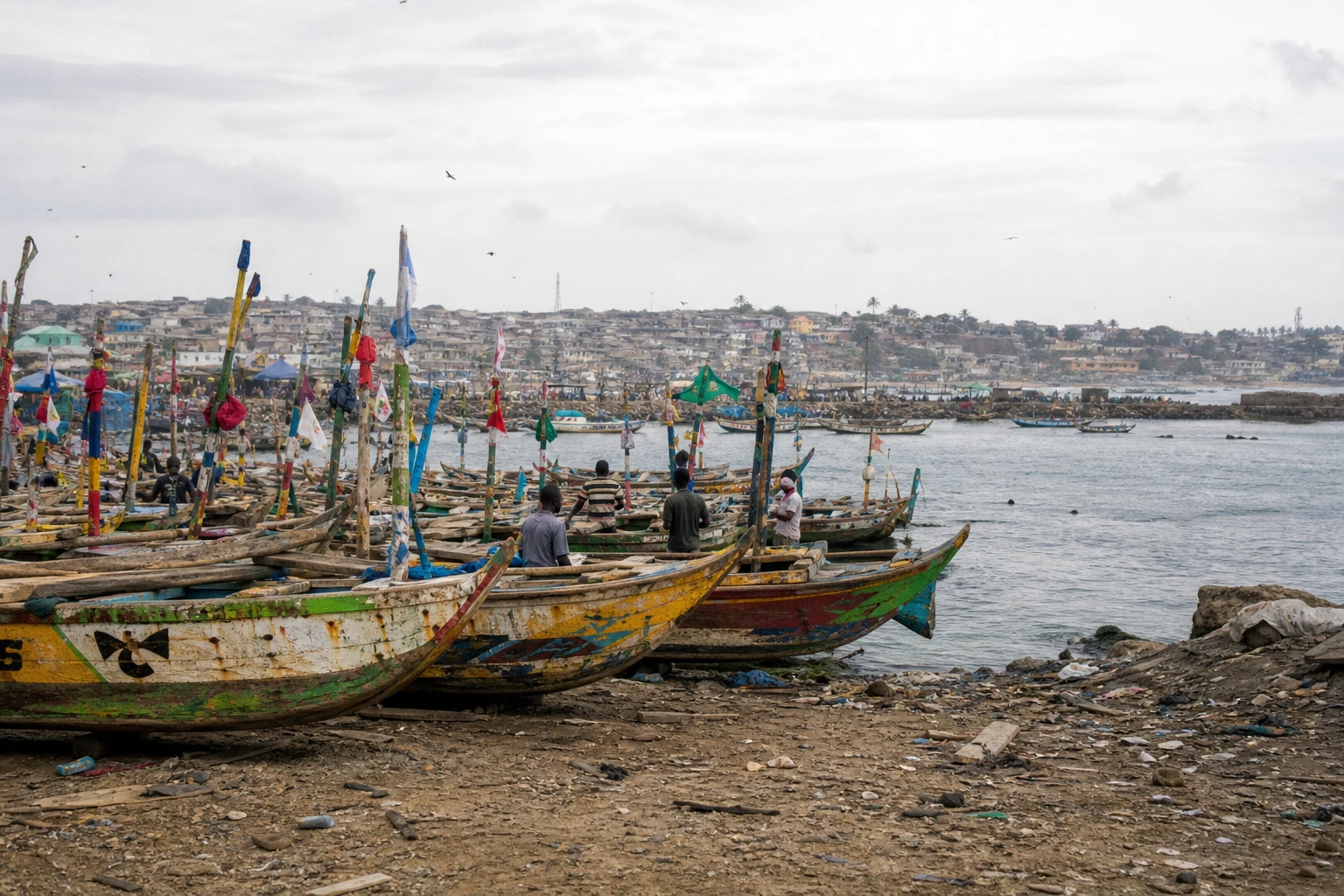
A day in Ghana’s capital that starts with independence. The Kwame Nkrumah Memorial Park honours the man who led the country to it in 1957, and Independence Square, also called Black Star Square, is where the nation holds its parades. After the National Museum, drive past Osu Castle, the former seat of the presidency and before that a Danish fort, then walk Jamestown, Accra’s oldest neighbourhood, where Ga fishermen still launch canoes from the beach below the lighthouse. In the afternoon, drive west to Cape Coast for the night.

Cape Coast & Elmina
Day 7
Cape Coast Castle & Elmina

A day for the castles, and for going slowly. Cape Coast Castle, the largest of the slave forts on the Gold Coast, held captives in underground dungeons for weeks before they were shipped across the Atlantic. A short drive west, Elmina Castle is older: the Portuguese built it in 1482, and it is the oldest European building in sub-Saharan Africa. Both are UNESCO World Heritage Sites. Local guides take you through the dungeons and the officers’ rooms built above them. Take whatever time you need. Back to Accra in the evening.

Departure from Accra
Day 8
Accra and Home

A last morning in Accra, with time for a walk or a coffee depending on your flight, then the transfer to Kotoka International Airport.

Ghana Cape Coast Castle Atlantic

Five Guests at Most

Two Borders, Seven Nights.
One Stretch of Coast.

What’s Included

Duration 8 days / 7 nights
Group Size Maximum 5 guests, small enough that everyone can ask questions and be heard
Countries Benin, Togo, Ghana
Accommodation Hotels in Ouidah (3 nights), Lomé (1 night), Accra (2 nights), Cape Coast (1 night)
Meals Breakfast daily. Lunch and dinner are on you, and your guide will point you to the maquis in Benin and Togo and the chop bars in Ghana that are worth the stop.
Transport Private vehicle and driver for every ground transfer, including both border crossings
Not Included International flights, visa fees, travel insurance, lunches and dinners

FREQUENTLY ASKED QUESTIONS

Common Questions About This Expedition

Of the places we travel in West Africa, this coast is among the most settled. Ghana is widely regarded as one of the safest countries on the continent, and Benin and Togo are well used to visitors along this road. This route keeps to the south: Abomey is as far inland as it goes. Our local team knows all three countries well and handles logistics, security and access throughout.
Vodun (often written Voodoo) is a practised religion in Benin, with priests, initiates, shrines and obligations, and it has little in common with the film version. In Ouidah you'll visit sacred temples with a local guide, meet practitioners who are willing to receive visitors and, where a ceremony is under way and outsiders are welcome, watch it with your guide beside you to explain. Dress modestly, follow your guide's lead and ask before photographing anyone.
Yellow fever vaccination is required for entry to all three countries, so carry the certificate itself, not a photo of it. We also recommend being up to date on hepatitis A, typhoid and routine vaccinations, and malaria prophylaxis is strongly recommended for the whole route. Once you book, we send a full health brief with specific medical guidance.
Directly, and without hurry. In Ouidah you walk the Route des Esclaves to the Door of No Return. In Togo you stop at the slave house in Agbodrafo. In Ghana you go inside Cape Coast Castle and Elmina Castle, two of the most significant slave trade sites in the world, down into the dungeons and through the Door of No Return, with local guides who know the full history. It is hard material, and with five guests at most you can take it at your own pace.

Expedition Investment

$3,050USD

per person

Covers seven nights’ hotels, daily breakfast, the activities in the itinerary and all ground transport

International airfare and visa fees not included

Reserve Your Spot
A Note on Safety

Benin, Togo and Ghana see a steady stream of visitors along this coast, and Ghana in particular is regarded as one of Africa’s safest destinations. The everyday risks are ordinary ones: traffic on the coast road, pickpockets in a crowded market, the midday heat. Our local guides have long relationships in the communities on this route, and we handle both border crossings and every transfer, so the paperwork and logistics are ours to worry about.