The Emptiest Great Ruins in the Mediterranean
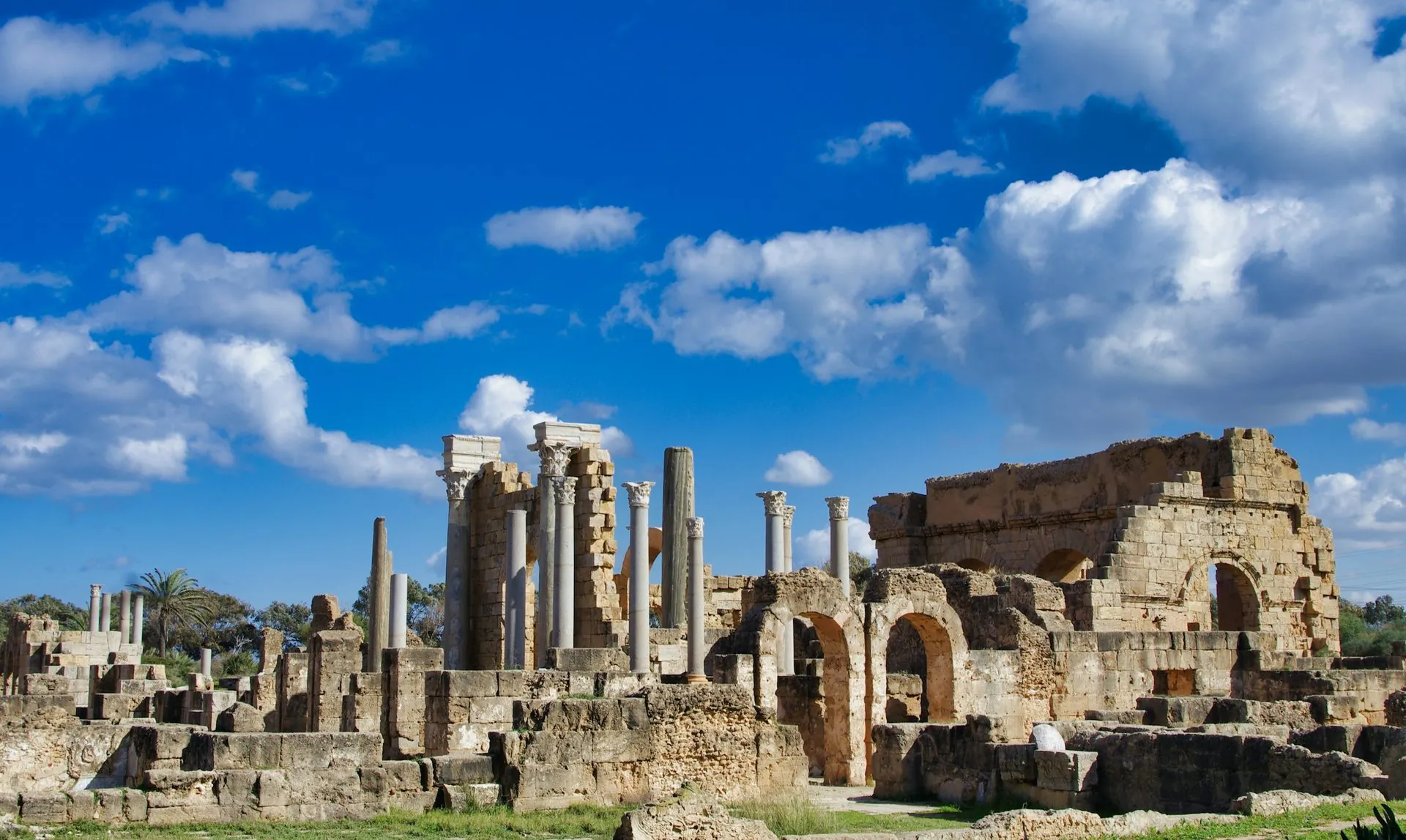
Stand in the forum of Leptis Magna on a January morning and do a quick headcount. A caretaker, maybe. A family from Tripoli if it is a Friday. The wind coming off the Mediterranean. That is usually the entire crowd at one of the most complete Roman cities on Earth.
Libya is the strangest gap on the modern travel map. A Mediterranean country a short flight from Rome, holding two of the finest Roman cities ever built, a mountain range of fortified Berber villages, a UNESCO oasis town on the old caravan roads, and a stretch of the Sahara painted with rock art twelve thousand years old. For years its foreign visitor count barely registered in international statistics.
That gap has a hard history behind it, and we will not pretend otherwise. But organised travel has quietly restarted. A small number of professional operators now run tightly managed expeditions through a corridor of the country that has been stable for years, and travelers come home reaching for words like unreal, mostly because they had Leptis Magna to themselves.
This guide covers what to see, how the visa actually works (it runs on invitations, not applications), when to go, and how we run our own Libya expeditions. It is honest about security, because a Libya guide that is not honest about security is not worth your time.
Why Go, and Why Now
The case for Libya is simple: it holds world-class places that almost nobody visits. Pompeii receives millions of visitors a year; Leptis Magna receives a few thousand, and it is larger, in places better preserved, and sits directly on the sea. Sabratha's theatre would anchor the tourism campaign of any European country. Here it is a quiet site an hour west of the capital where you can hear your own footsteps.
There is also the deeper pull of a country reassembling itself. Tripoli's cafes are full, the souks are working, and people are genuinely pleased to meet the few foreigners who make the trip. Tourism at this scale is a human exchange rather than an industry. That does not last forever anywhere, and it will not last forever here.
We wrote about this window in our guide to the world's most remote destinations: the years when a place is open but not yet discovered are short. Libya is inside that window now. Our own Libya expeditions start at $1,400 USD, which tells you how early it still is.
What to See in Libya
Leptis Magna
Leptis Magna is the reason most people come. Founded by the Phoenicians and expanded into a showpiece capital by Septimius Severus, the Roman emperor born here, it is a whole city rather than a ruin: the Arch of Severus, the basilica, a marble forum, baths, markets, an amphitheatre, and an ancient harbour, nearly all of it still standing on the shore east of Tripoli.
Give it a full day. The scale lands slowly, street by street, and the late light on the sea-facing colonnades is the image you will keep. UNESCO listed the site in 1982. On most days you will share it with the wind.
Sabratha
An hour west of Tripoli, Sabratha began as a Phoenician trading post and grew into a Roman port city. Its restored seaside theatre, three storeys of columned stage wall with the Mediterranean behind it, catches the light like a stage set. The mosaics and temples reward a slow morning, and the site is somehow even quieter than Leptis.
Tripoli's Old City
Tripoli's medina wraps Ottoman souks, mosques, and Italianate arcades around the Red Castle, a fortress that has guarded this harbour in one form or another for more than two thousand years. It is a working old city rather than a curated one: espresso in the old Italian cafes, mint tea in the souks, tailors and goldsmiths going about their day.
Walk it with a local guide who knows which doors open. The covered alleys hide caravanserais, small museums, and rooftop views across the harbour that you will not find on your own.
The Nafusa Mountains
South and west of Tripoli, the Nafusa range is Berber Libya: the vast circular granary of Qasr al-Haj, its storage vaults stacked like a honeycomb; the hilltop fortress villages of Nalut and Kabaw; and Gharyan's troglodyte houses, dug straight down into the limestone against the heat. These are some of the most photogenic and least photographed places in North Africa.
Ghadames, Pearl of the Desert
Ghadames sits in an oasis near the point where Libya, Tunisia, and Algeria meet. Its UNESCO-listed old town is a labyrinth of covered streets and whitewashed houses engineered entirely for desert heat: cool, dim walkways below, sunlit rooftop terraces above.
Families who lived inside the medina for generations still tend it, and dinner with them, followed by tea on a rooftop as the desert cools, is the kind of evening that makes a whole trip. Our longer itineraries overnight here for exactly that reason.
The Tadrart Acacus and the Ubari Lakes
The deep south is another journey entirely: a long overland drive south via Sebha, then days by 4x4 through the Tadrart Acacus, a UNESCO-listed wilderness of sandstone arches and dunes where rock art up to twelve thousand years old records giraffes, elephants, and dancers from a greener Sahara.
North of the Acacus, the Ubari lakes of Gabroun and Umm Al-Maa sit impossibly turquoise between high golden dunes, ringed by palms. Nights out here are spent camping under a sky with no light pollution for a hundred miles. If you have the time, this is the Libya that stays with you.
The Practicalities: Visas, Seasons, Money
Getting In: The Invitation System
Libya does not run on tourist visas you can simply apply for. Entry works on invitation: a Libyan operator obtains a letter of invitation and registers your itinerary with the authorities, and the visa itself is issued against that invitation. The visa fee is US$85, and online payment is available. Without an invitation there is, in practice, no way in.
Plan on three to four weeks of lead time for the invitation to be approved, and travel on the itinerary that was registered. Nearly all visitors arrive through Tripoli's Mitiga International Airport, where your guide meets you and walks you through the formalities.
When to Go
October through April is the season. Coastal Libya is mild all winter, good walking weather for the ruins, and the Sahara is cool enough for desert travel. November to February is the prime window for the Acacus. Summer is the wrong answer: the coast is very hot and the deep desert is genuinely dangerous.
Money
Libya is a cash country. Bring US dollars or euros in clean notes and exchange as you go; international cards do not work in any way you can rely on. Budget cash for tips and photography permits at certain sites. The US$85 visa fee can be paid online. Day-to-day costs are low once you are in: meals are inexpensive and good, especially the fish.
An Honest Word on Security
Most Western governments advise against travel to Libya, and we are not going to talk you out of taking that seriously. The country's recent history is heavy, its politics remain unsettled, and conditions differ sharply between regions.
What we can tell you is how travel actually operates. The corridor expeditions use, Tripoli, the coastal sites, the Nafusa, Ghadames, and the far southern Acacus, has been stable and consistently travelled for years. Itineraries are registered with the authorities in advance, a licensed guide is with you from the airport onward, and operators monitor conditions continuously, cutting or rerouting any segment that stops meeting their bar. That is risk management, not risk elimination, and the decision stays yours to make with current information rather than decade-old headlines.
How We Run Libya
Waypoint Journeys runs Libya with a maximum of five guests, a licensed English-speaking guide throughout, and three itinerary lengths: a two-night classical circuit of Sabratha, Leptis Magna, and Tripoli from $1,400 USD; a five-night route that adds the Nafusa villages, Gharyan, and two nights inside Ghadames, from $3,045 USD; and a twelve-night Sahara expedition that drives south via Sebha into the Acacus and the Ubari lakes, from $5,845 USD.
The letter of invitation is included in every option, hotels are the best available (4-star in Tripoli, the traditional Dar Ghadames inside the oasis medina), and the desert legs run with experienced Saharan drivers. The full details, day by day, are on our Libya expedition page.
Libya Travel FAQ
Is Libya safe for tourists right now?
Most Western governments advise against travel to Libya, and anyone considering the trip should read those advisories in full. In practice, the corridor used by professional operators (Tripoli, Sabratha, Leptis Magna, the Nafusa Mountains, Ghadames, and the southern desert) has been stable and consistently travelled for several years, with registered itineraries and licensed guides throughout. Go with an operator who monitors conditions daily, or do not go.
Do I need a visa to visit Libya?
Yes, and you cannot get one on your own. Libyan visas are issued against a letter of invitation obtained by an in-country operator, who also registers your itinerary with the authorities. The visa fee is US$85. Online payment is available. Allow three to four weeks for the invitation to be approved.
When is the best time to visit Libya?
October through April. Winter on the Mediterranean coast is mild and ideal for walking the Roman sites, and November to February is the best window for the Tadrart Acacus in the deep south. Avoid the summer months, when coastal heat is intense and desert travel shuts down.
Can you travel independently in Libya?
Not in any practical sense. Entry requires an operator-sponsored invitation, itineraries are registered in advance, and a licensed guide accompanies you throughout. This is simply how the country works at the moment, and the guides are genuinely good, so the constraint costs you less than you might think.
How much does a Libya trip cost?
Our expeditions start at $1,400 USD per person for a two-night circuit of Sabratha, Leptis Magna, and Tripoli, rising to $5,845 USD for the twelve-night Sahara expedition through the Acacus with one domestic flight included. International flights to Tripoli and the visa fee are extra.
Ready to See Roman Africa?