Waypoint Journeys Presents
Modernist Asmara and the Red Sea Coast
5 Days
Five Days Through a Country Almost Nobody Has Seen
View Expedition Details ↓Eritrea receives fewer foreign tourists each year than many boutique hotels receive in a week. This is the quiet miracle of the Horn of Africa — an independent, safe, remarkably cultured country that has, by circumstance and by design, stayed almost entirely off the world's map. It sits at the historic cross-current of Arabia and Africa, a coastline on the Red Sea that reached back to the Aksumite empire, the Ottomans, the Egyptians, and eventually the Italians, whose thirty years of colonial ambition gave the capital its extraordinary architecture.
Asmara is the story here. In 2017, UNESCO recognised the Eritrean capital as the most complete surviving example of early 20th-century modernist urbanism — an entire city of Rationalist, Futurist, and Art Deco architecture laid out across a highland plateau at 2,325 metres. The Fiat Tagliero service station, designed in 1938 to look like an aircraft, is still functioning. So is the Cinema Impero. So are the pastel cafés of Harnet Avenue, where espresso culture survived because the Italians left behind the machines and the habit.
Then the land drops dramatically — 2,300 metres in under two hours of winding road — to Massawa, the old pearl of the Red Sea, a city of coral stone and Ottoman palaces half-ruined, half-still-lived-in. And Keren, three hours north of the capital, where the Monday camel and livestock market has been meeting in the same place for centuries under a fig tree taller than most of the buildings in town. Five days is enough to see the essential Eritrea. A lifetime wouldn't be enough to understand it.
"It feels like a country held out of time — a 1950s Italian boulevard sitting on a plateau in Africa, and nobody has seen it yet."
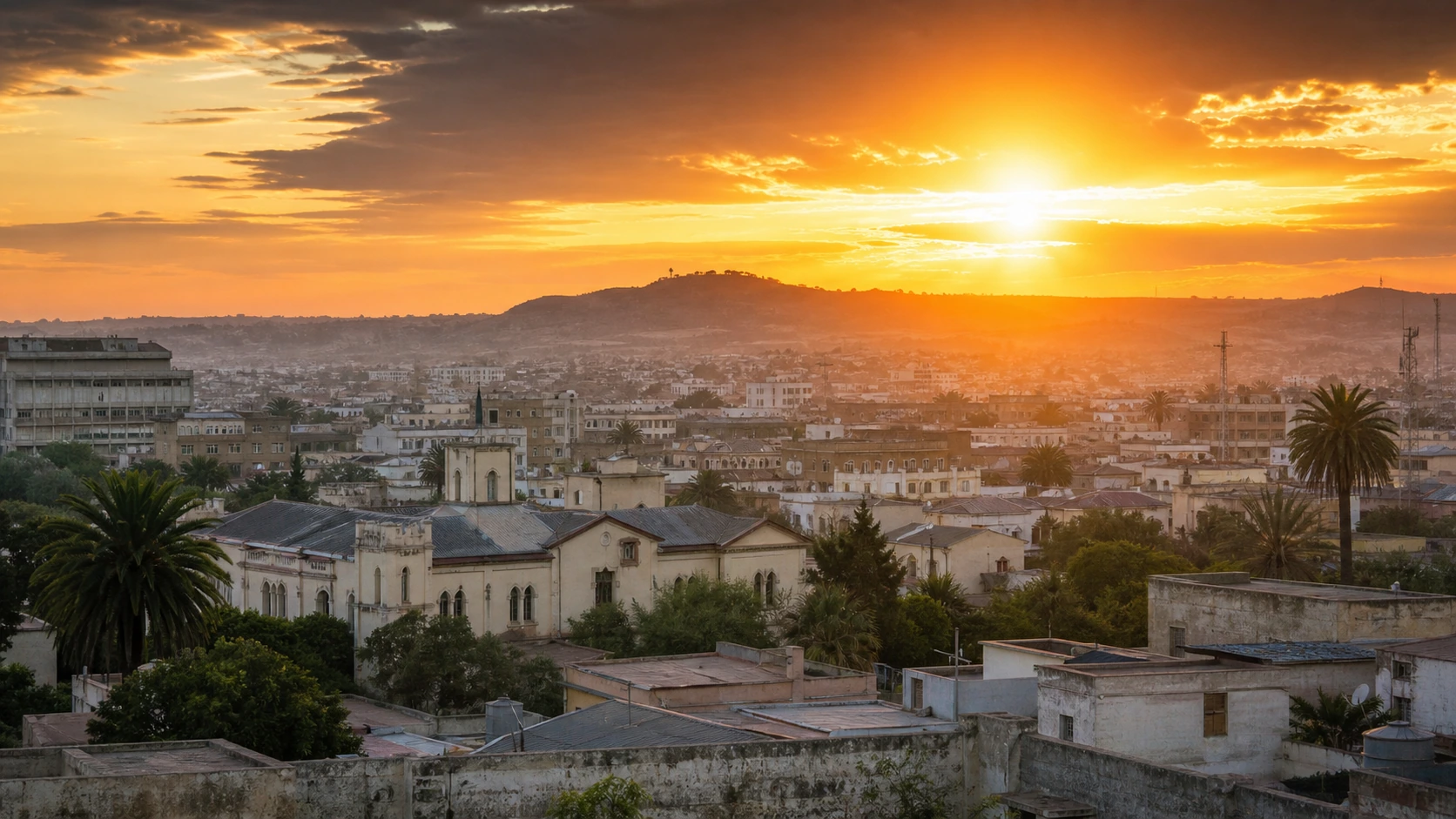
UNESCO's newest architectural world heritage site. An entire highland capital of 1930s Italian Rationalism, Futurism, and Art Deco — the most complete collection of early modernist urbanism anywhere on Earth.
Giuseppe Pettazzi's 1938 service station — designed to look like an aircraft — is one of the world's great unbuilt-but-actually-built buildings, and still the undisputed symbol of the city.
A coral-stone Ottoman port half-ruined, half-still-lived-in. The old pearl of the Red Sea, with Italian waterfront promenades, mosques from the dawn of Islam, and boat trips to Green Island.
A centuries-old baobab tree hollowed out around a shrine to the Virgin Mary, at the Italian-era sanctuary outside Keren. One of the most unusual pilgrimage sites in East Africa.
Every Monday since long before colonial memory, camels, cattle, and silver are traded under a fig tree taller than most of the buildings in town. One of the great ethnographic markets in East Africa.
Eritrea's coffee ceremony shares its lineage with Ethiopia's — three rounds of incense-smoked ceremonial coffee served on carved wooden trays, with popcorn, over conversations that last the afternoon.
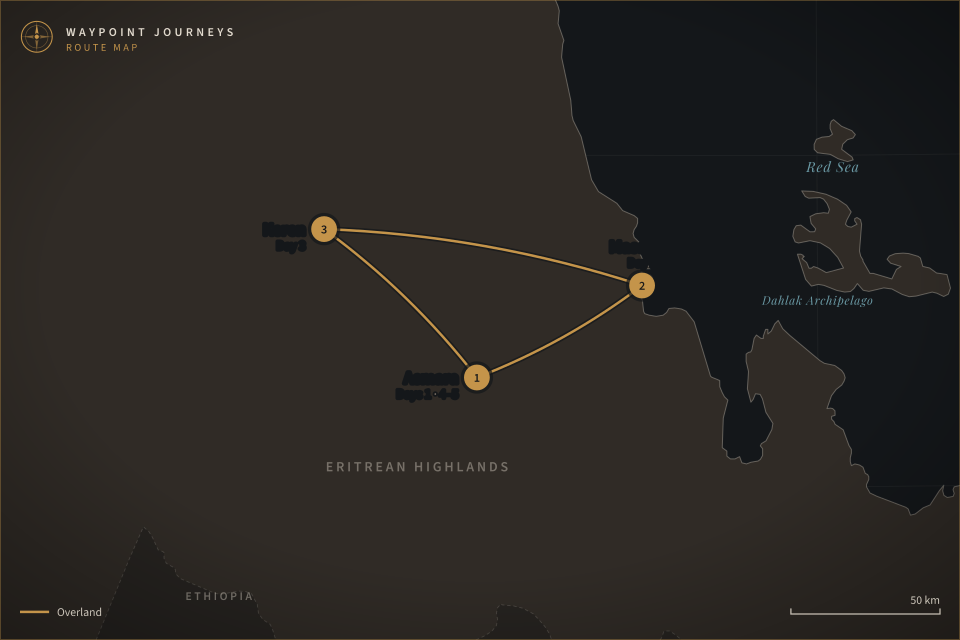
Five days across the Eritrean highlands and the Red Sea coast.
Fly into Asmara International and transfer to the Asmara Palace Hotel. At 2,325 metres, Eritrea's capital sits in a highland climate that is cool and clear even in mid-winter. An easy first evening on Harnet Avenue, the palm-lined boulevard that anchors the old Italian downtown, and welcome dinner at a classic Asmarino trattoria.
A morning walking tour of Asmara's UNESCO-listed modernist core: the Fiat Tagliero service station, Cinema Impero, the Catholic Cathedral of Santa Maria, Cinema Roma, the Nda Mariam Coptic Church, and the vibrant Medeber recycling markets where tin cans become oil lamps and engine blocks become chairs. After lunch, descend 2,300 metres in two dramatic hours of switchbacks to the Red Sea port of Massawa. Check in at the Grand Dahlak Hotel and walk the old coral-stone city as the Muezzin calls evening prayers.
At first light, take a small boat from Massawa's harbour to Green Island, a mangrove-fringed cay in the Red Sea where you can swim, snorkel, and see the coast as the old Ottoman and Italian governors once did. Back in town for a seaside lunch, then explore Massawa's Ottoman royal residence, the 7th-century Mosque of the Companions (believed to be one of the earliest mosques in the world), and the Gurgusum coastline. Drive north through the highlands to Keren by late afternoon. Overnight at Sarina Hotel.
An early start for the Monday market — Keren's great weekly rendezvous of camel traders, cattle drovers, silversmiths, and nine Eritrean ethnic groups gathering under an ancient fig tree. Afterwards, visit the Mariam Dearit, the centuries-old baobab tree hollowed out around a shrine to the Virgin Mary, and the Italian and Commonwealth war cemeteries that mark the fierce 1941 battle that ended Italian East Africa. Return to Asmara in the late afternoon, check in at the Crystal Palace Hotel, and enjoy a farewell dinner in the Italian quarter.
A final morning on foot through the old town — an espresso at a 1930s café, one last look through the stalls on Harnet Avenue, a photograph of Cinema Impero at mid-day light — before transfers to the airport for your onward flight. Five days that will redraw your mental map of Africa.
FREQUENTLY ASKED QUESTIONS
Expedition Investment
USD per person
Fully inclusive of accommodation, ground transportation, activities, permits, and meals
International airfare and Eritrean visa fees not included
Reserve Your SpotEritrea is quiet, stable, and among the safest destinations in the Horn of Africa. Asmara is a walking city with low crime, and the highland-to-coast route we follow has been used by independent travellers and journalists for years. Our in-country partner in Asmara has two decades of experience running trips for small groups, and every move outside the capital is pre-permitted and pre-scheduled. We are happy to address any specific questions about safety directly.