Waypoint Journeys Presents
The Sahara, the Stone Libraries, and the Iron Ore Train
8 Days
Eight Days Across the Adrar, the Dunes, and the Atlantic Sahara
View Expedition Details ↓Mauritania is the last country in the world where you can ride one of the longest freight trains on Earth, sleep beneath dunes untouched by a single neon sign, and walk through libraries whose manuscripts were shelved while Europe was still building its first cathedrals. It is a country the size of France and Spain combined, most of it sand, all of it administered by a people whose culture was forged in motion — the Moors of the western Sahara, the bidan, who measure wealth in camels, tea, and the silence between words.
The Adrar Plateau, at the heart of the country, is the Sahara at its most photogenic: towering dunes of the Ouarane Erg, palm groves folded into stone canyons at Terjit, and the UNESCO-listed caravan cities of Chinguetti and Ouadane whose stone libraries still hold Qur'ans and astronomical manuscripts written in the eleventh and twelfth centuries. These were the great trans-Saharan trading towns, where salt from the north met gold from the south, and where Islamic scholarship flourished for five hundred years.
And then there is the train — one of the longest trains in the world, sometimes three kilometres long — that crawls for hundreds of kilometres across the desert from the iron mines of Zoueraet to the Atlantic at Nouadhibou. To ride it, in an open-top ore wagon, wrapped in a scarf against the dust and the stars, is among the great romantic journeys remaining on Earth.
"Few countries let you touch the Sahara this honestly. Mauritania is the desert when the desert still belongs to the people who live in it."
The Adrar Plateau is the Sahara at its most cinematic. Ouarane and Amatlich ergs roll unbroken to the horizon, and the dunes around Chinguetti glow copper at first and last light.
A UNESCO caravan city where handwritten Qur'ans and astronomical treatises from the 11th–17th centuries are still shelved in stone libraries maintained by the same scholarly families who wrote them.
One of the longest trains on Earth, hauling ore hundreds of kilometres across the Sahara. We ride it overnight in an open wagon — bedrolls, star map, and the whole milky way overhead.
A colossal block of granite rising from the desert floor — the second largest monolith on Earth after Uluru. We camp in its shadow and watch the sun slide across its 400-metre face.
The peninsula south of Nouadhibou hosts the last remaining colony of Mediterranean monk seals on Earth. Fresh fish, salt wind, and a coastline that feels a century removed from anywhere.
The bidan are among the most generous hosts in the Sahara. Three rounds of sweet tea, a shared lamb tagine under the stars, and the quiet company of people who have lived here a thousand years.
Eight days across the Adrar, its caravan cities, and the iron spine of the Sahara.
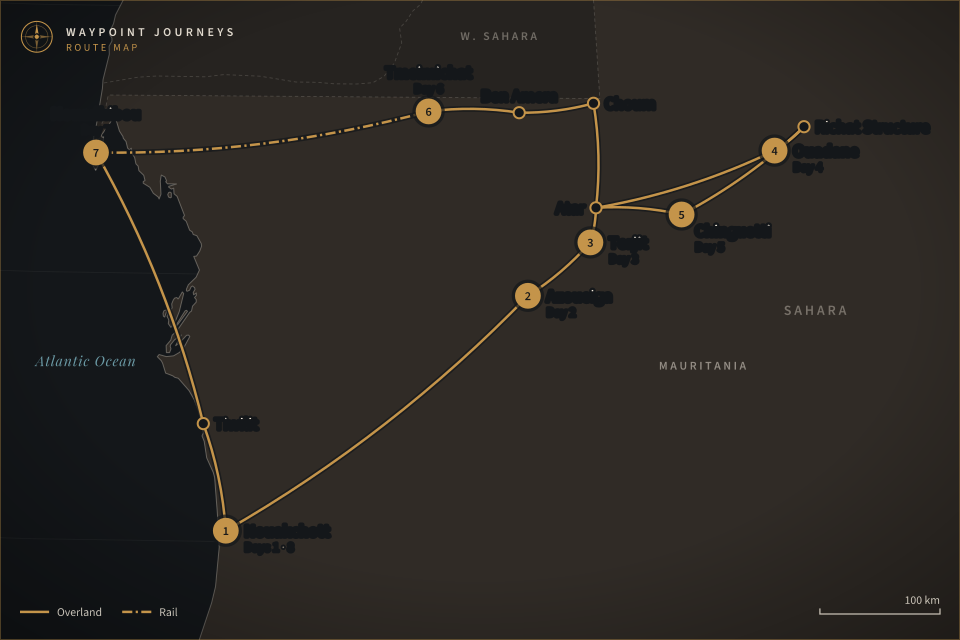
Land at Nouakchott International and transfer to the Semiramis Hotel Centre Ville for a welcome dinner and trip briefing. The Moorish capital sits between the open Atlantic and the Sahara's western edge. A rest day lets you acclimate; visa-on-arrival formalities are managed by our team.
Leave Nouakchott at first light and drive east toward the Adrar, stopping at Terjit — a hidden oasis where date palms and hot springs rise out of a narrow canyon of red stone. Continue past Mhayreth, the largest oasis in Mauritania, as the plateau opens into dune country. We arrive in Chinguetti by late afternoon to watch the sun sink behind the old town. Overnight at a boutique auberge in the medieval quarter.
Begin the morning inside Chinguetti's 13th-century stone libraries, where families still care for Qur'anic manuscripts, astronomical treatises, and poetry dating back nearly a thousand years. Walk the sandblown alleys of the old town and its great Friday Mosque. In the afternoon, drive northeast across the dunes to Ouadane, another caravan city half swallowed by sand, dramatically ruined and still beautiful. Stay overnight at the simple, atmospheric Chez Zaida auberge.
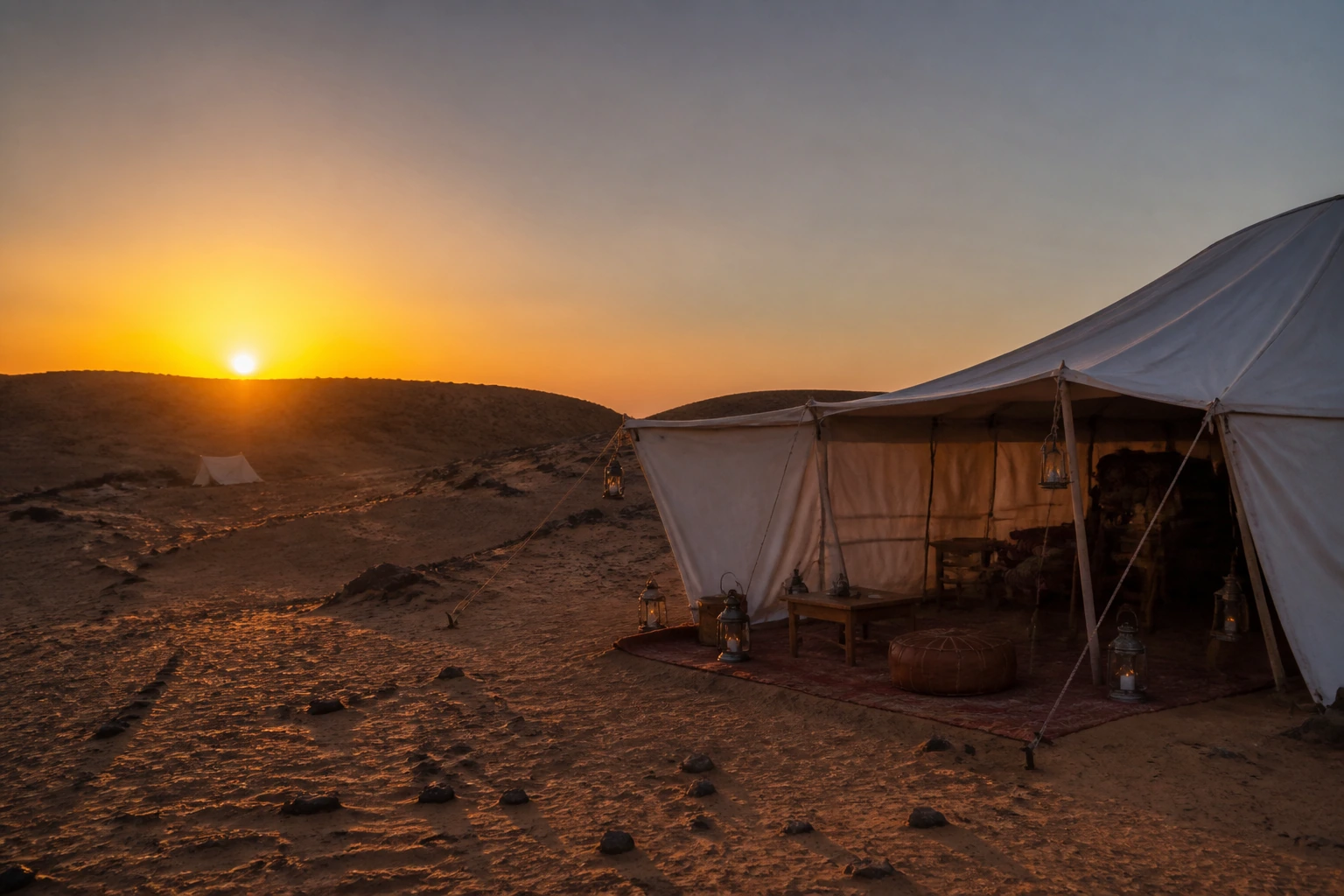
A long, slow day across open desert to Ben Amera, the second-largest monolith in the world after Uluru. En route, stop at the Neolithic rock art of the Agrour escarpment and pause in Atar, the administrative capital of the Adrar, for tea with local Moorish merchants. Tonight we camp beneath the monolith itself — a traditional Saharan tent, a small fire, and the Milky Way unfiltered.
Continue north to Zoueraet, the iron mining town where the great train begins its 700-kilometre run to the Atlantic. Visit the mining terminal and meet the local team who have ridden this line for decades. Brief on the ride: goggles, scarves, bedrolls, thermoses of hot tea. Overnight at Hotel Lyezid, a modest but comfortable base camp, with an early dinner and early bed.
The headline day. We board one of the longest trains on Earth — up to three kilometres long and carrying more than 200 ore wagons — and ride westward across the Sahara for roughly 18–20 hours. Wind-scoured dunes, stars of an intensity impossible at sea level, a shared thermos of tea passed between strangers. We alight in Nouadhibou dust-covered and transformed. Hot showers, a warm meal, and a proper bed at a coastal guesthouse are waiting.
Morning visit to Cabo Blanco, the windswept peninsula that hosts the last surviving colony of Mediterranean monk seals on Earth — around 300 animals cling on here, protected by a national reserve. Lunch on the Atlantic coast, then drive south to Nouakchott along the edge of the Banc d'Arguin, stopping at fishing villages where hand-built pirogues still land the day's catch on the sand. Overnight in Nouakchott at the Semiramis Hotel, with a final farewell dinner.
A final Moorish breakfast, an optional stroll through the Nouakchott fish market as the pirogues return, and transfers to the airport for your onward flight. Eight days, two UNESCO caravan cities, one of the longest trains in the world, and a Sahara that will call you back.
FREQUENTLY ASKED QUESTIONS
Expedition Investment
USD per person
Fully inclusive of accommodation, ground transportation, the Iron Ore Train crossing, and activities
International airfare and visa-on-arrival fees not included
Reserve Your SpotMauritania sits at the western edge of the Sahel, and like any destination in this region it carries a cautious reputation. The reality on the ground in the areas we travel — the Adrar, the Atlantic coast, and the Iron Ore Train corridor — is one of welcome, quiet, and stability. Our local team has operated here for years, we travel with experienced Moorish driver-guides who know every community on the route, and we coordinate continuously with regional contacts. We monitor conditions closely and adjust when necessary. We are happy to address any specific questions about safety directly.