The Island That Invented Its Own Wildlife
Here is the number that explains Madagascar: roughly nine out of every ten species you will see there exist nowhere else on Earth. Not nine percent. Ninety. The lemurs, most of the chameleons, six of the world's eight baobab species, whole families of plants and birds and reptiles, all of it evolved on one island and never left.
The island broke away from the other continents and has been on its own for something like eighty million years. It is the fourth-largest island in the world, nearly the size of France, sitting in the Indian Ocean off the coast of Mozambique. Biologists sometimes call it the Eighth Continent, and for once the nickname undersells the place. Evolution ran a private experiment here, and the results look like nothing else alive.
Travel in Madagascar splits along a simple line. The west is dry: deciduous forest, red laterite roads, and the baobabs. The east is wet: rainforest, orchids, and the indri, the largest living lemur. The highland capital, Antananarivo, sits between them. A week covers both sides properly, and two extra days add the strangest landscape in the country, the stone forest of the Tsingy de Bemaraha. This guide walks through all of it, then gets into the practicalities: seasons, visas, money, and how to do the place justice.
Why Nothing Here Exists Anywhere Else
Isolation is the whole story. When Madagascar separated from the ancient continents, it carried a cargo of early mammals, reptiles, and plants, then shut the door. No big cats ever arrived, no monkeys, no antelope. The passengers evolved to fill every empty role. Lemurs, the ancient cousins of monkeys, radiated into more than a hundred species, from mouse lemurs small enough to sit in an espresso cup to the indri, which can weigh as much as a large housecat and sings like a whale.
The island's apex predator is the fossa, a sleek, low-slung hunter that looks like a cross between a cat and a mongoose and is related to neither cats nor dogs. Close to half the world's chameleon species live here, from giants the length of your forearm to species that fit on a fingertip. And then there are the baobabs: of the eight species on Earth, six grow only in Madagascar, and the rest of the planet makes do with two.
The West: Baobabs, Dry Forest, and the Fossa
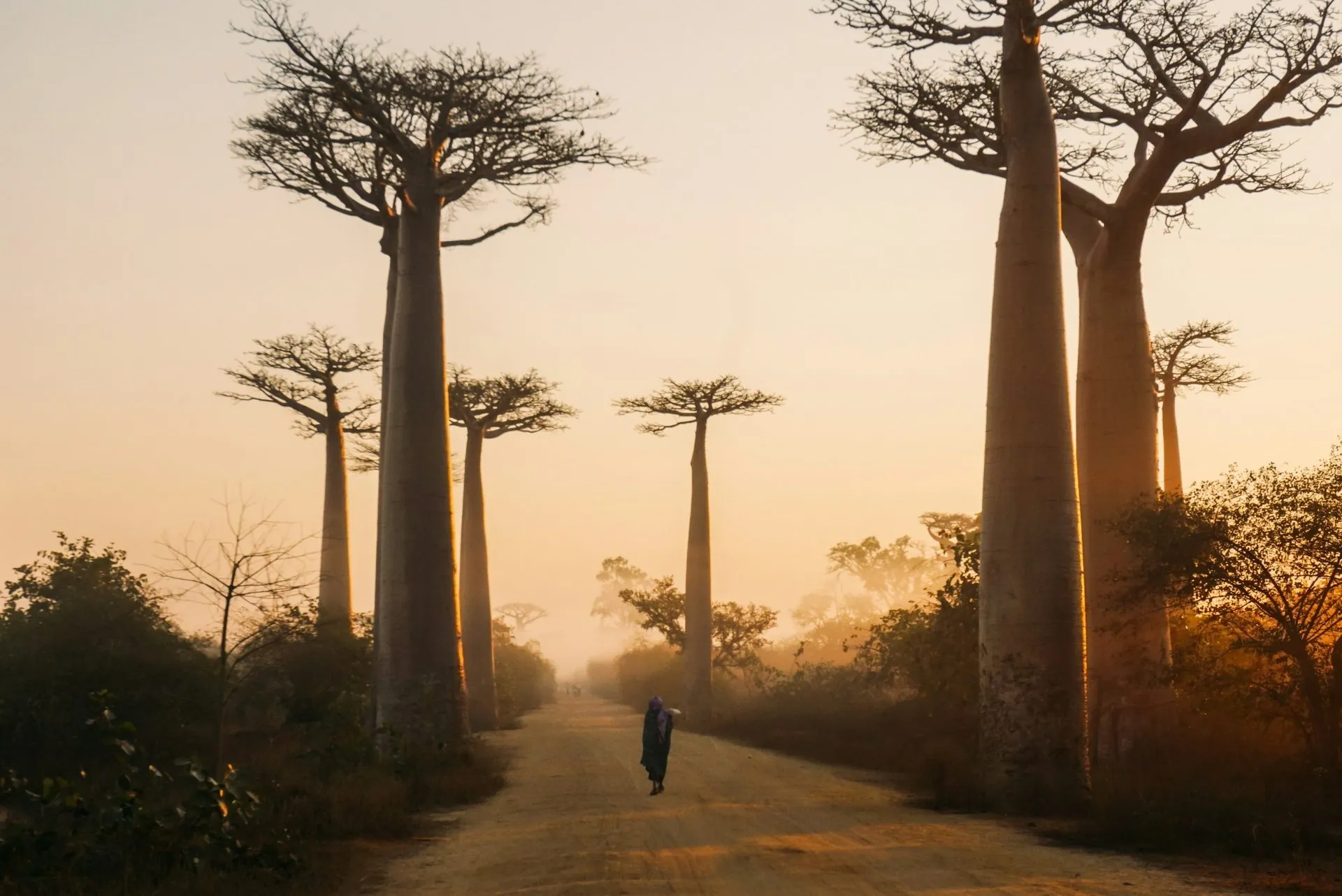
The Avenue of the Baobabs
Outside the coastal town of Morondava, about two dozen colossal Grandidier's baobabs line a stretch of red laterite road. Some stand thirty meters tall, their trunks like architecture, their branches a strange afterthought at the very top. This is the most photographed landscape in Madagascar, and it earns the attention. Come in the last hour before sunset, when the light turns the trunks copper and the trees throw shadows a hundred meters down the road, and stay until the zebu carts have gone home and the first stars come out.
On the way, it is worth stopping at the sacred baobab of Marofandilia, a tree roughly eight hundred years old that local Sakalava communities still venerate. A tree that was already a giant when Marco Polo was alive resets your sense of what old means, and hearing why it matters from a local guide is better than any signboard.
Kirindy by Night
North of the Avenue lies Kirindy, a dry deciduous forest that runs on a completely different schedule from the rainforests in the east. The best of it happens after dark. Night walks by torchlight reveal fork-marked lemurs, sportive lemurs, and mouse lemurs blinking in the beam, along with chameleons sleeping pale at the ends of branches. Kirindy is also the most reliable place in the country to see the fossa, especially in the dry months. Watching the lemurs' predator slide through the same trees you walked beneath an hour earlier changes the way the whole forest feels.
The East: Andasibe and the Song of the Indri
A short flight back to the highlands and a drive east delivers a different Madagascar entirely: the rainforest corridor of Andasibe-Mantadia, dense with tree ferns, orchids, and mossy trunks. The reason to be here is the indri. It is the largest lemur alive, black and white like a panda rearranged, and at dawn the family groups begin to sing, a rising, wailing chorus that carries two kilometers through the canopy. The forest goes quiet around it. People who have heard whales sing say it is the closest comparison, and no recording does it justice.
No zoo anywhere keeps an indri, because they do not survive captivity. If you want to hear that sound, you stand in this forest at first light, and that is the entire deal. Day walks turn up sifaka, bamboo lemurs, and more chameleons than you will bother counting by the second afternoon; a night walk along the forest edge finds the small nocturnal world waking up again.
The Tsingy de Bemaraha
North of Morondava, reachable by a long 4x4 day with a river crossing, stands one of the strangest landscapes on the planet: the Tsingy de Bemaraha, a UNESCO-listed forest of limestone pinnacles sharpened by a few million years of rain into fields of gray razors. Trails thread through canyons at the base, climb through caves, and cross the tops of the pinnacles on suspended bridges and fixed-cable sections where you clip in with a harness.
It is moderately demanding, genuinely unlike anywhere else, and the reason we built it into our itinerary as an optional two-day extension. The road is only reliably passable in the dry season, roughly May through October, which happens to be exactly when the rest of the western route is at its best.
Practicalities: Seasons, Visas, Money
When to go
The dry season runs roughly late April through October, and it is when the country works. May and June are exceptional: clear light on the baobabs, comfortable highland temperatures, active night forests in Kirindy. September is another superb window, with the eastern rainforest still wet enough for the indri and the western roads comfortably dry. The cyclone season, roughly December through March, is the time to avoid; rain dissolves the western roads and the river crossings stop being charming.
Getting there and around
International flights land at Ivato International Airport outside Antananarivo, usually via Paris, Addis Ababa, Nairobi, or Johannesburg. Inside the country, distances deceive. Madagascar is enormous, the roads are slow, and the drive from Antananarivo to Morondava swallows two full days that a one-hour domestic flight replaces. Any sane week-long itinerary flies the long legs and drives the short ones, which is how we run ours: both internal flights included, private 4WD and driver for everything else.
Visas and money
Most nationalities receive a 30-day tourist visa on arrival at Ivato for around 35 US dollars, or as an eVisa in advance through the official portal. The currency is the Malagasy ariary. Cards work at larger hotels in the capital and not far beyond, so carry cash for the rest of the country, in small denominations, and change money officially. Park fees, community guides, and tips all run on cash. A travel health consultation is worth booking before departure; malaria prophylaxis is standard advice for the lowland regions.
Visiting a Fragile Place Well
Madagascar's endemism is also its vulnerability. Only a fraction of the island's original forest remains, and every species that exists nowhere else has nowhere else to go. That makes where your money lands unusually consequential. Park fees fund rangers. Community guides turn standing forest into livelihoods. Projects like the Zazamalala reserve near Morondava are actively replanting the western dry forest, and visiting them funds the work directly. Travel in small numbers, stay on trails, skip anything involving captive lemurs, and the trip becomes part of the answer rather than the problem. We wrote more on this thinking in our guide to responsible travel in sensitive destinations.
How We Run Madagascar
Our Madagascar expedition is seven days: Antananarivo, the flight west to Morondava for Kirindy and the Avenue of the Baobabs, then the eastern rainforest at Andasibe for the indri. $2,850 USD includes both internal flights, 4x4 ground transport, park fees across five reserves, an English-speaking naturalist guide throughout, and most meals, with the group capped at five guests, as on all our trips outside the cruises, Antarctic camps and the Battle Abbey lodge in British Columbia. The two-day Tsingy de Bemaraha extension adds $200 USD, for $3,050 USD total, and slots in between Morondava and the return east.
And if primates are the reason you travel, Madagascar pairs remarkably well with the mountain gorillas of the Virungas. Our gorilla expedition runs through Burundi, Rwanda, and Uganda with a group cap of four, and more than one guest has done the two trips back to back: the world's strangest primates one week, its most imposing the next.
Madagascar at a Glance
| Location | Indian Ocean, off Mozambique |
| Capital | Antananarivo |
| Best time to visit | Late April to October; May, June and September shine |
| Avoid | December to March (cyclone season) |
| Getting there | Fly to Ivato, Antananarivo; internal flights for long legs |
| Visa | On arrival or eVisa, about $35 USD for 30 days |
| Currency | Malagasy ariary; cash beyond the capital |
| Languages | Malagasy and French; English in tourism |
| Typical expedition length | 7 days, or 9 with the Tsingy |
| Group size | Capped at 5 guests |
Frequently Asked Questions
Is Madagascar safe for tourists?
Yes. Madagascar is a peaceful, welcoming country, and the classic route (Antananarivo, the Morondava region, and the Andasibe rainforest corridor) is stable and well traveled. Petty theft happens in crowded markets, as it does in any big city, so the usual precautions apply. With a guide and driver throughout, problems are rare.
When is the best time to visit Madagascar?
The dry season, roughly late April through October. May and June are exceptional: clear light over the baobabs, comfortable highland temperatures, and active nocturnal wildlife in Kirindy. September is another superb window. The cyclone season, roughly December to March, is worth avoiding for travel on the roads.
Do I need a visa for Madagascar?
Most nationalities can get a 30-day tourist visa on arrival at Ivato International Airport for around 35 US dollars, or an eVisa in advance through the official government portal. We brief every guest on the current paperwork and fees before departure.
Will I actually see lemurs?
Yes, and not one or two. Across the reserves on our route, guests typically encounter around a dozen species, from ring-tailed lemurs and Coquerel's sifaka near Antananarivo to the nocturnal species of Kirindy and the indri of Andasibe. Sightings are close, frequent, and unhurried; the only lemur that takes real luck is none of them, it is the fossa that hunts them.
How demanding is the Tsingy de Bemaraha extension?
Moderate, and worth it. Reaching the Tsingy involves a long 4x4 day from Morondava with a river crossing each way, and the circuits through the pinnacles use fixed cables, ladders, and suspended bridges. You wear a harness on the exposed sections. Anyone with reasonable fitness and a steady head for heights will manage; it runs best between May and October when the road is passable.
Meet the Eighth Continent