An Unusual Comparison, on Purpose
Most versus articles pit two companies fighting over the same booking. This one does not. Secret Atlas runs expedition micro-cruises with 12 guests, mostly in the high Arctic. We run land expeditions with a maximum of five guests, mostly in frontier countries a long way from any ice; our Antarctic camps, our seven cruises and the Battle Abbey lodge in British Columbia are the exceptions. The products barely overlap, and yet people keep comparing us, because both companies answer the same instinct: getting to the far end of the map without a crowd standing in front of it.
So treat this as a sorting exercise rather than a contest. By the end you should know which kind of trip fits the journey you are actually imagining. Some of the time, the honest answer will be theirs, and we will tell you exactly when.
What Secret Atlas Does
Secret Atlas built its reputation on a simple, radical act: shrinking the expedition cruise until it stops feeling like a cruise. Conventional polar ships carry anywhere from a hundred to several hundred passengers. A Secret Atlas micro-cruise carries 12 guests, and that number changes everything downstream. No queueing for zodiac seats, no landing rotas, no lecture-theater dynamics. When a polar bear appears off the bow, everyone is on deck inside a minute, and everyone gets the rail.
Their heartland is the polar north, Svalbard and East Greenland above all, with expedition leaders and photography guides who know those coastlines intimately. A ship that small slips into fjords the big vessels pass by, lingers when the light turns good, and reroutes around ice without drama. The season follows the light and the melt, clustering in the polar summer. For wildlife and landscape photographers especially, the format is close to unbeatable: hours at the rail instead of hours in line.
We will say it plainly. If the trip in your head is Svalbard by sea, pack ice, walrus haul-outs, the long gold light of an Arctic evening, book Secret Atlas. A land itinerary does not substitute for that, and we would rather you take the right trip than our trip.
What Waypoint Journeys Does
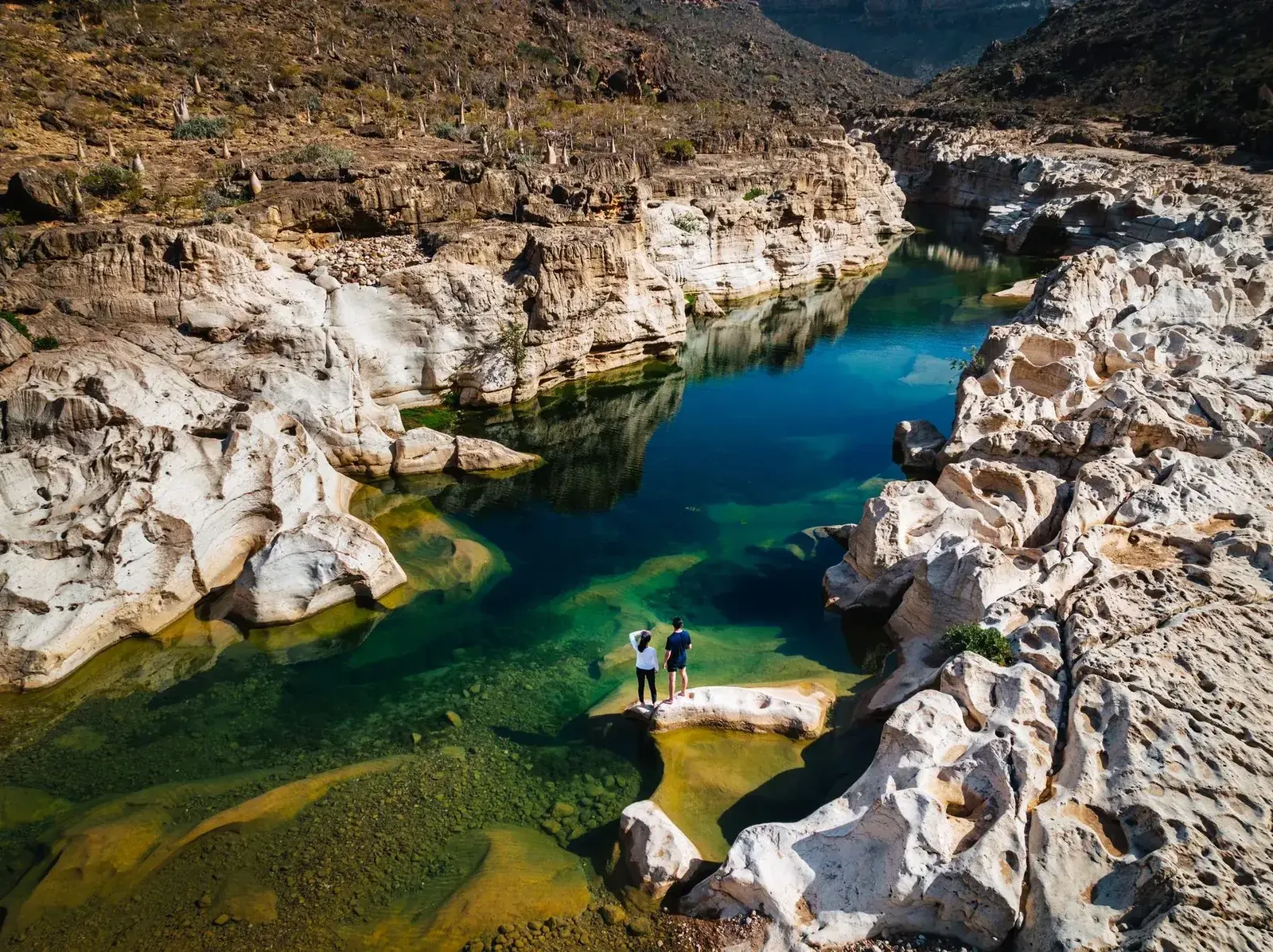
Our version of the far end of the map is terrestrial. Waypoint runs expeditions in more than 70 countries, capped at five guests every time outside our cruises, Antarctic camps and the Battle Abbey lodge in British Columbia, weighted toward places with thin tourist infrastructure and thick human history. Our Socotra expedition camps under dragon blood trees from $3,395 USD. Our Eritrea expedition, from $2,550 USD, pairs Asmara's Italian modernist architecture with the Red Sea coast. The list runs on through the Karakoram, the Sahara's edge, and the steppe.
A land expedition runs on different fuel. You cross ground slowly, eat in homes and roadside canteens, sleep in guesthouses and camps, and the texture of the trip comes from people: fishermen, monks, drivers, market traders, a fixer who knows every checkpoint on the road north. Everything is bespoke by default, arranged over email or WhatsApp, with 24/7 support on the ground for the whole trip.
If Secret Atlas sells the far edge of the natural world, we sell the far edge of the human one. Both are real edges. They just ask for different vehicles.
The Days Feel Different
Consider what a good day looks like in each format. At sea, you wake in a cabin that moved overnight, weather decides the morning, a zodiac puts you on a beach no road has ever reached, and the afternoon belongs to whatever the ice allows. The ship stays warm, the kitchen stays steady, and the wilderness waits on the other side of the hull until you choose it.
On land, you wake in a guesthouse or a tent, breakfast usually involves the family that owns it, and the day is a chain of human encounters threaded along a road that may or may not cooperate. Comfort varies by night, and we tell you in advance which nights are which. The wilderness is not on the other side of anything. You are in it, and so is everyone who lives there.
Neither format is harder in fitness terms; any reasonably healthy traveler can do either. They simply demand different tolerances: motion, cold, and weather days at sea; long drives, variable beds, and improvisation on land.
What the Two Formats Agree On
For all the differences, the two products rest on the same three convictions. First, that group size is the biggest single lever in remote travel: 12 on a ship, five on land, both numbers chosen so the place outnumbers the audience. Second, that expertise beats amenity: a leader who reads ice, or a fixer who reads checkpoints, matters more than thread count. Third, that the far ends of the map reward travelers who arrive curious and flexible, because pack ice and border posts do not read itineraries.
That shared philosophy is why this article is generous by design. Companies that take remoteness seriously tend to respect each other across the formats, and travelers move between them: a micro-cruise one year, a land expedition the next.
What the Money Buys
Micro-cruise economics are worth understanding before you compare any prices. A ship, its crew, its fuel, and its expedition staff are largely fixed costs, spread across just 12 berths instead of two hundred. That is why small-ship voyages carry premium per-night pricing, and why they deserve to: you are buying a twelfth of a private expedition vessel, not a cabin in a floating hotel. Check their current brochures for numbers; we will not guess at them here.
Our arithmetic is different. Land logistics in frontier countries are inexpensive in absolute terms (vehicles, guesthouses, local crews), so even with five guests the totals stay within reach: $3,395 USD for Socotra, $2,550 USD for Eritrea, $720 USD for our shortest route and $15,900 USD for our longest. Every trip includes accommodation, expert local guides, ground transport, most meals, and support around the clock. Neither model hides margin in mystery fees. They are simply built on different cost bases, and the price tags reflect geography more than ambition.
Pick by Trip Type, Not by Brand
Choose Secret Atlas when the destination is a coastline: Svalbard, East Greenland, the places where wildlife outnumbers people and the sea is the only road. Choose them when photography is the point, when you want expedition intensity without giving up a warm bunk, and when 12 like-minded shipmates sounds like good company rather than a compromise.
Choose Waypoint when the destination is a country: Socotra, Eritrea, Pakistan, Mongolia. Choose us when you want the trip built around your own people and your own dates, when culture pulls harder than wildlife, and when you want entry prices that start at $720 USD rather than five figures.
Helpfully, the calendars barely conflict. Arctic micro-cruises cluster in the boreal summer, while many of our expeditions, Socotra in particular, run October to April. More than one traveler we know has done both in a single year and called it their best travel year yet. For raw material, our list of the ten most remote destinations you can actually visit is a good place to let your imagination off the leash.
If You Plan to Do Both, Which First?
A practical suggestion for the ambitious: take the land expedition first. Frontier travel teaches a set of instincts, patience at checkpoints, grace when plans change, curiosity in strangers' kitchens, that improve every trip that follows, including a polar voyage. Polar travel, meanwhile, has a way of spoiling you for scenery, while a place like Socotra or Eritrea spoils you for something rarer: standing somewhere the world has not yet made up its mind about.
But that is a preference, not a rule. The travelers who get this decision right are the ones who choose by trip type first and brand second, which is the entire argument of this article compressed into one sentence.
Frequently Asked Questions
What is an expedition micro-cruise?
A small-ship expedition voyage with a tiny passenger count, 12 guests in Secret Atlas's case, focused on landings, wildlife, and flexible routing rather than onboard amenities. The format trades pools and theaters for time ashore and speed off the ship.
How many guests do Secret Atlas and Waypoint Journeys take?
Secret Atlas micro-cruises carry 12 guests. Waypoint Journeys land expeditions are capped at five guests, and four on our gorilla expedition. The exceptions are our Antarctic camps, which take up to 12 guests each, our seven cruises, where you share the ship with other passengers, and the Battle Abbey lodge in British Columbia, which hosts up to 12.
Is a land expedition harder than an expedition cruise?
Not in fitness terms; any reasonably healthy traveler can do either. They demand different tolerances. Sea travel brings motion, cold, and weather days. Land travel brings long drives, variable beds, and improvisation when roads or permits misbehave.
Which is better for photography?
For polar wildlife, ice, and landscape work, a micro-cruise is hard to beat: deck access at all hours and fast zodiac landings. For portraits, markets, architecture, and cultural photography, a five-person land group wins, because people relax around a group that small.
Does Waypoint Journeys offer sea or polar expeditions?
No. We are a land operator across 40+ frontier countries, from Socotra to Eritrea to Mongolia. If sea-based polar travel is the dream, a micro-cruise operator like Secret Atlas is the right call, and we say so happily.
Ready to Start Planning?