The Strangest Country in Central Asia
There is a pit of fire in the middle of the Karakum Desert that has been burning since 1971. Geologists opened a gas pocket, the ground gave way, and the leak was lit to burn itself out. It never did. Locals call it the Door to Hell, and you can stand on its rim at midnight with the heat pushing against your face.
That crater, Darvaza, is the image that pulls people toward Turkmenistan. It is nowhere near the whole story. This is a country with a white marble capital that holds a Guinness World Record, two of the great ruined cities of the Silk Road, a canyon that looks borrowed from another planet, and fewer foreign visitors in a year than Venice receives in a morning.
It is also, by deliberate policy, one of the most closed countries on Earth. Independent travel is not really possible: tourist visas require a letter of invitation, itineraries are registered with the authorities, and a licensed guide accompanies you throughout. With the right local partner, none of that is a burden. It is simply how the door opens.
Here is what to see, how the visa process actually works, and what a week inside the strangest country in Central Asia feels like.
Why Go
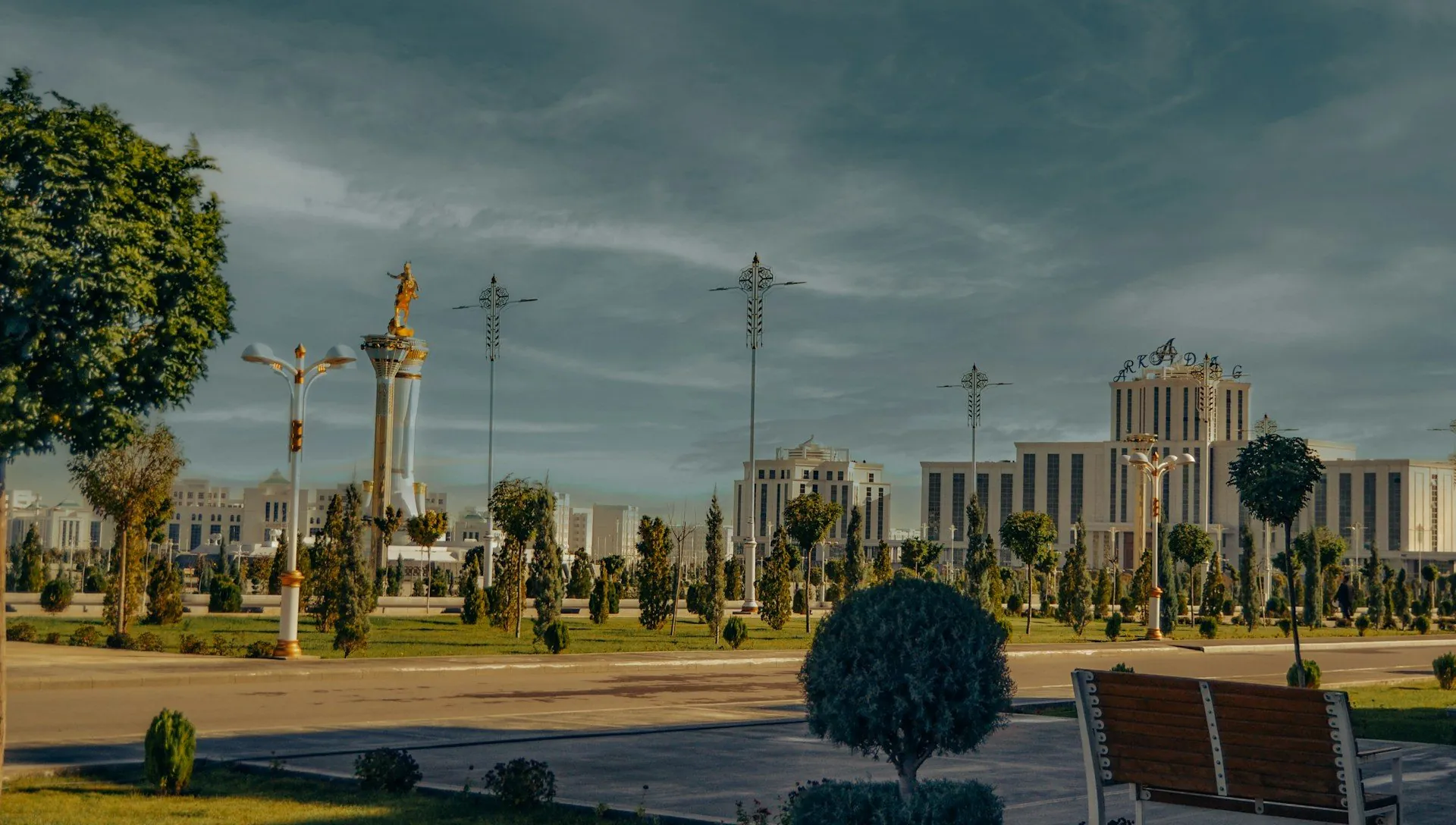
Turkmenistan rewards the traveler who likes history unrestored and strangeness undiluted. Merv and Konye-Urgench are not tidied-up heritage parks; they are vast, wind-blown fields of ruin where camels graze among 12th-century mausolea. Ashgabat is the opposite: polished to a shine, gold domes and white marble and ten-lane boulevards with almost no traffic on them.
The combination is the point. In one week you move from a burning crater to a Parthian royal capital to a city that feels like a rendering of the future built by the past. Nothing about it is ordinary, and nothing about it is crowded.
And beneath the spectacle there is a culture worth meeting. Turkmen identity runs on horses, carpets, and hospitality: the Akhal-Teke, the golden-sheened breed that is a national emblem here, the carpet patterns that appear on the state flag itself, and a habit of welcoming guests that decades of isolation never managed to dent.
What to See in Turkmenistan
The Darvaza Gas Crater
Roughly 70 meters wide and burning for more than five decades, Darvaza sits in open desert about three hours north of Ashgabat. Arrive before sunset and watch the fire change character as the light goes: pale and translucent by day, then copper, then gold, then a deep red roar against the black.
The right way to do it is to sleep there, in a tented camp on the rim, with dinner cooked over coals and the sound of fire and wind all night. The government has said more than once that it would like to extinguish the crater, and the flames are reported to be lower than they once were. Our advice is unambiguous: go sooner.
Set your expectations correctly: Darvaza is not a managed attraction. There are no fences, no tickets, no floodlights except the fire itself, and no other structure in any direction. That absence is most of the magic, and it is also why you go with people who know the desert.
Ashgabat, the White Marble City
The capital holds the Guinness World Record for the highest concentration of white marble buildings on Earth. Ministries the size of city blocks, a wedding palace shaped like a marble-and-gold cube, an indoor Ferris wheel enclosed in glass, fountains in the desert, and boulevards that stay strangely quiet.
It is one of the most photogenic and most surreal capitals anywhere, best absorbed slowly: the Arch of Neutrality, the Russian Bazaar, the monuments lit at night against the Kopet Dag foothills. Photography rules exist (no government buildings, no military sites), and your guide will tell you exactly where the line falls.
Ancient Merv
For a stretch of the Middle Ages, Merv was one of the largest cities on Earth, spoken of alongside Baghdad, Cairo, and Damascus. Genghis Khan's armies destroyed it in 1221 and it never recovered. What remains is UNESCO-listed and enormous: the ramparts of Gyz Gala and Erk Gala, the Mausoleum of Sultan Sanjar, and city walls that take real time to walk. Bring water and imagination; the scale does the rest.
Pause longest at the Mausoleum of Sultan Sanjar, whose dome once showed caravans the way into the city a day before they reached it. Merv sat at the heart of the Silk Road for two thousand years; standing in the quiet that replaced it is the point of coming.
Konye-Urgench
In the far north near the Uzbek border, Konye-Urgench was the capital of the Khwarezmid Empire before the Mongols arrived. Its centerpiece is the Kutlug Timur minaret, 60 meters of patterned brick and the tallest minaret in Central Asia, standing over a scatter of mausolea and madrasas that the desert has been slowly reclaiming for seven centuries.
It remains a living place of pilgrimage rather than a museum. On most days you will share the monuments with Turkmen families making the rounds of the shrines, and with nobody else at all.
Yangykala, Nokhur, and Old Nisa
West of Ashgabat, the Yangykala Canyon is the floor of an ancient ocean lifted and weathered into 25 kilometers of striped pink, white, and gold cliffs. Fewer than a thousand foreign travelers a year see it, which is its own kind of wonder.
In the Kopet Dag mountains, the villages around Nokhur keep older ways: graveyards bristling with mountain-goat horns, weavers working in courtyards. And 18 kilometers from the capital, Old Nisa, a UNESCO-listed royal seat of the Parthians, holds the foundations of an empire that once faced Rome as an equal.
What a Week Looks Like
Our own route runs seven days: east to Mary and the ruins of Merv, north through the Karakum to Darvaza for the night on the rim, on to Konye-Urgench, a short flight back from Dashoguz, then west for the Yangykala Canyon and the Nokhur villages before two final days in the marble capital. It is a long loop with a lot of desert driving, and it earns every kilometer. The day-by-day version is on our Turkmenistan expedition page.
If you want the wider region, our Central Asia expedition covers Kazakhstan, Kyrgyzstan, Tajikistan, and Uzbekistan in one 18-day arc. Turkmenistan stands apart from all four: harder to enter, stranger to move through, and emptier when you arrive.
The Practicalities: Visas, Seasons, Money
The Letter of Invitation
Turkmenistan requires a letter of invitation (LOI) issued through a licensed local operator before you can get a visa at all. The LOI takes roughly three to four weeks to approve, and refusals happen without explanation. Once it is granted, the visa itself is issued on arrival at Ashgabat airport for about $40 USD, plus small migration fees.
The second requirement is the one that surprises people: tourist travel is guided travel. Your itinerary is registered before you arrive, and a licensed guide or driver-guide is with you for the duration. There is no version of Turkmenistan where you rent a car and wander.
When to Go
Spring (April to May) and autumn (September to October) are the windows. The Karakum in high summer regularly passes 45 degrees Celsius, which makes the desert legs miserable, and winter nights fall well below freezing. The shoulder seasons give you warm days, cold clear nights at the crater, and the best light on the canyon.
Money
Bring US dollars in cash, clean and recent notes. Cards and international ATMs are not dependable, and the manat is not exchangeable once you leave. Costs inside the country are modest when the trip is prepaid: meals are inexpensive, and there is honestly not much to buy except carpets, which are a genuine art form here and regulated for export, so buy them with your guide's advice.
How We Run Turkmenistan
We run Turkmenistan as a seven-day expedition for a maximum of five guests at $3,600 USD per person: daily breakfast, hotels, the Dashoguz flight, the night camped on the crater rim with its meals, permits, and an English- or Russian-speaking driver-guide throughout, with the letter of invitation handled end to end. It is one of the smoothest hard-to-enter countries we operate, precisely because nothing is left to chance.
Turkmenistan Travel FAQ
Do I need a visa for Turkmenistan?
Yes. A letter of invitation arranged through a licensed operator is required first, which takes three to four weeks to approve. The visa itself is then issued on arrival at Ashgabat International for roughly $40 USD plus small migration fees. We handle the invitation for every guest.
Is the Darvaza crater still burning?
Yes. It has burned continuously since 1971. The government has stated an intention to extinguish it, and the flames are reported to be somewhat lower than at their peak, but at the time of writing the crater is still alight and still extraordinary at night. If it is on your list, do not wait.
Is Turkmenistan safe for tourists?
In terms of crime, it is one of the safest countries we operate: offenses against visitors are virtually unheard of. The real constraints are rules rather than risks: registered itineraries, photography restrictions around government and military sites, and a guide with you throughout. Follow the rules and the country is calm, orderly, and welcoming.
Can I visit Turkmenistan independently?
Not on a tourist visa in any practical sense. Guided travel is a condition of entry: your route is registered with the authorities and a licensed guide accompanies you. Transit visas allowing brief independent crossings exist, but they are short, unpredictable, and regularly refused.
How much does a Turkmenistan trip cost?
Our seven-day expedition runs $3,600 USD per person with a maximum of five guests, including daily breakfast, accommodation, the domestic flight, permits, and guiding. International flights to Ashgabat and the visa and migration fees (roughly $56 USD in total) are extra.
Ready to Stand on the Rim?