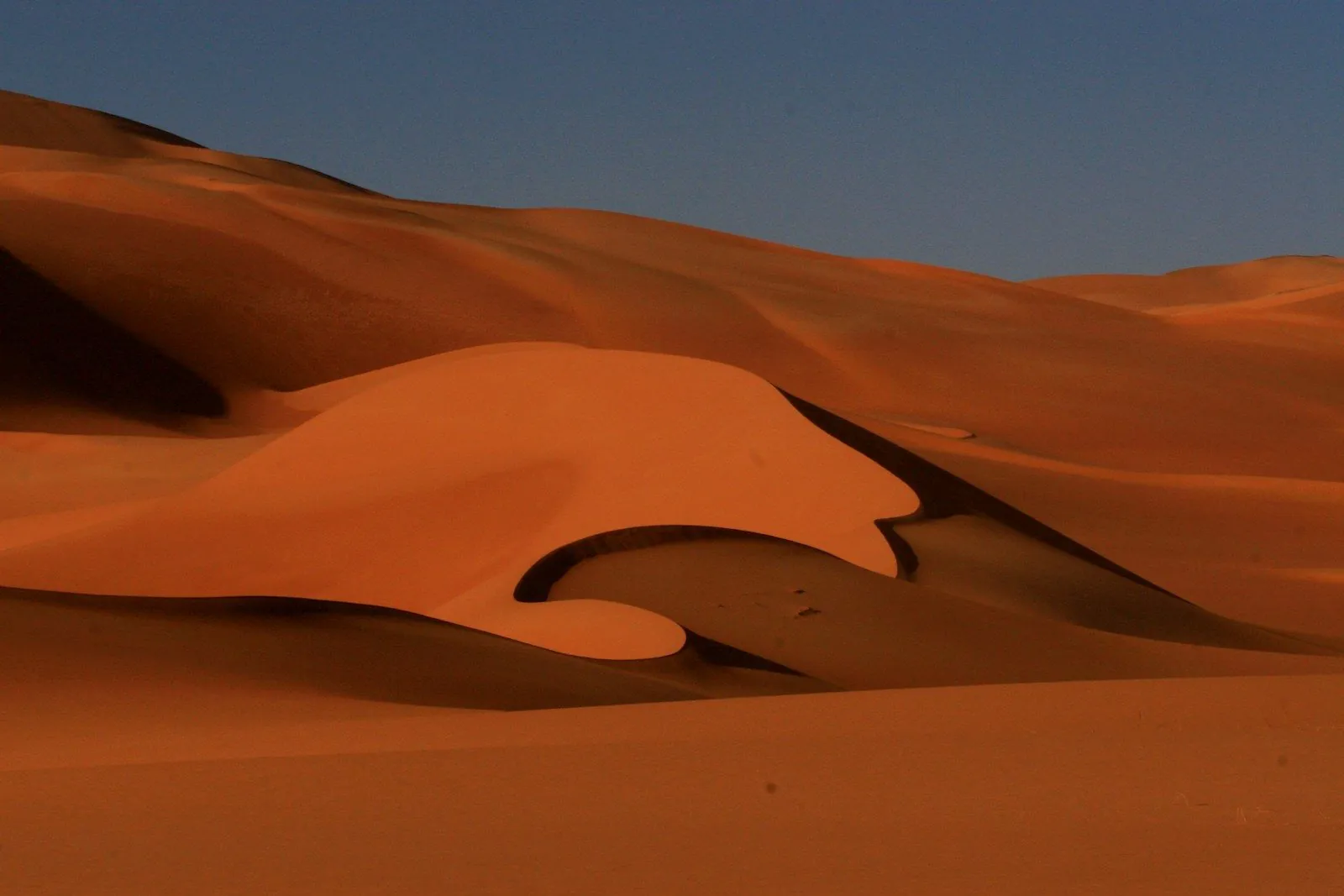
The Desert That Still Belongs to Itself
Somewhere in the middle of a Mauritanian night, on top of a freight wagon full of iron ore, you will check the time and find that only forty minutes have passed since you last checked, and that you do not mind. The train sways. The dust settles into everything you own. Overhead is the entire Milky Way.
Mauritania is the size of France and Spain combined and almost all of it is Sahara. It has caravan cities where manuscripts have sat on the same shelves for eight centuries, an Atlantic shore where the desert runs straight into the sea, and one of the longest trains on Earth, which anyone with enough nerve and a good scarf can ride in an open ore wagon.
It receives a fraction of the visitors of Morocco next door, and that is precisely its appeal. This guide covers the train, the libraries, the desert rhythm, and the practicalities: the visa on arrival, when to go, and what eight days here actually feel like.
Why Go
Morocco gives you the Sahara with infrastructure: camps with Wi-Fi, camel trains queuing for the same dune at sunset. Mauritania gives you the Sahara itself. The Moors of the western desert, the bidan, built a culture around motion and scarcity, measured in camels, tea, and the silence between words, and it is still the operating system of the country.
Nothing here is staged for you, which means everything you see is real: the trains run because the mines run, the libraries survive because families kept faith with them, and the hospitality is offered because that is what the desert requires of people. For travelers who want the texture of a place rather than its performance, there are few better weeks anywhere.
The Iron Ore Train
The numbers first: up to three kilometers long, more than two hundred wagons, hauling iron ore from the mines at Zouerat across roughly 700 kilometers of open desert to the port at Nouadhibou. It is one of the longest and heaviest trains in the world, and it runs with magnificent indifference to timetables. Mauritanians have ridden it between desert towns for decades; travelers began joining for the sheer scale of the thing.
Riding it means climbing into an open-top wagon on the ore itself, wrapped in a scarf and goggles against the dust, with bedrolls, water, and thermoses of sweet tea. The crossing takes somewhere between 18 and 20 hours. It is cold at night, filthy throughout, occasionally tedious, and one of the great romantic journeys left on Earth. You climb down in Nouadhibou at dawn coated in red-black dust, feeling like you got away with something.
Treat it as an expedition moment rather than transport. Done with guides who have ridden the line for years, with the right kit and a hot shower waiting at the far end, it is entirely manageable. Done casually, it is a long, cold lesson.
The Caravan Cities and the Coast
Chinguetti and Its Libraries
Chinguetti grew rich as a gathering point for pilgrims crossing the Sahara toward Mecca, and became one of the intellectual centers of the medieval Islamic world. Its UNESCO-listed stone old town still holds family libraries where Qurans, astronomical treatises, and works of law and poetry, some from as early as the 11th century, sit in the care of the same scholarly families who have kept them for generations.
The custodians will show you pages by hand, in rooms the size of a small bedroom, with dunes visibly advancing at the end of the street. It is one of the most quietly astonishing museum visits anywhere, precisely because it is not a museum.
Give the old town itself an unhurried evening: the dry-stone minaret of the Friday Mosque, the sand-floored alleys, the light going amber over the wadi. Chinguetti is sometimes counted among the holy cities of Islam, and at dusk, with the calls to prayer crossing the dunes, you understand why.
Ouadane
A few hours northeast across the dunes, Ouadane is Chinguetti's ruined twin: a caravan city built down a rocky slope, half swallowed by sand, its dry-stone houses collapsing back into the hillside they came from. Walk it in the late afternoon when the stone turns copper. A handful of families still live around the newer edge of town.
Terjit, Ben Amera, and the Open Adrar
The Adrar plateau between them is the Sahara you have imagined: the dune seas of the Ouarane, the palm-canyon oasis of Terjit with its warm springs, Neolithic rock art on the escarpments, and Ben Amera, a granite monolith second in size only to Uluru, rising out of flat desert beside the train line. Camping in its shadow, with tea on the fire and no other light to the horizon, is a highlight of any itinerary that includes it.
Banc d'Arguin and the Nouakchott Fish Market
On the Atlantic side, Banc d'Arguin National Park is one of the most important bird habitats on the planet, a UNESCO World Heritage Site where millions of migratory birds winter on shallow banks between desert and sea, and where Imraguen fishermen still work the water from sail-powered boats.
And in the capital, Nouakchott's fish market on the beach is the best free spectacle in the country: hundreds of painted pirogues surfing ashore in the late afternoon, the catch hauled out by hand, half the city seemingly there to meet it.
Further north, the Cabo Blanco peninsula beyond Nouadhibou shelters the last major colony of Mediterranean monk seals on Earth, a few hundred animals holding on in the sea caves of a windswept headland. It is a strange, moving footnote to a desert journey: one of the rarest mammals alive, at the end of the train line.
The Practicalities: Visa, Season, Rhythm
Getting In
Mauritania is refreshingly simple by Saharan standards: most nationalities receive a visa on arrival at Nouakchott International for around $60 USD, paid in cash. No invitation letters, no advance clearance. A support letter and an operator meeting you at the airport smooth the queue, but the door is genuinely open.
When to Go
The broad window is November through February, when daytime temperatures in the Adrar sit in the comfortable twenties and low thirties Celsius and desert nights turn sharply cold. We run our own departures in October and November, when the air has cooled but the light across the dunes is still at its most cinematic. Summer is out of the question: the interior regularly passes 45 degrees.
The Desert Rhythm
Desert travel here has its own tempo, and you surrender to it: up before dawn, long hours of 4x4 across ergs and gravel plains, a shaded halt through the worst of midday, camp pitched before dark. Distances are honest and the infrastructure between towns is nearly nonexistent, which is the point.
Then there is the tea. Three rounds, poured from a height into small glasses, each round sweeter than the last, and declining the third is quietly bad manners. Half of Mauritanian social life happens over those glasses. Sit, drink, and let the afternoon go where it wants.
Travel here also asks a little of you in return. This is a conservative Islamic republic: dress modestly, ask before photographing people, and accept that schedules bend to heat, prayer, and sand. Buy crafts directly from the maker where you can. None of this is hardship; it is simply the country on its own terms.
Money
The currency is the ouguiya. Bring euros or dollars in cash and change in Nouakchott; ATMs exist in the capital but should not be relied on, and cards barely feature outside it. Daily costs are modest, and on an organised expedition nearly everything is prepaid before you land.
How We Run Mauritania
Our Mauritania expedition runs eight days for a maximum of five guests at $3,595 USD per person: Nouakchott, the Terjit oasis, nights in the caravan cities of Chinguetti and Ouadane, a camp beneath Ben Amera, the iron ore train crossing with full kit and briefing, Cabo Blanco's monk seal colony, and the drive down the Banc d'Arguin coast back to the capital.
Breakfast, meals on the desert nights with the expedition cook, a Moorish driver-guide who has worked the Adrar for years, and the train logistics are included. Travelers who want a very different West Africa afterward often pair it with our Ghana, Benin, and Togo expedition.
Mauritania Travel FAQ
Do I need a visa for Mauritania?
Most nationalities receive a visa on arrival at Nouakchott International Airport for roughly $60 USD, paid in cash. There is no invitation letter or advance clearance requirement. We provide an arrivals briefing and meet guests at the airport to walk the process.
Is the iron ore train dangerous?
Done properly, it is uncomfortable rather than dangerous: an open wagon, serious dust, cold night hours, and 18 to 20 hours of desert. We ride with experienced local guides, bedrolls, goggles, scarves, water, and food, and a guesthouse with hot showers waits in Nouadhibou. Treat it with respect and it becomes the highlight of the trip.
Is Mauritania safe to visit?
The corridor travelers use, Nouakchott, the Adrar around Atar, Chinguetti and Ouadane, the train line, and the Atlantic coast, is stable and routinely travelled, and Mauritania is among the calmer countries of the wider Sahel. Advisories still apply to remote border regions well away from this route. We run fixed corridors with drivers who know every community on the road and monitor conditions continuously.
When is the best time to visit Mauritania?
November through February is the broad window; we run October and November departures for the cooler air and the best light on the dunes. Desert days are warm and nights genuinely cold, so pack layers. Avoid April through September, when interior heat is extreme.
Can you visit Chinguetti's libraries?
Yes. Several family libraries open to respectful visitors, with the custodians themselves showing manuscripts that date back as far as the 11th century. A small donation is customary and goes directly to preservation. Photography rules vary from library to library; ask before you shoot.
Ready for the Sahara, Properly?