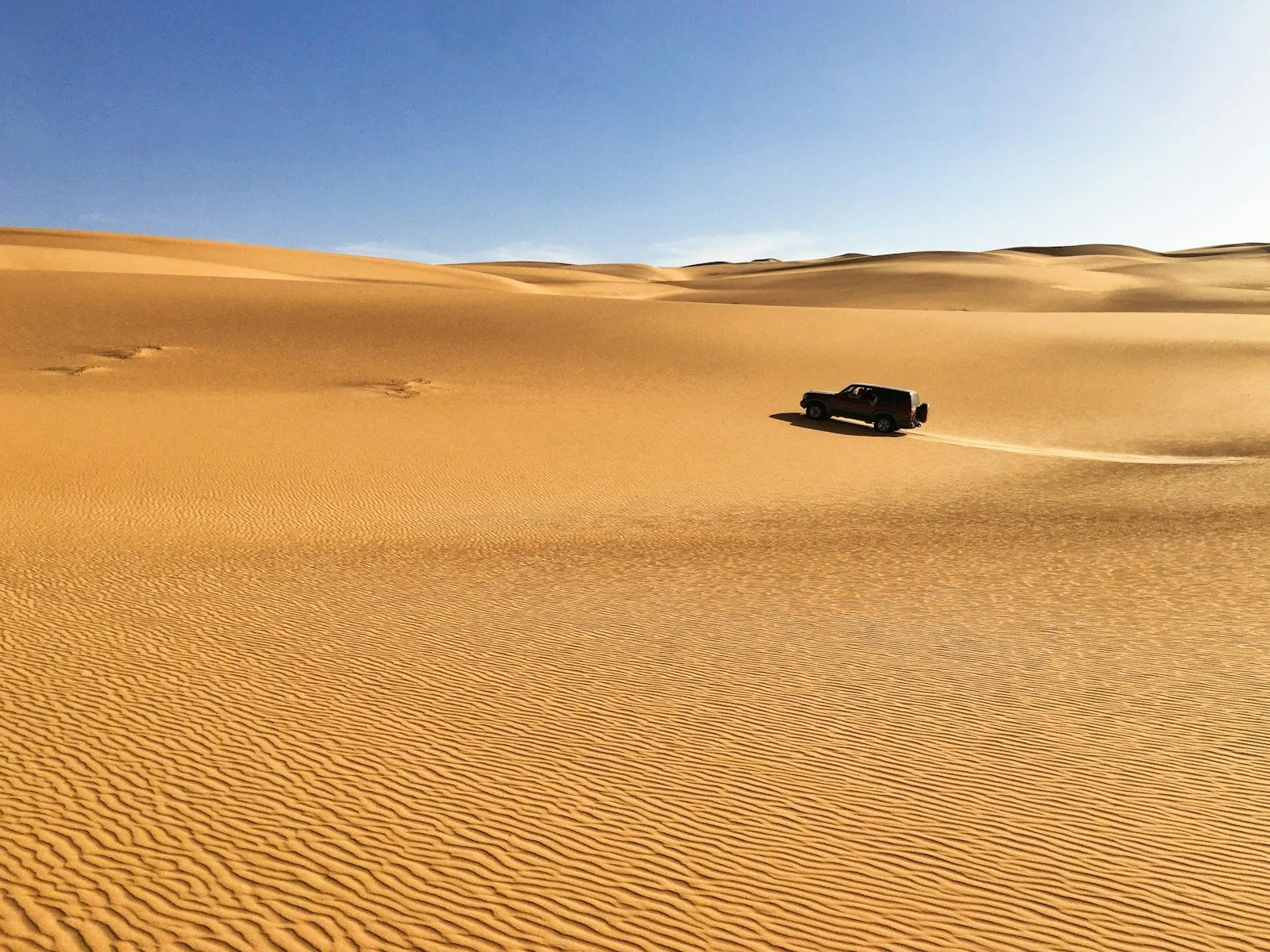
The Country That Sits Off the Map
Chad is the fifth largest country in Africa and one of the least visited places on the continent. Most people could not point to it on a map, and most of the travel industry has quietly agreed to leave it alone. That suits us fine.
We come here for one landscape above all others: the Ennedi, a sandstone massif marooned in the middle of the Sahara, where wind and time have carved arches, towers, and canyons that feel closer to sculpture than geology. There are mornings in the Ennedi when you will not see another vehicle, another traveler, or a footprint that is not your own. For a country of roughly seventeen million people, Chad can feel astonishingly empty once you leave the capital.
This guide covers what the Ennedi actually is, when to come, how the logistics work, and the honest security picture. None of it is casual. Chad rewards preparation and punishes improvisation, and that is exactly why so few people make it here.
Where Chad Is, and Why It Stays Empty
Chad is landlocked, wedged between Libya to the north, Sudan to the east, and Niger, Nigeria, and Cameroon around the west and south. The country is really three worlds stacked together. The south is green Sahel, farmland and river country along the Chari. The middle is dry savanna. The north is pure Sahara, and it runs for hundreds of kilometers until it climbs into the volcanic Tibesti, home to Emi Koussi, the highest peak in the entire desert.
N'Djamena, the capital, sits in the far southwest on the border with Cameroon. It is a working African city, not a tourist one, and for most expeditions it is simply the place where the trip is assembled before heading north. The people of the desert are mostly Toubou and Zaghawa, camel herders and traders who have crossed these sands for centuries.
Why does Chad stay empty? There is no coastline and no easy circuit. Government advisories are blunt and discouraging. The distances are enormous and the infrastructure thins to nothing within a day of the capital. All of that keeps the crowds away, and all of it is the reason the Ennedi still looks the way it does.
The Ennedi Plateau
The Ennedi is the reason to come to Chad. UNESCO added it to the World Heritage list in 2016, recognizing both the landscape and the human history written across it. Picture a plateau the size of a small country, split by canyons and studded with sandstone formations that the wind has been working on for millions of years.
The Arches and Canyons
The signature sight is the Aloba Arch, a slender span of rock rising around 120 meters, one of the tallest natural arches on Earth. It stands at the end of a dry valley, and reaching it is part of the experience. Elsewhere the plateau breaks into narrow slot canyons and forests of stone towers. You spend your days driving between them, walking into them, and camping beneath them. The scale is hard to photograph and harder to forget.
The Rock Art
Thousands of paintings and engravings are scattered across the Ennedi, tucked under overhangs and along canyon walls. They show cattle, camels, horses, and hunters, a record of a Sahara that was once green and full of water. Some are several thousand years old. Standing in front of them, with the desert silent in every direction, is one of those moments that quietly reframes how you think about this part of the world.
Guelta d'Archei and the Lakes of Ounianga
The Sahara's best surprise is water, and Chad holds two of the most extraordinary examples anywhere. The Guelta d'Archei is a permanent pool hidden in a deep canyon in the heart of the Ennedi. Each day camel caravans file down to drink, their reflections doubling in the dark water while the cliffs above turn black with centuries of guano. The guelta also shelters a small relict population of desert crocodiles, survivors from the wetter era the rock art remembers.
Further north lie the Lakes of Ounianga, a separate UNESCO World Heritage site inscribed in 2012. This is a cluster of lakes set among ochre dunes and cliffs, fed by ancient groundwater and holding on against an evaporation rate that should have drained them long ago. Some are fresh, some are deep blue and heavily salted, and the sight of open water against raw desert is genuinely startling. Reaching Ounianga is a serious undertaking, which is precisely why so few travelers ever see it.
When to Go
There is one sensible season for the Chadian Sahara, and it runs from November to March. During these months daytime temperatures sit in a workable range, roughly 25°C to 32°C, while the nights turn genuinely cold. In December and January the desert can drop close to freezing after dark, so a warm layer and a proper sleeping bag are not optional.
The dry harmattan wind can carry dust through these months, softening the light and sometimes the horizon. From April onward the heat builds fast, and by the height of summer the deep desert becomes punishing and, for practical purposes, off limits to travel. We do not run northern expeditions outside the cool season, and no responsible operator should.
Getting There: Flights, Visas, and the Drive North
Flights
Everything begins in N'Djamena. The city's international airport is reached from Paris on Air France, from Addis Ababa on Ethiopian Airlines, from Istanbul on Turkish Airlines, and from Cairo on EgyptAir, among others. For most travelers a connection through Addis or Istanbul is the simplest way in. Schedules are thinner than at major hubs, so build a buffer day at each end.
The e-Visa
Chad moved to a mandatory electronic visa system in May 2026. Applications now go through the official portal at evisa.td, and paper visas issued the old way are no longer accepted. You will need a passport valid for at least six months, a yellow fever vaccination certificate, proof of onward travel, and confirmation of your accommodation or itinerary. Tourist visas generally cover stays of thirty to ninety days. Permits for travel into the Ennedi and the north are arranged separately, and a licensed operator handles those on your behalf.
The Drive North
The Ennedi lies well over a thousand kilometers northeast of the capital. Overland, that is around three days of driving in each direction, first on tarmac and then on sand and rough track through towns like Kalait, the last real crossroads before the deep desert. Some expeditions cut the long transfer by chartering a light aircraft to Fada, the small administrative town at the edge of the Ennedi, and beginning the desert driving from there. Either way, the plateau is not a day trip. It is the destination at the end of a genuine journey.
What a Chad Expedition Actually Looks Like
Once you leave the last town, you are entirely self-contained. We travel with at least two 4x4 vehicles, because in terrain this remote a single breakdown or a truck buried to its axles in sand needs a second vehicle to solve it. There is no fuel, no shop, and no help ahead, so everything, from diesel to drinking water to food, is loaded in N'Djamena and carried the whole way.
Nights are spent in a mobile camp, struck and rebuilt as the route unfolds. Expect a comfortable bedroll under an enormous sky rather than a lodge with a pool. The reward is a level of silence and darkness that is almost impossible to find anywhere else, and the company of Toubou guides who read this desert the way most of us read a street map. Formalities and resupply happen in Fada, and after that it is just the plateau, the camp, and the track you make yourselves.
Zakouma: Chad's Other Masterpiece
If the Ennedi is Chad's stone masterpiece, Zakouma is its living one. This national park in the southeast has become one of Africa's quiet conservation success stories. After poaching gutted its elephant herds in the 2000s, the park has been managed since 2010 by African Parks, and the elephants, along with lions, Kordofan giraffe, and vast concentrations of birds, have come back in force.
The catch is geography. Zakouma sits at the opposite corner of the country from the Ennedi, so the two are best treated as separate expeditions rather than one loop. The park's own season peaks late in the dry months, roughly February to April, when the wildlife gathers around shrinking water and the great flocks arrive. For travelers who want Chad's wilderness in two very different forms, it earns the return trip.
Safety, Honestly
This is the part that deserves a straight answer. Most Western governments, including the United States and the United Kingdom, advise against travel to Chad, and against all travel to the northern provinces in particular. Those warnings are not invented. The risks in Chad are real, but they are also concentrated in specific places.
The most serious threats sit far from the Ennedi. The Lake Chad basin in the far west has seen attacks linked to Boko Haram and its offshoots. The far north, up toward the Tibesti and the Libyan border, carries risks of banditry and old landmines. The Ennedi itself, reached and traveled with a licensed operator and local guides, has hosted expeditions season after season. What it does not have is any rescue infrastructure, and that is the real point.
Chad is not a place to improvise. It is a place to travel with a team that holds current, on-the-ground intelligence, carries satellite communications and a serious medical kit, and knows when to change the plan. Comprehensive insurance with medical evacuation is a baseline requirement, not an upsell. Go in clear-eyed, with the right people, and the Ennedi is one of the most rewarding journeys left on the map.
Practical Information at a Glance
| Location | Central Africa, southern Sahara and Sahel |
| Capital | N'Djamena |
| Best time to visit | November to March |
| Avoid | April to September (extreme heat) |
| Getting there | Fly to N'Djamena, then 4x4 or a light-aircraft charter to the Ennedi |
| Visa | e-Visa via evisa.td; yellow fever certificate required |
| Currency | Central African CFA franc (XAF) |
| Language | French and Arabic (official) |
| Guides | Licensed local guide and permits required |
| Accommodation | Mobile desert camp |
| Typical expedition length | 12–16 days |
| Group size | Capped at 5 guests |
Planning Your Chad Expedition
Chad asks more of a traveler than almost anywhere else we go. The flights take effort, the drives are long, and the desert offers no shortcuts. What it gives back is a landscape that most people will never see and a kind of solitude that has become genuinely rare: sandstone arches with no one beneath them, a canyon pool where camels still come to drink, and lakes that hold their color against the largest desert on Earth.
We run Chad as a private, small-group expedition, capped at five guests, built around your dates and your appetite for the deep desert. If the Ennedi has been sitting on your list, the hardest part is deciding to go. The rest is what we do.
Ready to Start Planning?