Skip to content

Waypoint Journeys Presents

The Maya Corridor

El Salvador · Guatemala · Honduras

7 Days

Volcanoes, Ruins, and the Road the Conquistadors Walked

7 DaysFrom $2,295 USDMax 5 guests

We reply within 24 hours

Three Countries Most Travellers Skip Entirely

Most people pass through this corner of Central America without slowing down. That's the wrong approach. The triangle formed by western El Salvador, eastern Guatemala, and the Copán valley in Honduras contains more concentrated history, geology, and living culture than routes ten times its size.

El Salvador's volcanic backbone breaks into view the moment you leave the capital: the Santa Ana crater — El Salvador's highest volcano — holds a lake the colour of antifreeze far below its rim. A few hours west, Antigua sits beneath three volcanoes like a stage set, its Baroque churches crumbling beautifully into the cobblestones. The Acatenango overnight places you on a ridge above the clouds, watching Volcán de Fuego throw lava into the dark from an uncomfortably close distance.

Then Esquipulas, where the Baroque basilica that houses the Black Christ has drawn pilgrims from across the isthmus since the seventeenth century. And finally, a short crossing into Honduras and the Copán valley, where the ancient Maya carved a civilisation into stone with such precision that the inscriptions are still being deciphered. Seven days. Three countries. One corridor.

"Watching Volcán de Fuego throw lava into the dark from an uncomfortably close distance — sleep is optional."
The turquoise crater lake of Santa Ana volcano, El Salvador
The Santa Ana crater lake, El Salvador

Concentrated History, Geology, and Living Culture

Acatenango & Fuego

An overnight hike to a ridge at altitude beside Volcán de Fuego — the most persistently active volcano in the region, erupting every twenty to forty minutes. After dark the eruptions light the underside of the cloud, the deep percussion arriving seconds after the flash. The narrative centrepiece of the expedition.

Colonial Antigua

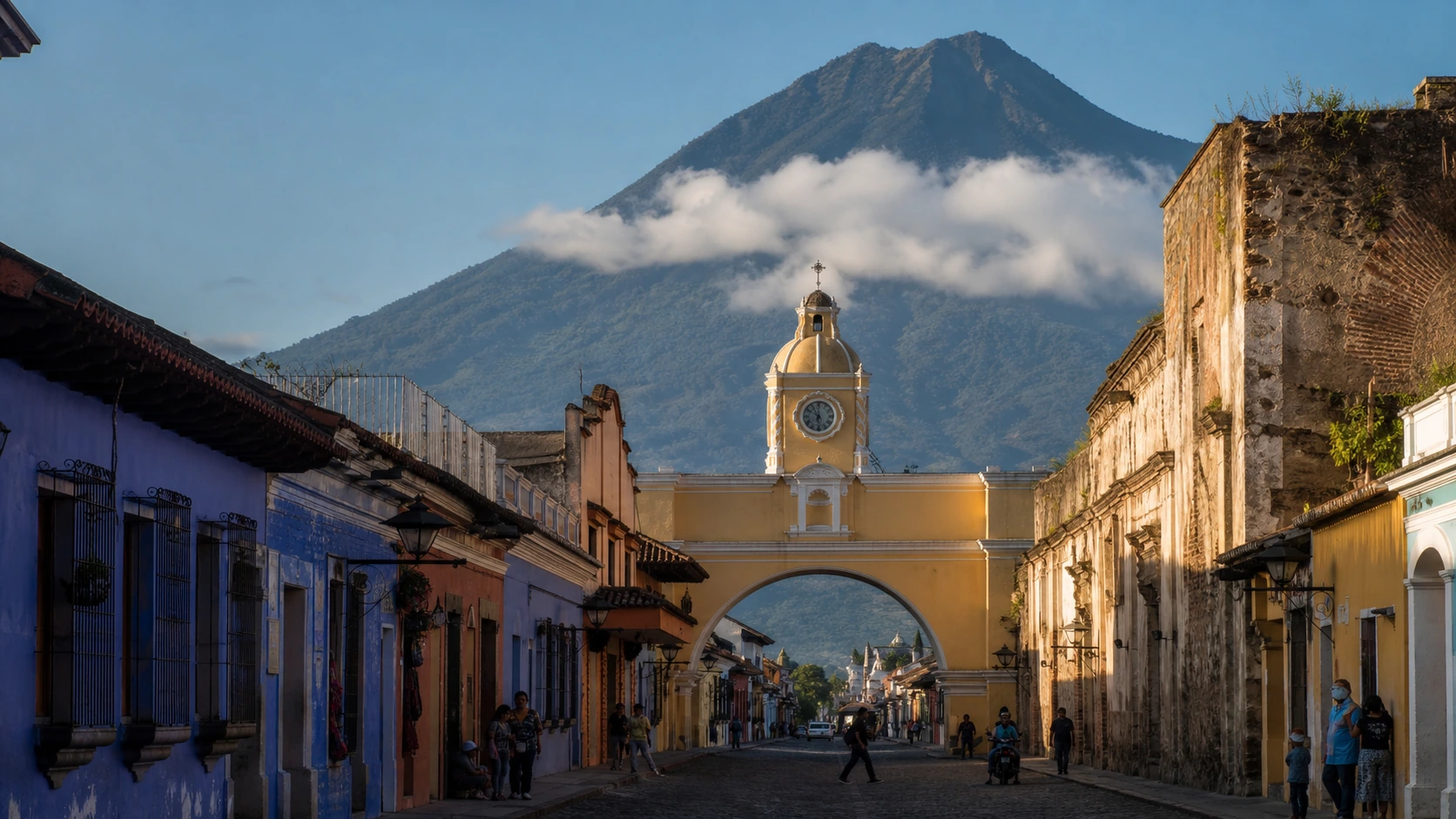
A UNESCO city beneath the three volcanoes of Agua, Fuego, and Acatenango, its cobblestone grid lined with Baroque churches crumbling beautifully — the ruined façade of La Merced, the yellow Santa Catalina Arch, the particular quality of late-afternoon light.

The Santa Ana Crater

El Salvador's highest volcano, rising above 2,300 metres, with a summit crater lake that shifts between pale green and turquoise depending on the sulphur concentration that day. A two-hour ascent with views to the Pacific and the lake-filled Guatemalan border.

The Black Christ of Esquipulas

The largest Catholic church in Central America and one of its most important pilgrimage sites, drawing some 4.5 million visitors a year. The Black Christ at its centre was carved from dark wood in 1594 by a Quiché Maya craftsman and has been credited with miracles ever since.

The Carvings of Copán

A Maya city at its height in the eighth century, whose rulers commissioned some of the most detailed carved stonework in the pre-Columbian Americas. The Hieroglyphic Stairway — more than 1,250 glyphs, the longest known Maya inscription — carries an entire dynastic history up sixty-three steps.

Three Countries, One Route

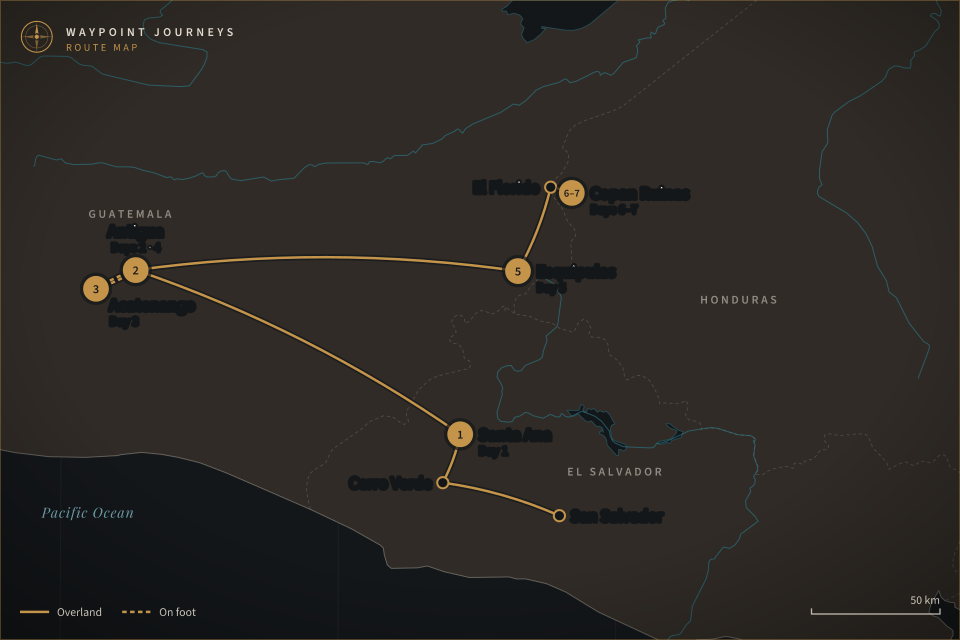
A horseshoe arc from San Salvador through Santa Ana, Antigua, and Esquipulas to Copán — two land border crossings, all logistics handled, across a region of more concentrated interest than almost anywhere in the Americas.

The Expedition

Seven days across three countries — a horseshoe from San Salvador to Copán, built around the Acatenango overnight.

Day 1 · 🇸🇻
San Salvador · Santa Ana · Cerro Verde
Day 1 · El Salvador

We begin in San Salvador with an early transfer west toward the volcanic highlands. The morning brings Cerro Verde National Park — cloud forest, sulphur vapour, and exposed lava fields. The main event is Santa Ana, known locally as Ilamatepec: El Salvador's highest active volcano, rising just above 2,300 metres, with a crater lake that shifts between pale green and turquoise. The two-hour ascent offers views to the Pacific on one side and the lake-filled Guatemalan border on the other. The late afternoon is for the view across Lake Coatepeque — a flooded caldera far below — before we settle in Santa Ana city for the night.

Day 2 · 🇬🇹
Santa Ana · drive to Antigua
Day 2 · Guatemala

The border crossing into Guatemala is straightforward and brings us into the eastern highlands. We make the long arc west and south around Guatemala City to Antigua — a city whose formal name, La Muy Noble y Leal Ciudad de Santiago de los Caballeros, tells you how seriously it took itself in the colonial era. The approach, with the three volcanoes of Agua, Fuego, and Acatenango arranged behind the tile rooftops, is one of those arrivals that earns its reputation. We arrive by early afternoon, leaving time to walk the cobblestone grid, see the famous ruined façade of La Merced, and settle in before the most demanding day of the expedition.

Day 3 · 🇬🇹
Acatenango overnight hike
Day 3 · Guatemala

This is the day the expedition is built around — and the reason we keep nothing else in the schedule. Acatenango is a stratovolcano at 3,976 metres, the third-highest in Central America, and its neighbour is Volcán de Fuego, erupting every twenty to forty minutes. We depart Antigua late morning for the trailhead at La Soledad: six to seven hours of steep climbing through farmland, then forest, then open scree, gaining 1,570 metres before reaching base camp. Dinner is cooked at altitude. After dark, Fuego takes over — eruptions lighting the underside of the cloud, the deep percussion arriving seconds after the flash, the lava flows visible in the clear gaps between. Sleep is optional.

Day 4 · 🇬🇹
Acatenango summit sunrise · return to Antigua
Day 4 · Guatemala

The pre-dawn alarm is worth it. A summit push at 4 a.m. puts us on the rim as first light separates Fuego from the sky to the east, the Pacific coast just visible to the south, the volcanic chain of Central America stretching in both directions. The descent takes three to four hours and returns us to Antigua by midday — battered, exhilarated, and ready for a long lunch and the afternoon off. Antigua in the afternoon is its own reward: the Central Park, the yellow Cathedral of San José, the rooftop views from the Santa Catalina Arch, the textile markets, and the particular quality of light this city manages in the late afternoon.

Day 5 · 🇬🇹
Antigua · Esquipulas
Day 5 · Guatemala

The drive from Antigua to Esquipulas takes four to five hours, heading east across the Guatemalan highlands and then dropping into the drier valleys near the Honduran and Salvadoran borders. Esquipulas sits in a bowl-shaped valley at 920 metres, its gleaming white Baroque basilica visible from the road well before the town appears. The Basílica del Cristo Negro is the largest Catholic church in Central America and one of the continent's most important pilgrimage sites — around 4.5 million visitors a year. The statue of the Black Christ at its centre was carved from dark wood in 1594 by a Quiché Maya craftsman and credited with miracles since the seventeenth century. The interior is spare; the figure does the work. We spend the afternoon here at a considered pace.

Day 6 · 🇭🇳
Esquipulas · border crossing · Copán Ruinas
Day 6 · Honduras

The border crossing from Guatemala into Honduras at El Florido is a short drive from Esquipulas — one of the easier land crossings in the region, and just fourteen kilometres from the Copán archaeological site. The town of Copán Ruinas, which grew up around the ruins, has the unhurried pace of a place that knows it has something worth staying for: cobblestone streets, good coffee, and the scarlet macaw — Honduras's national bird — at the nearby Macaw Mountain reserve, where canopy walkways bring you eye-level with creatures that would otherwise remain a distant flash of colour. The afternoon, once settled, is yours for the town or the reserve.

Day 7 · 🇭🇳
Copán ruins · depart
Day 7 · Honduras

The Maya city of Copán was at its height in the eighth century — a sophisticated astronomical and ceremonial centre whose rulers commissioned some of the most detailed carved stonework in the pre-Columbian Americas. The UNESCO site covers the main acropolis, the ball court, and the Grand Plaza, where seventeen intricately carved stelae — each a portrait of a ruler, precisely dated and captioned in glyphs — stand in the open air. The Hieroglyphic Stairway, with more than 1,250 glyphs constituting the longest known Maya inscription, is the centrepiece: an entire dynastic history carved into sixty-three rising steps. The on-site Sculpture Museum — entered through a doorway carved as the open mouth of a serpent — holds the original carvings and a reconstruction of the Rosalila temple found buried intact beneath the acropolis. We spend the morning here slowly. Departures connect to San Pedro Sula airport or back to Guatemala City.

The Santa Catalina Arch in Antigua, Guatemala, with Volcán de Agua behind

Small Group Expedition

Three Countries.
One Unhurried Corridor.

What's Included

Duration7 days / 6 nights, San Salvador to Copán
Group SizeSmall group expedition: maximum 5 guests
GuidesExpert local guides throughout, including a specialist volcano guide for Acatenango; all ground transport in private vehicles
Acatenango ExpeditionOvernight volcano expedition — all equipment, meals at base camp, cabin or tent accommodation on the ridge
AccommodationSix nights: Santa Ana/Metapán, Antigua (x2), Acatenango base camp, Esquipulas, Copán Ruinas
Border CrossingsAll border crossing logistics handled (El Salvador → Guatemala; Guatemala → Honduras). No visa required for most Western passports
MealsAll breakfasts daily; lunches on Days 1 and 7; dinner at Acatenango base camp (Day 3); Copán entrance fees and Sculpture Museum
Not IncludedInternational flights to San Salvador / from San Pedro Sula, travel insurance, meals not listed, alcohol, and the optional Macaw Mountain entrance

FREQUENTLY ASKED QUESTIONS

Common Questions About This Expedition

It is the most demanding day on the expedition and should be taken seriously. The ascent gains roughly 1,570 metres over six to seven hours on steep, uneven trail — including a final stretch on loose volcanic scree that most people find harder than expected. A reasonable level of fitness is required. We advise spending the first night in Antigua (at 1,530m) before attempting the summit. Those who prefer not to hike can opt out of the Acatenango night and spend an extra evening in Antigua — we can arrange this when you enquire.
Santa Ana is an active volcano and hikes are subject to park authority approval, which can close the trail on short notice if monitoring indicates elevated activity. This is rare but possible. We monitor conditions in the days before departure and have alternative programmes in place if needed. The hike itself, when open, is well-marked and done with an experienced guide.
The El Salvador–Guatemala crossing and the Guatemala–Honduras crossing at El Florido are both manageable land borders well used by travellers. Citizens of most Western countries do not require visas for any of the three countries. We handle all logistics, paperwork, and transfers across both crossings.
November through April — the dry season — offers the clearest conditions for volcano hiking and the best chance of unobstructed views from Acatenango. The wet season (May–October) is possible but morning cloud is more frequent at altitude. Esquipulas is best avoided in the two weeks around January 15th (the feast of the Black Christ), when the town receives its largest pilgrimage crowds.

Expedition Investment

$2,295USD

per person, twin share

Fully inclusive of accommodation, expert guides, the Acatenango overnight expedition, all ground transport, border logistics, Copán entrance, and listed meals

Excludes international flights, travel insurance, and meals not listed. Single supplement $295 USD. Small group supplement $250 USD for groups of 2 or fewer. Lake Atitlán two-night extension available on request

Reserve Your Spot
A Note on Safety

This expedition keeps to the well-travelled cultural and volcanic corridor of western El Salvador, the Guatemalan highlands, and the Copán valley — routes long used by travellers, with trusted local guides, drivers, and accommodation throughout. The Acatenango and Santa Ana hikes are done with experienced specialist guides, and active-volcano conditions are monitored continuously (trails can close on short notice if activity is elevated). We handle all border logistics and paperwork. We're glad to discuss fitness requirements and the current picture directly before you book.