Waypoint Journeys Presents
The Smiling Coast
Senegal & The Gambia
8 Days
Two Countries, One River — Gorée, the Delta & the Roots Voyage Upcountry
View Expedition Details ↓ Plan This Expedition →We reply within 24 hours
A Country Inside a Country, Wrapped Around a River
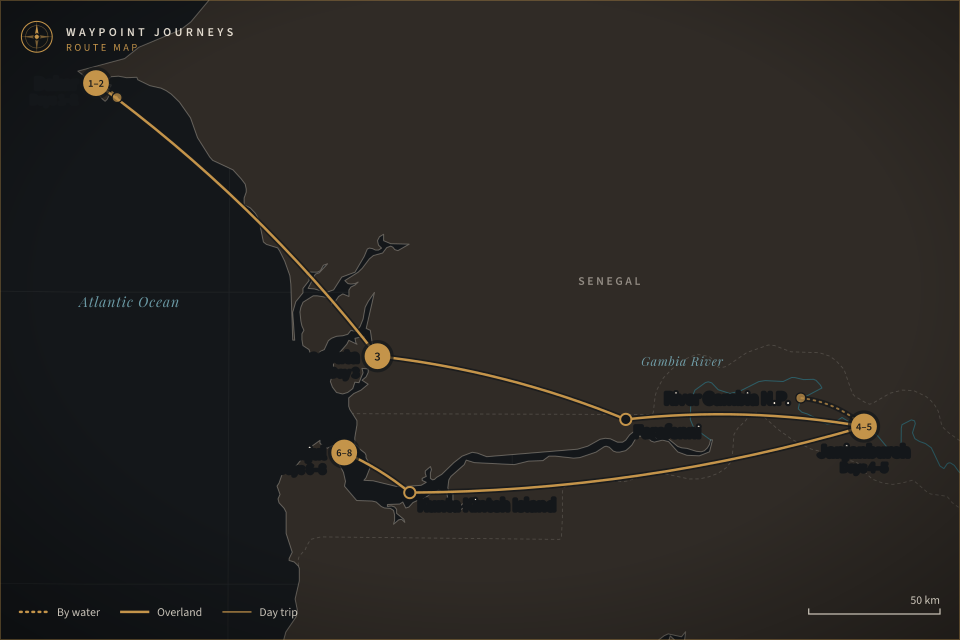
Look at the map and smile: The Gambia — Africa's smallest mainland nation — is a river with borders, a green ribbon threaded three hundred kilometres into the body of Senegal and nowhere more than fifty wide. The two countries share peoples, markets, music and the Wolof language, yet split by colonial accident into francophone and anglophone halves. Travelling both in one journey is the only honest way to read this corner of West Africa — and one of the friendliest journeys on the continent.
Senegal brings the grandeur: Dakar's cliff-edge energy at the westernmost tip of Africa, the heartbreaking beauty of Gorée Island and its House of Slaves, and the Sine-Saloum Delta — two hundred islands of mangrove, shell middens and sandbanks where dolphins work the channels and fishing pirogues sail like painted arrows. The Gambia brings the intimacy: a slow river running through forest and peanut country, chimpanzees on their protected islands, and Kunta Kinteh Island — the UNESCO fort-islet at the heart of the Roots story, where the Atlantic trade's memory is kept by the villages that face it.
This is an 8-day arc from Dakar to Banjul — city, island, delta, river, and back to the sea — with every night's accommodation included, from boutique Dakar to delta eco-lodges. Finish in Banjul, or let the journey exhale: the extended version crosses back to Senegal's Petite Côte for two beach nights at Saly before a Dakar departure. Teranga — the Wolof art of hospitality — does the rest.
"One river, two flags, a thousand pirogues — and the warmest welcome in West Africa on both banks."

Gorée's Memory, a Delta of a Thousand Channels, and the River at the Heart of Roots
Twenty minutes off Dakar, a car-free island of ochre colonial houses and bougainvillea holds the House of Slaves and its Door of No Return — the most affecting memorial of the Atlantic trade. Gorée insists on both truths at once: the beauty of the place and the horror it served. A UNESCO site that no visitor leaves unchanged.
Where two rivers dissolve into the Atlantic, two hundred islands of mangrove and shell-midden villages make one of West Africa's great wildernesses — a UNESCO biosphere where pelicans and flamingos crowd the sandbars, dolphins hunt the channels, and the only traffic is a painted pirogue. We sleep inside it, at a delta eco-lodge reached by boat.
Upcountry Gambia is Africa at river pace — laterite roads red between the baobabs, hand-cranked ferries, kingfishers stitching the banks, and Janjanbureh (colonial Georgetown) drowsing on its island as it has for two centuries. The journey is the destination, and the river writes the schedule.
In River Gambia National Park, a celebrated rehabilitation project has returned over a hundred chimpanzees to forested islands in mid-river. From a quiet boat at respectful distance you watch families patrol their banks — with hippos surfacing between the hulls and red colobus monkeys shaking the crowns. One of West Africa's most moving wildlife encounters.
The fort-islet the world knows from Roots — a UNESCO site shrinking into the river it once controlled, from which captives were shipped for two hundred years. The villages of Juffureh and Albreda keep its memory on the bank, told by guides whose families have carried the story for generations. Paired with Gorée, it completes West Africa's most important act of remembrance.
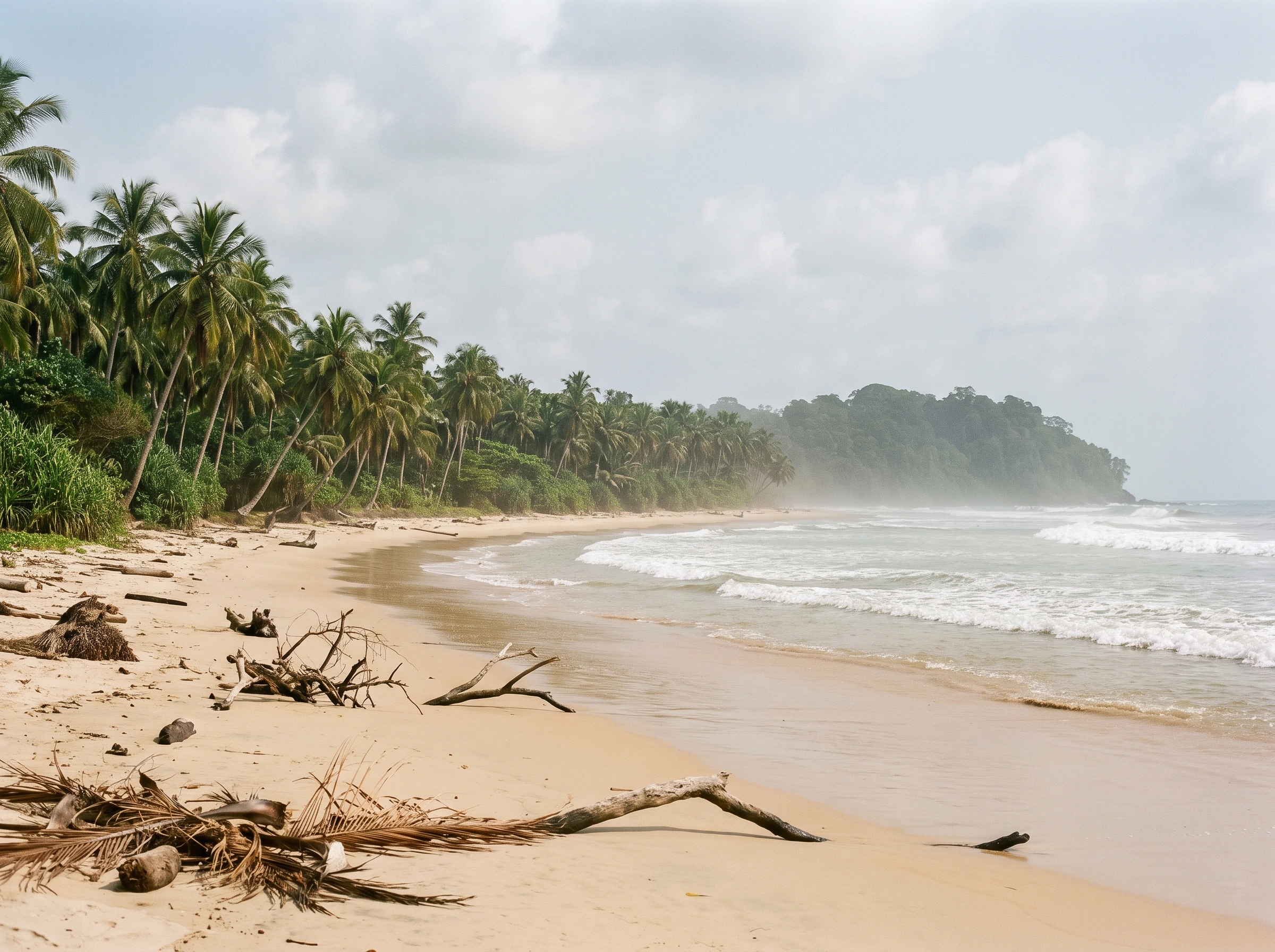
Teranga, the Wolof word for hospitality, is Senegal's national brand and The Gambia's daily practice — thieboudienne shared from one platter, attaya tea poured three times, mbalax drumming into the night. The extended version of this expedition ends the way West Africans themselves holiday: two beach days at Saly on the Petite Côte, doing gloriously little.
The Expedition
Eight days from Dakar to Banjul — city, island, delta and river — with an optional two-night Saly beach finale on Senegal's Petite Côte. All accommodations included.
Land in Dakar, the Atlantic-battered capital on the westernmost point of the African continent, and transfer to a boutique hotel above the corniche. The first afternoon takes the city's pulse gently: the cliff road past surf breaks and fish markets, the towering African Renaissance Monument for the view, and sunset with the ocean on three sides. Dinner is thieboudienne — the national rice-and-fish masterpiece — eaten the proper way, from the shared platter.
The morning ferry crosses to Gorée — a car-free island of ochre facades, sandy lanes and bougainvillea whose beauty makes its history land harder. At the House of Slaves, the Door of No Return opens onto the open Atlantic; our guide gives the history straight, without theatre, and the island's artists' quarter and ramparts give the afternoon back its breath. Return to Dakar for the Medina and the IFAN museum's masks, or the tailors' street if your wardrobe is feeling brave, and a final capital dinner with live mbalax if the night obliges.
Out of the city and south through baobab savanna and peanut country to the Sine-Saloum — the delta where two rivers shatter into two hundred islands of mangrove and shell-midden. A pirogue carries you to an eco-lodge inside the biosphere reserve; the afternoon glides the channels as the tide turns — pelicans queuing on the sandbars, fish eagles overhead, oyster-women working the mangrove roots, and dolphins if the delta is feeling generous. Dinner is the day's catch, grilled steps from the water, under a sky with no competition.
A border day with a change of language but not of family: crossing into The Gambia, the signs turn English while the greetings stay Wolof and Mandinka. The road runs east along the river's north bank — red laterite between the baobabs, donkey carts and groundnut villages, kingfishers on the wires — to Janjanbureh, the old colonial river port of Georgetown drowsing on its mid-river island. A hand-cranked ferry, a walk among the wharf ruins and freedom tree, and a riverside lodge with hippos grunting somewhere in the dark.
The expedition's wild heart. By boat onto the wide brown river and along the forested islands of River Gambia National Park, where a decades-old rehabilitation project has returned over a hundred chimpanzees to the wild. Engines low, distance respectful, you watch families patrol the banks and squabble in the crowns — while hippos surface alongside and red colobus crash the gallery forest. The afternoon drifts back downriver with the current, birds ticking by at a rate that embarrasses the notebook. Second night at Janjanbureh, earned.
West with the river to the country's most important acre: Kunta Kinteh Island, the UNESCO-listed fort-islet from which captives were shipped for two centuries, now shrinking into the river that made it valuable. The crossing is short; the silence on the island is not. On the bank, Juffureh and Albreda — the villages of the Roots story — keep the memory with guides whose families have carried it for generations, and the small museum sets the local history in the Atlantic whole. The evening reaches the coast: a comfortable lodge near Banjul, and the first cold ocean breeze in days.
The smallest capital in mainland Africa deserves its lap of honour: Albert Market's fabric canyons, the colonial-era Arch 22 for the rooftop view, and the fish quay at Tanji where the afternoon fleet surfs ashore into a carnival of gulls, smoke-houses and headline colour — the best photography hour of the trip. The Kachikally crocodile pool or the Bakau botanic gardens fill the gap before a farewell dinner on the Atlantic, grilled ladyfish and benachin under the palms.
Version one ends here, cleanly: breakfast, a last swim, and the short transfer to Banjul airport ($2,750, all seven nights included). Version two exhales instead: north across the border to Senegal's Petite Côte for two nights at a beach resort in Saly — warm Atlantic, poolside attaya, grilled captain fish, and precisely no itinerary — before a comfortable Day 10 transfer up the coast to Dakar for departure ($3,595, all nine nights included). After a week of rivers and red roads, we rarely have to argue for it twice.
What's Included
FREQUENTLY ASKED QUESTIONS
Common Questions About This Expedition
Expedition Investment
per person, twin share — Banjul ending
Fully inclusive of all seven nights' accommodation (boutique hotels, delta eco-lodge and river lodges), expedition leader and local hosts throughout, private vehicle, all boats, pirogues and ferries, both border crossings, all listed excursions from Gorée to Kunta Kinteh, daily breakfast, all up-country meals, and the welcome and farewell dinners
Saly beach finale: $3,595 USD twin share — adds two resort nights on the Petite Côte and the Dakar departure transfer (10 days all-in). Excludes international flights, insurance, remaining city/beach meals, alcohol, and tips. Single supplement $420 / $560 USD
Reserve Your SpotSenegal and The Gambia are two of West Africa's most stable and welcoming countries, with decades of tourism practice on the coast and genuinely low risk for travellers on this route. What we manage is logistics, not security: two border crossings (paperwork handled, patience supplied), river ferries with their own sense of time, upcountry laterite roads, and the strong Atlantic sun. Malaria prophylaxis is sensible year-round and we send full health guidance before you fly; the water we drink is bottled, the pirogues carry life jackets, and the wildlife viewing keeps engine-off distances. Bring soft luggage, a headtorch for the delta nights, and space in the bag for fabric — Albert Market wins every time.