Waypoint Journeys Presents
The Forgotten Coast
Guyana & Suriname
6 Days
South America's Caribbean Fringe, Where the Jungle Meets the Atlantic
We reply within 24 hours
The Most Overlooked Corner of the Continent
The three Guianas — Guyana, Suriname, and French Guiana — sit on the northeastern shoulder of South America, pressed against the Atlantic, speaking English, Dutch, and French respectively, which tells you something about how thoroughly this region was carved up and how thoroughly it has been ignored since. Guyana is the only English-speaking country in South America. Suriname was a Dutch colony until 1975.
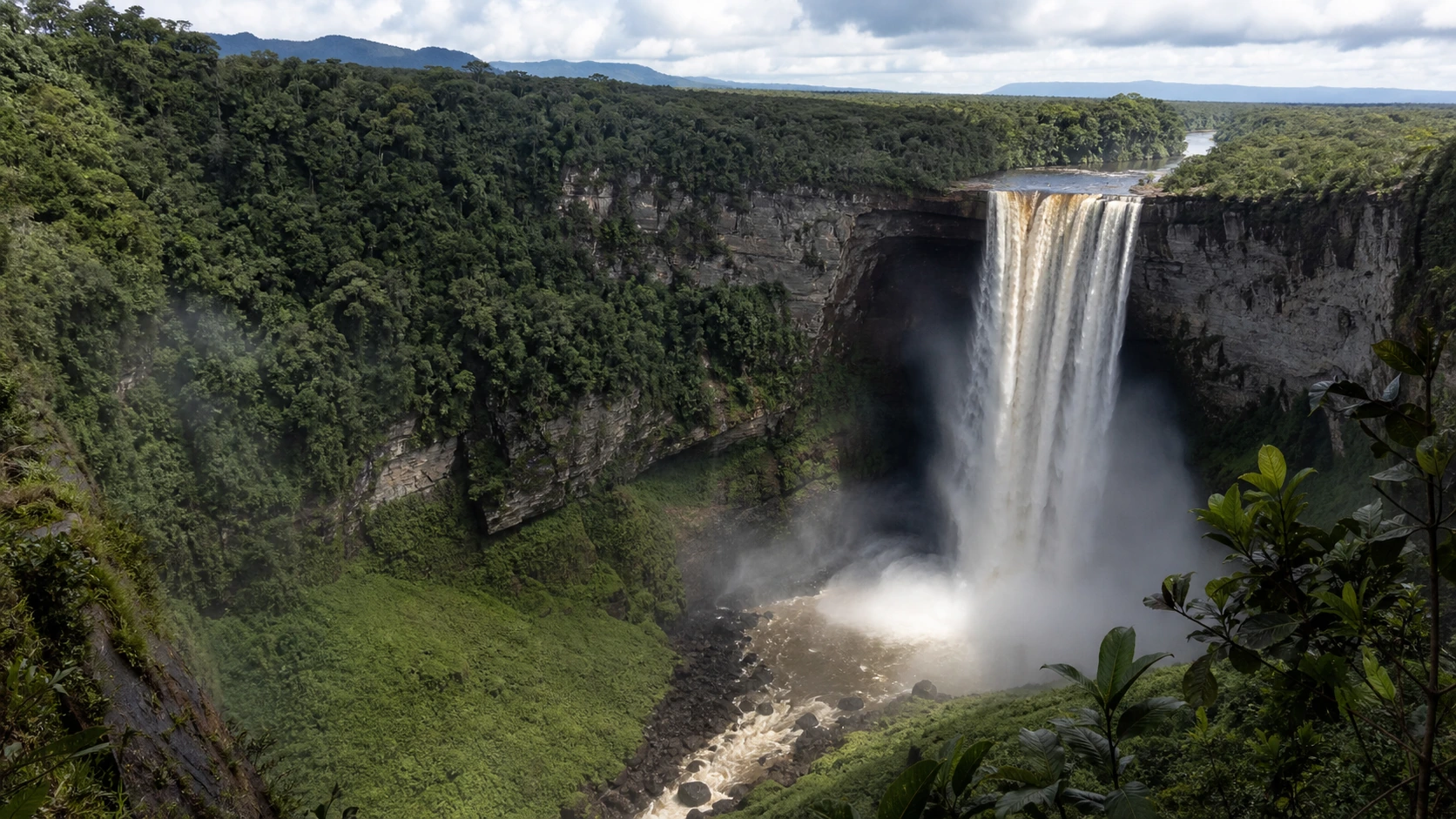
Suriname's capital, Paramaribo, is a UNESCO World Heritage Site on the strength of its colonial architecture — something that surprises most people who didn't know Paramaribo existed. The interior of both countries is among the least-disturbed tropical rainforest on the planet. And Kaieteur Falls, which most people have never heard of, is one of the most powerful waterfalls on Earth by volume — five times the height of Niagara.
Kaieteur drops into an unbroken jungle gorge with no viewing platform, no cable car, no souvenir shop, and almost no other visitors. That combination — the extraordinary, the obscure, and the genuinely wild — is what this expedition is built around. It runs as a standalone or as a seamless extension of our Caribbean Arc itinerary, departing from Port of Spain, Trinidad.
"Five times the height of Niagara, dropping into an unbroken jungle gorge with no guardrail and almost no other visitors."

The Extraordinary, the Obscure, and the Genuinely Wild
A single unbroken 226-metre plunge — nearly five times the height of Niagara — into a gorge carved by the Potaro River over millions of years. No guardrails, no cable car, and only a handful of other visitors. Reached by private charter over an unbroken carpet of rainforest.
The colonial streetscape along the Waterkant waterfront looks more like Amsterdam transported to the tropics than any Caribbean capital should. The Saint Peter and Paul Cathedral is one of the largest wooden buildings in the Western Hemisphere.
A motor-canoe journey south from the coast into undisturbed primary rainforest, ending at a riverbank ecolodge. The jungle at night makes a noise the daytime jungle only hints at — and caimans' eyes reflect red in the torch beam just above the waterline.
Descendants of escaped enslaved Africans who established autonomous communities in the interior centuries ago and have maintained distinct languages, religious practices, and craft traditions largely outside the reach of the coastal state.
The Bigi Pan marshes are among the finest birding areas in South America, holding wetland species that require great effort to find elsewhere. Morpho butterflies the size of a hand, giant river otters, three species of monkey, and — on a very good day — the harpy eagle.
At Paramaribo's Central Market, Javanese, Creole, Maroon, Chinese, and Hindustani vendors sell from adjacent stalls in what might be the most ethnically diverse market in the Americas — the legacy of Suriname's layered colonial migrations.
The Expedition
Six days from the Atlantic coast to the deep interior — two countries, one river, and the most powerful waterfall most people have never heard of.
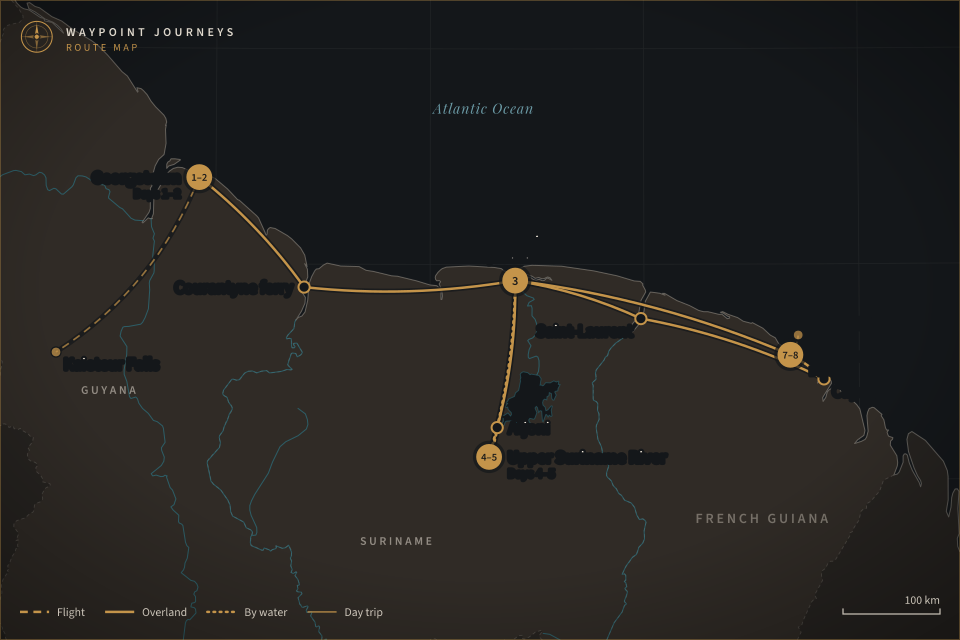
Arrive in Georgetown, Guyana's capital, on the Atlantic coast — its wooden colonial architecture bleached silver by the tropical sun, its seawall the only thing between the streets and a sea that sits above the level of most of the city. The morning is given entirely to Kaieteur Falls: a private charter from Ogle Airport, about forty-five minutes over unbroken rainforest to a grass airstrip near the rim of the Potaro Gorge. Kaieteur drops 226 metres in a single plunge, the spray rising back up in a permanent mist. There are no guardrails at the main viewpoint and only a handful of other visitors. Return to Georgetown by afternoon.
An early start for the drive east to the Surinamese border — the crossing is made by ferry across the Courantyne River, which forms the border between the two countries. From there it is a few hours' drive to Paramaribo, where the colonial streetscape along the Waterkant looks like Amsterdam transported to the tropics. The afternoon is for walking the old city: the Saint Peter and Paul Cathedral, Fort Zeelandia on the river, and the Central Market — perhaps the most ethnically diverse market in the Americas.
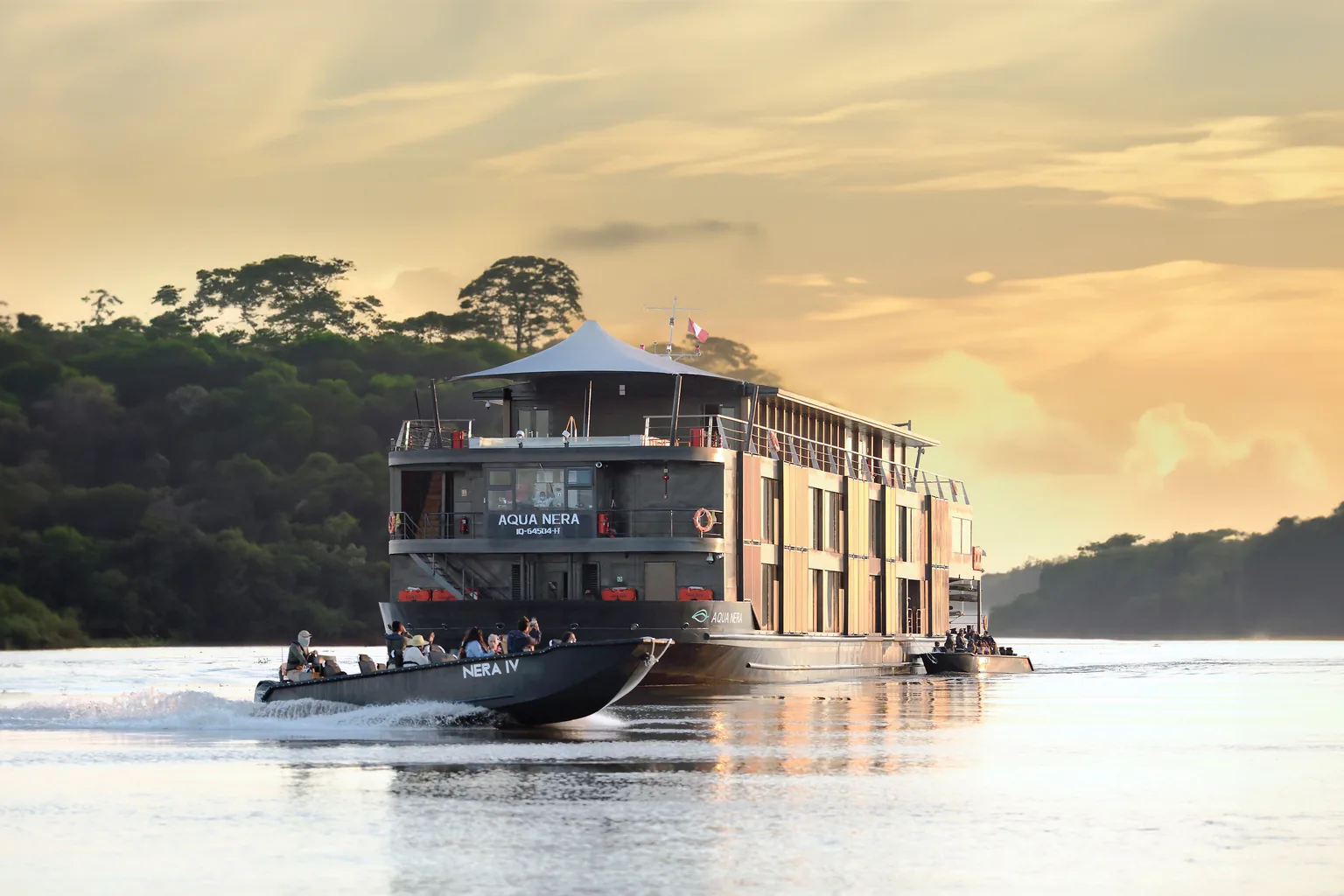
A morning departure by motor canoe begins the transition from the colonial city to the interior. The river journey south takes several hours, moving through flat coastal savanna and then into riverside forest that thickens as the population thins, the canopy closing overhead until the sky is a strip of blue between the crowns. The destination is an ecolodge — open-sided cabins on the riverbank, surrounded by undisturbed primary rainforest. The evening is for the river: caimans come out after dark, their eyes reflecting red in a flashlight beam.
A full day in the forest. The morning village walk visits the Maroon community near the lodge — descendants of escaped enslaved Africans who established autonomous communities in the interior centuries ago. The afternoon forest walk goes deeper into the primary rainforest, where the guide can identify species by sound before they become visible: morpho butterflies the size of a hand, giant river otters, three species of monkey, the harpy eagle on a very good day. The Bigi Pan marshes are accessible by canoe and represent one of the finest birding areas in South America. After dark, another caiman count from the canoe.
The return journey upriver is slower than the descent — current against the bow — and the morning light on the forest is different from the afternoon. Back in Paramaribo by early afternoon, the remainder of the day is genuinely free: the Numismatic Museum for the extraordinary range of currencies that have circulated through Suriname, the Javanese neighbourhood of Kwatta for the best food in the country, or simply the hammock on the hotel terrace with a Parbo beer and a view of the river traffic.
The expedition closes with breakfast and a transfer to Johan Adolf Pengel International Airport for onward connections. Those with a further appetite for the Guianas can continue east into French Guiana — Cayenne, the Salvation Islands (where Dreyfus was imprisoned), and the Ariane rocket launch site at Kourou are all within reach. Ask us about the French Guiana extension.
What's Included
FREQUENTLY ASKED QUESTIONS
Common Questions About This Expedition
Expedition Investment
per person, twin share
Fully inclusive of the Kaieteur charter, accommodation, expert guide, all ground and river transport, and listed meals
Excludes international flights, travel insurance, e-visas, and meals not listed. Single supplement $320 USD. Small group supplement $280 USD for groups of 2 or fewer. Combined Caribbean Arc + Guianas pricing available on request
Reserve Your SpotThe Guianas are rewarding precisely because they are logistics-heavy: a private charter to Kaieteur, an international border crossing by river ferry, and a multi-hour canoe journey into the interior are far better handled by an experienced operator than attempted independently. We use trusted drivers and accommodation partners throughout, travel with an expert English-speaking guide, and manage every connection, permit, and river transfer. Georgetown and Paramaribo call for the same common-sense precautions as any port city; with a guide, both are entirely manageable.