Waypoint Journeys Presents
Venezuela
The Lost World
10 Days
Angel Falls, the Table-Top Mountains & the Labyrinth of the Orinoco
View Expedition Details ↓ Plan This Expedition →We reply within 24 hours
The Country Conan Doyle Called the Lost World
In the south-east of Venezuela the land lifts into the tepuis — sheer-walled sandstone table mountains, some of the oldest exposed rock on Earth, rising two kilometres straight out of the rainforest and savanna of the Gran Sabana. Arthur Conan Doyle set his Lost World on top of one of them. Off the rim of the largest, Auyán-tepui, the longest thread of falling water on the planet drops almost a kilometre before it touches anything: Angel Falls.
A thousand kilometres north and east, the same continent does the opposite. The Orinoco — one of the great rivers of the world — breaks apart before the Atlantic into a delta the size of a small country, a labyrinth of channels called caños threaded with moriche palms. The Warao have lived above its water in stilt houses for thousands of years; the country's name, "little Venice," comes from villages like theirs.
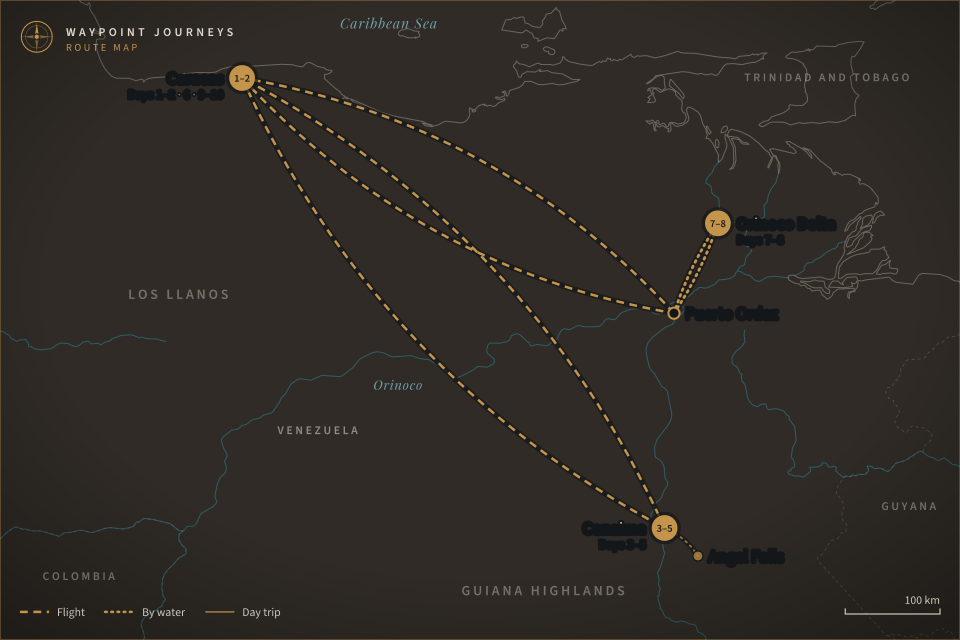
Between the two sits Caracas, in a long valley beneath the green wall of El Ávila. This expedition draws a line through all three — the tepuis and Angel Falls, the delta and the Warao, and the city in its mountain bowl — by internal flight rather than the long and difficult roads. It is the wild heart of a country most travellers have written off, reached the way it should be.
"The longest drop of falling water on Earth, off the rim of a mountain that inspired the Lost World — and almost no one there to see it."

The Tallest Waterfall on Earth, and the River That Forgets the Sea
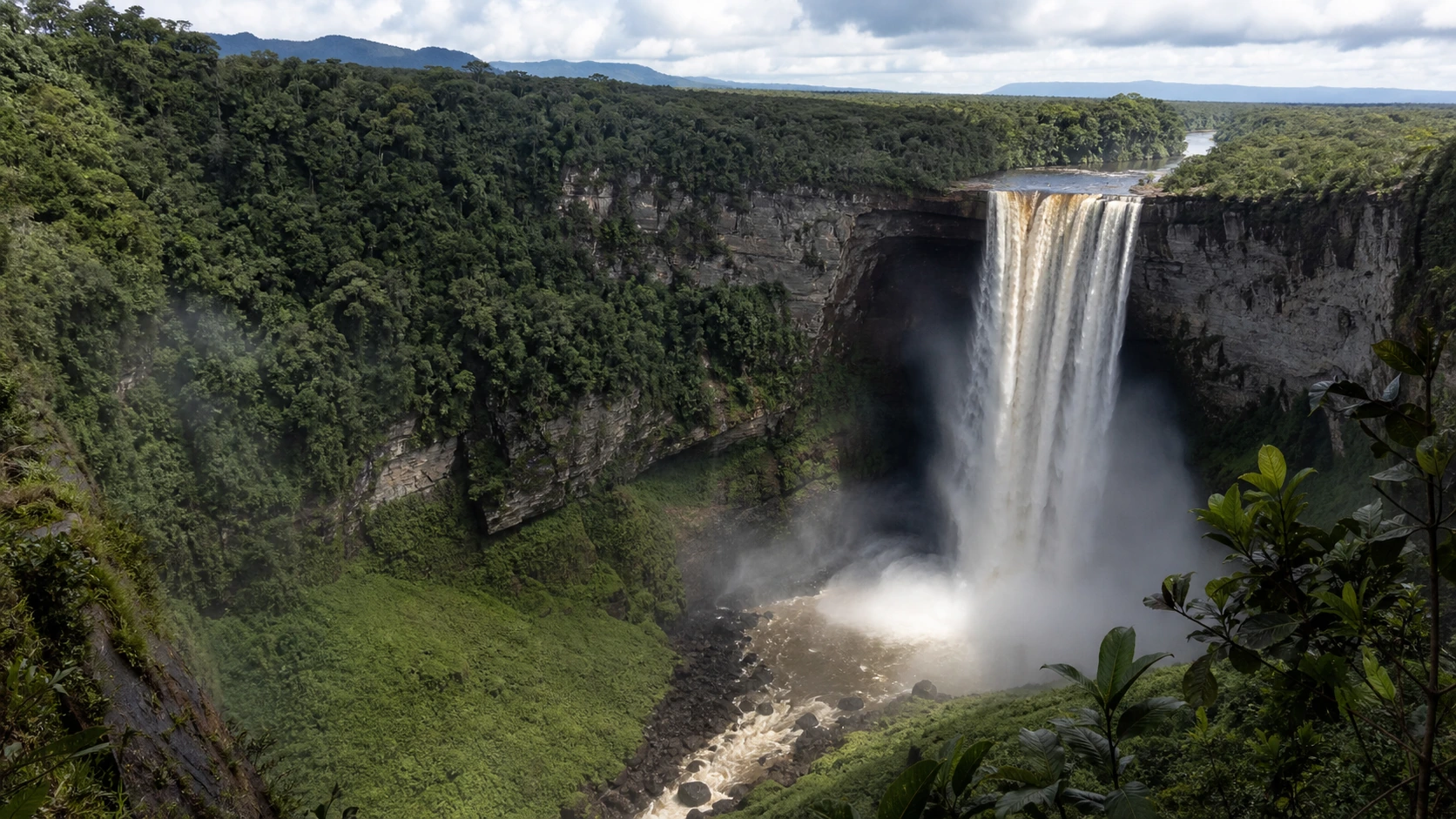
Kerepakupai Merú — at 979 metres, the tallest waterfall on Earth, nearly three times the height of the Empire State Building. It falls so far off the rim of Auyán-tepui that in the dry season the water turns to mist before it lands. We reach it twice: by river to the foot, and by light aircraft from above.
A pink-sand lagoon ringed by its own row of waterfalls, beneath the flat horizon of the table mountains. At Salto El Sapo the trail runs behind the curtain of the falls, the water roaring an arm's length away. The tepuis are among the oldest landscapes on the planet, each one an island of species found nowhere else.
Where one of the world's great rivers loses itself in a maze of channels the size of a small country before reaching the Atlantic. Days move by dugout through corridors of moriche palm, the water black and still, the forest pressing in on both banks — a different planet from the tepuis four hundred kilometres south.
The "boat people," among the oldest cultures in South America, who have lived above the delta's water in stilt houses for thousands of years and still move by dugout from birth. Their palafito villages over the channels gave the whole country its name — Venezuela, "little Venice."
A capital strung along a single valley with a wall of green mountain rising straight off the streets — Warairarepano, El Ávila — reached by a cable car to the ridge above the city. The colonial cobbles and red roofs of El Hatillo sit a short drive away, a quiet counterpoint to the modernist sprawl below.
Red howler monkeys roaring at first light, scarlet ibis crossing the channels in flocks, freshwater dolphins surfacing in the caños, and caimans whose eyes catch the torch beam after dark. The delta is one of the most wildlife-rich corners of a country that holds a slice of the Amazon and a slice of the Andes at once.
The Expedition
Ten days through the wild heart of Venezuela — Caracas, the tepuis and Angel Falls, and the Orinoco Delta — linked by internal flight, not by road.
Arrive at Maiquetía, on the Caribbean coast, and transfer up over the coastal range into Caracas — a city strung along a single long valley beneath the green wall of El Ávila. Check in, settle, and gather at golden hour for the first long view down the valley and an evening briefing over the days ahead. The roads in Venezuela are slow and difficult; from here on, we fly.
The morning rides the Warairarepano cable car from the city up to the ridge of El Ávila, the mountain that separates Caracas from the sea, for the view back down over the whole valley. The afternoon crosses to El Hatillo — a colonial village of cobbled streets and painted houses on the city's edge — before a final repack for the interior, trading the city kit for the light camera-and-quick-dry kit of the days to come.
A morning flight south to Canaima, on the edge of the Gran Sabana in Bolívar state, landing beside the pink-sand lagoon that is ringed by its own row of waterfalls — Hacha, Golondrina, Ucaima — under the flat horizon of the tepuis. In the afternoon a curiara crosses to Salto El Sapo, where the path runs behind the curtain of the falls themselves, the water thundering past an arm's length away.
The full day belongs to Angel Falls. A motorised curiara works up the Carrao and then the Churún rivers, into the canyon between the sheer walls of Auyán-tepui, the largest of the table mountains. From the river landing, a forest trail climbs to the Mirador Laime — the viewpoint that faces the falls across the gorge — where the water comes off the rim almost a kilometre above and dissolves into spray on the way down. A swim in the pool at the base for those who want it, then back downriver.
A light aircraft lifts off the Canaima strip and banks in over the rim of Auyán-tepui for the view of Angel Falls the river can never give — the whole drop at once, from the top, with the tepui falling away beneath. The rest of the day is held deliberately as a weather buffer: a second attempt at the overflight if cloud closed the first, more time on the lagoon and its falls, or simply the long quiet of the savanna under the tepuis.
A morning flight back to Caracas marks the hinge of the expedition — from the highlands of the south to the delta of the east. The afternoon in the city is genuinely free: time to back up the cards from Canaima and rest, the galleries and cafés of Los Galpones, or simply the terrace, before the early start for the Orinoco.
Fly east to Puerto Ordaz, then transfer by road and boat into the Orinoco Delta — where the river, one of the largest on Earth, breaks into hundreds of mouths before the Atlantic, a labyrinth of channels threaded with moriche palm. The lodge sits over the water on stilts in the manner of the Warao; the first evening is for the sunset along the caño and the sounds of the forest closing in after dark.
A full day on the water by dugout. The Morichal Largo and its side channels run between corridors of moriche palm, the route chosen by the guide for wildlife — red howler monkeys, scarlet ibis crossing in flocks, freshwater dolphins, and the chance of a giant otter. A visit to a Warao community, whose stilt houses over the channels gave the country its name, sits at the centre of the day. After dark, a slow run with a torch to find the caimans' eyes along the bank.
A dawn paddle by kayak through the still channels, before the heat and before the engines, when the delta is at its quietest and the birds are loudest. After breakfast the boat and the road carry us back to Puerto Ordaz for the flight to Caracas, and a final evening in the city — the last long valley view, a quiet dinner, and the count of nine nights behind us.
The expedition closes with breakfast and the transfer down to Maiquetía for onward flights. Those who want a Caribbean coda can continue with us to Los Roques — a flat turquoise archipelago of coral cays and white sandbars an hour off the coast, the calm opposite of the falls and the delta. Ask us about the Los Roques extension.
What's Included
FREQUENTLY ASKED QUESTIONS
Common Questions About This Expedition
Expedition Investment
USD per person, twin share
Fully inclusive of internal flights, the Angel Falls river ascent and overflight, accommodation, expert guide, and all ground, river, and boat transport with listed meals
Excludes international flights, travel insurance, national-park fees (cash on arrival), and meals not listed. Single supplement $480. Small group supplement $350 for groups of 2 or fewer. Los Roques Caribbean extension available on request
Reserve Your SpotVenezuela carries an elevated government travel advisory, and we do not pretend otherwise. What makes the country travellable is the way the trip is built: it is run by trusted local operators in the regions we know, it flies over the difficult road network rather than driving it, and it concentrates on the national parks and the delta — Canaima and the Orinoco — rather than the cities. Time in Caracas is guided, daylight, and limited to its safer districts. We carry US dollars in cash, monitor conditions continuously, and brief every confirmed traveller in detail before departure. This is a destination for prepared, well-guided travellers, and with the right operator it is one of the great wild journeys of South America.