Waypoint Journeys Presents

The Caribbean Arc

Nine Islands · The Full Length of the Antilles

13 Days

From the Sugar Highlands of Saint Kitts to the Spice Plantations of Grenada

View Expedition Details ↓

Nine Distinct Islands, One Continuous Arc

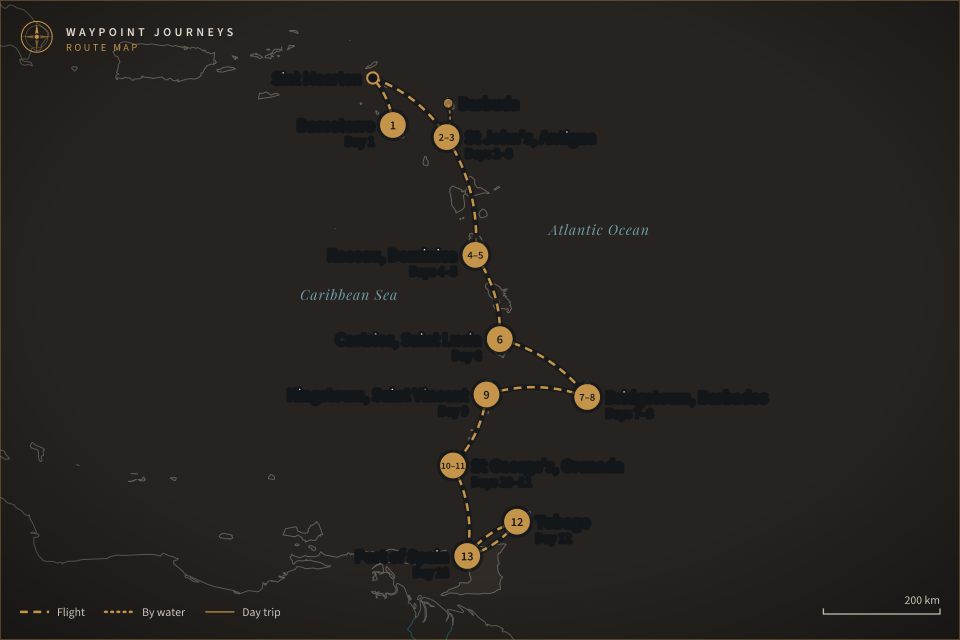
Most Caribbean holidays are one island, one resort, one week. This expedition is the opposite. The Lesser Antilles run in a 900-kilometre arc from the Puerto Rican shelf in the north to the Venezuelan coast in the south, and each island along that arc is distinct — different geology, different colonial history, different culture, different food.

Saint Kitts and Barbados were the engines of the British sugar economy. Dominica never submitted to plantation agriculture because its mountains were too steep and its Kalinago population too resistant. Grenada smells of nutmeg from the air. Saint Vincent is where the last Carib resistance was crushed, and where the La Soufrière volcano buried everything in ash in 2021 and the jungle grew back within months.

Trinidad sits just off the Venezuelan coast and its culture — Carnival, steelpan, doubles, the Pitch Lake — has almost nothing in common with the Leeward Islands four hours north. Thirteen days is the right amount of time to feel the difference between them. The expedition ends at Port of Spain, where our Guianas expedition can continue the journey into South America.

"Each island along the arc is distinct — different geology, different colonial history, different culture, different food. Thirteen days to feel the difference."
A cannon at Brimstone Hill Fortress overlooking the Caribbean Sea, Saint Kitts
Brimstone Hill Fortress, Saint Kitts

The Eastern Caribbean Done Properly

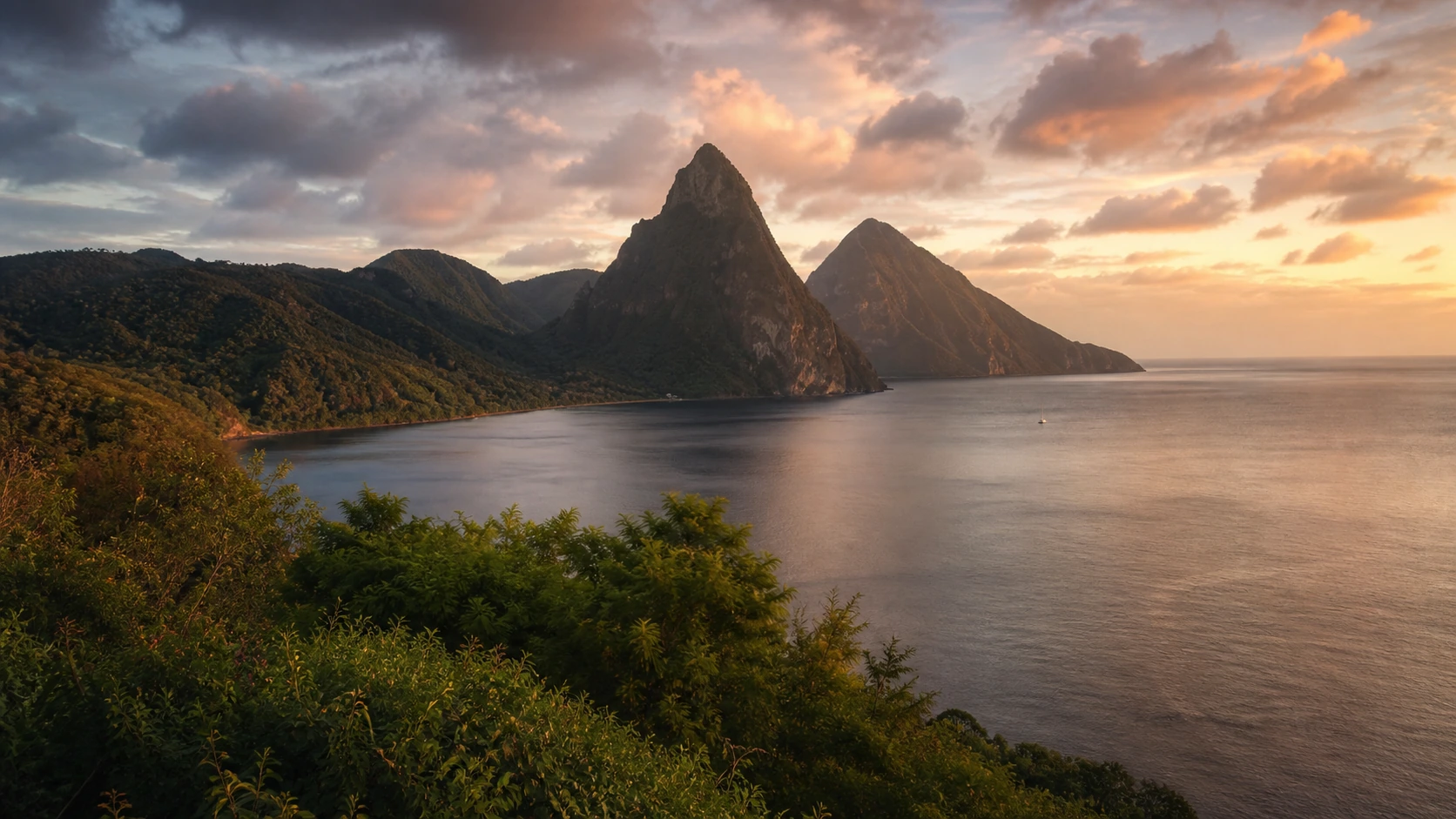
The Pitons, Saint Lucia

Twin volcanic spires rising sheer from the sea south of Soufrière — the version of Saint Lucia that every photograph shows, and the single most recognisable image in the Eastern Caribbean.

Dominica's Boiling Lake

The Nature Isle's interior is undisturbed rainforest. The optional Boiling Lake hike crosses the Valley of Desolation — sulphur vents and moonscape terrain — to the world's second-largest boiling lake, at around 90°C. Trafalgar Falls and the Titou Gorge are the gentler alternatives.

Barbuda's Pink Sand

Fewer than 2,000 residents, no high-rises, and miles of pale pink sand — coloured by pulverised coral — without a beach bar or another person. Plus the largest frigatebird colony in the Western Hemisphere in the Codrington Lagoon.

Sugar, Spice & Forts

Brimstone Hill Fortress (Saint Kitts) and Nelson's Dockyard (Antigua, the only working Georgian dockyard in the world); Grenada's nutmeg and chocolate cooperatives; Barbados's rum shops and the Garrison Historic Area.

Maho Beach & Mahaul Spectacle

At Sint Maarten, Maho Beach sits at the end of the Princess Juliana airport runway, where arriving aircraft clear the beach fence by what feels like a few metres. Loud, ridiculous, and genuinely spectacular.

Trinidad & Tobago

A culture apart — Hindu temples and mosques alongside churches and rum distilleries, the Pitch Lake at La Brea (the largest natural asphalt lake on Earth), and doubles sold from carts at every junction. Tobago holds the oldest protected rainforest in the Western Hemisphere.

The Expedition

Thirteen days, north to south down the island chain — Saint Kitts to Trinidad, by inter-island flight and ferry.

Day 1
Saint Kitts · Basseterre · Brimstone Hill
Day 1

The expedition opens on Saint Kitts — a narrow volcanic island whose economy ran on sugar for three hundred years. Basseterre is small enough to read in an afternoon: the Circus roundabout, the Georgian waterfront, the National Museum. The island's great monument is Brimstone Hill Fortress, a UNESCO site at 220 metres, its cannon still trained over the Caribbean Sea. Dinner by the harbour as the light dies over Nevis Peak.

Day 2
Saint Kitts · Sint Maarten · Antigua
Day 2

A morning flight hops north to Sint Maarten — the Dutch half of an island split between two European nations. Its claim to fame is Maho Beach, at the end of the Princess Juliana airport runway, where arriving aircraft clear the fence by a few metres and departing jets send sunbathers sliding across the sand. Loud, ridiculous, spectacular. In the afternoon, a connecting flight to Antigua. (Sint Maarten transit is subject to flight connections.)

Day 3
Antigua · Barbuda
Day 3

The ferry to Barbuda runs early and returns in the evening — exactly the right way to see the most pristine coastline in the Eastern Caribbean. Fewer than 2,000 residents, no high-rises, and miles of pale pink sand without a beach bar or another person. The island's other spectacle is the frigatebird colony — the largest in the Western Hemisphere, several thousand birds nesting in the mangroves of Codrington Lagoon. Back to Antigua by evening.

Day 4
Antigua · fly to Dominica
Day 4

The morning allows time for Antigua's signature sight: English Harbour and Nelson's Dockyard — a Georgian naval base so well preserved it is now the only working Georgian dockyard in the world, with views from Shirley Heights out to Montserrat and Guadeloupe. In the afternoon, a short flight south to Dominica, whose dramatic mountain approach and dense green interior tell you immediately this is not a typical island.

Day 5
Dominica · Morne Trois Pitons (Boiling Lake optional)
Day 5

Dominica calls itself the Nature Isle and it is not wrong. The morning brings Trafalgar Falls — twin cascades fed by different volcanic springs, one cool and one warm — and the Titou Gorge, a narrow slot canyon reached by swimming. For those up for the most demanding option, the Boiling Lake hike is one of the genuinely extraordinary walks in the Caribbean: six to eight hours through the Valley of Desolation to the world's second-largest boiling lake. The gentler alternative — Emerald Pool, Trafalgar Falls, and a riverside lunch — is also perfectly satisfying.

Day 6
Dominica · fly to Saint Lucia
Day 6

A morning flight south to Saint Lucia, whose twin Pitons — volcanic spires rising sheer from the sea south of Soufrière — are the version of the island the photographs show. The afternoon is given to Pigeon Island National Park in the north: a former pirate stronghold and British naval base, its restored fortifications offering long views to Martinique. The day closes at a calm west-coast beach as the sun drops behind the hills.

Day 7
Saint Lucia · fly to Barbados
Day 7

A short hop east and the landscape changes completely. Barbados is not volcanic — it is a coral island, flat by Caribbean standards, with a settled, prosperous air from three centuries as the most economically significant island in the British Caribbean. The afternoon leaves time to walk Bridgetown: the Garrison Historic Area, the colonnaded buildings of Broad Street, and the rum shops that are the actual social infrastructure of the island. The Oistins Fish Fry closes the evening if the timing is right.

Day 8
Barbados
Day 8

A full day on the island. The north coast, between Bathsheba and the Scotland District, is the part of Barbados nobody photographs for the brochures and everybody remembers: Atlantic swell coming in uninterrupted from Africa, the water a different colour entirely from the calm Caribbean side. Harrison's Cave is a kilometre of white stalactites navigated by electric tram; the Barbados Museum, in the old military prison, covers the plantation era and the 1816 rebellion led by Bussa.

Day 9
Barbados · fly to Saint Vincent
Day 9

A morning flight west to Saint Vincent, an island at the top of the Grenadines chain and less visited than almost anything in the Eastern Caribbean, despite the La Soufrière volcano at its northern end being the most recently active in the island arc — the April 2021 eruption evacuated the northern half. The capital Kingstown is a compact working port with a covered market, a botanical garden that claims to be the oldest in the Western Hemisphere, and a Victorian cathedral decorated by a self-taught Vincentian artist.

Day 10
Saint Vincent · Bequia · fly to Grenada
Day 10

The morning ferry south takes an hour to Bequia — the largest of the Grenadines, a small island of white wooden houses, boatyards, and fishing boats that has been a centre of Caribbean boat-building for as long as anyone can establish. The harbour at Port Elizabeth is one of the most pleasant anchorages in the Eastern Caribbean, ringed by rum bars. An evening flight to Grenada closes the day.

Day 11
Grenada
Day 11

Grenada is the Spice Isle: nutmeg and mace grown in the volcanic interior, accounting for a significant percentage of the world's production. The capital St. George's is consistently cited as the most beautiful town in the Caribbean — its horseshoe harbour, coloured houses rising up the hillsides, and the eighteenth-century Fort George on the headland. The Grand Etang crater lake, the nutmeg and chocolate cooperatives in Gouyave, and the Underwater Sculpture Park at Molinière Bay — a gallery of life-size figures on the seabed — round out the day.

Day 12
Grenada · fly to Trinidad · Tobago
Day 12

An early flight to Port of Spain, Trinidad, where a connecting flight continues to Tobago — a completely different island in character despite being its political twin. Tobago is quieter, smaller, and geologically older, its interior covered by the oldest protected rainforest in the Western Hemisphere. The evening brings a first encounter with Tobago's food: crab and dumplings at one of the beach shacks along Store Bay, eaten at a plastic table while the fishing boats come in.

Day 13
Tobago · return to Trinidad · onward
Day 13

The final morning on Tobago before the short flight back to Port of Spain. Trinidad's capital is a city apart from anything else on the expedition: Hindu temples and mosques alongside churches and rum distilleries, the Magnificent Seven Victorian buildings along the Savannah, the Pitch Lake at La Brea — a forty-hectare lake of natural asphalt, the largest on Earth — and doubles sold from carts at every junction from before dawn. Those continuing onward can extend into the Guianas — ask us about the Guyana and Suriname add-on.

The twin Pitons at sunset, Saint Lucia

Small Group Expedition

Nine Islands.
One Continuous Arc.

What's Included

Duration13 days / 12 nights, Saint Kitts to Trinidad
Group SizeSmall group expedition: maximum 5 guests
Flights & FerriesAll inter-island flights within the itinerary; ferry crossings (Antigua–Barbuda, Saint Vincent–Bequia) — all booked and scheduled by us
GuidesExpert local guide on each island; all ground transport in private vehicles
AccommodationAll 12 nights at hotels across the nine islands
MealsAll breakfasts daily; welcome dinner (Day 1); dinners on Days 5 and 11; Dominica national park entrance and guide fees
Best SeasonDecember–May (dry season). We do not run this itinerary July–October (hurricane season)
Not IncludedInternational flights to Saint Kitts / from Trinidad, travel insurance, visa fees where applicable, meals not listed, tips, alcohol

FREQUENTLY ASKED QUESTIONS

Common Questions About This Expedition

The Maho Beach stop is subject to flight connections and scheduling, which vary by season. We always include it when connections allow. If direct routing bypasses Sint Maarten on a given departure, we adjust the schedule and let you know in advance.
No. The Boiling Lake is the expedition's most demanding optional experience — six to eight hours of strenuous hiking through volcanic terrain. We present it as a choice on Day 5. Guests who prefer a less demanding day have excellent alternatives: Trafalgar Falls, the Emerald Pool, the Titou Gorge, and a riverside lunch.
December through May is the dry season across the Eastern Caribbean — best for beaches, hiking, and flight reliability. June through November is hurricane season; we do not run this itinerary from July through October. The Barbados Fish Fry (Friday and Saturday evenings in Oistins) is worth timing an arrival for.
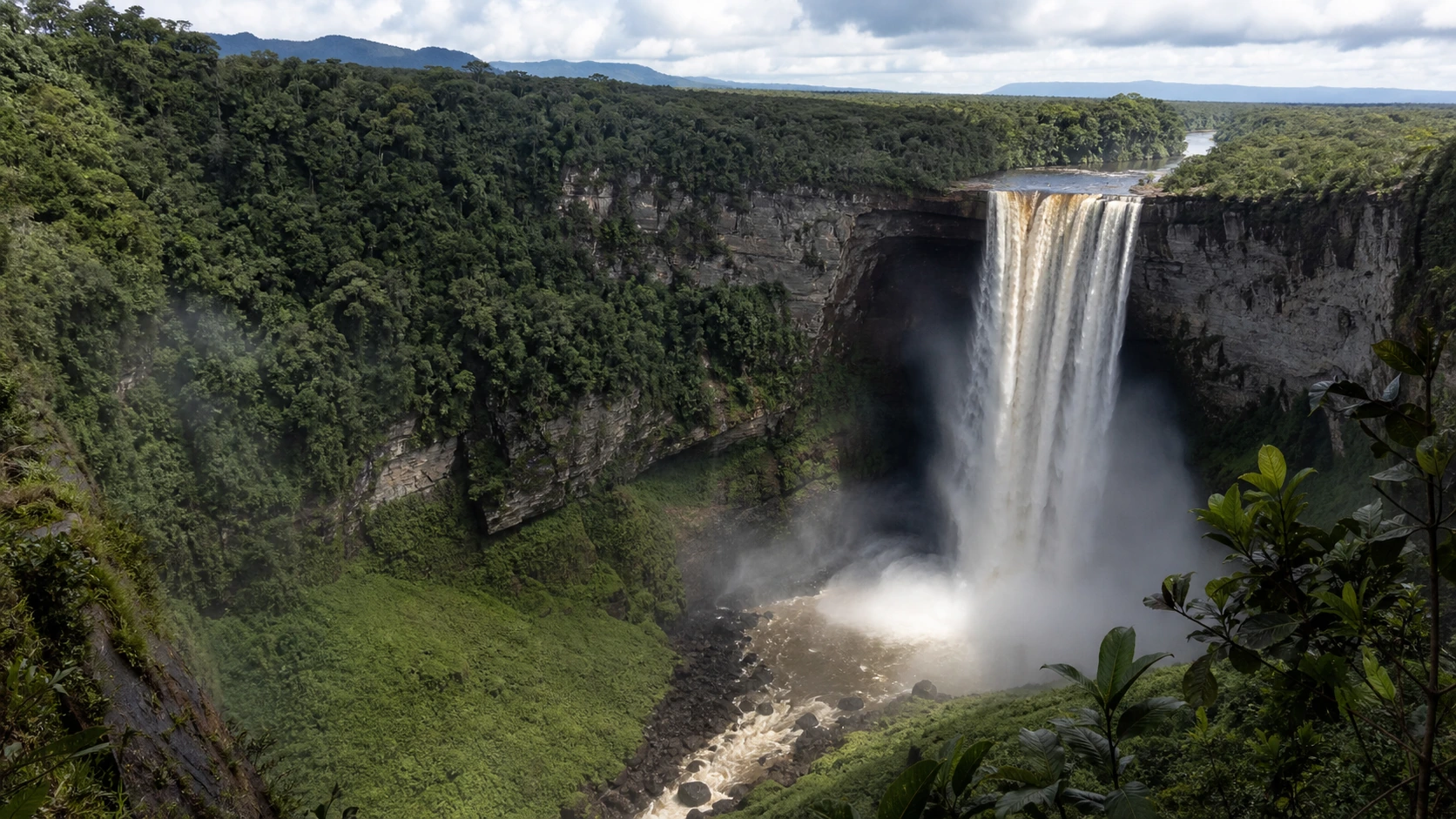
Yes — we offer a Guyana and Suriname add-on that departs from Port of Spain at the end of this expedition. See our Guianas expedition (The Forgotten Coast) for full details; combined pricing is available on request.

Expedition Investment

$5,995

USD per person, twin share

Fully inclusive of accommodation, all inter-island flights and ferries, expert guides, ground transport, and listed meals

Excludes international flights, travel insurance, and meals not listed. Single supplement $695. Small group supplement $450 for groups of 2 or fewer. Combined Caribbean Arc + Guianas pricing available on request

Reserve Your Spot
A Note on Timing & Logistics

The Eastern Caribbean is stable and welcoming; the real work of this expedition is logistical — nine islands, eight inter-island flights, and two ferries across thirteen days, all booked, scheduled, and managed by us with an expert local guide on each island. We run the itinerary only in the December–May dry season and never during the July–October peak of hurricane season. The Boiling Lake hike on Dominica is demanding and entirely optional, with excellent gentler alternatives. We're glad to discuss fitness, timing, and the Guianas extension directly.