Day 1
Arrive Cairo
Meet & assist inside Cairo International, then the private transfer to your 4–5★ hotel in Cairo. The evening is yours to land softly: the oldest country on Earth begins in the morning.
Waypoint Journeys Presents
Totality on the Nile · Cairo, Luxor & Aswan
10 Days · July 30 – August 8, 2027
Six Minutes of Darkness Over Luxor: The Century’s Longest Land-Based Totality
We reply within 24 hours
On August 2, 2027, the Moon’s shadow will cross Upper Egypt with more than six minutes of totality, the longest total solar eclipse over land this century. Nowhere on the entire path does it fall on ground like this: the shadow runs almost directly over Luxor, ancient Thebes, where Egyptians were charting the sun’s behaviour five thousand years before anyone called it astronomy. The sun-priests of Amun-Ra never saw a show like the one their sky is about to put on.
This expedition wraps the eclipse in the full sweep of the Nile: Giza and the Grand Egyptian Museum before the drive south up the Nile Valley; Karnak’s forest of columns on arrival; a dedicated eclipse day at a hand-scouted site with hours of setup time; then the Valley of the Kings and Luxor Temple in evening light, the painted ceilings of Dendera and the sublime reliefs of Abydos (the two great temples most itineraries skip) before the road south through Edfu and Kom Ombo to Aswan, Philae, a Nubian village, and dawn at Abu Simbel.
It runs as a fixed departure, July 30 to August 8, in groups of at most ten guests, with a professional Egyptologist throughout and every entrance (Abu Simbel included) plus bottled water on touring days. One departure, on a date that cannot move; this is the trip to book early, not eventually.
"Totality is the only sight that makes the Pyramids the second-most extraordinary thing you saw that week."

The eclipse of August 2, 2027 delivers over six minutes of darkness near Luxor, the longest land totality of the 21st century, more than double a typical eclipse. We position you at a hand-scouted site with clear horizons, on location hours before first contact and staying through last: no rushing, no compromises.
A 2+ hour setup window for tripods, rigs and solar filters, vehicle power in the field, and the evening after totality deliberately left free. Whether you shoot the corona or simply stand in the shadow, the day is engineered around one thing happening perfectly.
The Great Pyramids and the Sphinx with time at the panorama viewpoints, then the Grand Egyptian Museum, the largest archaeological museum on Earth and home of the complete Tutankhamun collection, finally displayed as one.
Karnak’s 134-column hypostyle hall on the afternoon you arrive, then the west bank: the Valley of the Kings, Hatshepsut’s terraces rising out of the Theban cliffs, and the Colossi of Memnon in morning light, and Luxor Temple as the stone turns gold.
The two masterpieces most Egypt itineraries never reach: Dendera’s astronomical ceiling still carrying its original colour (a map of the very sky you’ll watch go dark) and Abydos, where the reliefs of Seti I are the finest carving in all of Egypt.
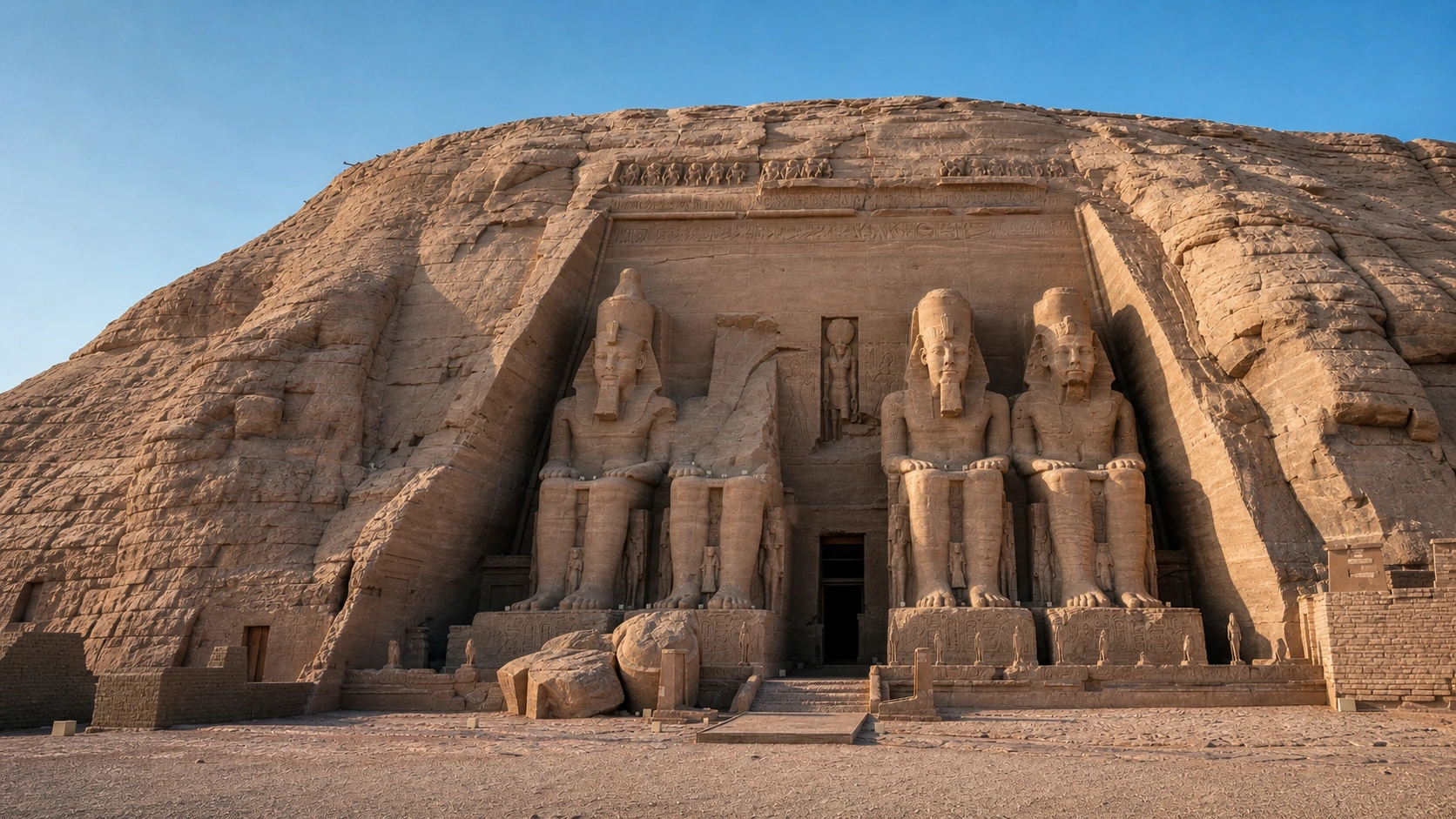
South along the Nile through Edfu and Kom Ombo to Aswan: the island temple of Philae by boat, tea in a painted Nubian village, a felucca under sail at sunset, and the pre-dawn run to Ramses II’s rock-cut colossi at Abu Simbel, included, not optional.
Ten days, Cairo to Abu Simbel, with the century’s longest land totality at the centre of it.
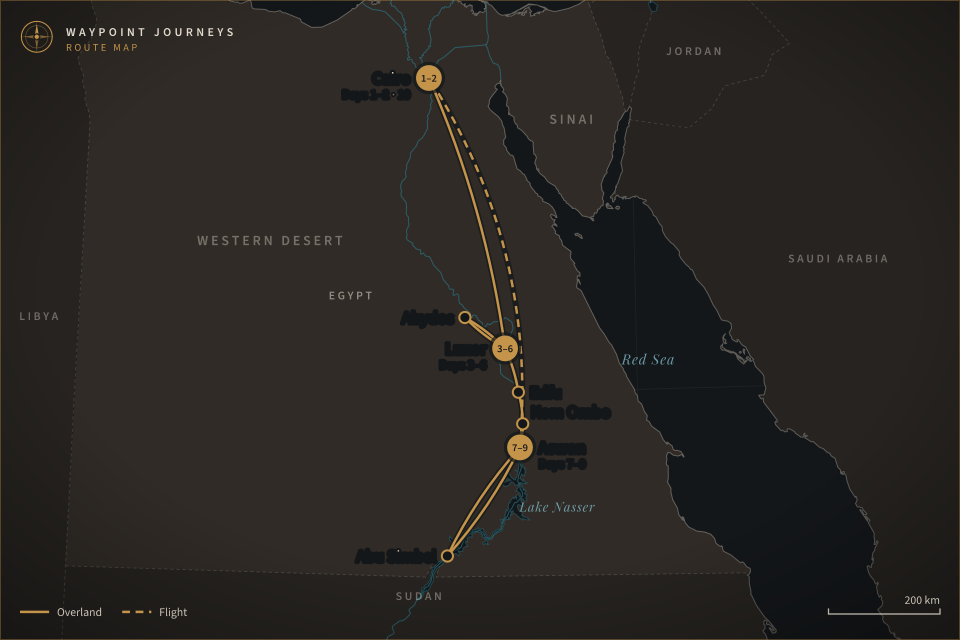
Cairo, Luxor and Aswan
Two nights in Cairo, the drive south to four nights in Luxor for the eclipse with a day north to Dendera and Abydos, then Edfu and Kom Ombo to Aswan, Abu Simbel, and the flight home.
Meet & assist inside Cairo International, then the private transfer to your 4–5★ hotel in Cairo. The evening is yours to land softly: the oldest country on Earth begins in the morning.

The Great Pyramids in morning light with unhurried time at the panorama viewpoint, then face to face with the Sphinx. After a break for lunch at your own expense, the Grand Egyptian Museum: Tutankhamun’s complete treasures under one roof at last, with your Egyptologist to cut the collection down to its stories.

An early start and the road south: some 650 kilometres up the Nile Valley from Cairo to Luxor, ancient Thebes, with the river, the cane fields and the desert edge alongside you the whole way, a private air-conditioned vehicle, and stops where you want them rather than where an airline schedule puts them. Into Luxor in the afternoon to drop your bags at your apartment-style hotel, your base for the next four nights, then Karnak’s great hypostyle hall (134 columns of carved sandstone, the largest religious building of the ancient world) in the last and best of the light.

Early departure to a hand-scouted viewing site near Luxor, chosen for clear horizons and reliable access. Hours on location before first contact to settle in and set up; then the whole event, first contact to last, with more than six minutes of totality at the centre, day becoming night over the Nile Valley. An unhurried return, and an evening deliberately kept free to let it sink in.

Across the river with the morning light: the Valley of the Kings and a carefully chosen set of painted tombs, the great terraces of Queen Hatshepsut’s temple against the Theban cliffs, and the Colossi of Memnon standing watch over the floodplain. A break for lunch at your own expense and an afternoon at leisure, then back to the east bank for Luxor Temple as the light goes gold and the crowds go home, the colonnade of Amenhotep III standing under the same sky that went out over it the day before.

North to the two great temples day-trippers miss. Dendera’s astronomical ceiling still carries its original blues and golds (a chart of the heavens two days after you watched them go out) and at Abydos the reliefs of Seti I are, simply, the finest carving in Egypt. Rarely crowded, endlessly photographable.

The classic river road south. At Edfu, the Temple of Horus is the most complete in Egypt (roof still on, darkness still in the sanctuary) and at Kom Ombo the double temple to Sobek and Horus sits directly above a bend in the Nile. Into Aswan, Egypt’s gentlest city, by evening, and into your 4–5★ hotel for the final three nights.

By boat to Philae, the temple of Isis rebuilt stone by stone on its island. Then upriver to a painted Nubian village for tea and colour, and a traditional felucca ride under sail as the sun drops behind the west-bank dunes; the Nile exactly as it has looked for five thousand years.

The early run south to Abu Simbel, where Ramses II’s four colossi have guarded the Nubian frontier for 3,200 years, included, and worth every pre-dawn minute. A break for lunch at your own expense after the visit, then back north to Aswan with the afternoon and evening free: the granite islands, the last of the light on the cataract, and no airport to make. Most itineraries fly you out exhausted the same day; this one gives Abu Simbel a night to settle.

Breakfast, the transfer to Aswan airport, and the flight north to Cairo to meet your international departure.
FREQUENTLY ASKED QUESTIONS
Expedition Investment
per person, twin share
$2,855USD per person: if you book your own accommodation and flights
Fully Inclusive
Payment: this departure is payable in full at the time of booking. There is no deposit option and no staged balance. Once paid, all payments are non-refundable, whatever the reason for cancellation; the eclipse date cannot move and the seats, the flight and the eclipse-day ground are secured against it. Please arrange cancellation insurance before you pay.
Excludes international flights, Egypt visa (on arrival or e-Visa for most nationalities), travel insurance, lunches and dinners, and photography passes at select sites. Single supplement $1,535 USD. Fixed departure on a date that cannot move; new bookings join groups of at most ten guests
Reserve Your SpotEgypt’s tourist corridor (Cairo, Luxor, Aswan and the temple road between them) is among the most travelled and most protected ground in the region, and this expedition never leaves it. We run licensed guides and drivers, stays chosen as much for location as comfort, and the timing discipline August demands: early starts, air-conditioned transport, midday shade, water constantly in hand. Eclipse day runs on a scouted site with reliable access and a straightforward drive, not a desert gamble. As everywhere we operate, our team monitors conditions continuously and adjusts without drama; you travel with 24/7 support from booking to boarding.