Waypoint Journeys Presents
Aotearoa
New Zealand, North & South
12 Days
Boiling Earth to Blue Ice — the Whole Country, Top to Bottom
View Expedition Details ↓ Plan This Expedition →We reply within 24 hours
Two Islands, Every Landscape the Planet Owns
The Māori named it Aotearoa — the land of the long white cloud — and packed beneath that cloud is a continent's worth of geography wearing an island costume. Steam vents hiss through suburban Rotorua. Volcanoes stand in tidy rows across the middle of the North Island. The sea has carved cathedrals into the Coromandel, glaciers pour almost to rainforest on the West Coast, and between the two islands the Marlborough Sounds fold the ocean into green corridors that a ferry threads like a needle.
This is the classic top-to-bottom traverse, done properly: Auckland to Christchurch through everything that made New Zealand famous. You kayak to coves on the Coromandel, eat from a Māori hāngī as the geysers throw steam at the stars, cross Tongariro's volcanic saddle between the Emerald Lakes, ride the Interislander through the Sounds, paddle Abel Tasman's golden coastline, and finish under the blue ice of Franz Josef.
We run it social, adventure-lodge style — characterful backpacker lodges in the best locations, multi-share rooms, fellow travellers from everywhere — because that is how this country's great circuit is best travelled: lightly, sociably, and with the budget saved for the mountains rather than the minibar. Twelve days, both islands, every legend of the Kiwi road.
"Nowhere else fits volcanoes, glaciers, fjords and a Polynesian heart into two islands — and then builds a trail through all of it."

Geysers, a Volcanic Crossing, a Ferry Through Drowned Valleys, and a Glacier in a Rainforest
The earth's crust runs thin at Rotorua — geysers on schedule, mud pools muttering, the Champagne Pool steaming orange and jade. The evening belongs to the culture that has lived on this heat for centuries: a marae welcome, haka and waiata, and a hāngī feast lifted from the ground where volcanic steam has done the cooking.
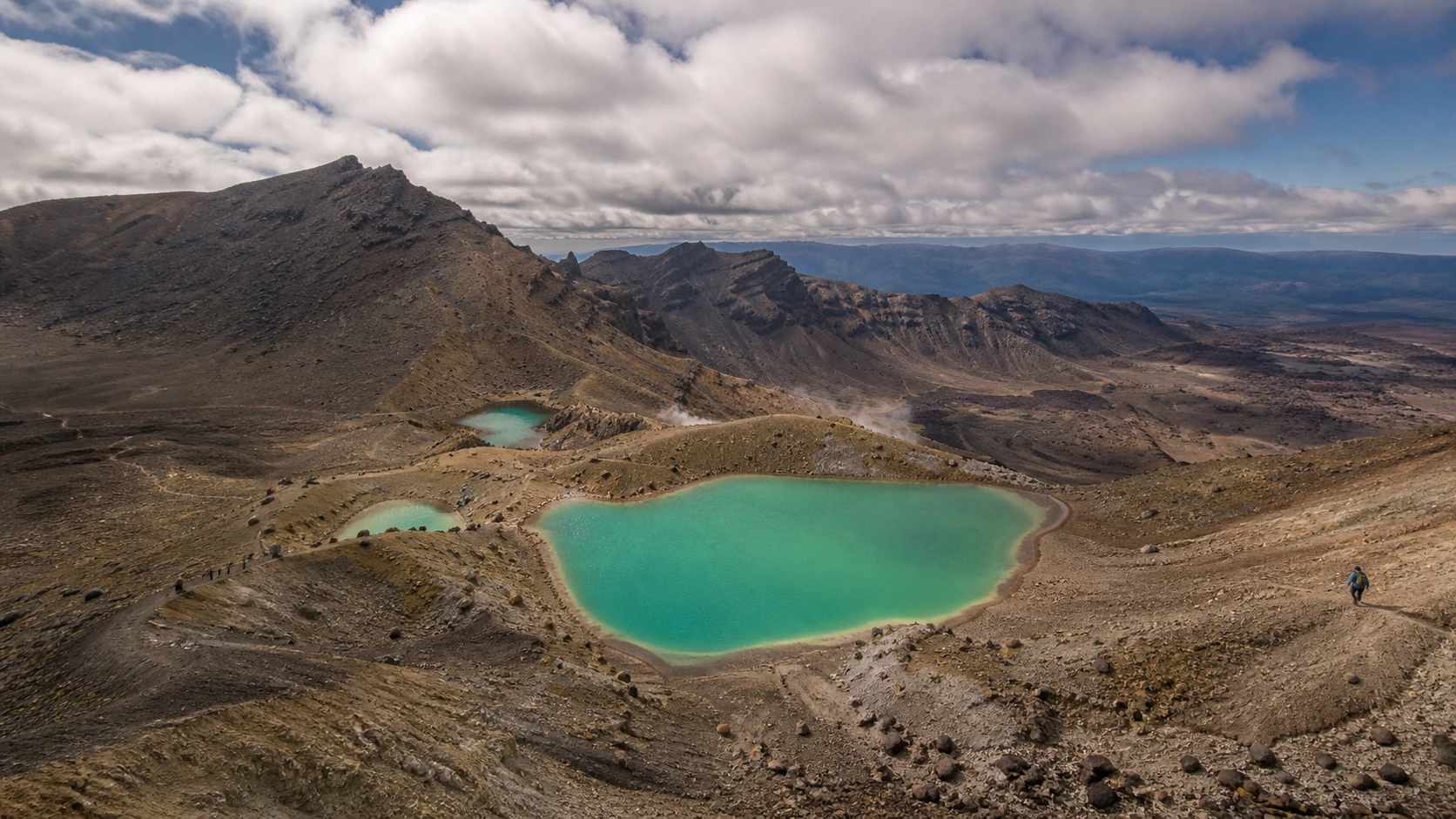
Routinely ranked the finest one-day walk on Earth: nineteen kilometres over a live volcanic saddle, past the red crater and the impossibly turquoise Emerald Lakes, with Ngāuruhoe — cinema's Mount Doom — standing guard. A real mountain day, guided, weather-managed, and remembered forever.
One of the world's great ferry rides: three hours from Wellington across the Cook Strait and into the Marlborough Sounds, where drowned valleys close around the ship and the deck rail becomes the country's best viewpoint. Arriving in the South Island by sea is the only correct way.
New Zealand's smallest national park is its most golden: beaches the colour of honey, granite headlands, seals hauled out on the islets, and water clear enough to count the rays. You take it the right way — by sea kayak along the coast, on foot over the headland track, and home by water taxi.
On the wild West Coast, a river of blue ice pours from the Southern Alps to within a few hundred metres of temperate rainforest — one of the very few places on Earth where ferns and glaciers share a postcode. Walk the valley to the face, or trade up to the heli-hike for crampons on the ice itself.
This expedition runs adventure-lodge style: characterful backpacker lodges in the best corners of each town, communal kitchens and firepits, and a busload of the world for company. It is the classic way the great New Zealand circuit has always been travelled — light, funny, and full of people you will know for years.
The Expedition
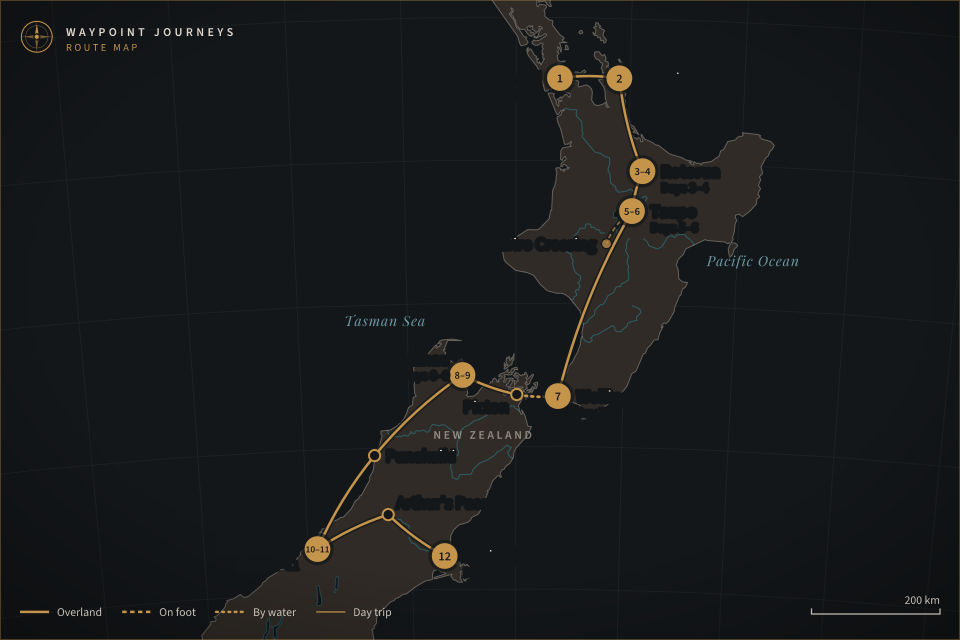
Twelve days down the spine of both islands, Auckland to Christchurch — geothermal country, a volcanic crossing, the Sounds by ferry, golden bays and glacier country.
Land in Auckland, where two harbours squeeze the city to an isthmus and half the households seem to own a boat. Meet your expedition leader and crew this evening for the welcome briefing, then a first taste of the country's food-and-craft-beer renaissance on the Viaduct or up Karangahape Road. Early arrivals can climb a volcano before dinner — Mount Eden's crater rim is twenty minutes from downtown, which is a very New Zealand sentence.
East to the Coromandel Peninsula, where pōhutukawa trees leans over green coves. The afternoon earns the postcard: the walk (or optional kayak) to Cathedral Cove, a marble-white sea arch cut clean through a headland. Then the peninsula's best trick — Hot Water Beach, where you dig your own spa pool in the sand as the tide drops, thermal water rising through your toes while the Pacific rolls in cold two metres away. Night in Hahei, salt in hair, sand in everything.
South through farm country that smells increasingly of sulphur — Rotorua announces itself by nose. The afternoon walks a full geothermal park: geysers running on their own schedule, mud pools blooping like slow porridge, silica terraces, and the Champagne Pool ringed in fluorescent orange. Steam drifts across suburban streets and municipal parks here; the whole town lives on a thin lid over the planet's engine room. Evening free for the Polynesian-style lakeside spa or the mountain-bike forest.
A gentler Rotorua day: the Redwoods of Whakarewarewa on foot or treetop walkway, the green and blue lakes, and optional add-ons for the adrenaline-inclined (zorbing was invented here, and the town has never calmed down since). The evening is the North Island's cultural centrepiece — a pōwhiri welcome onto a marae, haka and song, and a hāngī feast steamed underground in the traditional way, eaten long and happily. You will hum the harmonies for days.
A short hop to Taupo via the Huka Falls, where the Waikato River — New Zealand's mightiest — is squeezed through a slot and comes out the other side the colour of glacier mints. The lake beyond is the caldera of one of Earth's great supervolcanoes, now behaving itself beautifully under trout and sailboats. The afternoon is for lake swimming, the Māori rock carvings by kayak, or nothing at all; the evening is for early bed, because tomorrow the mountain calls at dawn.
The day the whole trip bends around. Nineteen kilometres over the saddle of a live volcanic massif: up the Devil's Staircase, across the lunar South Crater, along the rim of the Red Crater's rust-and-black gash, then down past the Emerald Lakes — three impossible turquoise eyes in the volcanic grit — with Ngāuruhoe's perfect cone (Mount Doom, to a certain generation) standing over everything. Guided, weather-checked, transfers handled, legs jelly, grin permanent. Gentler lake-country alternatives run for anyone sitting the mountain out.
Down the island to Wellington, the little capital folded into hills around a harbour, with more cafés, craft bars and film-industry wizardry per head than anywhere in the hemisphere. The afternoon is yours for Te Papa — the national museum, and one of the world's best — the cable car, Cuba Street's happy weirdness, or the Weta Workshop tour. Dinner and a last North Island pint somewhere snug; the ferry sails in the morning.
Sail the Cook Strait on one of the world's great ferry crossings: open water giving way to the Marlborough Sounds, where the ship threads drowned valleys with bush to the waterline for the last hour into Picton. Then west through Havelock (green-lipped mussels, if you're brave at lunch) and the hop country of Nelson to Marahau, the gateway village of Abel Tasman National Park. The sea outside your lodge is tomorrow's highway.
A full day in the golden park. Morning by sea kayak along granite headlands and honey-coloured beaches — fur seals on the islets, rays under the hulls, tea on a beach with no footprints — then boots on for a stretch of the coastal track, all mossy switchbacks and lookouts over water that refuses to be photographed accurately. A water taxi skims you home along the whole glorious coastline. This is the South Island's gentlest perfect day, deliberately placed before its wildest ones.
The wild side. Down the West Coast — a 600-kilometre strip of rainforest, surf and stubborn little towns — pausing at Punakaiki, where the Pancake Rocks stack the shoreline like burnt crêpes and blowholes detonate with the swell. The Tasman Sea keeps you company on the right, the Southern Alps rise on the left, and by evening you are in Franz Josef village with a glacier hanging in the valley above the pub.
Morning with the glacier: the valley walk to the viewing point, where Kā Roimata o Hine Hukatere — the tears of the avalanche girl, as Māori tradition names the ice — pours off the Alps into rainforest. Upgrades available for the heli-hike (crampons, blue caves, and the best money you'll spend all trip) or a scenic flight over the névé. The afternoon soaks it off in the glacier hot pools, rain forest overhead, sandflies plotting outside. Final night on the wild coast.
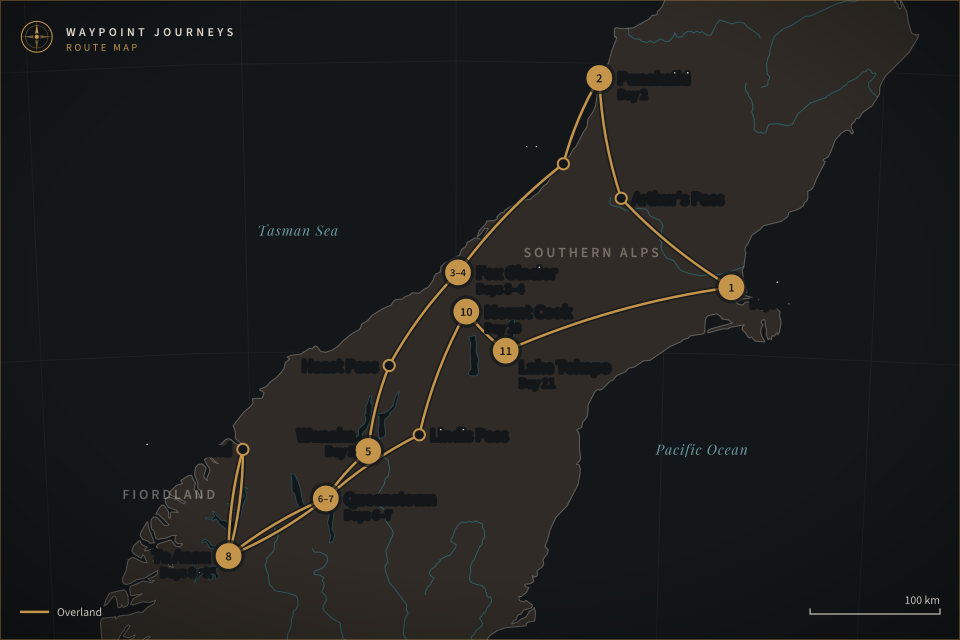
One last mountain flourish: over Arthur's Pass, the high road through the Southern Alps, kea (the world's only alpine parrot, and its most criminal) inspecting the car park, waterfalls stitching the walls. Down onto the Canterbury Plains and into Christchurch by mid-afternoon for onward flights — or, far better, for our South Island expedition, which begins where this one ends and goes deeper: Milford Sound, Aoraki/Mount Cook and the deep south await.
What's Included
FREQUENTLY ASKED QUESTIONS
Common Questions About This Expedition
Expedition Investment
per person
Fully inclusive of eleven nights' adventure-lodge accommodation, private vehicle for the complete Auckland–Christchurch traverse, the Interislander ferry, the guided Tongariro Alpine Crossing, the Abel Tasman kayak day with water taxi, the Rotorua geothermal park and marae hāngī evening, Franz Josef valley walk, daily breakfast, and your expedition leader throughout
Excludes international flights, travel insurance, most lunches and dinners, optional add-ons (heli-hike, bungy, skydive), and tips. Private-room upgrade on request. Pairs perfectly with our South Island expedition, which starts where this ends
Reserve Your SpotNew Zealand is about as safe as travel gets — the risks worth respecting all come from the landscape, not the people. Alpine weather is the serious one: the Tongariro Crossing and the passes get real wind, cold and cloud in any month, so we run them with licensed guides, hard go/no-go calls, and required layers (a proper rain shell is non-negotiable kit). The sun burns faster here than almost anywhere — the ozone is thin and SPF50 is a daily food group. Water is drinkable, roads are excellent if winding, sandflies on the West Coast are a form of local taxation, and the kea will steal anything not bolted down. Come with layers and leave with legends.