Waypoint Journeys Presents
The Last Atolls
A Central Pacific Island Expedition
15 Days
The Most Remote Countries on Earth, Connected by One Historic Flight
We reply within 24 hours
Five of the Least-Visited Nations on Earth
Tuvalu, Kiribati, Nauru, the Marshall Islands, and the Federated States of Micronesia share the distinction of being among the least-visited countries on Earth — not because they are difficult or dangerous, but because reaching them requires deliberate effort: a chain of small regional carriers, infrequent connections, and a willingness to treat the journey as part of the expedition.
The reward is a world most travellers do not know exists: atolls so flat that the highest point is a coconut palm, colonial histories that left remarkably little trace, and communities where the ocean is not a view but the entire context of existence. The pace of life is genuinely unhurried, and the population knows one another by name.
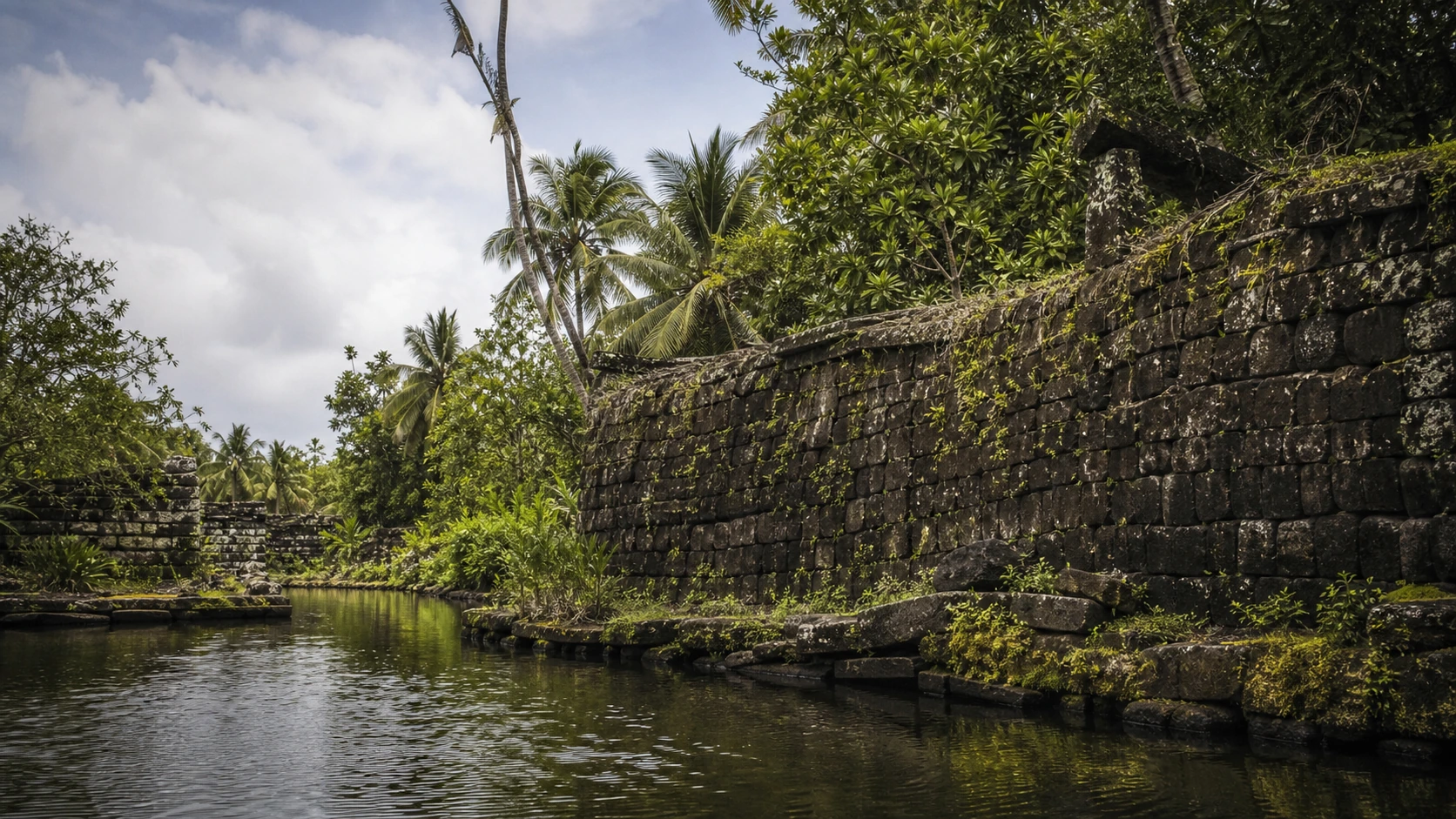
And at the end of it, the most mysterious archaeological site in the Pacific — Nan Madol, a city of ninety-two artificial islands built from basalt logs in the open lagoon off Pohnpei, begun around 1200 AD, the purpose of which remains only partly understood. The expedition is structured around the United Airlines Island Hopper, one of the most unusual scheduled flights on Earth.
"Atolls so flat that the highest point is a coconut palm, where the ocean is not a view but the entire context of existence."

A World Most Travellers Never Reach
Ninety-two artificial islands built from stacked basalt prisms — some weighing fifty tonnes — in the tidal lagoon off Pohnpei. The ritual capital of the Saudeleur dynasty from around 1200 AD, engineered beyond what the historical record explains. A UNESCO site, approached by boat at dawn.
A single Boeing 737 running between Honolulu and Guam, stopping at remote coral airstrips across a sixteen-hour day. Crossing the Date Line and the equator in one flight, it has run in some form since 1968 — one of the most unusual scheduled services in commercial aviation.
Nine atolls, around 11,000 people, and the lowest average elevation of any country on Earth. Funafuti's runway — built by US engineers in 1943 — doubles as the main road. Extraordinarily clear lagoon snorkelling over untouched coral.
The Battle of Tarawa (1943) lasted 76 hours on an atoll six kilometres long. The Red Beach and Betio memorial sites hold tank hulks, gun emplacements, and bunkers still in place — among the most complete WWII battlefield landscapes left in the Pacific.
The world's smallest island nation, once briefly among the richest per capita from phosphate. The mined-out interior — 'Topside' — is a moonscape of coral pinnacles, the most complete industrial ruin visible from the air in the Pacific, ringed by an intact reef.
The Marshallese hold one of the oldest traditions of ocean navigation on Earth: stick charts made from palm fronds and shells, mapping ocean swells, used to cross thousands of kilometres without instruments. The Alele Museum in Majuro holds the finest collection in the world.
The Expedition
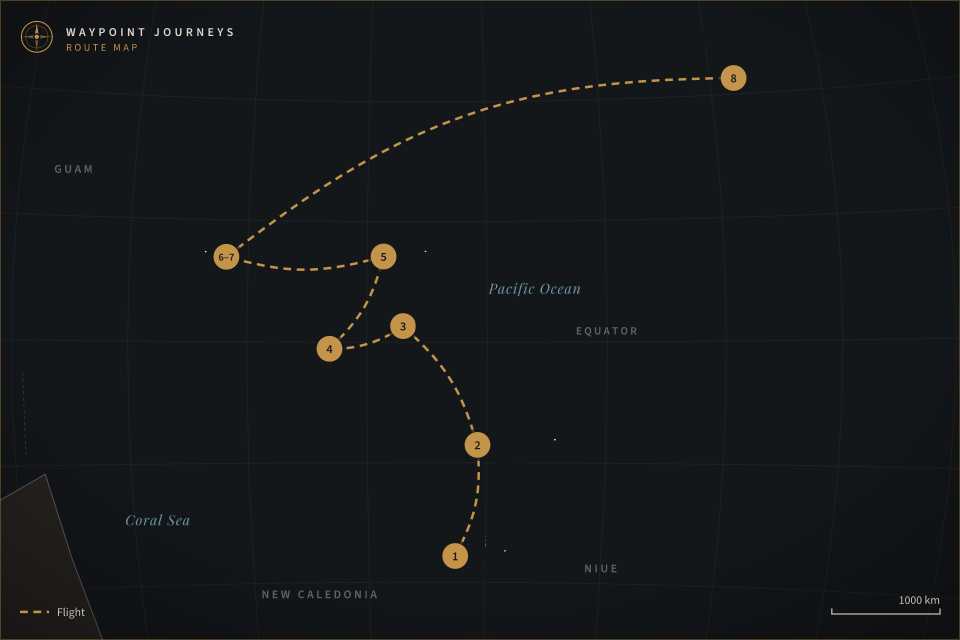
Fifteen days, east to west across the central Pacific — built around confirmed Island Hopper and Nauru Airlines departures.
The journey begins in Nadi or Suva, Fiji — the central Pacific's main aviation hub — with an overnight covering the connection to Funafuti. Fiji Airways flies the route three times weekly. Funafuti's approach is one of aviation's most intimate arrivals: a strip of land so narrow you can see the ocean on both sides at once, the runway doubling as the main road when no aircraft are due.
Tuvalu is nine atolls and the lowest average elevation of any nation on Earth. Funafuti was a major Allied air base in WWII — bunkers and ammunition dumps now reclaimed by vegetation. The draws are elemental: an extraordinarily clear lagoon with some of the best snorkelling in the Pacific, the western-reef Conservation Area, and the simple fact of being in one of the most remote capitals in the world, where a Climate Change Commission negotiates the island's very survival as seas rise.
South Tarawa holds around 60,000 people on a strip of land that makes Manhattan look spacious. Its other identity is one of the Pacific's most significant war battlefields: the Battle of Tarawa (1943) lasted 76 hours. The Red Beach and Betio sites still hold tank hulks, gun emplacements, and bunkers. Beyond the battlefield, the I-Kiribati culture — maneaba meeting houses, traditional canoes, a calendar of communal life centred on the lagoon — is distinct from anything else in the Pacific.
The world's smallest island nation — a raised coral island eight kilometres across with a story unlike anything else in the Pacific. Phosphate from millions of years of seabird guano made Nauru briefly one of the richest countries per capita; the wealth was largely lost in failed ventures, and the phosphate has nearly run out. The interior, 'Topside', is a moonscape of mined-out coral pinnacles. The coast has recovered more gracefully — intact reef, calm western lagoon, and accessible Japanese WWII relics on the high ridge.
The flight from Nauru crosses 1,400 kilometres of open Pacific to Majuro — a longer, more relaxed, genuinely tropical atoll whose rim runs nearly 100 kilometres. The Marshallese hold one of the world's oldest navigation traditions; the Alele Museum holds the finest collection of stick charts on Earth. The islands' other defining context is nuclear: Bikini Atoll was the site of 23 weapons tests between 1946 and 1958, including the first hydrogen bomb. The peace memorial in Majuro addresses it plainly.
United Flight UA154 departs Majuro mid-morning and arrives in Pohnpei early afternoon, crossing the Date Line and the equator in a single flight. The Island Hopper has run since 1968, when Air Micronesia launched it with a 727 on coral runways coated in Teflon. Today's 737 carries island families with taped-up cargo, medical supplies, and a few travellers who ride the whole sixteen-hour run for the experience. An onboard mechanic steps off at every stop to inspect the aircraft.
Pohnpei is among the wettest islands in the Pacific — up to 10 metres of rain a year in its mountainous interior of largely unexplored rainforest. This is where the freshest sashimi in the western Pacific is landed, and where sakau — the Pohnpeian preparation of kava — is consumed in the nahs with a formality the phrase 'social lubricant' does not capture. And Nan Madol: ninety-two artificial islands of stacked basalt in the tidal lagoon, the ritual centre of the Saudeleur dynasty, approached by boat through the canals at dawn before the heat builds. UNESCO-listed in 2016, much of it still unexcavated.
The Island Hopper continues westbound to Chuuk and Guam, but the expedition turns east: a connecting flight from Pohnpei to Honolulu via Guam, or direct if scheduling allows. Honolulu serves as the arrival point for onward international departures. For those with time in Hawaii, the contrast between a 10,000-person Pacific microstate and Waikiki Beach is as complete as any in the world.
What's Included
FREQUENTLY ASKED QUESTIONS
Common Questions About This Expedition
Expedition Investment
per person, twin share — excludes international and inter-island flights
Fully inclusive of accommodation, guides, ground and boat transport, entry permits, and listed meals
Excludes international flights to Fiji and from Honolulu, inter-island flights within the itinerary, travel insurance, and meals not listed. Single supplement $520 USD. Small group supplement $380 USD for groups of 2 or fewer
Reserve Your SpotThis expedition lives or dies on flight planning. The central Pacific's regional carriers operate infrequently — often twice weekly per sector — so we build the entire itinerary backward from confirmed Island Hopper and Nauru Airlines departures, hold every seat, and manage all connections, entry permits, and on-ground logistics for you. The nations are safe and welcoming; the challenge is purely one of scheduling, which is exactly what we handle. We recommend the October–April dry window to minimise weather disruption.