Skip to content

Waypoint Journeys Presents

Chongqing

The Vertical City

10 Days

Six locked rooftops, a blue-hour photo production, a Cold War reactor inside a mountain, and the karst country the city was carved from.

10 DaysFrom $4,450 USDMax 5 guests

We reply within 24 hours

A City Built On Top Of Itself

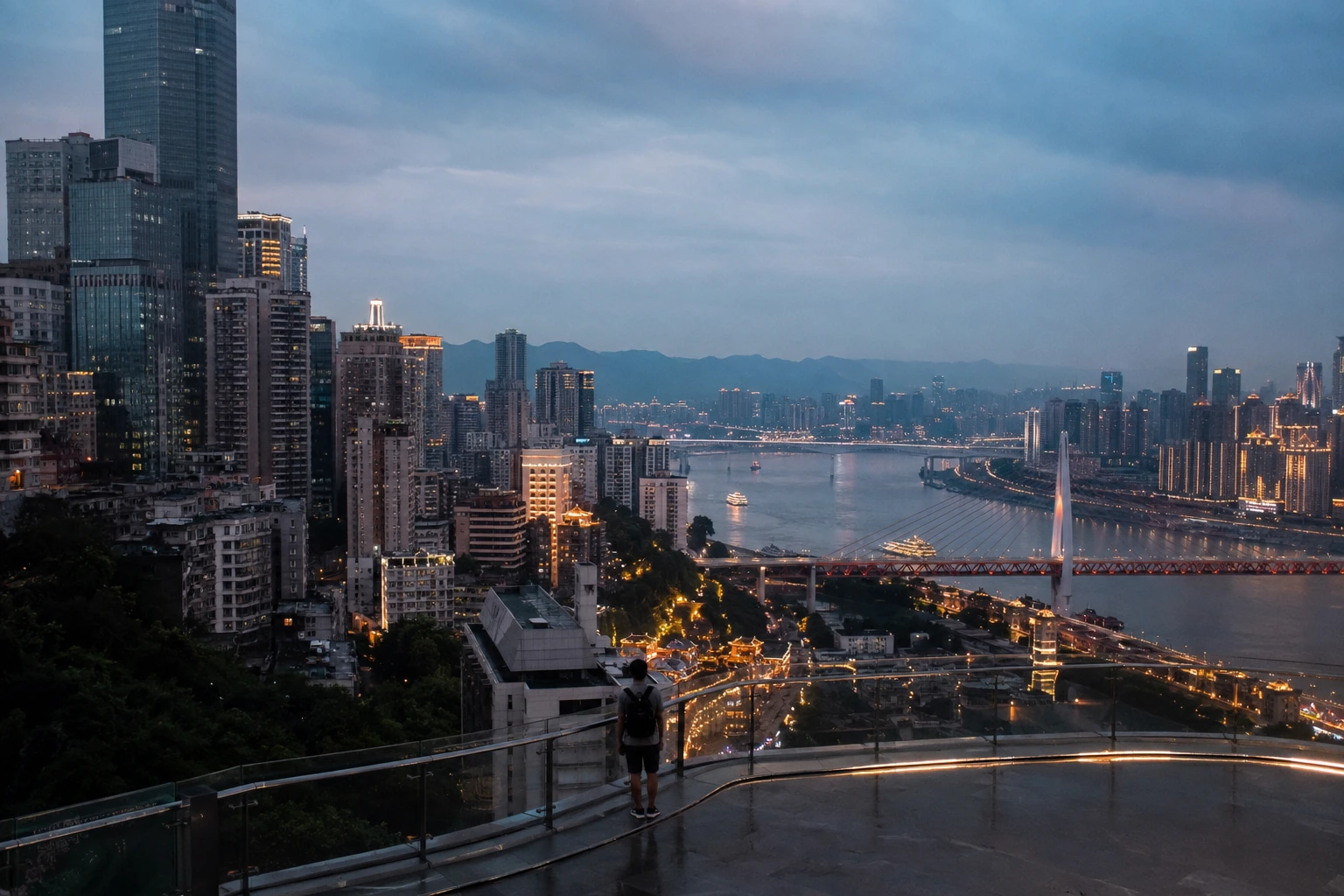
Chongqing is the only city on earth where a building can have a ground floor on the first storey and another on the twenty-second. Thirty-two million people live stacked on a peninsula between two rivers, on ground so steep that escalators do the work of streets, a monorail threads through an apartment block, and the address on your door tells a taxi driver almost nothing.

The result photographs like science fiction and works like a small town. Its famous skyline is best seen from roofs that are not open to the public, service lifts, locked doors, a building manager who has to be asked. That is the half of this expedition that cannot be improvised, and it is the half we do for you.

The other half leaves the city entirely. A plutonium reactor hollowed into a mountain and abandoned unfinished. Three limestone arches standing over a collapsed cave floor. Fifty thousand figures carved into cliffs eight hundred years ago. A canyon you walk up rather than along, and the cave system they call Journey to the Centre of the Earth. Chongqing without them is a light show; with them it is a place.

"You do not get above this city by accident. Someone has to open the door for you."
Hongyadong's stilted riverfront buildings beneath Chongqing's modern towers
Hongyadong below the towers of Yuzhong: the vertical city in a single frame

Why Chongqing

Six Locked Rooftops

Three Secret Rooftops, Yalan Mansion, Urban Sky Canvas and the 29th floor of Pride of Times, working buildings with locked roof doors, each arranged with the management before you arrive.

A Blue-Hour Production

Three hours with a working photographer, timed from blue hour into full dark across four to six locations. Ten finished, colour-graded frames plus every original file: not a walk with a camera.

The 816 Nuclear Cavern

A plutonium reactor hollowed into a mountain by soldiers from 1967, abandoned unfinished, declassified only in 2002. A hundred thousand square metres of hand-cut chamber, and almost unknown outside China.

Wulong's Three Arches

Tianlong, Qinglong and Heilong: three limestone natural bridges standing in sequence over a collapsed cave floor, with a Tang-dynasty post-station on the sinkhole floor for scale.

The Dazu Grottoes

Fifty thousand figures cut into cliff faces between the ninth and thirteenth centuries. Baodingshan's seventy-year narrative programme and Beishan's quieter gallery, read by a guide who knows them.

A Canyon and a Cave

Three hours upstream through the cold water of Jindao Canyon, and a full day in the Tianyan chambers below a collapsed doline. Both with a costed alternative if the weather or the legs say no.

The Expedition

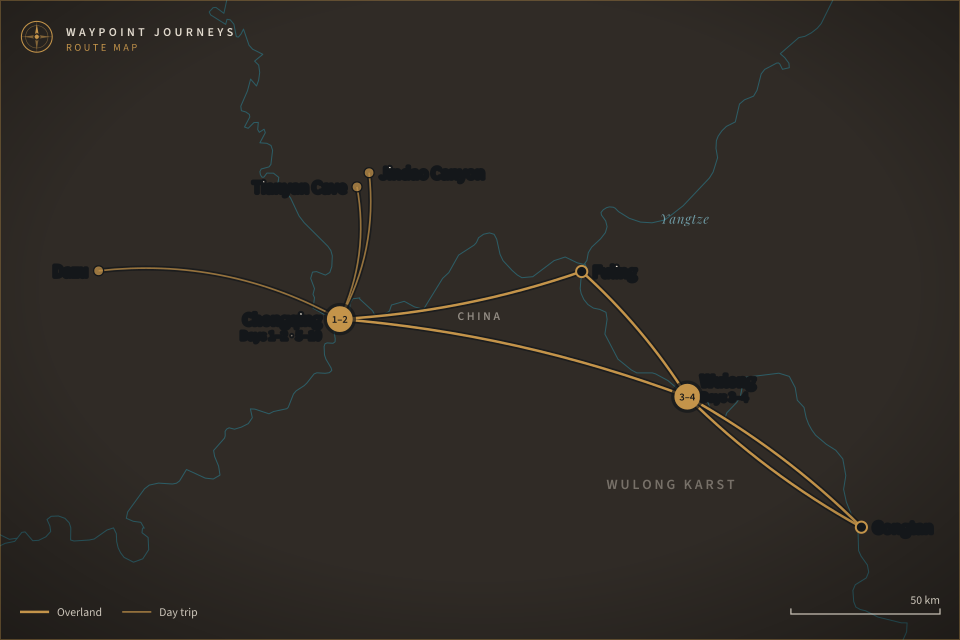
Two days on the roofs, four in the country the city was carved from, and four back inside it, at street level, underground, and in the water.

Day 1
Chongqing · arrival and the first rooftops

Met at Jiangbei and driven in over the viaducts that cross this city at roof height. The afternoon goes straight up: the three tiers of the classic peninsula view, Yalan Mansion's stepped terraces, the open deck at Urban Sky Canvas, and the 29th floor of Pride of Times timed for the moment the towers switch their façade lighting on. Hotpot afterwards, ordered the local way.

Day 2
Chongqing · the vertical city, shot at blue hour

The morning is the city at street level, where its logic finally shows: Shibati's eighteen stairs, the monorail running through the sixth floor at Liziba, Hongyadong's stacked stilt façade, and a shopping complex with no honest ground floor. From late afternoon a working photographer takes over for three hours, blue hour into full dark, then a night motorbike run through the tunnels and neon with a second bike filming.

Day 3
Fuling & Wulong · the 816 cavern and the karst arches

East along the Yangtze to the 816 Underground Nuclear Project: a plutonium reactor hollowed into a mountain by soldiers from 1967, abandoned unfinished in 1984, declassified in 2002, its reactor hall nine storeys tall. Then into karst country for the Three Natural Bridges: Tianlong, Qinglong and Heilong standing in sequence over a collapsed cave floor, reached by a glass lift down through the rock.

Day 4
Wulong · Fairy Mountain, the Flying Kiss and Gongtan

Gongtan's river mist lifts off the Wu at about seven and the town is briefly yours. Then the Wulong massif: Fairy Mountain's alpine meadow at 2,000 metres, and the Flying Kiss, two enormous cliff-edge figures that lift visitors out on rotating platforms over a hundred metres of open air, then turn to face each other. A serious drop and an entirely unserious idea. Watching from the terrace is respectable.

Day 5
Dazu · the cliff-carved grottoes

Ninety minutes west and a complete change of register. Seventy-five protected sites hold some fifty thousand statues cut into cliff faces between the ninth and thirteenth centuries, the last great flowering of Chinese rock sculpture. We take the two that matter: Baodingshan, composed as one continuous narrative over seventy years from 1174, and Beishan, older, quieter, and where the painted colour survives best.

Day 6
Beibei · Jindao Canyon, upstream

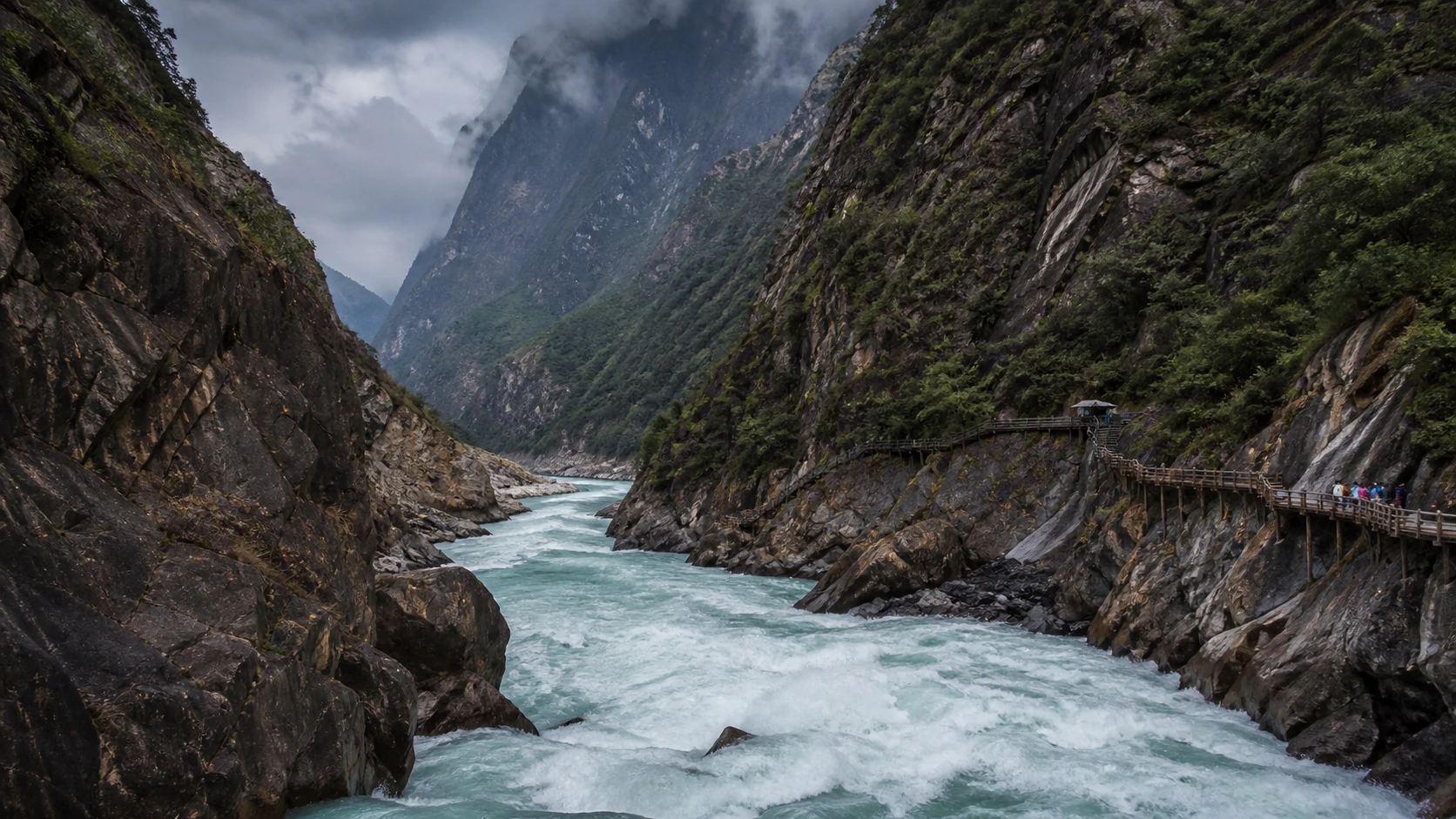
The one day that asks something physical. This is canyoning in the plain sense: you go up the watercourse, not along a path beside it: three hours through clear cold streams, between narrow walls, over boulders and under overhangs, with fixed lines on the harder steps. Water shoes and dry bags provided. Dry clothes, a long late lunch, and the hot springs Beibei is actually famous for on the way home.

Day 7
Tianyan · the cave below the doline

A full day underground in the system everyone here calls Journey to the Centre of the Earth, and for once the nickname earns it. You descend through a collapsed doline into chambers that stop conversation, flowstone curtains, a subterranean river, columns forty metres tall, and long stretches lit only by the lamp on your helmet. Boardwalks through the developed sections; the far chambers are dim, damp and properly wild.

Day 8
Chongqing · neighbourhoods, night market, unmarked doors

A day of the actual place. Stair-streets and cliff-side alleys, morning noodle counters, tea houses where the same eight men have played cards since 1990, and an outdoor lift that is technically public transport. Into the evening, the Guanyinqiao food circuit (xiaomian, maoxuewang, skewers, cold noodles) then an evening with a bar guide through the speakeasies behind laundries and above stairwells that are unfindable without an introduction.

Day 9
Nanshan · the mountain, the bathhouse, a last rooftop

Across the river and up the forested ridge the city looks at from the other side, the old temple road, and the two viewpoints from which the whole peninsula finally reads as a single object. In daylight, so you see the geography your rooftops were sitting inside. The afternoon is deliberately empty and spent in a proper multi-floor bathhouse. Then a last rooftop at dusk, your pick of the six.

Day 10
Chongqing · Chaotianmen and departure

A slow morning at the point of the peninsula where the clear green Jialing meets the brown Yangtze and the two run side by side, unmixed, for a good kilometre downstream; the reason the city is here at all. Then the transfer to Jiangbei, timed to your gate rather than the traffic report. A later flight buys you the Liziba platform, shot from the right side.

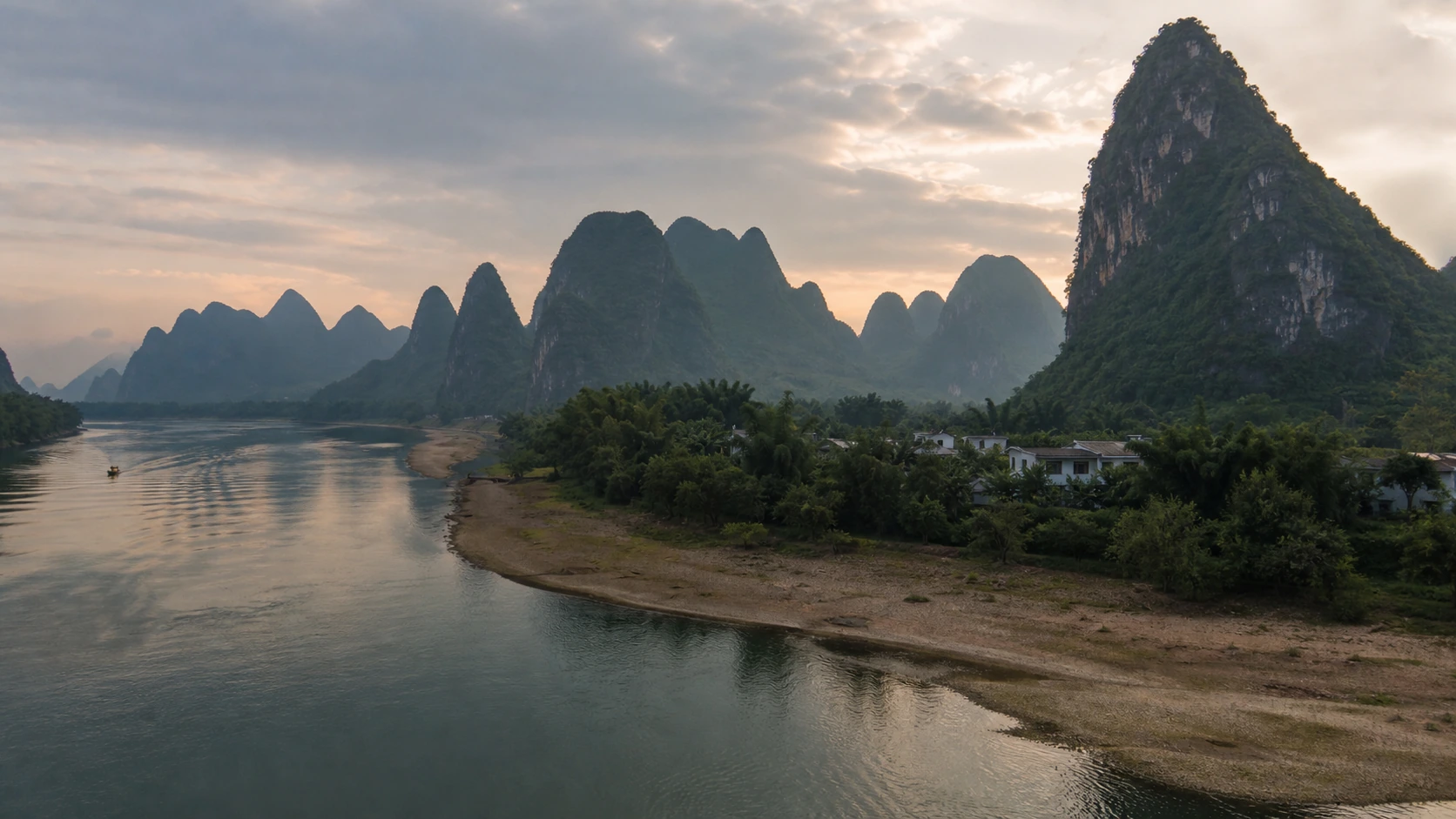
Gongtan Ancient Town climbing the wooded bank of the Wu River

Small Group Expedition

Five guests, six rooftops.
No one is standing outside a locked door.

What’s Included

Duration
10 days, 9 nights: Chongqing, Fuling, Wulong, Youyang, Dazu and Beibei
Group Size
Maximum 5 guests: intimate, unhurried, and personal. Rooftop access, the photo production and the motorbike night do not scale beyond that.
Accommodation
Two nights on a high floor in Jiangbei, one night in a riverside stilt house inside Gongtan Ancient Town, six nights in a panoramic river-view room above Jiefangbei.
Included Experiences
Six arranged rooftops, the photo production, the night motorbike run, 816, the Wulong Three Natural Bridges, Fairy Mountain, the Flying Kiss terrace, Gongtan, both Dazu sites, Jindao canyoning, Tianyan Cave, the Guanyinqiao food circuit, the bar-guide evening, Nanshan and the bathhouse.
Photography
Three hours with a working photographer, ten finished colour-graded frames and every original file, plus the edited motorbike film. Originals within two days, the finished set within ten.
Transport
Private vehicle and driver throughout, including every intercity leg, plus both airport transfers and a local eSIM installed before you land.
Guide
One English-speaking guide with you for all ten days, evenings included, not a different guide per activity.
Meals
Daily breakfast and all meals listed in the day-by-day, including the hotpot evening and the Guanyinqiao circuit.
Fitness
Moderate, with two optional hard days. A great many stairs; three hours upstream in cold water at Jindao; a long day of steps underground at Tianyan. Costed alternatives for both.
Not Included
International flights, China visa where required, travel insurance (must cover the canyoning and cave days), the Flying Kiss ride ticket, drinks and personal expenses, and gratuities.
Frequently Asked Questions

Before You Go

Chongqing does not do flat. Expect 8,000–15,000 steps on city days and a great many stairs, including service stairwells to the rooftops. Two days are active: three hours upstream in cold water at Jindao, and a long day of steps underground at Tianyan. Both have a full alternative already costed in (the Beibei hot springs and the Simian Mountain road) so opting out costs nothing and changes nothing else on the trip.
Yes. Chongqing's best vantage points are on working residential and office towers with locked roof doors, and every one on this itinerary is booked with the building's management before you land. Because management offices occasionally change their mind on the morning, we hold more permissions than the itinerary needs and swap without fuss. You will get six rooftops: not necessarily the same six, in the same order.
April, May, late September and October. Chongqing is famously hot and humid from June to August and famously foggy in mid-winter, which is atmospheric on a rooftop and useless in a canyon. October is the pick of them: clear enough for the long views, cool enough for Jindao, and Fairy Mountain still green. We run the expedition in the shoulder months and price it there.
China's visa-free transit provisions cover a great many nationalities for a stay of this length, and we confirm exactly what applies to your passport in writing before you book flights. The country runs on WeChat Pay and Alipay, both of which now take foreign cards; your guide sets you up on day one. An eSIM with a working VPN is included and installed before you land.
The Investment
$4,450USD

per person, twin share

Nine nights in the named rooms, one guide and one vehicle for the whole journey, all six rooftop accesses, the photo production and its deliverables, the motorbike night, 816, Wulong, the Flying Kiss terrace, Gongtan, both Dazu sites, Jindao, Tianyan, the food and bar evenings, the bathhouse, every ticket named above, all listed meals, both airport transfers and your eSIM.

International flights, visa where required and travel insurance are extra. Departures run April–May and late September–October, when the air is clear enough for the long views and cool enough for the canyon. Private departures for your own party are quoted separately.

Plan This Expedition

A note on the roofs, the water and the dark

Chongqing is a very safe city to walk at any hour, and nothing on this itinerary is dangerous by accident. The parts that carry real risk are the parts we control: every rooftop is entered with the building’s permission and a guide who has been on it before, never through a propped door; Jindao runs with a local canyon guide, fixed lines and equipment we supply, and closes on heavy rain, which we do not argue with; Tianyan is walked on boardwalks with helmet and lamp. Both active days have a full alternative already paid for, so stepping back costs you nothing. Travel insurance is required and must cover both.