Waypoint Journeys Presents
Georgia
Where Europe Runs Out
9 Days
Tbilisi · Kakheti · Kazbegi · Svaneti — Eight Thousand Years of Wine and a Mountain Range in the Way
We reply within 24 hours
A Small Country With the Caucasus Across the Top of It
Georgia occupies the ground where Europe stops being sure of itself. To the north the Greater Caucasus runs five thousand metres high in an unbroken wall; to the south the country falls away into the Middle East. Everything that has ever moved between those two worlds has come through here, and Georgia has spent three thousand years absorbing it, being invaded by it, and stubbornly remaining itself, with its own language, its own alphabet, a Christianity adopted in the fourth century, and a table culture that treats hospitality as something close to a legal obligation.
It is also, on the archaeological evidence, where wine was invented. People here were fermenting grapes in buried clay qvevri eight thousand years ago, and they are still doing it, in the same shaped vessels, in cellars under the same villages, a method UNESCO now lists as intangible heritage. Sit down at a Georgian supra with a tamada running the toasts and you are not at a dinner. You are inside an institution that has outlasted every empire that tried to run this place.
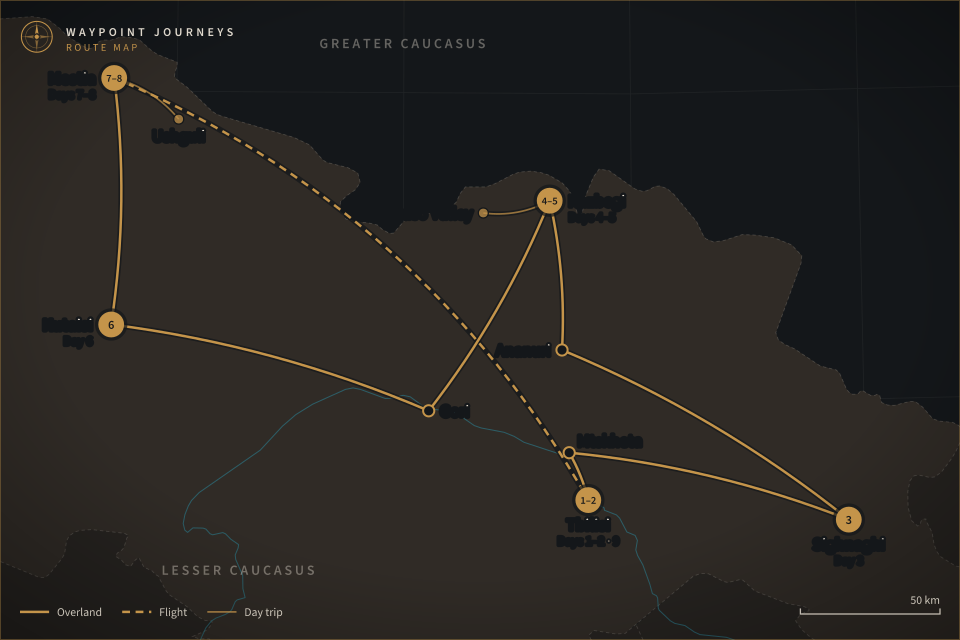
Nine days is enough to cross the country properly. Tbilisi first, a city of sulphur baths and crooked balconies stacked under a fortress; then Kakheti's vineyards; then north up the Georgian Military Highway into the high Caucasus at Kazbegi, where a fourteenth-century church stands alone on a ridge below a five-thousand-metre volcano. The last act is Svaneti: a valley system so hard to reach that its stone defensive towers, its dialect and its icons all survived intact, and where Ushguli sits at 2,100 metres under the highest mountain in Georgia.
"Every empire that came through Georgia left something behind and took nothing with it. That is the whole national character, and you can taste most of it at dinner."

Towers in the High Caucasus, Wine Buried in Clay, and a Church on a Ridge Below Kazbek
A fourteenth-century church stands alone on a green ridge at 2,170 metres above the village of Stepantsminda, with the glaciated cone of Mount Kazbek (5,054 metres, and a Georgian myth about a chained titan) filling the sky behind it. You can walk up in about three hours or ride up in forty minutes; either way the last turn of the path is one of the great reveals in the Caucasus.
Upper Svaneti is UNESCO-listed for one reason: nowhere else in Europe kept its medieval defensive architecture standing in working villages. Every Svan family built a koshki, a square stone tower of four or five storeys, from about the ninth century on, and hundreds of them still rise out of Mestia and Ushguli. Ushguli sits at 2,100 metres beneath Shkhara, Georgia's highest peak.
Tbilisi means warm place, and it was founded where a Georgian king's hunting falcon found a hot spring. The old town still stacks carved wooden balconies up the hillside under the Narikala fortress, with the brick domes of the sulphur bathhouses at the bottom of it. A long soak in the Abanotubani, then dinner and a bottle of amber wine, is the correct way to spend a first evening in the country.
Georgians have been making wine for roughly eight thousand years and never abandoned the original method: whole grapes into an egg-shaped clay qvevri, buried to the neck in the cellar floor, skins and stems and all, sealed and left. The result is amber-coloured, tannic and nothing like the filtered wines sold in a Western supermarket. You will drink it in the cellar it came out of, from the hands of the family that buried it.
Uplistsikhe is a whole town carved into a sandstone bluff above the Mtkvari, halls, wine cellars, a pagan temple and a Christian basilica, in continuous use from the first millennium BC. Downstream at Mtskheta, the old royal capital, Jvari Monastery watches from its hill over the confluence and Svetitskhoveli Cathedral covers the spot where Georgia's conversion began. Both are UNESCO-listed.
A Georgian feast is a structured event, not a meal. A tamada is appointed, and the evening proceeds through a sequence of toasts (to peace, to ancestors, to the guests, to those absent) each answered by everyone at the table. Between them arrive khinkali, khachapuri, walnut-thickened stews, herbs by the fistful and more wine than looks advisable. You will be at least one supra in on this trip.
The Expedition
Nine days from Tbilisi to Upper Svaneti by private vehicle, with the mountain flight back from Mestia so the last day is not spent in a car.
Arrive into Tbilisi, transfer to a hotel in or just above the old town, and take the afternoon at your own speed. The old city is small enough to walk out of the jet lag in: the crooked balconies of Betlemi, the cable car up to Narikala fortress and Kartlis Deda above it, and the brick domes of the Abanotubani sulphur baths in the gorge below, where a private room and an hour of scalding water is the traditional cure for having just arrived. Dinner and a first amber wine.
A full day in a capital that has been burned down and rebuilt more times than anywhere has a right to be. The Sioni and Anchiskhati churches, the Museum of Georgia and its extraordinary pre-Christian goldwork, Rustaveli Avenue and its Soviet-era grandeur, the Dry Bridge flea market where the twentieth century is laid out on blankets, and the Chronicle of Georgia on its hill above the reservoir, sixteen black pillars of carved history that almost no visitor gets to. Evening free.
North out of the city to Mtskheta, Georgia's spiritual capital, for the sixth-century Jvari Monastery above the meeting of two rivers and Svetitskhoveli Cathedral below it. Then east into Kakheti, the wine province: the walled hill town of Sighnaghi looking out over the Alazani valley to the Caucasus, the convent at Bodbe where St Nino is buried, and an afternoon in a family cellar among the buried qvevri, tasting from the clay. Overnight in Sighnaghi.
West and then north onto the Georgian Military Highway, the road the Russians cut through the Caucasus in the nineteenth century and the only one that crosses this range. It climbs past the Ananuri fortress on its reservoir, over the Jvari Pass at 2,379 metres, and down into the Terek valley at Stepantsminda. Weather permitting, Kazbek is out when you arrive, and the church is a white speck on the ridge above the village.
Up to Gergeti Trinity in the morning, on foot for those who want the three-hour climb through the birch woods, by 4WD for those who would rather save their legs. The church is fourteenth-century, tiny, still in use, and the mountain behind it is 5,054 metres of ice. In the afternoon, a walk into the Truso valley: mineral springs staining the ground orange, abandoned Ossetian hamlets, travertine terraces and, most days, nobody else at all.
Back over the pass and west along the Mtkvari. At Uplistsikhe you climb into a town cut out of the rock (a columned hall, wine cellars, a tunnel down to the river) that was already old when the Romans arrived. Gori below it is Stalin's birthplace, and its museum is a strange and instructive experience whatever you think of the man. Continue west to Kutaisi, capital of the old kingdom of Colchis, where Jason came looking for the fleece.
The morning goes to Gelati Monastery, founded in 1106 by David the Builder and one of the great medieval Georgian ensembles, its mosaics and frescoes intact and UNESCO-listed. Then north-west and up: the road runs beside the Enguri reservoir's improbable turquoise, climbs through gorges for four hours, and delivers you to Mestia at 1,500 metres, surrounded by stone towers and by mountains that have not let this valley be conquered.
The 4WD run east up the Enguri to Ushguli, a community of four hamlets at 2,100 metres that claims to be the highest continuously inhabited place in Europe, and looks it: dozens of medieval towers, stone roofs, cattle in the lanes, and the vast white wall of Shkhara, 5,193 metres, closing the head of the valley. There is time to walk towards the glacier, see the twelfth-century Lamaria church on its knoll, and eat kubdari in a family kitchen before the run back to Mestia.
The short mountain flight from Mestia's tiny airstrip back to Tbilisi, twenty-odd minutes over the whole Caucasus range in a light aircraft, and the best possible last look at where you have just been. If weather closes the strip we drive, which is long but well broken. Onward international flights leave Tbilisi through the day and overnight; we are glad to add Armenia or Azerbaijan to either end.
What's Included
FREQUENTLY ASKED QUESTIONS
Common Questions About This Expedition
Expedition Investment
per person, twin share
Fully inclusive of eight nights' accommodation; private vehicle and English-speaking driver-guide for the whole route; the Mestia–Tbilisi mountain flight; the Ushguli 4WD day; every site, museum and monastery entry; the Abanotubani bath, the Kakheti qvevri cellar and tasting, and a full supra with a tamada; daily breakfast and three included meals
Excludes international flights to Tbilisi, travel insurance, remaining meals, alcohol beyond the included tastings, and personal expenses. Single supplement $520 USD
Reserve Your SpotGeorgia is one of the easiest countries in this part of the world to travel in. Violent crime against visitors is rare, the police are trusted, most citizens under forty speak some English, and the hospitality is not a marketing line; it is a social norm that will occasionally leave you at a stranger's table for three hours. Two practical caveats matter. The first is geography: the de facto boundaries of South Ossetia and Abkhazia are not marked on the ground and should never be approached casually. Our route stays well clear of both, and the Georgian Military Highway, Kazbegi and Svaneti are all far from either. The second is the road. Georgian driving is enthusiastic, mountain roads are narrow and the Svaneti approach has real drops; we use experienced drivers, travel in daylight and do not run the high sections in poor weather. In the mountains the weather changes fast: the Mestia flight is weather-dependent, which is why the drive is priced in as a fallback rather than sold as a surprise.