Waypoint Journeys Presents
Timor-Leste
Asia's Youngest Nation
8 Days
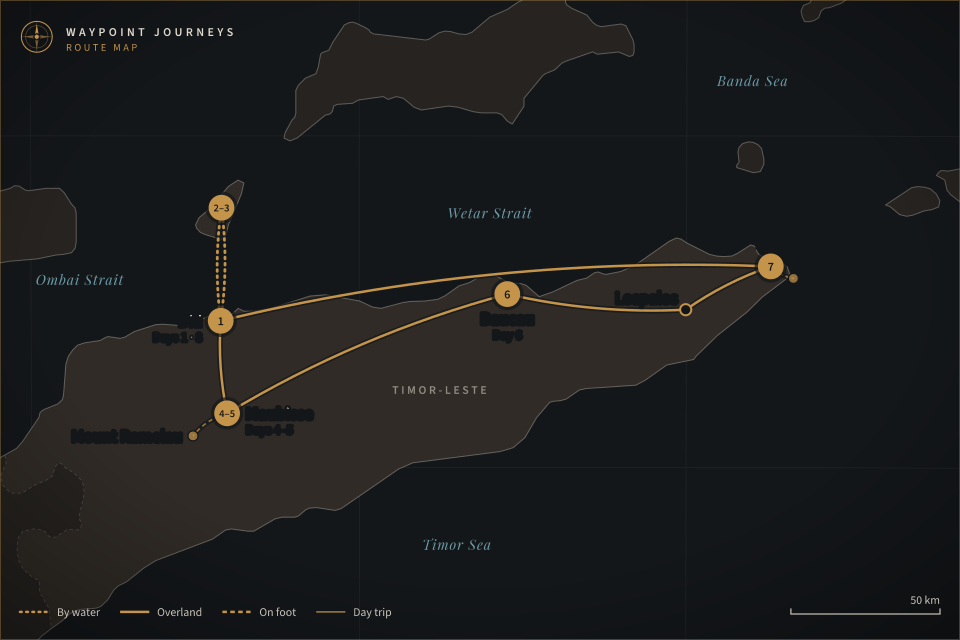
Dili · Atauro · Maubisse · Baucau · Jaco Island — The Half-Island Almost Nobody Crosses
We reply within 24 hours
The Country That Voted Itself Into Existence
Half an island at the far end of the Indonesian archipelago, Timor-Leste is the youngest country in Asia and one of the least visited on Earth. It spent four centuries as a Portuguese outpost, twenty-four years under Indonesian occupation, and in 1999 it voted for independence at a cost the country still counts. What that history left behind is a place unlike anywhere else in the region: Catholic in a Muslim archipelago, Portuguese-speaking in a Malay world, and almost entirely unprepared for tourism in the best possible sense.
The scale of it surprises people. The whole country is smaller than Wales, yet the road from the capital to the eastern tip climbs to nearly 2,000 metres, drops back to the sea, and passes through four distinct worlds on the way: the reef-fringed north coast, the coffee mountains of the interior, the Portuguese hill towns, and the dry, empty east where the tarmac finally gives out. Nothing is far. Everything takes time.
Underwater, it is a different argument altogether. Timor-Leste sits inside the Coral Triangle on the deep Ombai and Wetar straits, where the water drops thousands of metres just offshore. Atauro Island was found by a 2016 survey to hold the highest average reef-fish diversity ever recorded anywhere in the world. You reach it on the morning boat, and most days you have the reef to yourself.
"Half an island, four climates and a reef nobody has counted twice. Timor-Leste is what Southeast Asia looked like before the flights got cheap."

The Richest Reef Ever Surveyed, a Sacred Island Nobody Sleeps On, and a Capital Still Writing Its Own History
A 2016 Conservation International survey counted an average of 253 reef-fish species per site around Atauro, the highest figure ever recorded anywhere on the planet. The island sits between two straits that plunge thousands of metres, so the wall starts a few strokes from the beach and the water is a permanent 27 degrees. You snorkel it from a small boat with local guides, and on most days you will not see another visitor.
At the country's far eastern point, a 200-metre channel separates the mainland from Jaco, an uninhabited island the Fataluku people hold sacred. Nobody stays overnight; fishermen ferry you across in the morning and collect you in the afternoon. What is on the other side is a kilometre of blinding white sand between two blue-green seas, and, apart from your own boatman, nothing else at all.
The road south from Dili climbs into cloud within an hour, and by Maubisse at 1,400 metres you are among the arabica smallholdings that are still the country's largest non-oil export, grown in the shade under old Portuguese trees. You will stay in the hill town, walk in the plantations with a grower, and drink the coffee at the source, where it has never seen a shipping container.
Above Tutuala, on the cliff overlooking the Jaco channel, the Ili Kere Kere rock shelter holds paintings of boats, figures and stencilled hands that have been dated to the end of the last ice age. Timor was a staging post on one of the earliest human sea crossings toward Australia, and the walls of this cave are among the plainest evidence of it that you can still walk up to and stand in front of.
Baucau was the country's second city and looks it: a tiled, arcaded Portuguese old town stacked on a hillside above a spring-fed pool, with a mercado building that would not be out of place in the Alentejo. The coast east of it is a succession of empty white beaches under limestone terraces, and the drive along it is one of the great small journeys in Southeast Asia.
Dili does not sand down its recent history. The Chega! exhibition occupies the former Portuguese and then Indonesian prison at Balide, the Santa Cruz cemetery is where the 1991 massacre turned world opinion, and the Resistance Museum lays out the whole twenty-four years. It is a serious morning, handled by guides who lived it, and it is the reason the rest of the country reads the way it does.
The Expedition
Eight days from the capital to the eastern tip: one island crossing, one climb into the coffee mountains, and the long road east to a sacred island and back.
Fly into Dili (usually via Bali or Darwin) and transfer to a seafront hotel on the capital's long, quiet bay. The afternoon is the country's own introduction to itself: the Chega! exhibition in the former Balide prison, where the Indonesian-era cells have been left as they were found; the Santa Cruz cemetery; and the Resistance Museum, which lays out the occupation and the 1999 referendum in the words of the people who fought it. The day ends up at Cape Fatucama, climbing the steps to Cristo Rei for sunset over the whole capital, and a first plate of grilled fish on the waterfront afterwards.
The morning boat crosses the Ombai Strait to Atauro, an hour and a half of deep, dark water that regularly turns up dolphins and, in season, blue whales; the strait is one of the few places on Earth where they pass close to shore. You land at Beloi and settle into a beachfront eco-lodge with no road noise because there is essentially no road. The afternoon is spent in the water: the reef here holds the highest average fish diversity ever surveyed anywhere, and the drop-off is a short swim from the sand. Dinner is whatever the boats brought in.
A full day on the island. The morning runs by boat to two or three of the outer sites, drifting the wall where it falls away into the strait, then into the shallows over staghorn and table coral. In the afternoon you walk inland to Adara or Vila, where the island's fishing and weaving communities live largely outside the cash economy, and where a small women's cooperative makes the woven tais the country is known for. Sunset from the ridge looks back across the strait to the mainland mountains you drive into tomorrow.
The morning boat returns to Dili, and by lunchtime the road is climbing. It is only sixty-odd kilometres to Maubisse but it takes three hours, switchbacking up through terraced smallholdings into cloud forest; you will stop for the view back down the valley more than once. Maubisse sits at about 1,400 metres, cool enough for a jacket at night, and the old Portuguese pousada on the hilltop is where you sleep. The late afternoon is spent walking in the arabica gardens with a grower, in the shade trees the Portuguese planted.
A pre-dawn drive to Hatubuilico and the two-hour walk up Tatamailau, at 2,986 metres the highest point in the country and, on the right morning, one of the most extraordinary sunrises in Southeast Asia: the sea on both sides of the island at once, the whole of Timor laid out below, and a statue of the Virgin at the summit that pilgrims climb to barefoot. Down for a late breakfast, then the long, beautiful drive down the eastern flank of the range and back to the north coast road.
The coast road east runs between limestone terraces and empty beaches for two hours to Baucau, the country's second city and its most handsome. The old town is a tiled Portuguese hill settlement above a spring-fed swimming pool, with an arcaded market building at its centre and views straight down to the sea. The afternoon drops to Osolata and Watabo, where the sand is white, the water is clear and the only company is likely to be a few children from the village. Night in Baucau.
The last stretch east leaves the tarmac behind: three hours through Lautém and Lospalos to Tutuala, on the cliff at the end of the country. First the walk to Ili Kere Kere, a rock shelter whose painted boats, figures and hand stencils date back toward the end of the last ice age. Then the track down to Valu Beach, where a fisherman takes you the 200 metres across to Jaco. The island is sacred and uninhabited; nobody sleeps there, and for the hours you have it, you will most likely be the only people on it. Back to the mainland by late afternoon.
The drive back to the capital is the country in reverse, and worth doing in daylight: the eastern savannah, the Lospalos house-roofs shaped like ships, the long limestone coast, and finally Dili's bay opening up ahead. Depending on your flight, there is time for the Tais Market and a last lunch on the waterfront before the transfer to the airport. Onward connections run through Bali or Darwin; we are glad to build either onto the end of the trip.
What's Included
FREQUENTLY ASKED QUESTIONS
Common Questions About This Expedition
Expedition Investment
per person, twin share
Fully inclusive of seven nights' accommodation, private 4WD and driver throughout, an English-speaking Timorese expedition leader for the whole trip, the return Atauro boat crossing and all island boats including Jaco, two full days of guided snorkelling with equipment, the Ramelau dawn ascent, all listed entrances and site fees, and all meals on Atauro and at Maubisse plus daily breakfast
Excludes international flights to Dili (Bali or Darwin, typically $250–450 USD return; we are glad to book them), the $30 USD visa on arrival, travel insurance, free-time meals, alcohol and personal expenses. Single supplement $750 USD. Departures May to October only
Reserve Your SpotTimor-Leste is a calm, welcoming country and crime against visitors is rare; Dili is a small capital where people are pleased to see you and the Portuguese-Catholic formality means an evening walk is an ordinary thing to do. The honest risks here are logistical and medical rather than criminal. Malaria and dengue are both present, so prophylaxis and repellent matter and a travel clinic visit well before you fly is a condition of the trip. Medical facilities are limited and serious cases are evacuated to Darwin, which is why comprehensive insurance with evacuation cover is required rather than recommended. The roads are the real hazard: narrow, steep and shared with livestock, which is why we drive them in daylight only, with experienced local drivers, and price the itinerary around the true journey times. The Atauro crossing and the Jaco boat are both weather-dependent, and our leader carries the authority to move the day rather than push a marginal sea.