Skip to content

Waypoint Journeys Presents

Azerbaijan

Land of Fire

8 Days

Baku · Gobustan · Quba · Sheki — Forty Thousand Years of Rock Art, Fires That Never Go Out, and a Village Above the Clouds

8 DaysFrom $2,995 USDMax 5 guests

We reply within 24 hours

The Country That Has Been Burning for Three Thousand Years

Azerbaijan calls itself Odlar Yurdu, the land of fire, and it is not a metaphor. Natural gas seeps out of the ground on the Absheron peninsula and, once lit, does not stop, a hillside at Yanar Dag has been burning continuously for as long as anyone can document, and a temple at Surakhani was built around a vent that drew Zoroastrian and Hindu pilgrims for centuries. The same geology that produced those fires produced the oil that made Baku the richest city on the Caspian twice over, a hundred years apart.

It is also far older than the oil. Half an hour south of the capital, the boulder field at Gobustan carries more than six thousand rock carvings spanning something like forty thousand years (hunters, dancers, reed boats, aurochs) and, incised among them, a line of Latin left by a centurion of the Twelfth Legion, which is as far east as any Roman inscription has been found. Beside it, several hundred mud volcanoes gurgle across a grey moonscape; Azerbaijan has roughly a third of every mud volcano on Earth.

And then the country stands up. North and west of the Caspian plain the Greater Caucasus rises fast, and the villages in it are as distinct as the range is steep: Khinalug at 2,300 metres, where a few thousand people speak a language related to nothing much and their transhumance routes are UNESCO-listed; Lahij, a cobbled coppersmiths' town in a gorge; and Sheki, where the Khans built a summer palace whose windows are made of thousands of pieces of coloured glass and hand-cut wood assembled without a nail or a drop of glue.

"Baku spent the twentieth century deciding what to be and the twenty-first building it. Two hours out of town, nothing has changed its mind in six hundred years."
Azerbaijan Old City
İçərişəhər: the walled city of Baku, UNESCO-listed since 2000

Rock Art Older Than Farming, Mud Volcanoes, and a Palace Assembled Without Nails

İçərişəhər, the Walled City

Baku's old city is a complete medieval quarter inside its walls, in the middle of a twenty-first-century capital: the Maiden Tower, an eight-storey cylinder from the twelfth century that nobody has convincingly explained; the fifteenth-century Palace of the Shirvanshahs and its royal tombs; caravanserais, hammams and lanes barely wide enough for a car. UNESCO listed the whole ensemble in 2000.

The Gobustan Petroglyphs

On a limestone terrace above the Caspian, more than six thousand carvings cover the fallen boulders, some of them forty thousand years old. Hunters with bows, rows of dancers, long reed boats with sun-prowed hulls, aurochs the size of a wall. In one crevice, a Roman centurion of Legio XII Fulminata cut his name, the easternmost Roman inscription ever found. UNESCO-listed since 2007.

The Mud Volcanoes

Azerbaijan has something like a third of the world's mud volcanoes, and the cluster beside Gobustan is the easiest to walk into: a grey lunar plain of cones a metre or two high, each one belching cold, dense mud in slow gulps that break and reform. It looks like a special effect and behaves like a very patient one. The 4WD track in is part of the entertainment.

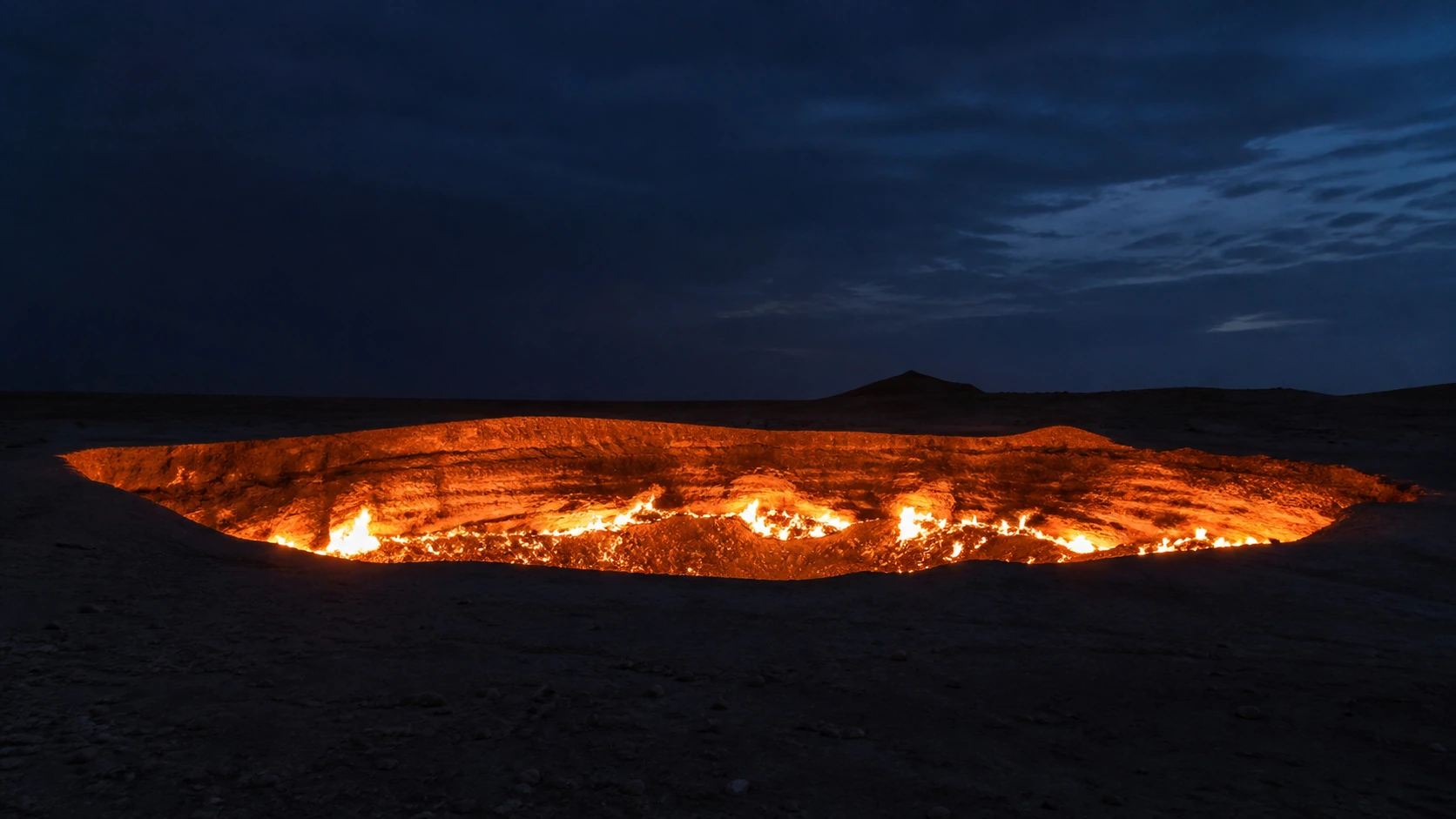
Yanar Dag and the Fire Temple

A ten-metre stretch of hillside on the Absheron peninsula has been alight for as long as records go back, fed by gas seeping through the sandstone, Yanar Dag, the burning mountain, and it is at its best at dusk. Nearby, the Ateshgah temple was built around another vent in the seventeenth and eighteenth centuries and drew Zoroastrian, Hindu and Sikh pilgrims from as far as Punjab.

Khinalug, Above the Clouds

At about 2,300 metres in the Quba highlands, Khinalug is one of the highest continuously inhabited villages in the Caucasus, a stack of flat-roofed stone houses on a ridge, where a few thousand people speak Ketsh, a language with no close relatives anywhere. UNESCO inscribed the village and its Köç Yolu transhumance route in 2023. The road up is spectacular and, in places, alarming.

The Khans' Palace at Sheki

The summer palace the Sheki Khans finished in 1797 is small, and the reason people come a long way to see it is its windows. Şəbəkə is a lattice of thousands of hand-cut pieces of wood and coloured Venetian glass, assembled without nails or glue, so that the light coming through it moves across the painted rooms all day. UNESCO listed the town's historic centre in 2019.

The Expedition

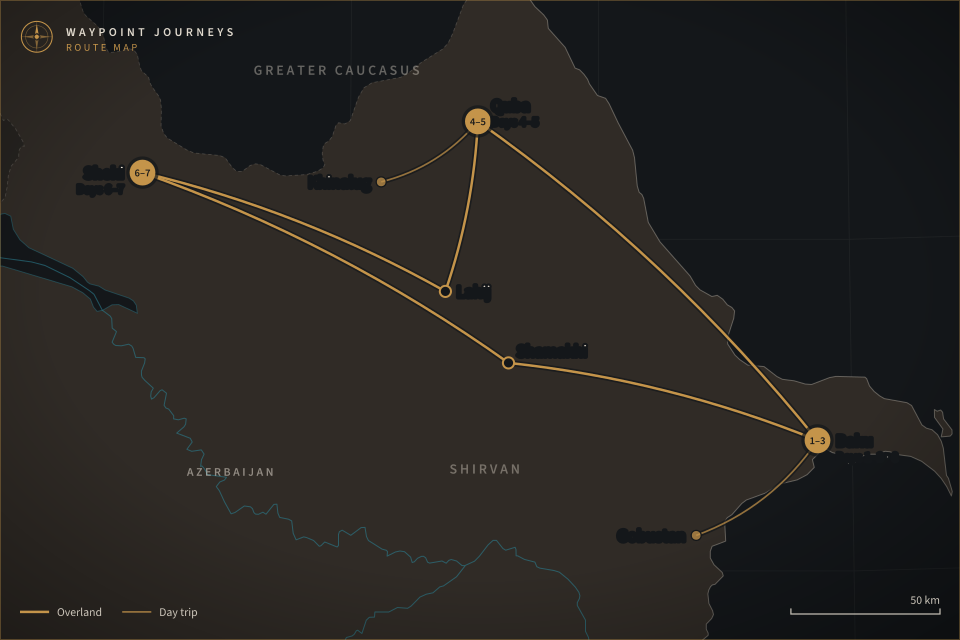
Eight days from the Caspian into the Greater Caucasus and back, by private vehicle, with two nights each in Baku, the Quba highlands and Sheki.

Day 1
Baku · arrival on the Caspian

Arrive into Heydar Aliyev International and transfer into the city. Baku is a surprise on first sight: a Caspian corniche, a belle-époque oil-boom centre built by Nobels and Rothschilds, and three flame-shaped towers above all of it. The afternoon is a gentle orientation along the Boulevard and up to the Highland Park terrace for the view down over the bay, then dinner in the old city.

Day 2
Baku · inside the walls and out the other side

A full day in the capital, starting inside İçərişəhər: the Maiden Tower, the Shirvanshahs' Palace and its tombs, the caravanserais and the hammam. Afterwards the twentieth and twenty-first centuries: the Carpet Museum, which is far better than it sounds and explains an entire visual culture, and Zaha Hadid's Heydar Aliyev Center, a building with no straight lines in it. Evening free on Nizami Street.

Day 3
Gobustan and the mud volcanoes

South along the Caspian to Gobustan, where the rock art covers the boulders of a limestone terrace: hunting scenes, dancers, reed boats, and the Roman centurion's graffito. The museum on site is well worth the stop. Then by 4WD onto the mud volcano field: a grey plain of small cones burping cold mud, entirely absurd and entirely real. Back to Baku via the Bibi-Heybat mosque and the oil derricks that made this coast.

Day 4
Absheron fires → Quba · north to the mountains

The Absheron morning is all fire: the Ateshgah temple at Surakhani, built around a natural gas vent and inscribed by Hindu and Sikh pilgrims, and Yanar Dag, the hillside that has never gone out. Then north along the Caspian shore and up into the Quba district, apple orchards, carpet-weaving villages, and the Caucasus filling the windscreen. Overnight in Quba, with time for the old Jewish quarter at Qırmızı Qəsəbə across the river.

Day 5
Khinalug · the road to 2,300 metres

The whole day for one village. The road climbs sixty kilometres up the Qudyal gorge past shepherds' camps, hairpins above a very long drop, and arrives at Khinalug on its ridge, flat stone roofs, cattle in the lanes, and a language spoken nowhere else. There is time to walk the village with a local guide, look into the old mosque, take tea in a family house and understand what a UNESCO-listed transhumance route actually means. Back to Quba for the night.

Day 6
Quba → Lahij → Sheki

West along the mountain front and up a side gorge to Lahij, a cobbled town of coppersmiths where the workshops still hammer trays and jugs to order and the drainage system dates to the Middle Ages. The road in is single-track and dramatic. On through İsmayıllı and Qəbələ to Sheki, arriving in the late afternoon at a town of tiled roofs and plane trees under the mountains. Dinner is piti, cooked and served in its own clay pot.

Day 7
Sheki · the palace, the caravanserai and Kish

The Khans' Palace at its opening hour, before the light gets high and while the şəbəkə windows are at their best. Then the eighteenth-century Upper Caravanserai, still functioning as a hotel, and the workshops where the lattice-makers still cut glass and wood by hand. In the afternoon, the village of Kish and its round-apsed Albanian church, one of the oldest Christian buildings in the Caucasus, and the sweet shops that make Sheki's famous halva.

Day 8
Sheki → Baku · departure

The drive back east across the Shirvan plain to Baku, breaking at Shamakhi for the Juma Mosque (first built in the eighth century, rebuilt after every earthquake since) and the Yeddi Gümbəz, the seven domed tombs of the Shirvan khans standing in a field above the town. Onward international departures leave Baku through the evening and night. We are glad to add Georgia to either end: Tbilisi is a comfortable day's drive north-west.

Azerbaijan Yanar Dag

Small Group Expedition

A Hillside That Never Stopped Burning.
A Country Named After It.

What's Included

Duration8 days / 7 nights: Baku, Quba, Sheki
Group SizeSmall group expedition: maximum 5 guests
AccommodationSeven nights: three in a boutique hotel in or beside Baku's old city, two in Quba, and two in Sheki
Included Experiencesİçərişəhər with the Maiden Tower and the Shirvanshahs' Palace, the Carpet Museum and the Heydar Aliyev Center (Day 2); Gobustan and the mud volcanoes by 4WD (Day 3); Ateshgah and Yanar Dag (Day 4); the full Khinalug day with a local guide (Day 5); Lahij (Day 6); the Khans' Palace, the Upper Caravanserai and Kish (Day 7); Shamakhi and the Yeddi Gümbəz (Day 8)
TransportPrivate vehicle with an English-speaking driver-guide for the whole route, the Gobustan mud-volcano 4WD, the Khinalug mountain 4WD, and all airport transfers
GuideA licensed English-speaking Azerbaijani guide throughout, plus village guides in Khinalug and Lahij
MealsDaily breakfast, a Khinalug family lunch, the Sheki piti dinner and a farewell dinner in Baku. Other meals are free: Azerbaijani cooking is excellent and your guide keeps the list
VisaAn ASAN e-visa is issued online in about three working days for most nationalities. We send the link and the instructions, and check your application before you submit it
Best SeasonApril to early November. May, June, September and October are the sweet spots; July and August are very hot on the Caspian plain, though the mountains stay comfortable
Not IncludedInternational flights to Baku, the e-visa fee, travel insurance, remaining meals, alcohol, personal expenses, tips

FREQUENTLY ASKED QUESTIONS

Common Questions About This Expedition

Very. The ASAN e-visa is applied for online, costs little and is usually issued inside three working days for most nationalities; we send the link and check your form before you submit. Baku is safe, modern and easy to walk, the roads on this route are good, and outside the capital hospitality is warm and insistent. Bring a passport with six months' validity and let us know your nationality when you book.
An Armenian stamp alone is not a bar to entering Azerbaijan and travellers with one enter routinely. What is a bar is evidence of an unauthorised visit to Nagorno-Karabakh: Azerbaijan treats that as illegal entry and refuses admission. If you are combining the two countries, do it through Georgia, keep well clear of Karabakh, and tell us your travel history when you book so we can advise you properly.
The driving is the demanding part, not the walking. It is roughly sixty kilometres of mountain road each way, climbing to 2,300 metres on hairpins with real exposure, in a 4WD with a driver who does it constantly, spectacular if you like that sort of thing and long if you do not. In the village itself the walking is gentle but the lanes are steep and cobbled, and the air is noticeably thinner. Take a warm layer whatever the forecast.
Spring and autumn. May and June bring green mountains, wildflowers and comfortable heat; September and October bring the harvest, clear air and the best light on the Caspian. July and August are hot in Baku and Gobustan, though Quba and Sheki stay pleasant. From late November the Khinalug road can close with snow, so we run this route between April and early November.

Expedition Investment

$2,995USD

per person, twin share

Fully inclusive of seven nights' accommodation; private vehicle and English-speaking driver-guide throughout; both 4WD excursions (the Gobustan mud volcanoes and the Khinalug mountain road); every site and museum entry including İçərişəhər, Gobustan, Ateshgah, the Khans' Palace and the Carpet Museum; village guides in Khinalug and Lahij; daily breakfast plus three included meals

Excludes international flights to Baku, the ASAN e-visa fee, travel insurance, remaining meals, alcohol and personal expenses. Single supplement $460 USD

Reserve Your Spot
A Note on Safety & Logistics

Azerbaijan is a comfortable and low-risk country to travel in. Baku has very little street crime, the police presence is heavy and orderly, and the road network on this route: Baku, the Caspian shore, Quba, the mountain front and Sheki, is good. Two things need saying plainly. The first is the eastern border region and the Karabakh area, which are not open to casual travel and are nowhere near this itinerary; entering Karabakh without Azerbaijani authorisation is treated as illegal entry and will get you refused admission to the country, now and later. The second is the mountain roads: the climbs to Khinalug and Lahij are narrow, exposed and weather-dependent, and we drive them with local drivers, in daylight, and not at all in snow or heavy rain, if we cancel a mountain day it is because the driver said no, and we back that judgement every time. Beyond that, the ordinary rules apply: it is hot in summer on the Caspian plain, the sun is fierce at Gobustan, and comprehensive travel insurance is a condition of travelling with us.