Waypoint Journeys Presents
Armenia
The First Christian Kingdom
8 Days
Yerevan · Ararat · Vayots Dzor · Syunik — Monasteries on Cliffs, Wine Older Than the Pharaohs, and a Mountain They Cannot Reach
We reply within 24 hours
A Country That Kept Everything Except Its Mountain
Armenia adopted Christianity as a state religion in 301, the first country anywhere to do it, and has spent the seventeen centuries since being conquered by people who wanted it to stop. It did not. What survives is a landscape of monasteries built where they were hardest to reach (on cliff ledges, inside rock faces, at the heads of gorges) and a culture that carried its alphabet, its liturgy and its manuscripts through every occupation, largely by hiding them and by writing everything down.
The national symbol is a mountain in another country. Ararat rises 5,137 metres directly across the closed Turkish border and dominates the view from Yerevan, from the vineyards, from half the churches in the country. Standing at Khor Virap (the monastery over the pit where Gregory the Illuminator was held for thirteen years before converting the king) with that snow cone filling the sky and an unreachable frontier in between, is the single most Armenian experience available.
Eight days covers the country properly, because Armenia is small and dense. Yerevan, founded in 782 BC and older than Rome, holds a manuscript library that survived every attempt to burn it. South of it are Garni's Roman columns, Geghard cut into living rock, Noravank in a red gorge, and the Areni cave where archaeologists found a six-thousand-year-old winery and the world's oldest leather shoe. Further south still, Tatev hangs above the Vorotan canyon, reached by a cableway that holds a Guinness record. North, the road runs to Lake Sevan and the beech forests of Dilijan.
"Armenia has been occupied by everyone and assimilated by no-one. Seventeen hundred years of that is not a history. It is a personality."

A Monastery on a Cliff, a Winery Six Thousand Years Old, and Ararat Across a Closed Border
The ninth-century monastery of Tatev stands on the lip of the Vorotan gorge in Syunik, defensible on three sides and spectacular from all of them. Getting there is half the pleasure: the Wings of Tatev cableway runs 5.7 kilometres across the canyon and holds the Guinness record as the world's longest reversible aerial tramway, twelve minutes suspended over a very long drop.
Khor Virap sits on a low hill on the Ararat plain, right against the sealed Turkish frontier, above the pit where Gregory the Illuminator spent thirteen years before converting King Trdat and, with him, the country. Behind it, five kilometres away and utterly unreachable, Ararat rises 5,137 metres out of the haze. Come at dawn, when the mountain is out and the border posts are still in shadow.
Half of Geghard is built and half is quarried straight into the cliff behind it, chapels, a mausoleum and a hall with a spring running through the floor, all carved downward from the surface with no walls brought in. It is UNESCO-listed, it is still a working monastery, and if the acoustics are demonstrated for you by a singer standing in the rock chamber you will not forget it.
In a cave above the village of Areni, archaeologists found a wine press, fermentation vats and grape seeds dated to roughly 4100 BC (the oldest known winery on Earth) along with a 5,500-year-old leather shoe. The valley never stopped: Areni-noir vines still grow on the slopes, and small producers a few minutes from the cave will pour you the descendant of that vintage.
Sevan is one of the largest high-altitude freshwater lakes in the world, sitting at 1,900 metres with mountains all round it and a colour that changes hourly. On the peninsula at its north-western corner, the monastery of Sevanavank has been watching the water since 874. Below it, the lakeside grills serve ishkhan, the endemic Sevan trout, and Armenians treat the whole shoreline as a national summer garden.
Garni is the only Greco-Roman colonnaded temple left standing anywhere in the former Soviet Union, a first-century peristyle on a promontory above the Azat gorge, kept when everything else was Christianised because a king used it as a summer house. Walk down into the gorge below and the cliffs turn into the Symphony of Stones: a hanging organ of hexagonal basalt columns, formed by cooling lava.
The Expedition
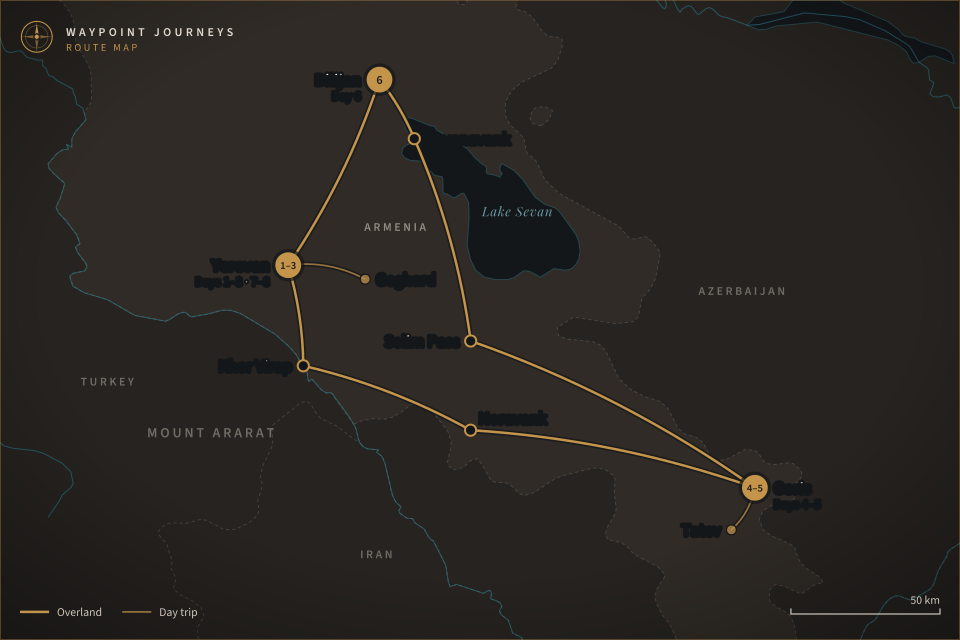
Eight days out and back from Yerevan by private vehicle, with two nights in the south so Tatev is not a race and one in the northern forests.
Arrive into Yerevan (most flights land in the small hours, which is normal here) and sleep. The day begins properly in the afternoon with the city's own geometry: Republic Square and its pink tufa arcades, the Cascade climbing the hillside in terraces full of sculpture, and the view from the top across the roofs to Ararat. Dinner on Saryan Street, where the wine bars are, and a first taste of Areni-noir.
A full day in the capital. The Matenadaran holds one of the world's great manuscript collections (seventeen thousand codices carried out of every invasion, some of them half-burnt and reassembled) and explains Armenia better than any monument. Then Tsitsernakaberd, the genocide memorial and its museum, which is a hard but necessary two hours. Afterwards the Vernissage market, the covered GUM food hall for dried fruit and sujuk, and a brandy tasting to end the day.
East into the Azat gorge. Garni's Roman colonnade stands on its promontory; below it the Symphony of Stones hangs off the cliff in basalt hexagons, and you walk into the gorge to stand under them. Then up the valley to Geghard, half-built and half-carved into the rock, still working after eight centuries. Lunch is in a village house where the lavash is baked in front of you against the wall of a clay tonir, which you will be invited to attempt.
Out early to Khor Virap for Ararat in the morning light, and down into the pit beneath the chapel if you have the nerve for the ladder. Then south into Vayots Dzor: Noravank at the head of a gorge of red cliffs, thirteenth-century and carved by Momik, and the Areni-1 cave where the world's oldest winery was excavated. A tasting in the village afterwards, then on over the Vorotan pass to Goris for two nights.
The Wings of Tatev carries you 5.7 kilometres across the Vorotan gorge to the monastery: twelve minutes and a very long way down. Tatev was a university as well as a monastery, and the site has a swinging column, a working oil mill and a view that goes on for fifty kilometres. In the afternoon, Old Khndzoresk: an abandoned cave settlement in the cliffs below Goris, reached across a swinging footbridge, where families lived in the rock into the 1950s.
North again, over the Selim Pass at 2,410 metres where a fourteenth-century Silk Road caravanserai still stands complete beside the road, its stone stalls exactly as the camels left them. Down to Lake Sevan for the peninsula monastery of Sevanavank, the enormous blue of the water and a lakeside lunch of ishkhan trout. Then over the ridge into Dilijan, where the landscape turns unexpectedly into deep green beech forest.
A gentle morning in what Armenians call their Switzerland: Haghartsin, a tenth-to-thirteenth-century monastery in a forested side valley that is at its most beautiful under autumn colour, and Goshavank in the village of Gosh, with the finest carved khachkar (cross-stone) in the country. Old Dilijan's restored craft street for lunch, then the drive back to Yerevan and a last dinner in the city.
A slow morning (the Blue Mosque, the Ararat brandy cellars or simply the Cascade with a coffee) before your transfer to Zvartnots. Most departures leave late in the evening or before dawn, so there is usually a full free day; we hold a day room where the schedule needs it. Armenia pairs naturally with our Georgia expedition, and we are glad to run the two back to back through Tbilisi.
What's Included
FREQUENTLY ASKED QUESTIONS
Common Questions About This Expedition
Expedition Investment
per person, twin share
Fully inclusive of seven nights' accommodation; private vehicle and English-speaking driver-guide throughout; the Wings of Tatev cableway; every monastery, museum and site entry including the Matenadaran, Tsitsernakaberd and the Areni-1 cave; the village lavash lunch, the Areni winery tasting, the Sevan trout lunch and a farewell dinner; daily breakfast
Excludes international flights to Yerevan, travel insurance, remaining meals, alcohol beyond the included tastings, and personal expenses. Single supplement $440 USD
Reserve Your SpotArmenia is a straightforward and welcoming country to travel in. Yerevan is safe to walk at night, petty crime is rare, the roads on our route are good and English is widely spoken by younger Armenians. The one thing that requires care is the map. Armenia's borders with Turkey and Azerbaijan are closed, the eastern and south-eastern frontier zones have seen military activity in recent years, and a handful of roads in the far south-east run close enough to the line to be worth avoiding. This itinerary does not go near any of them: the southern leg follows the main Syunik highway to Goris and Tatev, and everything else sits in the centre and north of the country. We take a fresh read before every departure and will re-route or postpone rather than run something we cannot stand behind. Practically, the rest is ordinary: mountain roads mean winter snow on the passes, which is why we run April to November; altitude is modest but Sevan and the Selim Pass are high enough to feel; and comprehensive travel insurance is a condition of travelling with us.