Skip to content

Waypoint Journeys Presents

Oman

Arabia Before the Skyline

9 Days

Muscat · Wadi Shab · Ras al Jinz · The Wahiba Sands · Nizwa · Jebel Shams — The Gulf State That Never Traded Its Past for a Tower

9 DaysFrom $4,950 USDMax 5 guests

We reply within 24 hours

The Arabia That Declined the Skyline

Oman is the counter-argument to the rest of the Gulf. While its neighbours spent the oil on towers, Oman spent it on roads, schools and hospitals and passed a building code that keeps almost everything low, white and traditionally proportioned. There is no forest of glass in Muscat and there never will be. What there is instead is a country of forts, wadis, mountains and a coastline that runs for seventeen hundred kilometres, and a national manner so courteous it takes visitors a day or two to adjust.

It is also the oldest independent state in the Arab world, and it behaves like one. Omani ships were trading to Zanzibar and Canton when Europe was still coasting; the empire ran from Gwadar to the Swahili coast; and the mud-brick forts that stand over every oasis town were built by people who expected to have to hold them. Nizwa, Bahla, Jabreen and Rustaq are not ruins tidied up for visitors, they are the physical record of how the interior governed itself.

And then there is the terrain, which is the real surprise. In a single day you can swim a turquoise canyon between thousand-foot cliffs at Wadi Shab, watch a green turtle haul out to nest on the beach at Ras al Jinz, and sleep in the orange dunes of the Wahiba. Two days later you are at 2,000 metres on the rim of Wadi Ghul, walking a ledge cut into the cliff to an abandoned village, with the Hajar range going on in every direction.

"Everywhere else in the Gulf built upward. Oman kept the forts, the falaj and the coastline, and it is now the only one of them worth nine days on the ground."
Nizwa Fort and souq, Oman
Nizwa: the great round tower of the interior's old capital, above a souq that still trades at dawn

A Swimming Canyon, a Turtle Beach, a Night in the Dunes and a Ledge Walk at Two Thousand Metres

Wadi Shab

The finest wadi in Oman and one of the best half-days in Arabia. A small boat ferries you across the mouth, then forty-five minutes of easy walking up a green canyon between cliffs on a falah channel, past date gardens, to a chain of turquoise pools. You swim the last three, and the last of all takes you through a slot barely wider than your shoulders into a hidden cave with a waterfall falling through a hole in the roof.

Green Turtles at Ras al Jinz

The headland at Ras al Jinz is the most important green turtle nesting site in the Indian Ocean, with thousands of females coming ashore each year to lay in the same sand they hatched in. You stay at the reserve itself, which is the only way to join the ranger-led walks, and go out at night and again before dawn with a red-filtered torch to watch a turtle dig, lay, cover and haul herself back down to the sea.

A Night in the Wahiba Sands

The Sharqiya, still known to everyone as the Wahiba, is a sea of orange linear dunes running two hundred kilometres south to the coast, and it is home to Bedouin families who still keep camels in it. You drive in over the crests in the late afternoon, watch the light go from the top of a dune, eat under more stars than most people have seen, and wake to a sunrise that turns the whole sand red.

The Forts of the Interior

Nizwa's vast round tower dominates the old capital of the interior and its Friday livestock market; Bahla, a UNESCO site, is a mud-brick fortress and twelve-kilometre oasis wall that took decades to stabilise; and Jabreen, half an hour away, is the elegant one, a fortified palace with painted ceilings, a Quranic school and secret passages. Three forts, three different arguments about how to hold a valley.

The Balcony Walk on Jebel Shams

Oman's highest mountain stands over Wadi Ghul, a canyon a thousand metres deep that everyone calls the Grand Canyon of Arabia. The W6 Balcony Walk follows an old donkey path cut into the cliff face at around 2,000 metres, two hours out along the rim to the abandoned village of As Sab, with the drop always on one side. It is not technical, and it is the walk people talk about afterwards; we do it in the morning cool.

Jebel Akhdar and the Falaj Villages

The Green Mountain rises to 2,000 metres above the interior and is cool enough to grow pomegranates, walnuts and the damask roses distilled here each spring. The terraced villages of the Sayq plateau are stitched together by falaj, the two-thousand-year-old gravity irrigation channels that are themselves UNESCO-listed, and the walk between them along the water is one of the quiet pleasures of the country.

The Expedition

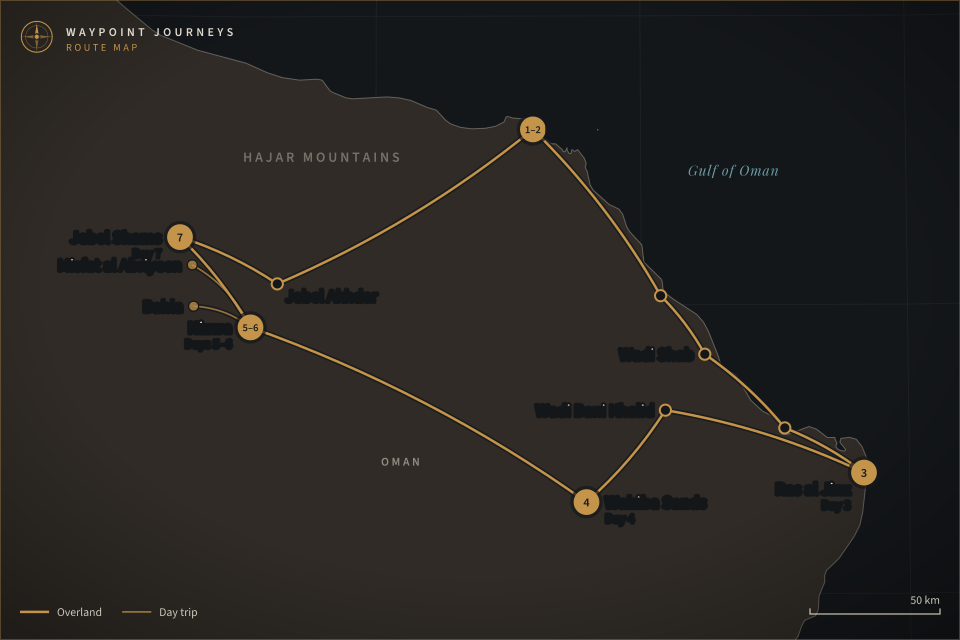
Nine days in a loop from Muscat: down the coast to the turtles, into the sands, up to the forts, and along the canyon rim at two thousand metres.

Day 1
Muscat · arrival on the Mutrah waterfront

Arrive at Muscat International and transfer into the city, low and white along its bay under bare brown mountains. The afternoon is a gentle introduction: the Mutrah corniche at the hour the light goes gold on the water, then the souq behind it, one of the oldest in the Arab world and still a working market rather than a display, thick with frankincense, silver and Kashmiri traders. Dinner overlooking the harbour where the royal yacht and the dhows share an anchorage.

Day 2
Muscat · the Grand Mosque, the Opera House and Old Muscat

Early to the Sultan Qaboos Grand Mosque, which admits non-Muslim visitors only in the morning and is worth being first through the door for: a prayer hall under a fifty-metre dome, a Persian carpet that took six hundred women four years to weave, and a chandelier of Swarovski crystal and gold. Then the Royal Opera House, the Bait Al Zubair museum for the silver, khanjar daggers and household history, and Old Muscat itself, where the Al Alam palace stands between two Portuguese forts on the rock. The afternoon is free on the corniche.

Day 3
The coast road · Bimmah, Wadi Shab and Sur

South along one of the great coastal drives, the road running between the Hajar mountains and the Gulf of Oman. First the Bimmah Sinkhole, a limestone collapse of startlingly blue water a few hundred metres from the sea. Then the day's centrepiece: the boat across the mouth of Wadi Shab, the walk up the canyon past date gardens and falaj channels, and the swim through three pools and a slot in the rock into the cave with the waterfall inside it. Late afternoon into Sur, where they still build wooden dhows by eye on the creek, and on to the reserve at Ras al Jinz.

Day 4
Ras al Jinz · turtles, then into the Wahiba Sands

A pre-dawn walk down to the beach with the rangers for the quietest hour of the trip: green turtles finishing their nests in the half-light and dragging themselves back to the water, and, in season, hatchlings breaking out of the sand and running for the surf. Back for breakfast, then inland. Wadi Bani Khalid at midday, a chain of deep emerald pools in a limestone gorge, before the drive into the Sharqiya Sands: deflating the tyres at the edge, driving the crests in the late light, and a camp among the dunes with dinner under the stars.

Day 5
The Wahiba Sands → Nizwa

Sunrise from the top of a dune with the whole erg going orange, then a morning with a Bedouin family who still herd camels here, drinking coffee with cardamom in a goat-hair tent and hearing how the sands are actually lived in. Out of the dunes by late morning and west across the gravel plain to Nizwa, the old capital of the interior, arriving in time to climb the great round tower of the fort for the view over the date palms, and to walk the souq at the hour the silver and the halwa sellers are still open.

Day 6
Nizwa · Bahla, Jabreen and Misfat al Abriyeen

A day among the interior's forts. Bahla first, a UNESCO site where a vast mud-brick citadel stands inside twelve kilometres of oasis wall, and where the restoration took the better part of thirty years. Then Jabreen, the elegant one: a fortified palace of painted ceilings, date stores, a Quranic school and a horse stair, built by an imam who preferred scholarship to sieges. In the afternoon, the old quarter of Al Hamra and then Misfat al Abriyeen, a mud-brick village stacked into the mountainside above its own terraces, walked along the falaj channel that still waters them. On a Friday we start at the Nizwa livestock market instead, at dawn.

Day 7
Jebel Shams · the Balcony Walk

Up the mountain road onto the rim of Wadi Ghul, a canyon a kilometre deep that Oman calls its Grand Canyon and that genuinely earns the comparison. The morning walks the W6 Balcony Walk, an old donkey path cut into the cliff at around two thousand metres that traverses the wall for two hours to the abandoned village of As Sab, terraces and all, hanging above the drop. It is not technical, but it is exposed, and the views are relentless. Night on the mountain, where it is properly cold after dark and the stars are the best of the trip.

Day 8
Jebel Akhdar · the rose terraces, then Muscat

Across to the Green Mountain and up onto the Sayq plateau, two thousand metres of terraced villages growing pomegranate, walnut and the damask roses that are distilled here every spring. The walk links Al Ayn, Ash Shirayjah and Al Aqr along the falaj, with the terraces dropping away below and the canyon opening out at Diana's Point. Then the descent and the drive back to the capital, arriving in time for a last dinner on the Muscat coast.

Day 9
Muscat · departure

The final morning is shaped around your flight. If there is time, the fish market on the Mutrah waterfront at seven is the real Muscat and takes an hour, or the National Museum opposite the palace is the best single account of the Omani maritime empire anywhere. Then the transfer to the airport. Oman connects easily onward to the Gulf, East Africa and South Asia, and we are glad to add Musandam, the Salalah frankincense coast in khareef season, or our Jordan expedition to either end.

A green turtle nesting at Ras al Jinz, Oman

Small Group Expedition

Forts, Wadis and a Thousand-Metre Rim.
Not a Single Tower.

What's Included

Duration9 days / 8 nights: two nights Muscat, one at Ras al Jinz, one in the Wahiba Sands, two at Nizwa, one on Jebel Shams, one back in Muscat
Group SizeSmall group expedition: maximum 5 guests
AccommodationBoutique hotels in Muscat and Nizwa, the scientific reserve at Ras al Jinz (the only way to join the ranger turtle walks), a private desert camp in the Wahiba, and a mountain lodge on the Jebel Shams rim
Included ExperiencesSultan Qaboos Grand Mosque, Mutrah Souq and Old Muscat; Bimmah Sinkhole and the full Wadi Shab walk and swim with the boat crossing; two ranger-led turtle walks at Ras al Jinz; Wadi Bani Khalid; a dune drive, a Bedouin family visit and a night in the Wahiba; Nizwa Fort and souq; Bahla Fort and Jabreen Castle; Al Hamra and Misfat al Abriyeen; the W6 Balcony Walk on Jebel Shams; the Jebel Akhdar falaj villages
TransportPrivate 4WD with an experienced Omani driver-guide for all nine days, including the dune driving, plus airport transfers
GuideAn English-speaking Omani driver-guide throughout, a licensed mountain guide on the Balcony Walk, and the reserve's own rangers on the turtle beach
MealsDaily breakfast, all meals at the desert camp and at Ras al Jinz, and the farewell dinner in Muscat. Other lunches and dinners are left free
Best SeasonOctober to April. May to September is genuinely severe in the interior and the desert, regularly above 45°C, and we do not run the trip then. Roses on Jebel Akhdar flower in April
FitnessModerate. Wadi Shab is a 45-minute walk plus a 200-metre swim; the Balcony Walk is four hours out and back on an exposed but non-technical path. Both have straightforward opt-outs
Not IncludedInternational flights to Muscat, the Oman e-visa (about $13 USD for 10 days, applied for online in advance), travel insurance, free-time meals, alcohol and personal expenses

FREQUENTLY ASKED QUESTIONS

Common Questions About This Expedition

Very probably. Ras al Jinz is the largest green turtle rookery in the Indian Ocean and nesting happens year-round, so there is no closed season; the peak is June to September when a hundred or more females may come ashore in a night, and even in the quiet winter months a handful still nest most nights. Staying inside the reserve means you get both the evening and the pre-dawn walk, which roughly doubles the odds. Nobody can promise wild animals, and we do not.
We run this expedition October to April only. In that window Muscat is in the high twenties, the interior is pleasant, and the Jebel Shams rim is cold at night. Between May and September the interior routinely passes 45°C, the wadi walks become genuinely dangerous and the desert night barely cools, which is why we simply do not sell it. If you want the Jebel Akhdar roses, come in April.
You need to be comfortable swimming about two hundred metres in still, warm, deep water; there is no current. The final passage into the cave is a narrow slot you swim through sideways, which some people find claustrophobic, and it is entirely optional. Everything up to the first pool is a walk, so anyone who would rather not swim can enjoy the canyon and wait in the shade. Dry bags are provided for cameras.
Oman is conservative and unfailingly polite, and it is easy to get right. Shoulders and knees covered for both men and women in towns, souqs and villages; at the Grand Mosque, women need long sleeves, long skirt or trousers and a headscarf, which we remind you to pack. Swimwear is fine in wadis and at hotel pools but you cover up between. Alcohol is served in hotels and licensed restaurants, not in public. Photographing people, especially women, needs asking first.

Expedition Investment

$4,950USD

per person, twin share

Fully inclusive of eight nights' accommodation including the Ras al Jinz reserve and a private Wahiba desert camp; a private 4WD and English-speaking Omani driver-guide for all nine days; both ranger-led turtle walks; the Wadi Shab boat crossing and guided walk; the dune drive and Bedouin family visit; a licensed mountain guide on the Balcony Walk; every fort, museum and site entrance; and daily breakfast, all desert and reserve meals and a farewell dinner

Excludes international flights to Muscat, the Oman e-visa (about $13 USD, applied for online before travel), travel insurance, free-time meals, alcohol and personal expenses. Single supplement $1,050 USD. Departures October to April only

Reserve Your Spot
A Note on Safety & Logistics

Oman is among the safest countries in the world to travel in, with negligible crime against visitors, excellent roads and a genuinely welcoming culture; the risks here are environmental rather than human. Heat is the first, which is why we run the trip only between October and April and start the wadi and mountain walks early. Wadis flood: flash flooding after rain in the mountains can fill a dry canyon in minutes, so our guides check the forecast daily and will cancel a wadi rather than gamble on it. The Balcony Walk is exposed with an unfenced drop and is walked with a licensed mountain guide; anyone uneasy with heights should say so and take the rim viewpoints instead. Desert driving is done by a driver who does it for a living, with deflated tyres, recovery gear and a second vehicle contactable at all times. Medical care in Muscat is very good and elsewhere is basic, so comprehensive insurance with evacuation cover is required.