Waypoint Journeys Presents
Bhutan
Best of the Thunder Dragon Kingdom
7 Days
The Last Himalayan Kingdom, Properly Done
We reply within 24 hours
The Only Country That Measures Happiness Instead of GDP
Bhutan is the only country on Earth that measures prosperity by Gross National Happiness rather than GDP. It has never been colonised. It banned plastic bags before most countries had considered the idea. It is, by deliberate policy, the least-visited nation in Asia — not because it is hard to reach, but because it chooses to be.
The Sustainable Development Fee is not a tax; it is a filter, designed to ensure that every person who enters has made a considered decision to be here. The result is a country that feels genuinely unhurried: monasteries that monks have maintained for five hundred years, valleys where the only road arrived in the 1970s, and a capital city that briefly installed traffic lights in the 1990s, then removed them after public complaint that they were too impersonal.
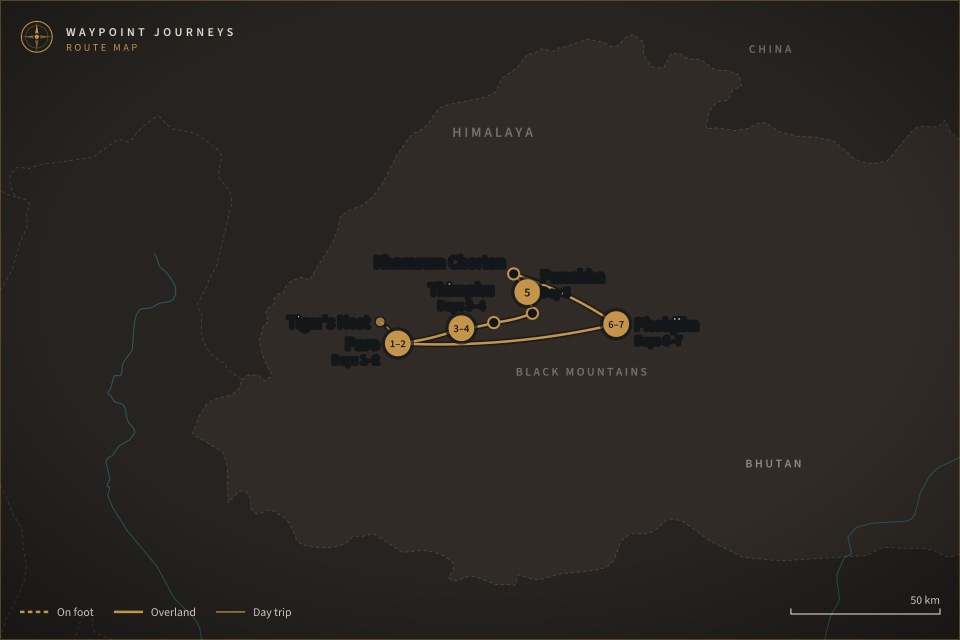
Bhutan is sui generis, and this itinerary treats it as such — covering the essential arc from Paro to the Phobjika valley with the unhurried pace the country demands: the Tiger's Nest, a hot stone bath, the phallus-painted Fertility Village, the most beautiful dzong in the country at Punakha, and the wintering grounds of the sacred black-necked crane.
"A country that briefly installed traffic lights, then removed them because they felt too impersonal — Bhutan tells you everything by what it chooses not to do."

A Kingdom Unlike Anywhere Else
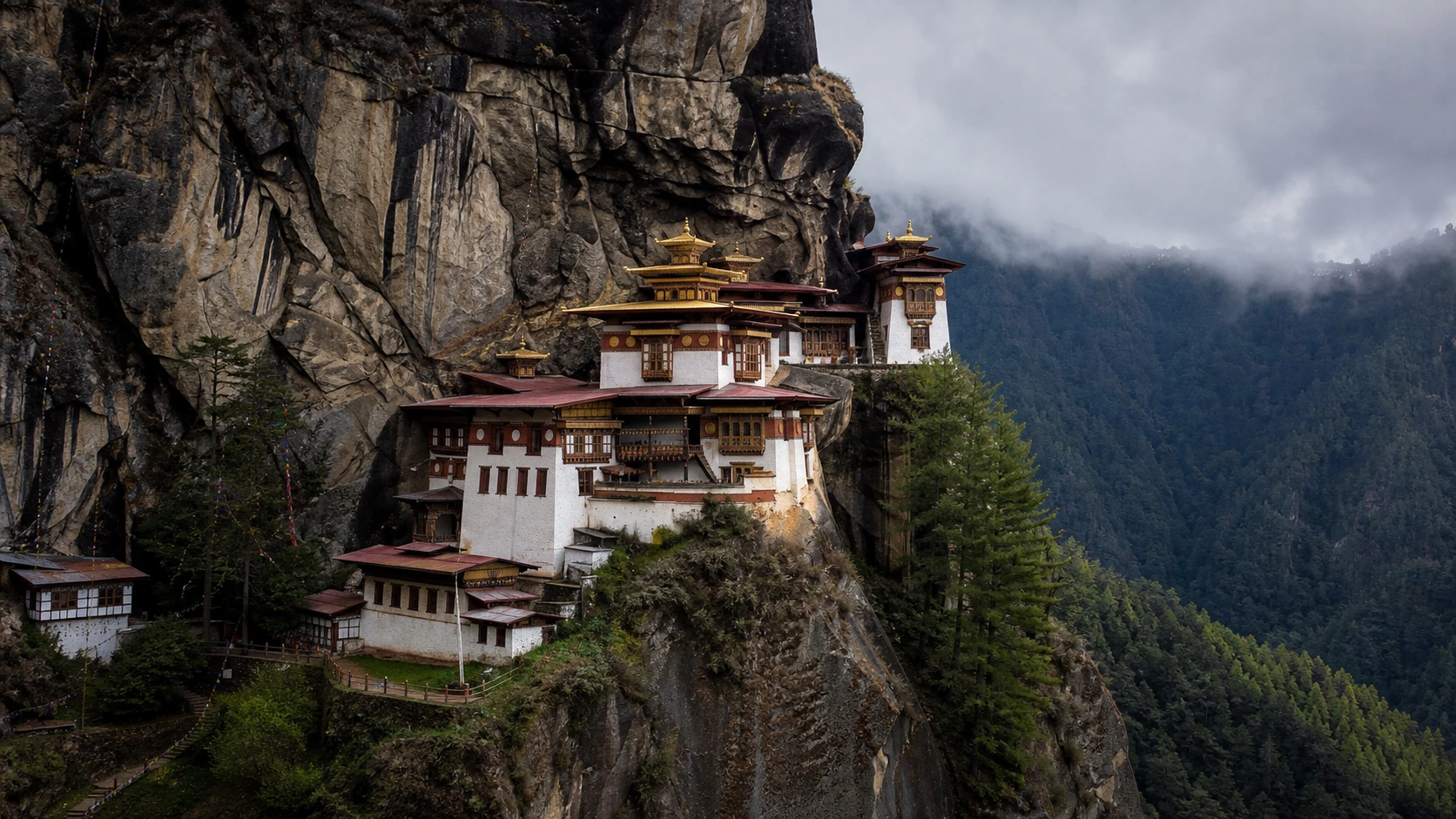
Paro Taktsang clings to a granite cliff 900 metres above the valley floor. Built in 1692 around the cave where Guru Rinpoche is said to have meditated, it is the most photographed sight in the Himalayas — and still feels like a pilgrimage.
The version almost nobody does: a two-day trek that camps on a 3,800-metre ridge above the clouds and descends to Tiger's Nest from above, arriving ahead of the crowds with the monastery below you rather than across from you.
In Sopsokha, every house is painted with vivid phalluses — ancient devotional iconography popularised by the 'Divine Madman' Drukpa Kunley. The 1499 Chimi Lhakhang nearby draws pilgrims seeking fertility blessings from across the world.
The most beautiful dzong in Bhutan, at the confluence of the Mother and Father rivers, flanked by jacaranda trees. Built in 1637, it remains the winter residence of the monastic body and holds some of the country's finest murals.
Each October, one of Earth's most endangered cranes migrates over the high Himalaya to winter in the Phobjika marshes. Local tradition holds that they circle Gangtey Monastery three times, clockwise, before landing.
At 3,088 metres, 108 white chortens arranged across the ridge, with the entire eastern Himalayan chain to the north — including Gangkhar Puensum, at 7,570 metres the highest unclimbed mountain on Earth.
The Expedition
Seven days from Paro to the Phobjika valley, at the pace the country demands.
The approach into Paro is one of the great arrivals in aviation — a steep descent through a tight river valley that only a handful of certified pilots may fly. Meet your guide and orient in the valley: the Rinpung Dzong straddling the river on a stone bridge, and the National Museum in the old watchtower above it. An evening walk along the river as the light drops.
The icon. The classic day hike climbs through prayer-flag-draped pine forest to a cafeteria viewpoint, then descends to a waterfall and climbs stone steps cut into the cliff — five to seven hours round trip. For the fit, the optional Bumdra extension (2 days, 1 night) camps on a 3,800-metre ridge and descends to Tiger's Nest from above, ahead of the crowds. Photography is not permitted inside the temples.
After yesterday's effort, a traditional Bhutanese hot stone bath: a wooden tub heated by river stones burning since morning, the minerals leaching into the water as they cool. In the late afternoon, dinner with a local farming family — ema datshi (the national dish of chillies and cheese), red rice, and whatever has come in from the garden — then the drive east to Thimphu.
Thimphu is the only capital in the world without a traffic light — a white-gloved officer directs the central intersection by hand. A full day covers the essential arc: the 51-metre Buddha Dordenma above the valley, the government fortress of Tashichho Dzong, the National Memorial Chorten where the elderly circle and spin prayer wheels, twelfth-century Changangkha Lhakhang, and the takin preserve — Bhutan's improbable national animal.
Cross the Dochula Pass (3,088m) — 108 chortens and, on a clear day, the entire eastern Himalaya. Descend into subtropical valley to Sopsokha, the Fertility Village, where every house is painted with phalluses; a twenty-minute walk through paddies reaches Chimi Lhakhang (1499), where a monk blesses pilgrims with a sacred wooden phallus. Close at Punakha Dzong, the most beautiful in Bhutan, at the confluence of the Mother and Father rivers.
A 45-minute morning climb through rice paddies and pine forest to the Khamsum Yulley Namgyal Chorten — four storeys of painted timber and gilded copper, its rooftop giving a 360-degree view of the Punakha valley. Then the road climbs over the Black Mountains (3,300m) and down into Phobjika: a broad, flat, treeless glacial basin at 3,000 metres, unlike anywhere else in Bhutan, with Gangtey Monastery on its forested knoll.
Phobjika is the winter home of the black-necked crane (October–February). The Gangtey Nature Trail descends six kilometres from the monastery through pine forest, bamboo, and open marsh — every habitat the valley contains. Then a three-hour drive returns to Paro for the late-afternoon flight out, the same canyon approach in reverse — this time you know what you are looking at.
What's Included
FREQUENTLY ASKED QUESTIONS
Common Questions About This Expedition
Expedition Investment
per person, twin share — excludes government fees
Fully inclusive of accommodation, licensed guide, private transport, listed experiences, entrance fees, and listed meals
Excludes Bhutan's mandatory government fees of $640 USD per adult (SDF + visa), paid separately to the Tourism Council. International airfare, insurance, and the optional Bumdra extension ($395 USD) not included. Single supplement $480 USD
Reserve Your SpotBhutan is one of the safest countries in Asia, with negligible crime and a tourism model built entirely around licensed guides and approved itineraries. Every guest travels with a certified Bhutanese guide and private driver throughout. The hikes we include are on well-maintained trails; the optional Bumdra camp is professionally catered and staffed. We monitor conditions and are glad to answer any specific questions directly.