Waypoint Journeys Presents
Five Flags
The Western Balkans
6 Days
Five Nations, Two Bridges, One Canyon — the Old Powder Keg, Now Pure Gold
View Expedition Details ↓ Plan This Expedition →We reply within 24 hours
Europe's Last Wild Corner, Five Countries Deep
The Western Balkans are what Europe was before it was tidied up: minarets and monasteries on the same skyline, coffee that arrives with ceremony and opinions, fortresses stacked on fortresses, and mountain roads that make drivers religious. Five small nations — Albania, North Macedonia, Kosovo, Montenegro, and Bosnia & Herzegovina — packed shoulder to shoulder, each certain the next one makes worse coffee.
In six days you thread all five: Ohrid, the lake so old and clear UNESCO protected the water itself; Skopje's gloriously strange statue-scape; Pristina, capital of Europe's youngest country, and Ottoman Prizren beneath its fortress; the black pines and glacial eyes of Durmitor; the Tara — Europe's deepest canyon; Sarajevo, where the twentieth century began and coffee never ends; Mostar's dive-worthy rebuilt bridge; and the fjord-like Bay of Kotor to finish.
We run it expedition-style: one leader, a private air-conditioned vehicle, five well-placed hotels, and borders handled like turnstiles. It is the espresso shot of the peninsula — short, strong, and impossible to forget. Maximum five guests, as always.
"Nowhere else in Europe do the mosques, monasteries, canyons and coastlines change nationality this fast — and stay this beautiful doing it."

A Sacred Lake, Europe's Deepest Canyon, the Street Corner That Started a Century, and a Bay That Thinks It's a Fjord
One of Europe's oldest and deepest lakes, ringed by early-Christian churches — a rare double UNESCO listing for both nature and culture. You walk the cobbled old town to the Church of St John at Kaneo, on its cliff above impossibly clear water, and understand instantly why monks picked this exact rock.
Montenegro means "Black Mountain," and Durmitor is the proof: glacial lakes like dark glass among black pines, and beside it the Tara River Canyon — 1,300 metres deep, the deepest in Europe — crossed on the elegant arc of the Đurđevića Tara Bridge. The optional summer rafting is legendary.
The old Ottoman bazaar where coppersmiths still hammer, ćevapi smoke drifts down the lanes, and Europe's faiths share a single square kilometre. A few steps away, the Latin Bridge corner where 1914 began. Sarajevo wears more history per street than any city on the continent — and serves the best coffee with it.
The single-arch Ottoman bridge that leapt the Neretva for 427 years, fell in 1993, and was rebuilt stone by stone from the same quarry — now a UNESCO symbol of a city stitched back together. Watch the local divers hurl themselves 24 metres into the green river, as they have for centuries.
A drowned river valley that performs as a fjord: black mountains straight out of the sea, Venetian walls climbing 260 metres of cliff behind the old town, and lanes below full of cats, campaniles and konobas. The Adriatic's most dramatic corner — and your grand finale.
Albania's double eagle, Macedonia's sun, Kosovo's six stars, Montenegro's golden lion, Bosnia's constellation — five borders crossed like turnstiles in one 1,300-kilometre sweep. Few journeys on Earth stack this much civilisational whiplash into six days, and none do it with better street food.
The Expedition
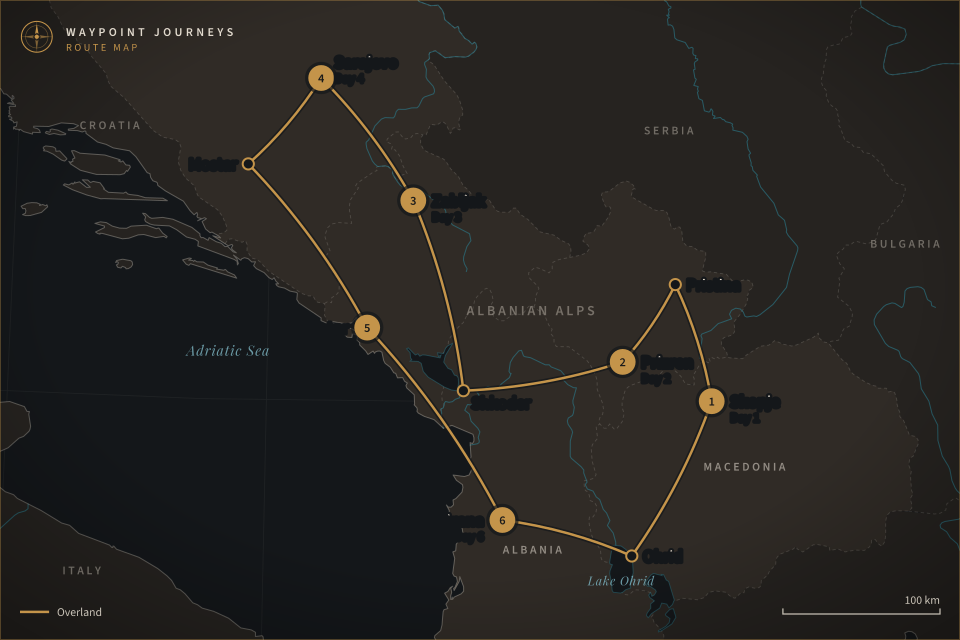
Six days, five nations, one great loop out of Tirana — lakes, fortresses, canyons, bazaars and bridges, with every border handled.
Pickup from your Tirana hotel at first light and east over the mountains into North Macedonia. The morning belongs to Ohrid — the cobbled UNESCO old town, Samuil's Fortress on its crown, and the Church of St John at Kaneo on its cliff above water so clear the fish look airborne. After a lakeside lunch, north to Skopje for the full tour of Europe's most gleefully eccentric capital: the Ottoman Stone Bridge, Macedonia Square's giant Alexander, the fortress walls and the old bazaar. First stamp, second stamp, day one.
North across the border into Kosovo, Europe's youngest state and statistically its youngest population — half the country is under thirty and the café scene proves it. In Pristina: the NEWBORN monument, the gloriously brutalist National Library (voted both ugliest and best building in the Balkans, depending who's voting), and Mother Teresa Boulevard's promenade. Then south to Prizren, Kosovo's Ottoman jewel — stone bridge, league house, mosque-and-church skyline — and the climb to the fortress for sunset over a thousand red roofs.
A day of magnificent geography. Back through the Albanian Alps' foothills to Shkodër, one of the oldest cities in Europe, where Rozafa Fortress rides its rock between two rivers and a lake — the legend of the walled-in bride is told on the spot. Then north into Montenegro, climbing hairpins into the karst until the world turns to black pines and grey towers of limestone: Žabljak, the Balkans' highest town, base camp for Durmitor National Park. Mountain air, mountain dinner, mountain sleep.
Morning at the Black Lake, Durmitor's glacial mirror under Međed peak — an easy, beautiful shoreline walk. Then the road tips over the edge of the Tara River Canyon, at 1,300 metres the deepest in Europe, crossed on the five-arch Đurđevića Tara Bridge with the river a green thread far below (summer departures can swap in a rafting run). Across the Bosnian border and down the Drina country to Sarajevo by evening — straight into the lantern-lit lanes of the Baščaršija for ćevapi and Bosnian coffee poured from a copper džezva.
Sarajevo in the morning light: the Gazi Husrev-beg Mosque, the Sacred Heart cathedral and synagogue within blocks of each other, City Hall's restored Moorish glory, and the Latin Bridge corner where a nineteen-year-old changed the twentieth century. Down the jade Neretva to Mostar for the Old Bridge — rebuilt stone by stone after 1993 — and lunch beneath it while the divers work up their nerve. Then the Herzegovina karst and the Adriatic reveal: into the Bay of Kotor by evening, mountains falling straight into the sea.
A slow morning inside Kotor's Venetian walls — the cathedral of St Tryphon, the maze of squares, the resident cats who own the place — with time, for the energetic, to climb the ramparts toward St John's fortress for the full postcard of the bay. Then the coast road south past Sveti Stefan's island silhouette and along the Adriatic into Albania, arriving back in Tirana by evening. Five flags, two bridges, one canyon, and roughly four hundred photographs later — drop-off at your hotel.
What's Included
FREQUENTLY ASKED QUESTIONS
Common Questions About This Expedition
Expedition Investment
per person
Fully inclusive of five nights' centrally located hotels with daily breakfast, private air-conditioned transport for the complete five-nation loop, Tirana hotel pickup and drop-off, your English-speaking expedition leader throughout, local guides in Sarajevo and Ohrid, and entrance fees to the major listed sites — Ohrid's churches and fortress, Rozafa, the Prizren fortress, Kotor old town and more
Excludes flights to/from Tirana, travel insurance, lunches and dinners, optional Tara rafting (summer departures), the Kotor city-walls climb, and tips
Reserve Your SpotThree decades on from the headlines, the Western Balkans are among Europe's safest and friendliest corners — violent crime against visitors is rare, and hospitality is a competitive sport. The practicalities are mundane: bring a passport with six months' validity and blank pages for five sets of stamps; carry some small-denomination euros (Montenegro and Kosovo use the euro; Albania, North Macedonia and Bosnia have their own currencies, and your leader handles the arithmetic). Mountain roads are winding and occasionally dramatic — our drivers know every curve. In Bosnia, stick to paved paths in rural areas; uncleared mine areas persist far off the beaten track, all well away from anywhere this route goes. Dress modestly in mosques and monasteries (scarves provided), and pace yourself on the coffee — it is stronger than it looks.