Waypoint Journeys Presents
The Mirror of the Sky
Bolivia · Salar de Uyuni & the High Andes
4 Days
Blood-Red Lagoons, Boiling Geysers & the Largest Salt Flat on Earth
View Expedition Details ↓ Plan This Expedition →We reply within 24 hours
The Altiplano Doesn't Do Ordinary
In the far southwest of Bolivia, above 4,000 metres, the planet stops behaving. Lagoons turn blood-red with algae and pink with flamingos that shouldn't survive here and do. Geysers roar out of a field of boiling mud at an altitude where jets cruise. Deserts painted like Dalí canvases — he never saw them, yet one is named for him anyway — run between volcanoes that hold up the border with Chile.
And then, at the end of it, the Salar de Uyuni: ten billion tonnes of salt spread across ten thousand square kilometres, the flattest place on Earth. In the dry months it is a white geometry lesson running to the curve of the planet; after rain it becomes something no photograph prepares you for — a mirror the size of a country, where the sky lies down on the ground and 4x4s drive through the clouds.
This is the classic high-route crossing from San Pedro de Atacama, done expedition-style: a dedicated Land Cruiser, a driver who reads this land like tarmac, nights in a hotel built of salt, and four days that feel like visiting several other planets on one tank of diesel.
"Four days above four thousand metres, where the lagoons are red, the deserts are surrealist, and the ground is a mirror for the sky."

A Salt Mirror, a Red Lagoon, a Geyser Field in the Sky, and an Island Made of Cactus
The largest salt flat on Earth and the flattest place on the planet — so flat that satellites use it to calibrate their instruments. Dry, it is a blinding white honeycomb running to the horizon; flooded, it becomes the world's largest mirror and the sky goes all the way to your boots. Sunrise here rearranges your standards permanently.
A shallow lake dyed blood-red by algae, edged with white borax islands and wading with thousands of flamingos — including the rare James's flamingo, which the world believed extinct until 1956 and which breeds almost nowhere else. At 4,278 metres, it is one of the strangest and most beautiful sights in the Americas.
At 4,900 metres — cruising altitude for small aircraft — a field of fumaroles, boiling mud pots and roaring steam vents marks the raw top of the Andes' plumbing. You arrive at dawn when the cold makes the steam columns tower, and walk (carefully) through a landscape that sounds like the planet breathing.
Under the perfect 5,916-metre cone of Licancabur, a lagoon of dissolved arsenic and copper turns emerald when the afternoon wind stirs it — poison has rarely looked this good. Beside it, Laguna Blanca sits milk-white and still: two lakes, two colours, one volcano, and the Dalí Desert's marooned boulders next door.
In the middle of the white nothing rises a fossil coral island bristling with giant cacti — some twelve metres tall and a thousand years old — left over from the ancient lake that became the Salar. You climb it at breakfast for the 360-degree view: white to every horizon, volcanoes floating on the heat haze.
On the Salar's shore you sleep in a hotel cut from the flat itself — salt-block walls, salt tables, salt beds under thick blankets, floors of loose salt crystals that crunch like snow. Add the refugio night under the altiplano's outrageous stars and the accommodation becomes part of the expedition, not a pause in it.
The Expedition
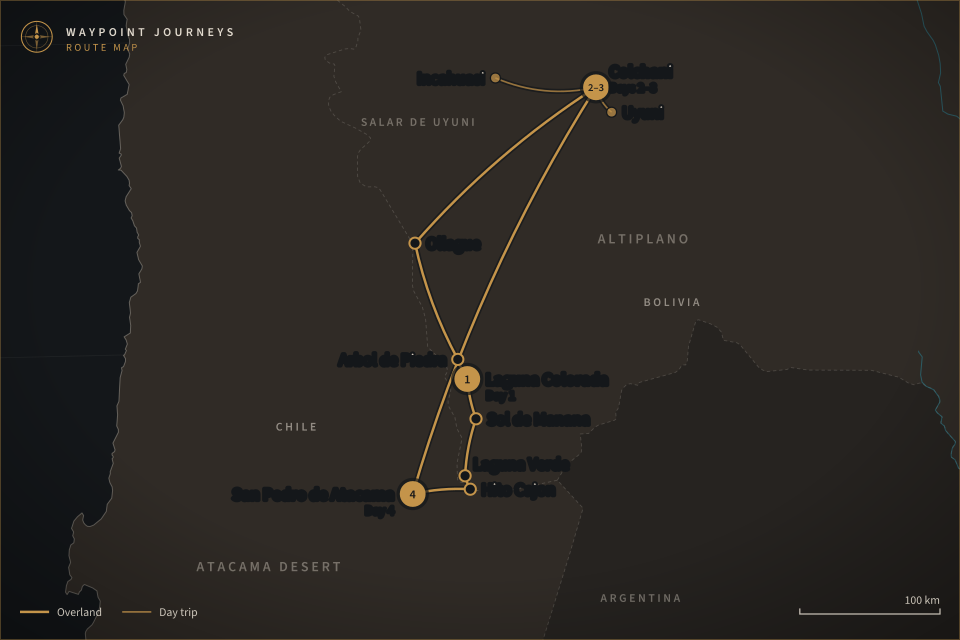
Four days by expedition Land Cruiser from San Pedro de Atacama — the coloured lagoons and geysers of the Eduardo Avaroa reserve, the Siloli Desert, and sunrise on the Salar de Uyuni.
Out of San Pedro de Atacama before the sun, up the switchbacks to the Hito Cajón border post at 4,500 metres, and into Bolivia — and immediately into the surreal. Laguna Blanca lies milk-white and dead still; Laguna Verde waits under Licancabur's perfect cone for the afternoon wind to turn it emerald. The Dalí Desert's stranded boulders, a soak in the Termas de Polques hot springs with flamingos for company, the roaring Sol de Mañana geyser field at 4,900 metres — and by late afternoon, Laguna Colorada, blood-red and impossible. Night at the refugio, under stars that need renaming.
Morning with Laguna Colorada's flamingos — thousands of them, including the once-thought-extinct James's — then north through the Siloli Desert, the driest corner of the driest region, where the wind has carved the Árbol de Piedra: a five-metre stone tree balanced on a trunk the width of a doorway. The chain of jewel lagoons follows — Honda, Ch'iarkota, Hedionda, Cañapa — each with its own colony of waders, while viscachas (rabbits doing a chinchilla impression) watch from the rocks. Past Ollagüe's smoking cone to the Salar's edge, and your first night inside a hotel built of salt.
The day everything has been driving toward. Onto the Salar in the dark, headlights on ten thousand square kilometres of nothing, to watch the sun come up over the world's largest salt flat — white hexagons to the horizon in the dry months, sky-on-the-ground mirror after rain. Breakfast beneath the thousand-year-old cacti of Incahuasi island, a morning of perspective photography (the toy dinosaur is traditional; we bring one), the salt harvesters' cones at Colchani, and the rust-and-silence poetry of the train cemetery outside Uyuni town. Sunset back on the flat, then the salt hotel's salt beds.
The long, magnificent run home: south across the altiplano with the whole reel playing again in reverse — volcanoes, lagoons, flamingos commuting between them, quinoa fields clinging to impossible slopes, and dust plumes marking the other Land Cruisers miles away. A picnic lunch somewhere with a hundred-kilometre view, the border formalities at Hito Cajón, and down the great switchbacks into Chile — 2,000 metres of descent that feels like landing — to arrive in San Pedro de Atacama by late afternoon, thicker-aired, salt-dusted, and permanently spoiled for scenery.
What's Included
FREQUENTLY ASKED QUESTIONS
Common Questions About This Expedition
Expedition Investment
per person
Fully inclusive of all three nights' accommodation (Laguna Colorada refugio and two salt hotels), a dedicated expedition Land Cruiser with professional driver-guide, San Pedro de Atacama pickup and both Hito Cajón border transfers, full board from Day 1 lunch to Day 4 lunch, expedition sleeping bags, oxygen on board, all listed excursions from the coloured lagoons and geysers to the Salar sunrise, Incahuasi and the train cemetery, and your expedition leader throughout
Excludes travel to/from San Pedro de Atacama, Bolivian entry formalities, reserve and Incahuasi entrance fees (~US$25, paid locally), refugio shower tokens, drinks and tips
Reserve Your SpotThe altiplano's hazards are environmental and entirely manageable: altitude first (acclimatise in San Pedro, hydrate relentlessly, tell your leader about any headache — our vehicles carry oxygen and the route always sleeps lower than it climbs), then cold (nights can hit −15°C in the austral winter; we provide expedition sleeping bags and the packing list is not a suggestion) and sun (the UV at 4,500 metres is ferocious — SPF50, sunglasses and a brimmed hat are required kit). The driving is on unmarked desert pistes, which is why we use experienced local drivers in well-maintained Land Cruisers rather than the cheapest 4x4 in the plaza. Border crossings at Hito Cajón are routine; bring your passport, some bolivianos and a sense of ceremony — you are crossing into somewhere genuinely else.