Skip to content

Waypoint Journeys Presents

Rome, Sand & the Maghreb

Tunisia & Algeria

8 + 8 Days

The Granary of Rome — Two Companion Expeditions Across the Ancient Province of Africa

8 + 8 DaysFrom $2,295 USDMax 5 guests

We reply within 24 hours

The Two Halves of Roman Africa

Tunisia and Algeria are the two halves of the ancient Roman province of Africa — the granary of Rome, the source of olive oil and grain that kept the empire running. The Roman ruins here are extraordinary and largely unvisited: Dougga and Timgad are among the finest preserved Roman cities in the world, comparable to anything in Italy, yet stand in near-complete solitude.

Tunisia adds the Sahara, the Berber south, Carthage, and Sidi Bou Said — the smallest and most accessible country in North Africa, where the Mediterranean coast connects to the Saharan south in a single day's drive. Algeria adds the drama of Constantine — a city perched on the edge of a 200-metre gorge, its bridges the only connection between the plateaus — and the Casbah of Algiers, a UNESCO labyrinth of Ottoman palaces and revolutionary history.

Neither country receives the visitors it deserves. Algeria is the largest country in Africa and receives fewer tourists annually than many European cities receive in a single weekend. We present the two as companion expeditions — run either one standalone, or both back to back for a single journey through the entire province.

"Dougga and Timgad are comparable to anything in Italy, yet stand in near-complete solitude. Neither country receives the visitors it deserves."
Constantine, Algeria — the city perched above the Rhumel gorge, spanned by the Pont El Kantara
Constantine, Algeria — the City of Bridges above its gorge

The Finest Roman Cities Almost Nobody Visits

Dougga & Timgad

Two of the best-preserved Roman cities anywhere — Dougga set on a Tunisian hillside with its Capitol temple and theatre virtually intact; Timgad, Trajan's military colony of 100 AD on the Algerian high plateau, its street grid as legible as the day it was laid out, both essentially crowd-free.

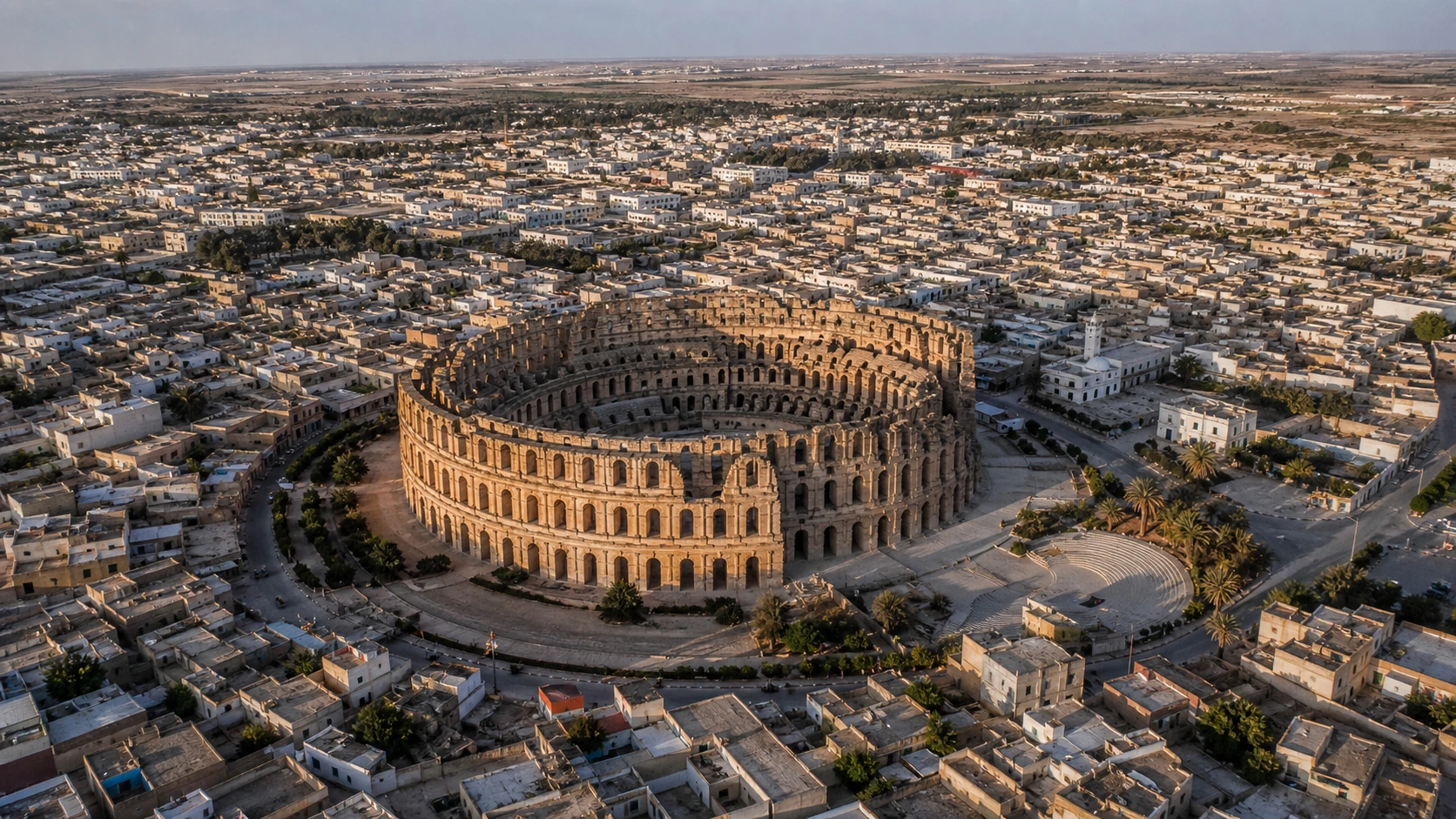
El Jem Amphitheatre

The third-largest Roman amphitheatre ever built — seating 35,000 — standing at the end of an ordinary street in a Tunisian market town of 20,000, intact to the upper gallery on most sides.

Constantine, City of Bridges

The old city occupies a limestone plateau cut off on three sides by a gorge, the Rhumel river 200 metres below, connected to the surrounding terrain by bridges spanning the centuries. The view from the Sidi M'Cid bridge is the definitive image of Algeria — and almost nobody has taken it.

Carthage & Sidi Bou Said

Carthage — Phoenician capital razed by Rome in 146 BC and rebuilt as a Roman city — beside the Mediterranean, its Antonine Baths the second-largest ever built. Fifteen minutes away, Sidi Bou Said: a hilltop village of blue doors and white walls above the bay.

The Sahara & Star Wars Country

From Tozeur's palm oasis across the Chott el-Jerid salt flat to the dunes of the south — the Ong Jemel rock formation and the troglodyte village of Matmata both served as filming locations for the original Star Wars, the landscape matching Tatooine so precisely it was used largely unchanged.

The Casbah of Algiers

A UNESCO hillside labyrinth of whitewashed walls, Ottoman palaces, and narrow stepped lanes climbing above the bay — the setting for Pontecorvo's 1966 film The Battle of Algiers, with a revolutionary history that shaped the twentieth century.

Two Companion Expeditions

Tunisia (Days 1–8) and Algeria (Days 1–8) — run either standalone, or both back to back. Combined pricing saves $295 USD.

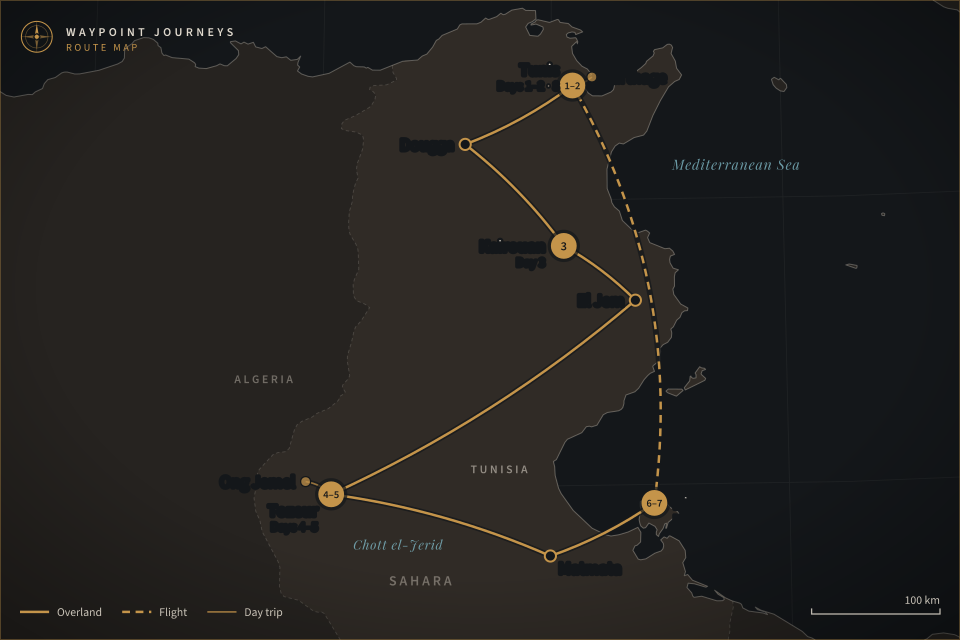
Tunisia · Day 1
Tunis · the Medina · Bardo Museum

The Medina of Tunis is a UNESCO World Heritage Site, a trading city since the ninth century — a tight grid of covered souks where perfumers, cloth merchants, leather workers, and spice sellers occupy distinct streets in an arrangement unchanged since the Ottoman period. The Bardo Museum holds the largest collection of Roman mosaics in the world, room after room of intact floors lifted from villas across the North African provinces.

Tunisia · Day 2
Carthage · Sidi Bou Said

Twenty minutes north of Tunis, Carthage sits beside the Mediterranean — founded by Phoenician settlers in the ninth century BC, razed by Rome in 146 BC, and rebuilt as a Roman city on the same site. The Antonine Baths give the most legible sense of the scale. Sidi Bou Said, a hilltop village of blue-painted doors and white walls overlooking the bay, is fifteen minutes away and as photographed as it is genuinely beautiful.

Tunisia · Day 3
Dougga · Kairouan

The drive inland takes us to Dougga — routinely cited as the best-preserved Roman city in North Africa. Set on a hillside above the Oued Khalled valley, the site is virtually intact: the Capitol temple, the theatre, the triumphal arch, the forum, and the Libyco-Punic mausoleum — accessible on foot, virtually unguarded, almost entirely crowd-free. The afternoon continues to Kairouan, one of the holiest cities in Islam; its Great Mosque, founded in 670 AD, is the oldest in the Maghreb.

Tunisia · Day 4
El Jem · drive south

El Jem is a market town of 20,000 in the middle of the Tunisian steppe, and it contains the third-largest Roman amphitheatre ever built — seating 35,000, constructed in the third century AD to serve the region's prosperous olive oil trade. The theatre is intact to the upper gallery on most sides. In the afternoon we drive south into the olive and almond country of the pre-desert, toward the edge of the Sahara.

Tunisia · Day 5
Tozeur · Chott el-Jerid · the Sahara

Tozeur is the gateway to the Saharan west: a palm oasis of 40,000 built on a spring that keeps two million date palms alive in otherwise extreme desert, its medina's ochre geometric brickwork unlike anything else in Tunisia. Beyond the oasis, the Chott el-Jerid is a vast seasonal salt lake — 5,000 square kilometres — that shimmers with persistent mirages in the dry months. Beyond it, the Ong Jemel rock formation, a Star Wars filming location, sits among the dunes.

Tunisia · Day 6
Matmata · Berber south · Djerba

Matmata is the village of the underground houses — troglodytic dwellings dug vertically into the soft rock, their courtyards open to the sky, occupied for generations as defence against summer heat reaching 45°C. Hotel Sidi Driss, the most famous, served as Luke Skywalker's childhood home in the original Star Wars. From Matmata, a drive to the coast and the causeway crossing to Djerba.

Tunisia · Day 7
Djerba · Houmt Souk · El Ghriba

Djerba is a flat, sun-bleached island off the southern coast, reached by a Roman-built causeway in use for two thousand years — the right place to close the land journey: whitewashed villages, a slow pace, a long beach. The El Ghriba synagogue, one of the oldest functioning synagogues in the world, is the centrepiece of an island that has maintained a small Jewish community continuously for more than two millennia. The souk in Houmt Souk sells the textiles and ceramics the island has produced since antiquity.

Tunisia · Day 8
Djerba · return to Tunis · depart

A morning flight from Djerba back to Tunis-Carthage for onward international connections, or a final night in Tunis for late departures. Those continuing to Algeria connect by a short flight to Algiers.

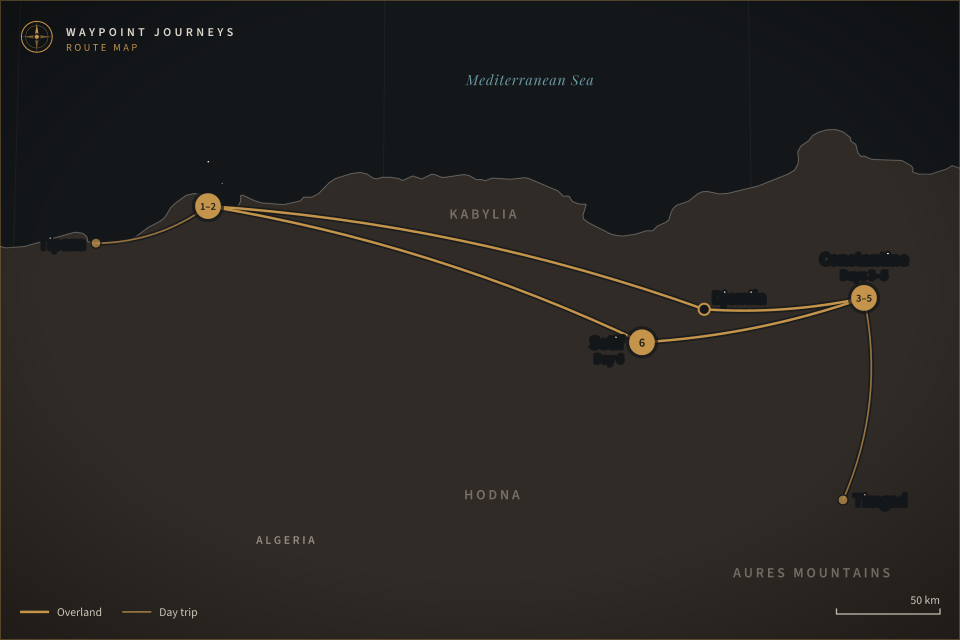
Algeria · Day 1
Algiers · the Casbah

The Casbah of Algiers climbs a steep hillside above the bay in a density of whitewashed walls, Ottoman palaces, and narrow stepped lanes. Built primarily in the sixteenth and seventeenth centuries, it was the setting for Pontecorvo's 1966 film The Battle of Algiers. The Dar Mustapha Pacha, an eighteenth-century palace with a carved-plaster interior of exceptional quality, and the Palais des Raïs, three restored Ottoman palaces, are the architectural centrepieces.

Algeria · Day 2
Tipaza · coast west of Algiers

The Roman ruins of Tipaza sit directly on the Mediterranean cliff edge west of Algiers: columns, basilicas, and mausolea growing from the coastal scrub, the sea visible through the ruins in every direction. Albert Camus, who grew up nearby, wrote about its melancholy in Nuptials with a precision the place still validates. The Mausoleum of Mauretania — a 30-metre circular tomb from the first century BC — stands a short drive inland, massive and almost entirely unvisited.

Algeria · Day 3
Drive to Constantine · Djemila

The road east from Algiers passes through the Kabyle region — the Berber heartland — to Djemila, a Roman city set in a narrow mountain valley near Sétif whose position required the grid plan to bend around the topography. The result is one of the most visually satisfying Roman sites in North Africa: a triumphal arch, a theatre, a Severan forum complex, and a museum housing the finest Roman mosaics in Algeria. Continue east to Constantine.

Algeria · Day 4
Constantine · City of Bridges

Constantine is not a standard stop on any itinerary, which is precisely why it should be. The old city occupies a limestone plateau cut off on three sides by a deep gorge — the Rhumel river runs 200 metres below — connected by bridges that span the centuries: the Roman Bab el-Kantara, the Ottoman-era Sidi Rached viaduct (27 arches), and the Sidi M'Cid suspension bridge, one of the longest in the world at its 1912 construction. The view from the Sidi M'Cid bridge is the definitive image of Algeria.

Algeria · Day 5
Timgad · the Roman north

Timgad — the Roman Thamugadi — was founded as a military colony by the Emperor Trajan in 100 AD on the high Aurès plateau and has been sitting there, largely intact, ever since. The street grid is as legible as the day it was laid out: the decumanus and cardo maximus, the forum, the library (one of the best-preserved in the Roman world), the Trajan Arch, and a 3,500-seat theatre. It is the best-preserved example of Roman urban planning outside Italy, standing on a semi-arid plateau at 1,000 metres, essentially deserted on most days.

Algeria · Day 6
Sétif · west toward Algiers

A final day in the northeast before returning toward the capital. The Sétif archaeological museum holds a substantial collection of mosaics and bronzes from the sites of the region. Sétif is also the site of the May 1945 massacre — the suppression of Algerian independence demonstrations on VE Day — an unavoidable context for any serious engagement with modern Algeria, and one we address directly rather than skirt.

Algeria · Day 7
Algiers · free day · optional Tlemcen

A day in Algiers at your own pace. The city repays slow attention: the Martyrs' Memorial on the hill above the port, the Museum of Fine Arts on the Trocadéro esplanade, the hammams of the lower Casbah, the fish restaurants along the corniche where the evening catch comes directly from the boats below. Or a day trip to Blida and the orange groves of the Mitidja plain, or a connection to Tlemcen — the Pearl of the West, a medieval Islamic city of Almoravid mosques near the Moroccan border.

Algeria · Day 8
Depart Algiers

Transfer to Houari Boumediene International Airport for onward connections.

Aerial view of the El Jem amphitheatre rising from the town, Tunisia

Small Group Expedition

The Granary of Rome.
Almost Entirely to Yourself.

What's Included

FormatTwo companion 8-day expeditions: Tunisia (7 nights) and Algeria (7 nights). Run either standalone, or both back to back
Group SizeSmall group expedition: maximum 5 guests
Guide & TransportPrivate vehicle and licensed guide throughout (a guide is mandatory by law in Algeria); all ground transport
Entrance FeesAll site entrances listed — Bardo Museum, Carthage, Dougga, El Jem (Tunisia); Tipaza, Djemila, Timgad, Casbah sites (Algeria)
Visa SupportTunisia is visa-free for most Western passports. Algeria requires a visa for most nationalities — we provide the Letter of Invitation documentation required for the application
MealsAll breakfasts daily; lunches on Days 3, 5, and 6; welcome dinner on Day 1 (each expedition)
Not IncludedInternational flights, Algerian visa fee, travel insurance, meals not listed, alcohol, and the Tunis–Algiers connecting flight (if combining)

FREQUENTLY ASKED QUESTIONS

Common Questions About This Expedition

Either. Tunisia (8 days, from $2,295 USD) and Algeria (8 days, from $2,495 USD) are designed as standalone expeditions. Booked back to back, the combined price is $4,495 USD — a saving of $295 USD — with a short connecting flight between Tunis and Algiers. Contact us to discuss routing.
Algeria requires all tourists to travel with a licensed guide by law, and most nationalities need a visa supported by a Letter of Invitation. We handle both — and the guide requirement is a genuine asset rather than a burden: an Algerian guide opens up the history, the language, and the context of sites that are otherwise entirely unexplained. We provide all LOI documentation.
The cultural and Roman heartlands covered by these itineraries — the northern coasts, the Tunisian centre and south, the Algerian north — are stable and welcoming, and the routes are well established. We travel with licensed local guides throughout, use trusted drivers and accommodation, and monitor conditions continuously. We avoid border regions and remote desert areas that carry travel advisories. We're glad to discuss the current picture directly.
Dougga, Timgad, and Djemila are comparable to the finest sites in Italy in their preservation — Timgad is often described as the best-preserved example of Roman urban planning outside Italy — but you will frequently have them almost entirely to yourself. The combination of quality and solitude is the whole point of this expedition.

Expedition Investment

$2,295USD

per person, twin share — Tunisia from $2,295 USD · Algeria from $2,495 USD

Each expedition fully inclusive of accommodation, private vehicle and licensed guide, listed entrance fees, and listed meals

Combined Tunisia + Algeria back to back: $4,495 USD per person (saving $295 USD). Single supplement $285 USD (Tunisia) / $310 USD (Algeria). Excludes international flights, Algerian visa, insurance, and meals not listed

Reserve Your Spot
A Note on Safety

These itineraries cover the stable cultural and Roman heartlands of both countries — the northern coasts, the Tunisian centre and south, and the Algerian north — on well-established routes. We travel with licensed local guides throughout (mandatory in Algeria), use trusted drivers and accommodation partners, manage all visa documentation, and monitor conditions continuously. We deliberately avoid border regions and remote desert areas that carry travel advisories. Both countries are welcoming and rewarding for the traveller who arrives prepared; we're glad to discuss the current picture directly before you book.