Skip to content

Waypoint Journeys Presents

Jordan

Petra and the Desert Road

8 Days

Amman · Jerash · The Dead Sea · Dana · Petra · Wadi Rum — Two Days at Petra, Because One Was Never Enough

8 DaysFrom $3,450 USDMax 5 guests

We reply within 24 hours

The Country Between Everything

Jordan is a small country in an extraordinary position, and it has spent three thousand years being the corridor everyone had to pass through. The King's Highway, running the length of the highlands, is one of the oldest continuously used roads on Earth; the Nabataeans grew rich taxing the frankincense that moved along it; Rome built a provincial city at Jerash that is now among the best-preserved anywhere; and the Crusaders, the Ayyubids and the Ottomans each left a castle on the ridge above it.

Petra is the reason most people come, and it does not disappoint, but it is also routinely underestimated. It is not a building at the end of a canyon; it is a city of more than a thousand carved monuments spread across a bowl of red sandstone mountains, and the walk to the Monastery alone is eight hundred rock-cut steps. Seeing it properly takes two days. Almost every itinerary gives it one, and almost everyone who does that regrets it.

What lifts the country beyond its monuments is the emptiness between them. The Dead Sea sits four hundred and thirty metres below sea level, the lowest dry land on the planet. Dana drops from Mediterranean highland to desert scrub inside one reserve. And Wadi Rum, where Lawrence rode and where half the film industry now shoots Mars, is a granite and sandstone desert on a scale that reduces vehicles to specks.

"Almost every Jordan itinerary gives Petra one day. It has over a thousand carved monuments and eight hundred steps to the Monastery. We give it two."
Ad Deir, the Monastery at Petra, Jordan
Ad Deir: eight hundred rock-cut steps above the city, and almost nobody there at eight in the morning

Two Full Days at Petra, a Roman City Almost Nobody Crowds, and a Night Under the Cliffs of Wadi Rum

Petra, Given the Time It Needs

The Siq and the Treasury are the opening, not the site. Two full days let you walk the Street of Facades and the Royal Tombs at the right hour, climb the eight hundred steps to Ad Deir when the light is on it, take the High Place of Sacrifice for the view down into the bowl, and come in a second morning through Little Petra and the back route, arriving at the Monastery from above with the crowds still down at the entrance.

Jerash: Rome, Almost Intact

Buried by an earthquake and forgotten for centuries, Jerash came out of the sand as one of the best-preserved Roman provincial cities anywhere: an oval forum ringed by columns, a colonnaded cardo with the chariot ruts still cut into the paving, two theatres, the Temple of Artemis and a hippodrome. It is comparable to anything in Italy or Turkey, and on most mornings you will share it with a handful of people.

A Night in Wadi Rum

Sandstone and granite mountains rise straight out of red sand across a valley you cross by open 4WD: Lawrence's Spring, the Khazali canyon with its Nabataean and Thamudic inscriptions, the great dunes and the rock bridges. You sleep in a Bedouin camp under cliffs that hold the last of the light, eat zarb cooked in an underground oven, and get a night sky that is genuinely one of the darkest accessible anywhere.

Four Hundred and Thirty Metres Below the Sea

The Dead Sea is the lowest dry land on Earth and nearly ten times saltier than the ocean, which means you do not swim in it so much as sit in it. An afternoon here is part spa and part geology lesson: the black mineral mud, the salt crusts along the shore, the hills of the West Bank across the water, and a sunset over Israel and Palestine from four hundred metres below where the rest of the world starts.

The King's Highway and Dana

The old road runs the spine of the highlands rather than the motorway's flat desert line, and it is the better country by a distance: the vast gorge of Wadi Mujib, the Crusader castle at Kerak, and the Dana Biosphere Reserve, which falls from 1,500 metres of Mediterranean highland to 50 metres of Rift Valley desert inside a single protected area, with a stone village on the cliff edge above it all.

Madaba, Nebo and the Mosaic Map

In the floor of a church in Madaba lies a sixth-century mosaic map of the Holy Land, the oldest surviving cartographic depiction of Jerusalem, laid out tile by tile. Twenty minutes away, Mount Nebo is the ridge from which Moses is said to have seen the promised land he would not enter, and on a clear day the view runs across the Jordan valley to the Dead Sea and the hills of Jerusalem beyond.

The Expedition

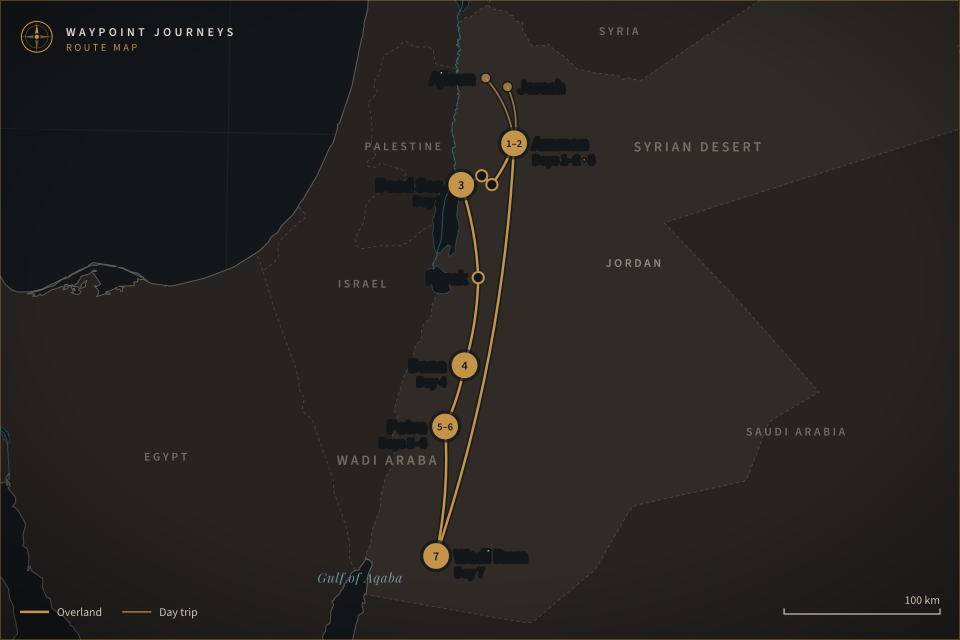
Eight days north to south: Roman Jerash, the mosaic map, the Dead Sea, the King's Highway, two full days at Petra and a night in Wadi Rum.

Day 1
Amman · arrival and the Citadel

Arrive at Queen Alia International and transfer into Amman, a city built across nineteen hills in pale limestone. The afternoon starts at the top: the Citadel on Jebel al-Qala'a, where the Temple of Hercules, an Umayyad palace and a Byzantine church stand on the same hill above the whole city, and where the Jordan Archaeological Museum holds the Ain Ghazal statues, among the oldest human figures ever made. Down to the Roman theatre in the old downtown, then Rainbow Street for dinner, and a first plate of mansaf or a very good mezze.

Day 2
Jerash and Ajloun · Rome and the Ayyubids

North through the olive hills of Gilead to Jerash, and a long morning in one of the most complete Roman cities in the world. Through Hadrian's Arch, past the hippodrome, into the oval forum with its ring of columns, then the length of the colonnaded cardo, chariot ruts and all, to the Temple of Artemis and the north theatre. In the afternoon, Ajloun Castle, the Ayyubid fortress Saladin's commanders built to watch the iron mines and the road to Damascus, with a view that on a clear day reaches the Jordan valley. Back to Amman for the night.

Day 3
Madaba, Mount Nebo and the Dead Sea

South to Madaba for the sixth-century mosaic map in the floor of St George's, the oldest surviving map of the Holy Land and still legible enough to find Jerusalem's cardo on. Then Mount Nebo, where Moses is said to have looked out over a land he would not enter, and the view still runs to the Dead Sea and beyond. In the afternoon the road drops, and keeps dropping, to four hundred and thirty metres below sea level: the rest of the day is the Dead Sea itself, the float, the black mud, and the sun going down behind the hills of the West Bank.

Day 4
The King's Highway · Wadi Mujib, Kerak and Dana

The old road south instead of the fast one, and worth every extra hour. Wadi Mujib first, a gorge of Grand Canyon proportions that the highway crosses on a long descent and climb. Then Kerak, the great Crusader castle on its ridge, with vaulted galleries and a keep looking out over the country Reynald of Châtillon terrorised until Saladin took it. In the late afternoon you reach Dana, a stone village on the edge of a cliff above a reserve that drops fifteen hundred metres to the Rift Valley, and stay there, with the whole gorge below the terrace at sunset.

Day 5
Petra · the Siq, the Treasury and the Monastery

Into Petra early, before the buses. The Siq takes twenty minutes on foot, a kilometre of gorge narrowing between two-hundred-metre walls with the Nabataean water channel still cut along the side, and then the Treasury appears in the gap the way it is supposed to. Beyond it the city opens: the Street of Facades, the theatre carved out of the rock, the Royal Tombs on the eastern cliff in the late morning light. In the afternoon, the eight hundred rock-cut steps up to Ad Deir, the Monastery, a facade fifty metres across on an empty summit.

Day 6
Petra · Little Petra and the back route

The second day is the one most itineraries never have. It starts at Siq al-Barid, Little Petra, a miniature Nabataean suburb up the valley with a painted ceiling still visible in one of its biclinia. From there a walking route drops over the hills into the main site from behind, arriving above the Monastery in the morning cool with the ordinary crowd still an hour away below. Back down through the city, and for those who want it the climb to the High Place of Sacrifice, the best single view over the whole bowl. Evening free in Wadi Musa.

Day 7
Wadi Rum · into the desert

An hour south, the highlands stop and Wadi Rum begins. You transfer into open Bedouin 4WDs at the village and spend the afternoon crossing the valley: Lawrence's Spring on the flank of Jebel Rum, the Khazali canyon with Nabataean and Thamudic inscriptions cut into its walls, the red dunes below Jebel Umm Ulaydiyya, and the rock bridge at Umm Fruth for anyone who wants to climb it. Sunset is taken from high on a sandstone shoulder, and the night is at a Bedouin camp under the cliffs, with zarb out of the ground and a sky with nothing in the way of it.

Day 8
Wadi Rum → Amman · departure

Sunrise on the desert from camp, when the rock goes from grey to orange in about ten minutes, then breakfast and the drive north. The Desert Highway returns to Amman in about four hours, and we time it to your flight; if there is room in the day we stop at Shobak, the first Crusader castle in Jordan and the least visited, standing alone on its hill. Transfer to Queen Alia. Jordan pairs naturally with our Oman, Lebanon and Syria expeditions, and we are glad to sequence them.

The Siq at Petra, Jordan

Small Group Expedition

A Thousand Carved Monuments.
Two Days to Meet Them.

What's Included

Duration8 days / 7 nights: two nights Amman, one at the Dead Sea, one at Dana, two at Petra, one in Wadi Rum
Group SizeSmall group expedition: maximum 5 guests
AccommodationBoutique hotels in Amman and Wadi Musa, a Dead Sea resort with private shore access, the cliff-edge lodge at Dana, and a Bedouin camp in Wadi Rum with private tents and proper bathrooms
Entrance FeesAll included: the Jordan Pass covering Petra for two consecutive days, Jerash, Ajloun, Kerak, Shobak and Wadi Rum, plus the Dana reserve fee. The Jordan Pass also waives your tourist visa fee
Included ExperiencesThe Amman Citadel and Roman theatre; a full morning at Jerash and Ajloun Castle; the Madaba mosaic map and Mount Nebo; a Dead Sea afternoon; the King's Highway with Wadi Mujib and Kerak; two full days at Petra including Ad Deir and Little Petra with the back route; a half-day Bedouin 4WD tour of Wadi Rum with a camp night
TransportPrivate air-conditioned vehicle with driver throughout, open Bedouin 4WDs inside Wadi Rum, and all airport transfers
GuideA licensed English-speaking Jordanian guide for the full eight days, with a specialist Petra guide on the first Petra day and Bedouin guides in Wadi Rum
MealsDaily breakfast, dinner at Dana and in the Wadi Rum camp, and the farewell dinner. Other lunches and dinners are left free; Jordan eats extremely well and your guide keeps the list
Best SeasonMarch to May and September to November are ideal. Summer is very hot at Petra and in Rum; winter is cold and can bring snow to Petra and Dana, which is spectacular but occasionally closes roads
Not IncludedInternational flights to Amman, travel insurance, free-time meals, alcohol, the optional Petra by Night ticket, horse or camel rides inside Petra, and personal expenses

FREQUENTLY ASKED QUESTIONS

Common Questions About This Expedition

Because one day is a tour of the entrance. Petra covers about sixty square kilometres with more than a thousand carved monuments; the walk from the gate to the Monastery and back is roughly sixteen kilometres with eight hundred steps in the middle. Two days lets you take the Royal Tombs in good light, climb Ad Deir without racing it, and come in a second morning by the Little Petra back route, which puts you above the Monastery before the day crowd reaches it.
The core days are 8–14 km on mostly good ground. Two optional climbs are steep: the 800 rock-cut steps to Ad Deir and the shorter, sharper ascent to the High Place of Sacrifice. Both can be skipped entirely, and there is plenty of Petra at valley level to fill the time. Donkeys and horses are available inside the site; we do not include them, because welfare standards vary and we would rather not vouch for what we cannot control.
It is included and it does two things. It bundles Petra for two consecutive days with Jerash, Ajloun, Kerak, Shobak, Wadi Rum and dozens of other sites, which on this itinerary is already better value than paying separately. It also waives the tourist visa fee at the border, provided you buy it before you fly and stay at least three nights, which you will. We buy it for you and send the QR code before departure.
Jordan is stable, well policed and has run tourism as a national industry for decades; violent crime against visitors is rare and the whole route on this itinerary sits far from any border of concern. The Dead Sea and Jordan Valley roads look close to the West Bank on a map but are ordinary, well-travelled highways. We monitor conditions continuously, our guide carries the authority to re-route, and we brief every confirmed traveller in detail before departure.

Expedition Investment

$3,450USD

per person, twin share

Fully inclusive of the Jordan Pass with two consecutive days at Petra and every listed site entrance; seven nights' accommodation including the Dead Sea, the cliff lodge at Dana and a Wadi Rum camp; a licensed English-speaking Jordanian guide for all eight days; a private air-conditioned vehicle throughout plus the Bedouin 4WDs in Rum; the Dana reserve fee; and daily breakfast with dinner at Dana, in Wadi Rum and a farewell dinner

Excludes international flights to Amman, travel insurance, free-time meals, alcohol, the optional Petra by Night ticket, and personal expenses. The Jordan Pass waives your tourist visa fee. Single supplement $795 USD

Reserve Your Spot
A Note on Safety & Logistics

Jordan is one of the most straightforward countries in the region to travel in: it has run tourism as a national industry for half a century, the sites are well managed, the police presence around them is visible and unobtrusive, and crime against visitors is rare. The practical risks on this itinerary are physical rather than political. Petra is a large, hot, uneven archaeological site where the main injuries are ankles and heat, so we walk it early, carry water and keep the pace sane; the climbs to Ad Deir and the High Place are steep, unfenced in places, and entirely optional. Wadi Rum driving is done by Bedouin drivers in their own valley, and the camps are in radio contact. Dana's trails are exposed and we walk them with the reserve's own guides. The regional picture is monitored continuously, our guide carries the authority to re-route, and every confirmed traveller is briefed in detail before departure.