Waypoint Journeys Presents
Brunei
The Abode of Peace
4 Days
Bandar Seri Begawan · Ulu Temburong · Kampong Ayer, Rainforest and Sultanate on the Coast of Borneo
We reply within 24 hours
The Quiet Kingdom on the Coast of Borneo
Brunei Darussalam is two small enclaves of jungle and coastline on the north shore of Borneo, wrapped on every landward side by Malaysian Sarawak, and it is what is left of a sultanate that once claimed the whole island and much of the Philippines besides. The court has run without interruption since the fourteenth century, which makes it one of the oldest continuous monarchies on Earth. Fewer than half a million people live here, and in a normal year the country receives a small fraction of the visitors who pass through Bali in a single week.
Oil came ashore at Seria in 1929 and changed everything except the forest. The revenue bought a citizenry with no income tax, free healthcare and schooling, a mosque sheathed in gold leaf on a lagoon in the middle of the capital, and a palace with 1,788 rooms that remains the largest residential building in the world. What it also bought, almost by accident, was the absence of a logging industry: more than seventy percent of Brunei is still primary rainforest, the highest proportion anywhere in Borneo, and the wildest of it is a national park most Bruneians have never needed to cut a road to.
Four days is the right length for a country this size, and this expedition uses all of them. A speedboat through the mangroves and a shallow wooden longboat poled up the rapids of the Temburong River to the canopy walk in Ulu Temburong. A morning in Kampong Ayer, the thousand-year-old water village that is still home to thousands of people living on stilts above the tide. Both of the great mosques, the Sultan's palace across the water, and a dusk cruise on the Brunei River for the proboscis monkeys that live nowhere else on Earth.
"A country that struck oil and kept its forest. Forty minutes from a gold-domed mosque, the road simply ends and the river takes over."

A Canopy Walk, a Water Village, and the Best-Kept Rainforest in Borneo
An aluminium tower bolted to a ridge in the middle of untouched dipterocarp forest carries a walkway to roughly forty metres above the ground, level with the crowns of trees that were mature before Brunei found oil. You climb at dawn, when the mist is still lying in the valleys and the gibbons and hornbills are working the canopy below you, and the forest runs unbroken to the horizon in every direction.
People have lived over this stretch of the Brunei River for a thousand years, and thousands still do: a lattice of stilt houses, mosques, schools, shops and a fire station strung together by kilometres of boardwalk, with water taxis instead of buses. Antonio Pigafetta, sailing with Magellan, described it in 1521 as a city built entirely on salt water. It still is.
The proboscis monkey lives on Borneo and nowhere else, and the mangrove creeks a few minutes upriver from the capital hold one of the easiest populations in the world to see. Late afternoon is when the troops come down to the water's edge to feed and settle for the night: pot-bellied, russet, the dominant males carrying the extraordinary pendulous nose that gives them their name. Silvered langurs, macaques, kingfishers and the occasional estuarine crocodile share the same banks.
The Omar Ali Saifuddien Mosque stands on its own artificial lagoon in the middle of the capital, Italian marble under a dome of pure gold leaf, with a replica sixteenth-century royal barge moored in front of it. Across town the Jame' Asr Hassanil Bolkiah answers it with twenty-nine gilded domes, one for each Sultan of the line. Between them, the 1,788 rooms of Istana Nurul Iman: the largest residential palace in the world.
There is no road into the heart of Ulu Temburong. You go the way the Iban always have: a narrow wooden temuai, sitting almost at water level, driven up a shallow brown river against the current while the boatman reads the gravel and picks his line through the rapids. Forest closes over both banks, spray comes over the gunwale, and you arrive at the park properly wet and entirely committed.
Brunei sells no alcohol, so the social life of the capital happens over food, and it happens at the Pasar Malam Gadong from late afternoon onward. Grilled stingray and satay over charcoal, pulut panggang steaming in banana leaf, trays of coloured kueh, sugarcane juice pressed to order, and ambuyat, the sago porridge eaten with a bamboo fork that is the closest thing the country has to a national dish.
The Expedition
Four days out of Bandar Seri Begawan: one for the capital, one for the rainforest across the bay, one for the sultanate and the river, and every transfer, boat and permit already handled.
Land at Brunei International, ten minutes from the middle of the capital, and meet your guide in arrivals. The afternoon starts gently, on foot: the Omar Ali Saifuddien Mosque on its lagoon, where the ceremonial barge sits on the water and the gold dome does what it was built to do at the end of the day, then the Royal Regalia Museum, which is where the coronation chariot, the jewelled crowns and sixty years of state gifts live. As the light goes, we drive out to Gadong for the Pasar Malam, the night market that is the real evening in Brunei: charcoal smoke, grilled stingray, sticky rice in banana leaf, and a first plate of ambuyat if you are willing. Dinner is here, standing up, and it is better than it sounds.
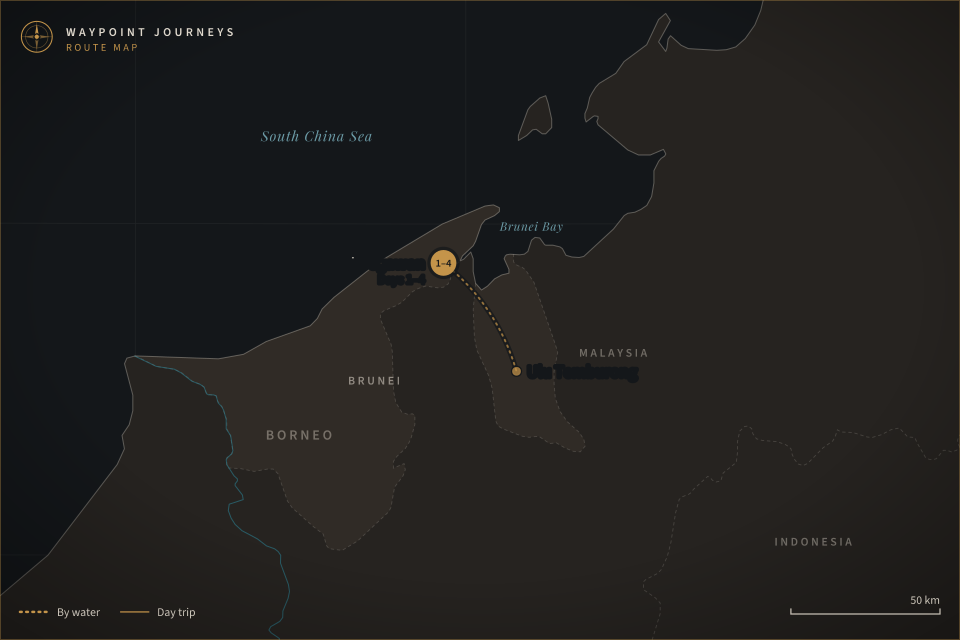
The big day, and an early one. A speedboat leaves the city wharf and runs east through the mangrove channels of Brunei Bay to Bangar, in the Temburong enclave, then a vehicle carries you upriver to Batang Duri where the road gives out. From there it is a temuai, a shallow wooden longboat, poled and driven up the Temburong River through the rapids to the park jetty, with the forest arching overhead the whole way. Morning tea at the lodge above the water, then the walk in and the climb: a boardwalk through the trees, and roughly 250 metres of staircase up an aluminium tower to the canopy walkway forty metres above the forest floor, with the crowns of the dipterocarps at eye level and unbroken rainforest to the horizon. Lunch is cooked by the lodge and eaten over the river, and the afternoon is spent in the cold pools below the falls, where the little fish will clean your feet if you sit still for them. Back in the capital by evening.
A water taxi takes you across to Kampong Ayer after breakfast, and you spend the morning walking its boardwalks with a resident: a settlement of stilt houses over the tide that has been continuously inhabited for a thousand years, with its own schools, mosques, shops and fire station, and a small museum that explains how it worked before the bridges. Back on land, the Jame' Asr Hassanil Bolkiah Mosque and its twenty-nine golden domes, the water-village boat builders, and a slow pass by the gates of Istana Nurul Iman, the Sultan's 1,788-room palace on the bluff above the river. Then the best hour of the trip: a small boat upstream at dusk into the mangrove creeks for proboscis monkeys coming down to the water, silvered langurs in the branches above them, kingfishers, and, if the tide is right, a crocodile holding station in the channel. Farewell dinner back in town.
A quiet last morning, shaped around your flight. Depending on the departure time there is room for the Malay Technology Museum on the riverbank, the Tamu Kianggeh produce market, or simply a long breakfast and the hotel pool, and your guide will steer you to whichever fits. The airport is ten minutes from the hotel, so nobody is rushed. Brunei sits an hour from Kota Kinabalu, two from Kuching and two and a half from Singapore, so this expedition extends easily in either direction; if you want Sabah, Sarawak or a few days on the coast added to the end, tell us before you book and we will build it.
What's Included
FREQUENTLY ASKED QUESTIONS
Common Questions About This Expedition
Expedition Investment
per person, twin share
Fully inclusive of three nights' central Bandar Seri Begawan accommodation; the complete Ulu Temburong day with speedboat, longboat, national-park entry and canopy-walkway permit; Kampong Ayer with a resident guide; both great mosques and the palace viewpoint; the dusk proboscis-monkey river cruise; private vehicle and all airport transfers; a licensed Bruneian guide throughout; daily breakfast, the night-market dinner, lunch in Temburong and the farewell dinner
Excludes international flights, travel insurance, visa fees where applicable, remaining meals and personal expenses. Single supplement $450 USD. Extensions into Sabah, Sarawak or Singapore can be added on either end
Reserve Your SpotBrunei is among the safest countries we operate in anywhere: violent crime is close to non-existent, the roads are excellent and largely empty, the tap water is drinkable, and the health system is a good one. What deserves respect here is the climate, the river and the local law. Equatorial heat and humidity are the real difficulty on the canopy climb, so we go early, carry water and set the pace by the slowest person. The Temburong crossing and the longboat depend on tide and river level, and if the boatmen say the water is wrong we move the day rather than argue with it. Brunei applies Islamic law: alcohol is not sold, modest dress is expected at the mosques and we bring the robes, and public behaviour during Ramadan is taken seriously. None of it is onerous, and your guide handles the etiquette before it becomes a question.