Skip to content

Waypoint Journeys Presents

Mount Hagen

The Greatest Sing-Sing on Earth

8 Days · August 11–18, 2027

The Paiya Pre-Show, Both Festival Days, the Skeleton Men of Simbu and the Asaro Mudmen at Dawn

8 DaysFrom $3,395 USDMax 5 guests

We reply within 24 hours

A Hundred Tribes, One Field, Two Days

Mount Hagen sits at about 1,650 metres in the Waghi Valley, a broad green trench in the Western Highlands that Australian patrol officers only reached in the 1930s and found, to their astonishment, full of people. Something close to a million of them, farming sweet potato in valleys nobody outside had mapped. The show began here in 1961 for a practical reason: the administration wanted clans who had been fighting each other to stand in the same field for two days without anyone getting hurt. It worked, and it kept going. Sixty-odd years later it is the largest gathering of its kind anywhere.

What arrives is not a stage production. Groups come from all seven Highlands provinces and from the Sepik and the coast, some of them travelling two days by truck, and they compete on decoration and performance rather than on land or pigs. Bird of paradise plumes that a family has kept wrapped in leaves for a generation. Kina shell on the chest. Ochre, charcoal and pig grease worked into faces over four or five hours. The Huli come in their human-hair wigs, the Simbu men come painted as skeletons, and somewhere in the middle of it a hundred kundu drums find the same beat.

This week is built to see all of that properly rather than quickly. We take the Paiya sing-sing on the Friday, which is where the photographers go, then both days of the main show with an early start so you are at the preparation ground while the paint is still going on. Then we drive east down the Highlands Highway to Mindima for the Simbu skeleton men and out to the Asaro valley at first light for the mudmen, which is the only hour of the day those clay masks look the way they are supposed to.

"Nobody performs at Hagen. They arrive as themselves, in the best their clan owns, and let you look."
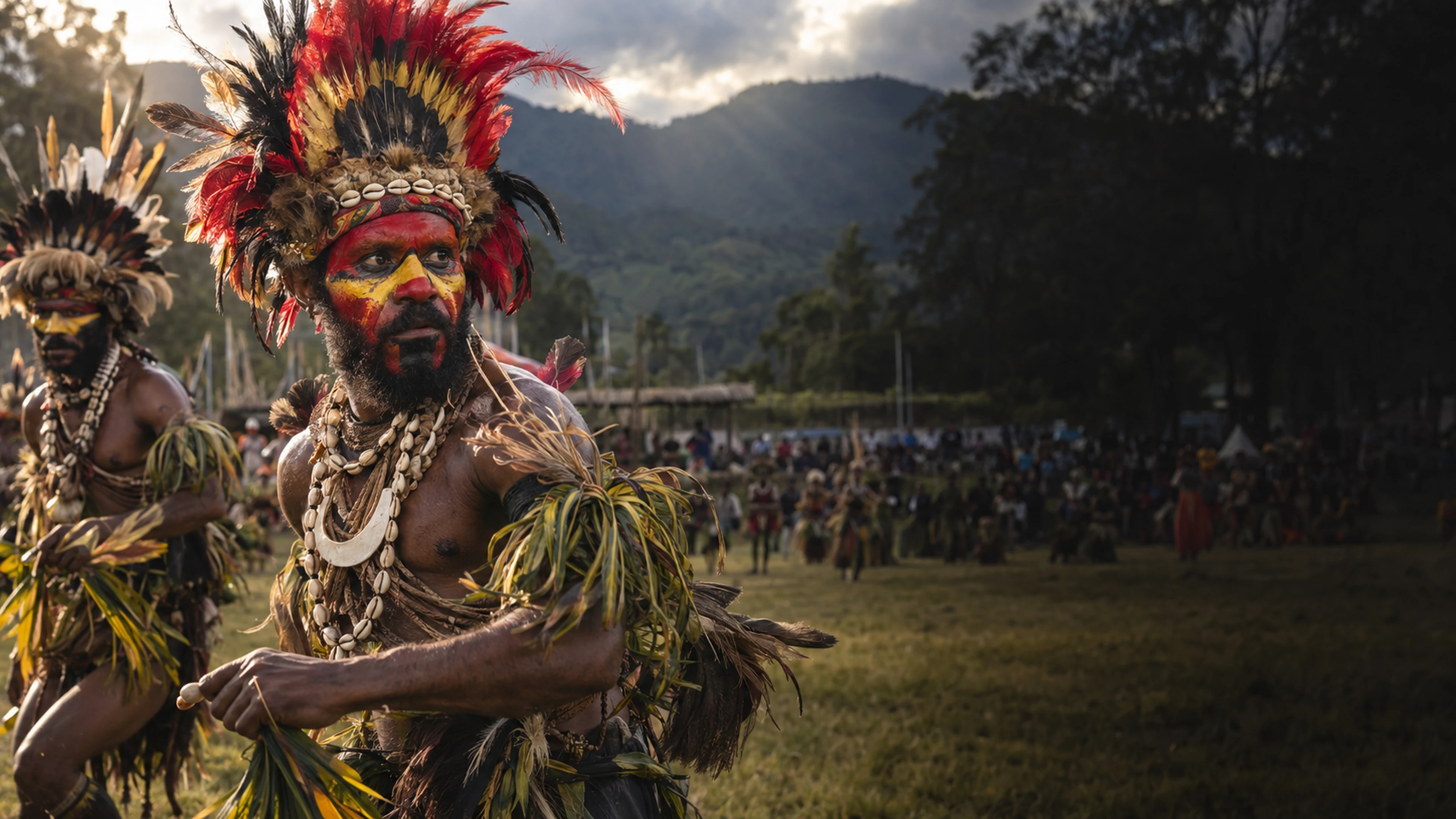
Highlands dancer in a feathered headdress and kina shell crescent at the Mount Hagen Show
Plumes, ochre and kina shell: a Highlands dancer before the grounds open

Three Days of Sing-Sing, Then the Road East

The Paiya Pre-Show

On the Friday, about fifty groups gather in a Melpa village an hour outside Hagen for a sing-sing held the day before the main event. Bush and grass behind the dancers instead of steel fencing and sponsor banners, no local crowd to work around, and time to photograph people one at a time. Most Hagen itineraries go straight to the show and miss it entirely.

Both Days of the Show

Two days, not one. The groups rotate, the light changes, and what you missed on Saturday because you were watching something else comes past again on Sunday. It also takes the pressure off: nobody spends day one worrying about getting the shot. We hold reserved seating and keep a fixed meeting point so you can wander and still find the group.

The Preparation Ground

The dancing is the last part of the day. Behind the arena, from soon after dawn, families work charcoal and ochre into each other's faces, tie plumes into headdresses and argue about whether the shell sits straight. We go in early, before the arena fills, because that hour is quieter, closer and more revealing than anything that happens later under the midday sun.

The Skeleton Men of Simbu

At Mindima, in Simbu province, men paint themselves as skeletons and act out the story of the Omo Masalai, a cave spirit their ancestors are said to have driven off by disguising themselves as the dead. They dance it on a hillside above their own village rather than in an arena, and the performance is closer to theatre than to parade.

The Asaro Mudmen at Dawn

The mudmen are on every poster about Papua New Guinea and are usually seen badly, in flat light, in a car park. We drive out of Goroka before sunrise so the clay heads come out of the treeline while mist is still sitting in the Asaro valley. It takes an early alarm and it is worth it. The masks are heavy fired clay, and the men wearing them cannot see much.

The Highlands Highway

The single road that links the Highlands provinces runs from the Waghi Valley over the Daulo Pass at about 2,450 metres and down into the Asaro valley at Goroka. It is one of the great drives in the Pacific: coffee gardens, cloud sitting in the side valleys, market stalls of pitpit and betel nut, and roadside villages that turn out to watch the vehicle go past.

The Expedition

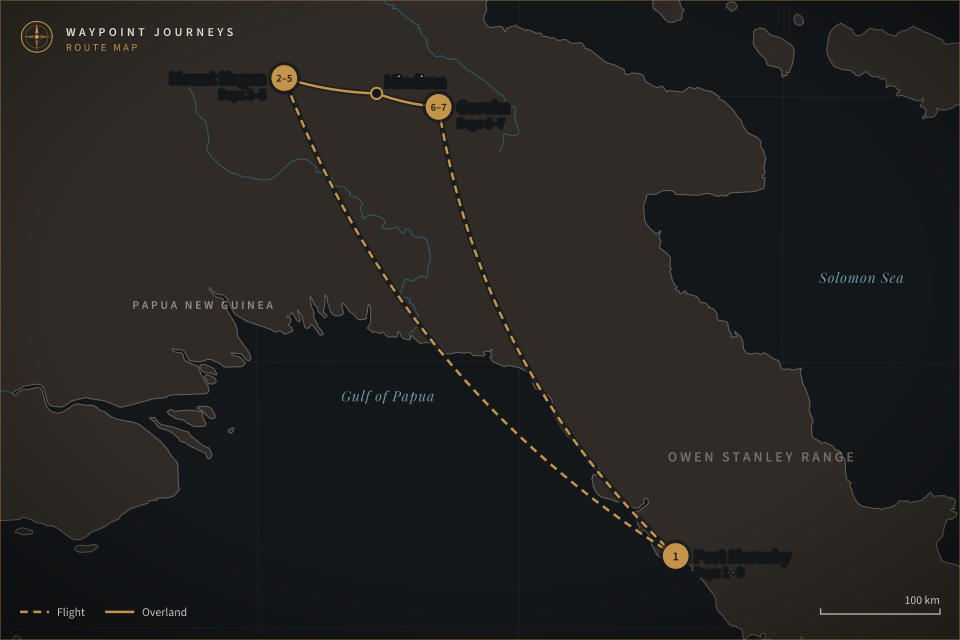
Eight days, seven nights: one in Port Moresby, four in Mount Hagen, two in Goroka. The show weekend sits in the middle with room on either side.

Day 1
Port Moresby · arrival
Wednesday 11 August

Fly into Port Moresby from Brisbane, Singapore, Manila or Cairns, arriving at whatever hour your connection allows. We meet you inside the terminal and drive you to the hotel; nobody arrives in this city and finds their own taxi. The rest of the day is deliberately empty so you can sleep off the flight. If you land early there is time for the National Museum and Art Gallery and the Nature Park, where the captive birds of paradise are a useful preview of the plumes you are about to see worn. We gather in the evening for dinner and the briefing: how the show week runs, what the days look like, and the handful of things worth knowing before we fly into the Highlands.

Day 2
Fly to Mount Hagen · the Waghi Valley
Thursday 12 August · flight POM–HGU, about 1h35

A morning flight over the Owen Stanley Range into Kagamuga, the airfield outside Mount Hagen. The temperature drops about ten degrees as you climb: the Highlands are cool, often wet, and nothing like the coast. We check in, then spend the afternoon getting the measure of the valley. Hagen's main market is one of the best in the country, stacked with sweet potato, taro, pitpit, strawberries and bilum bags, and busy in a way that takes a few minutes to get used to. Afterwards we drive out through the coffee gardens that pay for most of this province, stop at a smallholder washing station to see how the cherry is pulped and dried, and take in the valley from a ridge above the town before dinner.

Day 3
The Paiya sing-sing
Friday 13 August · the day before the show

The best photographic day of the week, and the reason to come a day early. An hour southwest of Hagen, the village of Paiya hosts a sing-sing on the eve of the main show. Around fifty groups perform, most of them competing at Hagen the next day, but here they do it on grass with bush behind them and no crowd to shoot over. We arrive while the painting is still going on, watch the groups come in one by one through the morning, eat what the hosts cook in a stone-and-banana-leaf earth oven, and spend the afternoon working with individual dancers who are happy to stand for a portrait away from the line. Those who want an early start can add a pre-dawn run up the Enga road to a Highlands lodge feeding table where ribbon-tailed astrapia and brown sicklebill come in at first light.

Day 4
Mount Hagen Show · day one
Saturday 14 August

We are at the ground early, while the arena is still empty and the work is happening behind it. Groups arrive by truck and by foot and set up wherever they can find space: wigs unwrapped from leaves, ochre mixed in a tin, a father drawing his son's face from memory. This is the part most visitors miss because they turn up when the dancing starts. By late morning the groups begin entering the arena, and they keep coming for hours, Huli wigmen, Melpa, Enga, Simbu, Sepik groups with carved masks and drums that carry across the whole field. Lunch is a packed one, eaten where you are standing, because leaving means losing your place. We finish when the ground empties in the late afternoon and go back to wash off the dust.

Day 5
Mount Hagen Show · day two
Sunday 15 August

Day two is calmer, and better for it. You know the ground, you know which groups you want to find again, and the pressure of seeing everything at once has gone. Judging happens today, so the biggest groups save something for the afternoon. We stay through the main performances, then leave before the crowd does and drive out of town to a river below the valley rim to swim, or simply to sit somewhere quiet after three days of noise. In the evening we are hosted at a village near Hagen: a fire in the middle of the round house, food cooked in the ground, and the sort of long unhurried conversation that never happens in an arena.

Day 6
Highlands Highway · Mindima · Goroka
Monday 16 August · about 270 km, a full day

East out of the Waghi Valley on the Highlands Highway, the single road that ties these provinces together. We climb over the Daulo Pass at around 2,450 metres, where cloud sits in the gaps and the gardens run up slopes too steep to look farmable, and stop where the view or the market is worth it. At Mindima, in Simbu, the skeleton men are waiting. They paint on a hillside above the village and then perform the Omo Masalai, the story of ancestors who disguised themselves as the dead to drive a cave spirit out. It is done at close range on their own ground, not on a stage, and it is unnerving in the best way. We reach Goroka in the late afternoon; if there is light left, the J.K. McCarthy Museum has the photographs from the 1930s patrols, taken when Highlanders and Australians first laid eyes on each other.

Day 7
The Asaro valley · Goroka
Tuesday 17 August · pre-dawn start

Out of Goroka in the dark with coffee in a flask. The Asaro Mudmen come from a valley about an hour away, and the whole point of going early is the mist: at sunrise it lies in the bottom of the valley and the clay heads come out of the treeline through it, which is what the photograph is supposed to look like and almost never does. The masks weigh several kilos, are fired from river clay, and the men wearing them move slowly because they can barely see. Afterwards we eat breakfast in the village, hear the story of the raid the disguise was invented for, and spend time with the potters who still make the heads. Back in Goroka the afternoon is open: the market, the coffee roasteries, or nothing at all. Farewell dinner tonight.

Day 8
Goroka to Port Moresby · departure
Wednesday 18 August

A morning flight from Goroka down to Port Moresby, where the expedition ends. Most international departures leave in the afternoon or evening, so there is usually time to sit somewhere with a view of the harbour first. Build a comfortable connection: Highlands flights are weather-dependent and do get delayed, and we would rather you had hours in hand than minutes. If you want to keep going, this pairs naturally with the Sepik, with a few days diving at Tufi or Kimbe Bay, or with our longer Papua New Guinea expedition across to Jayapura, and we are glad to arrange any of it.

A sing-sing group in grass skirts and feathered headdresses against the sky at Mount Hagen

Small Group Expedition

One Weekend a Year.
The Whole Highlands in One Field.

What's Included

Duration8 days / 7 nights: one night Port Moresby, four Mount Hagen, two Goroka
DatesAugust 11–18, 2027, a fixed departure built around the Mount Hagen Show weekend (expected 14–15 August; organisers confirm early in the year and we move the trip if they move the show)
Group SizeSmall group expedition: maximum 5 guests
Festival AccessEntry to the Paiya sing-sing plus both days of the Mount Hagen Show, with reserved seating and early access to the preparation ground on the first show morning. All show and site fees paid.
AccommodationSeven nights in secure, en-suite hotels and lodges: one in Port Moresby, four in Mount Hagen, two in Goroka. Rooms in Hagen are held a year ahead; show week sells out.
Included ExperiencesHagen market and a smallholder coffee washing station (Day 2); the Paiya sing-sing with afternoon portrait time (Day 3); both show days (Days 4–5); a hosted village evening near Hagen (Day 5); the Simbu skeleton men at Mindima (Day 6); the Asaro Mudmen at dawn and the mask potters (Day 7)
TransportBoth domestic flights (Port Moresby–Mount Hagen and Goroka–Port Moresby), private 4WD vehicles with driver throughout the Highlands including the Highlands Highway drive, and every airport transfer
GuidesA Waypoint expedition leader plus Highlands guides from the Hagen and Goroka areas who arrange village access, introductions and posing fees on your behalf
MealsAll meals from dinner on Day 1 to breakfast on Day 8, including packed lunches on both show days and the earth-oven meals at Paiya and the village evening. Drinking water throughout; alcohol is not included.
Not IncludedInternational flights to and from Port Moresby, the Papua New Guinea visa (e-Visa for most nationalities, applied for online before travel), travel insurance, the optional dawn birds of paradise excursion, alcoholic drinks, tips and personal expenses

FREQUENTLY ASKED QUESTIONS

Common Questions About This Expedition

The show has run on a weekend in the second half of August for decades, and 2027 is expected to fall on Saturday 14 and Sunday 15 August. Organisers confirm the exact dates in the first half of the year. We have built this departure, 11 to 18 August, so the show weekend sits in the middle with slack on both sides. If the dates shift, we move the trip with them and tell you as soon as we know, before you book flights.
Paiya is a smaller sing-sing held in a Melpa village about an hour from Mount Hagen on the day before the main show. Around fifty groups perform, many of them the same ones you will see at the show, but on grass with bush behind them instead of fencing, umbrellas and sponsor banners. There is no local crowd, so you can move freely and photograph people at close range. Most Hagen itineraries skip it. It is the single best day of the week for pictures.
Comfortable but plain, and genuinely scarce during show week. Mount Hagen has a small number of secure hotels and lodges and they sell out a year ahead. We hold rooms early and use the same properties every year: en-suite, hot water, secure compound, restaurant on site, generator backup. Do not expect international four-star. Expect a clean room, a locked gate and staff who know our guides by name. Goroka is a step up.
A body with a fast standard zoom and a short telephoto covers almost everything. Performers at Paiya and at the show expect to be photographed and are proud of their decoration, but ask first, and be ready to pay a small posing fee to individuals outside the show ground. Our guides handle those arrangements. Take twice the memory cards and batteries you think you need, and something waterproof for the bag: the Highlands get sudden afternoon rain even in August.

Expedition Investment

$3,395USD

per person, shared room (double or twin)

Fully inclusive of both domestic flights (Port Moresby–Mount Hagen and Goroka–Port Moresby); seven nights’ accommodation; entry to the Paiya sing-sing and both days of the Mount Hagen Show with reserved seating and early preparation-ground access; the Simbu skeleton men, the dawn Asaro Mudmen session and a hosted village evening; private 4WD transport throughout the Highlands; a Waypoint expedition leader with local Highlands guides; and all meals from dinner on Day 1 to breakfast on Day 8

Excludes international flights to and from Port Moresby, the Papua New Guinea e-Visa, travel insurance, the optional dawn birds of paradise excursion, alcohol, tips and personal expenses. Single supplement $895 USD. Fixed departure, maximum five guests: Mount Hagen rooms and show seating are held a year in advance and this date cannot move once the show is confirmed

Reserve Your Spot
A Note on Safety & Logistics

Papua New Guinea needs to be travelled properly, and we will not pretend otherwise. Port Moresby and Lae have real problems with opportunistic crime, which is why you are met inside the terminal, driven everywhere, and not walking around town after dark. The Highlands are a different matter: the risk there is not tourists being targeted but occasional local disputes that close a road, and our guides are from these valleys and know each morning which way to go. We use vehicles and drivers we have worked with for years, we keep the group together on show days, and someone is always carrying a satellite communicator. The other honest warning is about flying. Domestic schedules in Papua New Guinea slip for weather and for aircraft, sometimes by a day. We build the itinerary with slack, and we ask you to leave a comfortable gap before your international flight home rather than a tight one.