Skip to content

Waypoint Journeys Presents

Iran

The Land of Persia

8 or 15 Days

Tehran · Isfahan · Yazd · Shiraz — Four Thousand Years of Empire, Poetry and Tilework

8 or 15 DaysFrom $1,975 USDMax 5 guests

We reply within 24 hours

The Country Behind the Headlines

Twenty-five centuries ago Cyrus the Great ruled the largest empire the world had yet seen from a plain in southern Iran, and the road from his tomb at Pasargadae to the ceremonial staircases of Persepolis is a forty-minute drive today. Persia did not merely leave ruins. It left a civilisation that never broke: the same language Hafez wrote in is the language your driver sings along to, the walled garden the Achaemenids called pairidaēza gave English the word paradise, and the tilework that reached its impossible peak in Isfahan is still being cut by hand in the workshops around the square.

And then there is the part no guidebook conveys and no news bulletin will ever tell you: Iranians may be the most relentlessly hospitable people on earth. You will be invited to tea by strangers, waved into family picnics, asked where you are from and then thanked (sincerely, repeatedly) for coming. Shopkeepers will refuse your money as a formality you must politely defeat three times. The gap between the country as broadcast and the country as walked through is the widest of anywhere we operate, and closing it is most of the reason to go.

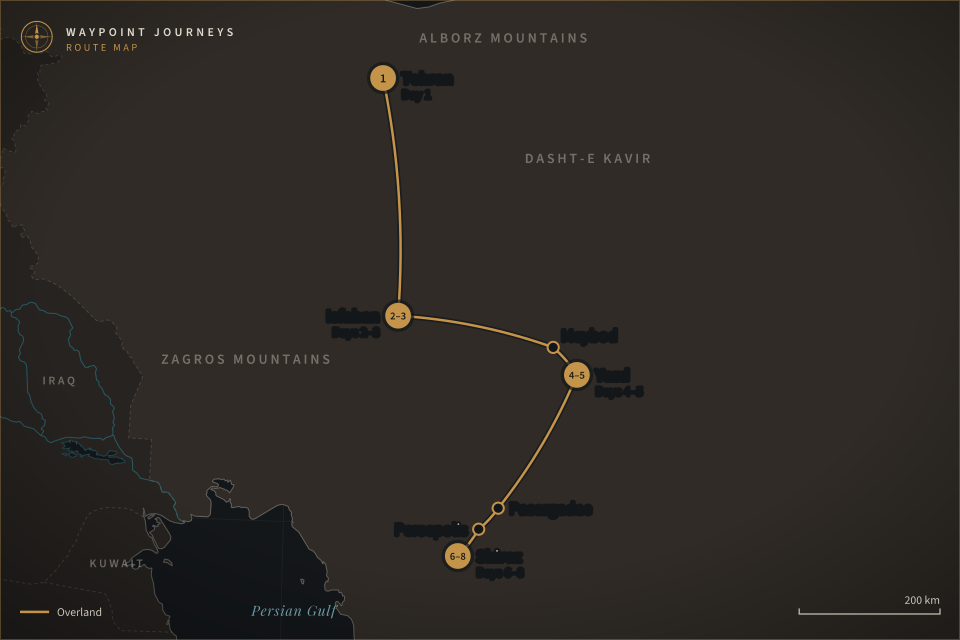
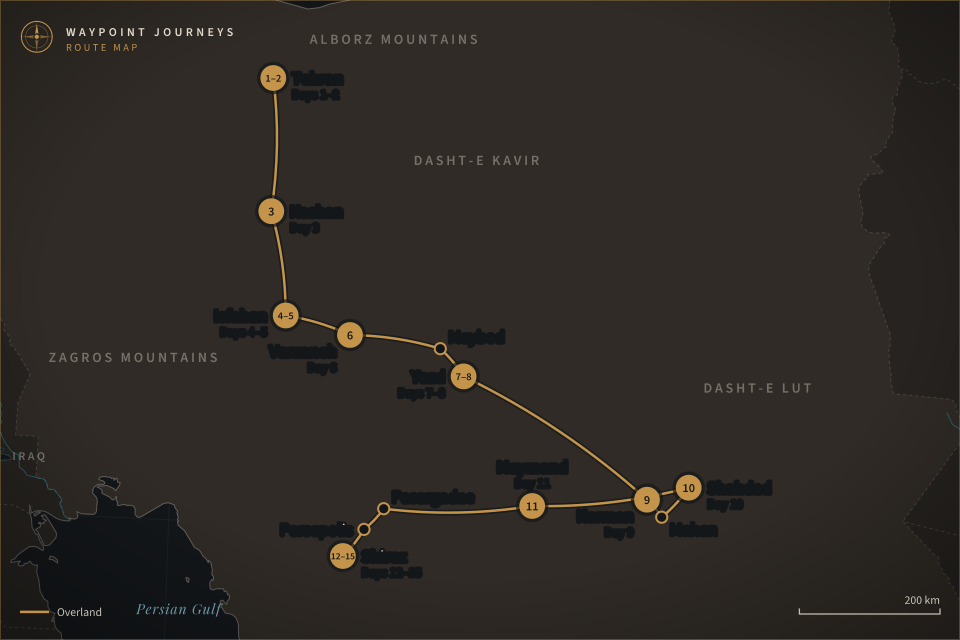
We run two routes. Eight days takes the four great cities (Tehran, Isfahan, Yazd, Shiraz) and the Achaemenid heartland between them, which is the classic circuit done properly and without rushing. Fifteen days adds Kashan's merchant houses, the dunes at Varzaneh, the Ganjali Khan bathhouse in Kerman, the wind-carved kaluts of the Lut Desert, and a night in the cave village of Maymand, where people have lived continuously for several thousand years. Both run with a licensed guide and driver of your own, and a maximum of five guests.

"The Iran on your news feed is not the Iran I walked through. The people are not the government, and the art is not the politics."
Morning light through the stained glass of the Nasir al-Mulk Pink Mosque in Shiraz, scattering colour across the carpets
The Nasir al-Mulk in Shiraz: the hour after opening, when the east windows do this

Nine UNESCO Sites, Two Deserts, and the Finest Square in the Islamic World

Naqsh-e Jahan, Isfahan

Shah Abbas laid out the Image of the World in 1598 and it remains the second-largest public square on the planet, a UNESCO site enclosing three of the great buildings of Islamic architecture. The Shah Mosque, the impossibly delicate Sheikh Lotfollah with its dome that shifts from cream to rose as the day turns, and the Ali Qapu palace terrace looking out over all of it. Horse carriages still circle at dusk. Families still picnic on the grass.

Persepolis & Naqsh-e Rostam

Darius began it in 518 BC and Alexander burned it in 330, and what survived the fire is still enough to stop you at the top of the staircase. Carved delegations from twenty-three subject nations climb the Apadana walls bearing tribute, each rendered with its own dress and gifts. Four miles away at Naqsh-e Rostam the Achaemenid kings lie in cliff tombs cut a hundred feet up the rock face, with Sasanian victory reliefs carved beneath them.

Yazd: the Living Desert City

The oldest continuously inhabited mud-brick city on earth, and the only historic urban fabric in Iran inscribed by UNESCO in its entirety. Wind towers rise from every roof (pre-electric air conditioning that still works) above a maze of covered lanes the desert sun never reaches. Yazd is also the heart of Zoroastrian Iran: a fire has burned in its Atash Behram for over fifteen hundred years, and the Towers of Silence stand on the hills at the edge of town.

The Pink Mosque at Sunrise

Someone designed the Nasir al-Mulk in the 1880s knowing the light would behave like this for about an hour a day, and only when the sun sits low enough to come through the east-facing glass. Arrive at opening, sit down on the carpet, and watch the stained glass turn the entire floor into a kaleidoscope. It is the most photographed room in Iran for a reason, and we build the morning around getting you there before anyone else does.

The Gardens That Named Paradise

Nine Persian gardens are inscribed by UNESCO as a single World Heritage Site, and the routes take in four of the finest: Fin at Kashan with its spring-fed channels running without a pump since the sixteenth century, Chehel Sotoun's twenty wooden columns doubled to forty in the reflecting pool, Dowlat Abad's tallest wind tower in the world, and the Eram Garden in Shiraz. The walled garden as an image of heaven is a Persian invention. These are the originals.

The Lut Desert & Maymand

On the fifteen-day route the country empties out. The Dasht-e Lut was the first natural site in Iran inscribed by UNESCO; the hottest land surface ever recorded, sculpted into kaluts, wind-carved ridges that run for miles and turn molten at sunset, best seen from a camel. Then Maymand, where families still live in dwellings hand-cut into soft rock, occupied for something close to three thousand years. You sleep there.

The Expedition

Two itinerary options. The 8-day takes the four great cities (Tehran, Isfahan, Yazd and Shiraz) and the Achaemenid heartland between them. The 15-day adds Kashan, the Varzaneh dunes, Kerman, the kaluts of the Lut Desert, and a night in the cave village of Maymand.

Day 1
Tehran · Golestan Palace & the National Museum

Your guide meets you inside the terminal at Imam Khomeini International and the country starts immediately. Golestan Palace first: the Qajar dynasty's mirrored, tiled, gloriously excessive seat of power and a UNESCO World Heritage Site, where the Peacock Throne sat and Iran's first photographs were developed. Then the National Museum of Iran, the oldest and richest in the country, for the through-line from Elam and Persepolis to the Islamic centuries. If the light holds you will also see the Gate of the National Garden and the Foreign Ministry palaces before finishing in the Grand Bazaar, ten kilometres of covered lane where Tehran actually happens. Overnight Tehran.

Day 2
Tehran to Isfahan · Jolfa and the Armenian quarter
Day 2 · ~5 hr drive south

Out early, with a stop beneath the Azadi Tower: forty-five metres of white marble in one of the largest squares on earth, clad in eight thousand individually cut blocks and the single most recognisable object in Iran. Then south across the plateau to Isfahan. You arrive into the Armenian quarter of Jolfa, a neighbourhood the Safavids created by relocating an entire city's worth of Armenian craftsmen, and Vank Cathedral inside it: Christian frescoes above, Persian tilework below, in the same room. Mollabashi House follows, one of the most beautifully restored private houses in the country. If the evening runs long, the historic bridges over the Zayandeh Rud. Overnight Isfahan.

Day 3
Isfahan · Naqsh-e Jahan Square & the Music Museum

Everything today happens around Naqsh-e Jahan, one of the great public squares of the Islamic world. Naqsh-e Jahan (the Image of the World) is UNESCO-listed, second-largest on the planet, and holds three masterpieces on three of its sides. The Ali Qapu palace and its music room upstairs, carved into acoustic honeycomb. The Sheikh Lotfollah, built as a private mosque for the royal women, with a dome that turns from cream to deep rose as the sun crosses it. The Shah Mosque and its seven-colour tile. The arcades between them are still working craft workshops. In the evening, the Isfahan Music Museum: three hundred instruments from across Iran, and a small live performance to close.

Day 4
Isfahan to Yazd · Meybod's pigeon tower & Narin Castle
Day 4 · ~5.5 hr drive east

East into the desert, and the landscape does the talking for a while. The break is at Meybod, a mud-brick town on the old caravan road with two things worth the stop: a circular pigeon house built to hold thousands of birds purely for their fertiliser, an elegantly strange piece of agricultural engineering, and Narin Castle, a mud fortress whose foundations run back into the pre-Islamic centuries and whose ramparts give you the whole oasis at once. Into Yazd by evening, when the old city's lanes are lit and the wind towers stand black against what is left of the sky. Overnight Yazd.

Day 5
Yazd · the Zoroastrian desert city

A full day in the only historic urban fabric in Iran that UNESCO inscribed whole. The Jameh Mosque and its portal (the tallest tiled minarets in the country) then Amir Chakhmaq Square, whose tiered alcoves are the image everyone brings home from Yazd. Dowlat Abad Garden next, another of the nine UNESCO Persian gardens, under the tallest badgir wind tower in the world. Then up to the Towers of Silence at the city's edge, where Zoroastrians laid out their dead so as not to defile earth or fire. The afternoon takes in a zurkhaneh (the drums and the ritual gymnastics of the House of Strength) and the Atash Behram, where a flame has burned continuously for more than fifteen centuries.

Day 6
Pasargadae, Persepolis & Naqsh-e Rostam to Shiraz
Day 6 · the Achaemenid heartland

The biggest day of the route, and the reason many people come. Pasargadae first: Cyrus the Great's capital and his tomb, a plain stepped block on an empty plain, which Alexander is said to have stopped at and ordered restored. Then Persepolis, begun by Darius in 518 BC: the Gate of All Nations, the Apadana staircase where twenty-three subject peoples still climb the wall bearing tribute, and the columns Alexander's fire brought down. Finally Naqsh-e Rostam, where four Achaemenid kings lie in cross-shaped tombs cut high into a cliff, with Sasanian victory reliefs carved below them and the Kaaba of Zoroaster standing square in front. Into Shiraz for the night.

Day 7
Shiraz · the Pink Mosque, Zandiyeh & Hafez

Up early: this one is timed, not scheduled. The Nasir al-Mulk opens at dawn and for roughly an hour the low sun comes through its east-facing stained glass and lays the entire carpet in shifting colour. Then Qavam's orangery at Narenjestan, and the Zandiyeh complex: Karim Khan's citadel with its famously leaning tower, the Vakil Mosque, the Vakil bathhouse, and the Vakil Bazaar, where the carpet dealers are worth an hour whether or not you buy. The shrine of Ali Ibn Hamzeh for its mirrorwork, and then Hafez, whose tomb is not a monument but a working garden where Iranians come at dusk to read poetry aloud to each other. Farewell dinner in Shiraz.

Day 8
Shiraz · departure

A transfer to Shiraz International timed to your flight, with the morning free if you have one that allows it; the Eram Garden and Saadi's tomb are both close by and both worth it. Your guide stays with you to the terminal, which in Iran is useful. We are glad to extend the trip at either end: the Persian Gulf islands of Qeshm and Hormuz, Tabriz and the northwest, or the cave village of Kandovan can all be built onto this route.

Day 1
Tehran · Saadabad Complex & Tajrish Bazaar

A morning arrival, and you start in north Tehran where the air is cooler and the Alborz mountains sit above the city. The Saadabad Complex is eighteen palaces in a wooded park, the summer seat of the Qajars and then the Pahlavis, abandoned at speed in 1979 and preserved more or less as it stood. The Time Museum follows: a Qajar mansion turned over to clocks and the history of measuring time, and one of the most photogenic buildings in the city. Then Tajrish Bazaar, which is where north Tehran shops rather than where tourists go. Overnight Tehran.

Day 2
Tehran · Golestan Palace & the Grand Bazaar

Down into old Tehran for the city's headline act. Golestan Palace, UNESCO-listed, is the Qajar dynasty at full volume: mirror halls, painted tile, marble thrones, and the room where Iran's first photographs were made by a shah who was an enthusiastic photographer himself. The National Museum of Iran next, for the long view from Susa and Elam through Persepolis to the Islamic centuries. Before lunch, the Gate of the National Garden and the Foreign Ministry palaces where visiting heads of state are still received. The afternoon belongs to the Grand Bazaar: ten kilometres of covered lanes, and the commercial heart of the country. Overnight Tehran.

Day 3
Tehran to Kashan · Fin Garden & the merchant houses
Day 3 · ~3.5 hr drive south

A stop under the Azadi Tower on the way out, then south to Kashan, a small desert city that was made extremely rich by carpets and silk, and spent the money on houses. The Tabatabaei and Borujerdi houses are the two finest: sunken courtyards, wind towers, stained glass and plasterwork commissioned by nineteenth-century merchants trying to out-build each other, and reportedly built by the same architect for a bride and her father. You go up onto the roof of the Sultan Amir Ahmad bathhouse for the domes-and-badgirs view, and finish at the Fin Garden, UNESCO-listed, fed by a spring that has run its channels without a pump since the sixteenth century. Overnight Kashan.

Day 4
Kashan to Isfahan · Naqsh-e Jahan Square

On to Isfahan, and straight into the square. Naqsh-e Jahan, the Image of the World, laid out by Shah Abbas in 1598 as the stage set of an empire: UNESCO-listed, second-largest public square on the planet, and holding the Ali Qapu palace, the Sheikh Lotfollah with its shifting rose dome, and the great Shah Mosque. The handicraft arcades around the edges are still working workshops (miniature painters, tile cutters, coppersmiths) and worth as much of your time as the monuments. The evening is the Isfahan Music Museum: three hundred instruments from across the country and an intimate live performance. Overnight Isfahan.

Day 5
Isfahan · Jolfa, Vank Cathedral & the bridges

A slower Isfahan day, away from the square. Mollabashi House is a restored Qajar mansion of fine detail and one of the best interiors in Iran to photograph. Then across to Jolfa, the Armenian quarter the Safavids created by moving an entire population of craftsmen here, and Vank Cathedral at its centre, Christian frescoes running above Persian tilework in a single continuous room, which tells you most of what you need to know about how Isfahan worked. The evening is for the Zayandeh Rud bridges: Si-o-se-pol with its thirty-three arches and Khaju, where people gather under the arcades in the evening and, often enough, someone starts singing.

Day 6
The Varzaneh Desert · dunes and an ecolodge night
Day 6 · signature stay: desert ecolodge

East of Isfahan the cultivation gives out and the dunes begin. Varzaneh is a small desert town with its own oddity (the women here wear white chadors rather than black, a local tradition nobody has fully explained) and a set of historic buildings and salt lakes around it. The afternoon is the dunes themselves, with off-road driving and ATVs available for anyone who wants them. Tonight is deliberately not a hotel: you stay in a traditional desert ecolodge, mud-brick and low-slung, for the silence and a sky with nothing in the way of it. One of the two nights on this route we would not swap for a five-star room.

Day 7
East to Yazd · Meybod's pigeon tower & Narin Castle
Day 7 · ~5.5 hr on the old caravan road

Out of the desert and east along the old caravan road toward Yazd, breaking at Meybod. The circular pigeon house there was built to hold several thousand birds and existed purely to harvest their droppings for fertiliser, a piece of agricultural engineering far more beautiful than it needed to be. Narin Castle sits above the town, a mud-brick fortress with pre-Islamic foundations and a rampart walk that lays out the whole oasis and its qanat-fed fields. Into Yazd in the late afternoon, in time to walk the old city while the lanes are still warm and the wind towers catch the last of the light.

Day 8
Yazd · the Zoroastrian desert city

The oldest continuously inhabited mud-brick city on earth, and the only historic fabric in Iran that UNESCO listed in its entirety. The Jameh Mosque and its portal carry the tallest tiled minarets in the country; Amir Chakhmaq Square and its tiered alcoves are the picture everyone takes home. Dowlat Abad Garden is another of the nine UNESCO Persian gardens, sitting beneath the tallest wind tower in the world. Then the Towers of Silence on the edge of town, where Zoroastrians once exposed their dead rather than defile earth or fire. The afternoon: a zurkhaneh session (drums, chanting, and the ritual gymnastics of the House of Strength) and the Atash Behram, whose flame has burned unbroken for over fifteen hundred years.

Day 9
Yazd to Kerman · the Ganjali Khan Complex

South-east to Kerman, a city very few visitors reach and the gateway to Iran's emptiest quarter. The Ganjali Khan complex at its centre is a complete seventeenth-century civic block (bathhouse, caravanserai, mint, water reservoir and school) arranged around a square and still stitched into the working bazaar around it. The bathhouse is now a museum, its vaulted chambers painted and peopled with waxworks, and its ceilings are the reason to go. The rest of the bazaar is a local one: spices, copper, cumin, and none of it arranged for you. Overnight Kerman.

Day 10
Shazdeh Garden, Mahan & the Lut Desert kaluts
Day 10 · camel riding at sunset

Early to Mahan, where the Shazdeh Garden (the Prince's Garden, another of the nine UNESCO gardens) steps down a hillside in terraced fountains with raw desert on every side of its walls, which is the entire Persian idea of paradise made literal. The shrine of Shah Nematollah Vali next, with its turquoise dome and old cypresses. Then east to Shahdad and into the Dasht-e Lut, the first natural site in Iran that UNESCO inscribed: the hottest land surface ever recorded, wind-carved into kaluts, ridges that run in ranks for a hundred and fifty kilometres. You go out by camel before sunset, when the whole formation turns molten. Overnight Shahdad.

Day 11
Maymand · a night in the cave village
Day 11 · signature stay: troglodyte dwelling

West into the hills of Kerman province to Maymand, a UNESCO World Heritage village where families live in dwellings hand-cut into soft rock, roughly four hundred chambers, some of them occupied continuously for something close to three thousand years. It is a semi-nomadic community that still moves with its herds through the year and returns to the caves in winter, which is why the place has never become a museum. You stay the night in one of the dwellings. It is not a five-star room and it is not trying to be; sleeping inside a rock that people have slept in since the Iron Age is the point.

Day 12
Persepolis, Naqsh-e Rostam & Pasargadae to Shiraz
Day 12 · the Achaemenid heartland

An early start west, and then the day the whole route has been building toward. Persepolis, begun by Darius in 518 BC and burned by Alexander in 330: the Gate of All Nations with its winged bulls, the Apadana staircase where delegations from twenty-three subject nations still climb the wall bearing tribute, each carved in its own dress. Naqsh-e Rostam four miles on, where four Achaemenid kings lie in cross-shaped tombs cut high into the cliff, Sasanian victory reliefs beneath them and the Kaaba of Zoroaster squared off in front. Then Pasargadae, Cyrus the Great's capital, and the plain stepped tomb that Alexander stopped to have restored. Into Shiraz for the night.

Day 13
Shiraz · Zandiyeh, Saadi & the Eram Garden

Shiraz proper, and the city relaxes you immediately: this is the soft, green, romantic end of Iran. The Zandiyeh complex covers Karim Khan's citadel with its conspicuously leaning corner tower, the Vakil Mosque, the Vakil bathhouse, and the Vakil Bazaar, where you can spend an hour among Persian carpets with no obligation whatsoever. Then Saadi's tomb, set over a spring-fed pool full of fish, and the Eram Garden, UNESCO-listed, cypress-lined, and the most beautiful of the Shiraz gardens in almost any season. Overnight Shiraz.

Day 14
Shiraz · the Pink Mosque at sunrise & Hafez

Timed, not scheduled. The Nasir al-Mulk opens early and for about an hour the low sun comes through its east-facing stained glass and turns the carpets into shifting colour, someone designed that room in the 1880s knowing exactly what the light would do. Then Qavam's orangery at Narenjestan, all mirrorwork and orange trees, and the shrine of Ali Ibn Hamzeh, whose mirrored interior is one of the great surprises of the city. You finish at the tomb of Hafez, which is not a monument so much as a garden where Iranians come at dusk to read his poems aloud to one another, and often to complete strangers. Farewell dinner in Shiraz.

Day 15
Shiraz · departure

A transfer to Shiraz International timed to your flight, with your guide alongside you to the terminal. If your departure is late enough there is room for one more garden or a last hour in the bazaar. As with the shorter route, we are glad to build extensions onto either end, Tabriz and the northwest, the cave village of Kandovan, or the Persian Gulf islands of Qeshm and Hormuz, which look like nowhere else in the country.

Wind towers, domes and the minarets of the Jameh Mosque above the rooftops of Yazd at dawn

Small Group Expedition

Twenty-Five Centuries.
One Unbroken Civilisation.

What's Included

DurationTwo routes: Essential Persia, 8 days / 7 nights; or Grand Persia, 15 days / 14 nights. Both arrive into Tehran and depart from Shiraz
Group SizeSmall group expedition: maximum 5 guests. Private departures for one or two travellers on request
AccommodationFive-star hotels throughout: every night on the 8-day route, and in every city on the 15-day: Tehran, Kashan, Isfahan, Yazd, Kerman and Shiraz. The 15-day adds two signature stays: a desert ecolodge at Varzaneh, and a night in the UNESCO cave village of Maymand
Route8-day: Tehran · Isfahan · Yazd · Shiraz. 15-day: Tehran · Kashan · Isfahan · Varzaneh · Yazd · Kerman · Lut Desert · Maymand · Shiraz
UNESCO SitesNine World Heritage Sites on the 15-day route, seven on the 8-day, Persepolis, Pasargadae, Naqsh-e Jahan, Golestan Palace, the historic city of Yazd, four of the nine Persian Gardens, the Lut Desert and the cultural landscape of Maymand
Entrance FeesAll included: every site, museum and monument on your itinerary is paid for in advance. No ticket queues, no cash needed at the gate
VisaVisa authorisation (reference) code obtained for you before departure. The embassy fee itself is paid by you when you collect the visa
TransportPrivate air-conditioned vehicle for the entire route with a licensed driver, plus both airport transfers, Tehran on arrival, Shiraz on departure
GuideA licensed English-speaking Iranian guide with you for the whole expedition, the legal requirement for US, UK and Canadian passport holders, and the single best thing about travelling here
MealsDaily breakfast at your hotel. Lunches and dinners are left free: Iranian restaurants are excellent and inexpensive, and your guide books the ones worth the detour
Not IncludedInternational flights, the Iranian embassy visa fee, travel insurance, lunches and dinners, alcohol (unavailable in Iran), tips, personal expenses, and the optional off-road, ATV and camel riding on the 15-day route
Best SeasonMarch to May and late September to November. Spring brings the gardens and the Nowruz new year; autumn brings clear desert light and comfortable days in Yazd and the Lut

FREQUENTLY ASKED QUESTIONS

Common Questions About This Expedition

Yes, on a guided tour, which is exactly what this is. Iran does not permit US, UK or Canadian passport holders to travel independently: you must be accompanied by a licensed guide for the duration and follow an approved itinerary. Both of our routes are built to that standard, with a licensed English-speaking guide and driver with you from arrival to departure. We obtain your visa authorisation code before you travel. Most other nationalities may travel more freely, but the same guided expedition applies.
Our office in Iran files for a visa authorisation code on your behalf, which typically takes two to four weeks. With that code you collect the visa itself, at an Iranian embassy or consulate, or at the Iranian interests section if your country has no embassy. The embassy fee is paid by you at collection and varies by nationality. One thing worth knowing before you commit: travel to Iran makes you ineligible for the US visa waiver programme, so future US trips will require a full visa interview.
Less burdensome than most people expect. Women wear a headscarf in public along with loose clothing covering the arms to the wrist and legs to the ankle, a long tunic over trousers is the easy uniform, and the scarf sits loosely rather than tightly. Men wear long trousers; short sleeves are fine, shorts are not. Shoes come off in mosques, and the larger shrines lend a chador at the door. Your guide will walk you through it on day one.
Correct, and it catches people out. Sanctions mean no international Visa, Mastercard or Amex works anywhere in Iran, and there is no way around it. Bring cash (euros or US dollars, in clean, new, untorn notes) and change it locally, which your guide will help you do at a fair rate. Because your hotels, guide, driver, transfers and site entrance fees are already paid for, you only need cash for meals, tips, and anything you buy in the bazaars.

Expedition Investment

$1,975USD

per person, twin share: 8-day Essential Persia · 15-day Grand Persia $3,695 USD

Fully inclusive of five-star accommodation with daily breakfast; a licensed English-speaking guide and a licensed driver for the entire expedition; a private air-conditioned vehicle throughout with Tehran and Shiraz airport transfers; every site, museum and monument entrance fee on your itinerary; and your Iranian visa authorisation code, obtained for you before you travel

Single supplement $595 USD on the 8-day route, $895 USD on the 15-day. Excludes international flights, the Iranian embassy visa fee paid at collection, travel insurance, lunches and dinners, tips and personal expenses. Note that international bank cards do not function in Iran: bring cash in clean euro or US dollar notes

Reserve Your Spot
A Note on Safety & Logistics

Iran surprises people. Ordinary crime against visitors is rare, the tourist infrastructure is long-established, the hospitality is close to overwhelming, and travellers (Americans among them) are visiting again in steady numbers. What takes care here is paperwork rather than the street, and that is our job. We run these routes with a licensed Iranian operator we know personally, and a licensed guide stays with you from arrival to departure, both the legal requirement for US, UK and Canadian passport holders and the reason the country opens up the way it does. Two things we always raise directly. If you hold Iranian citizenship or were born in Iran, including dual nationals, speak to us before booking: your legal position on arrival differs materially from a foreign visitor's, and we will give you an honest read. And never photograph military sites, government buildings or checkpoints; your guide will tell you where the line is. We stay in contact with our team on the ground year-round, and will give you a straight answer about conditions before you commit.