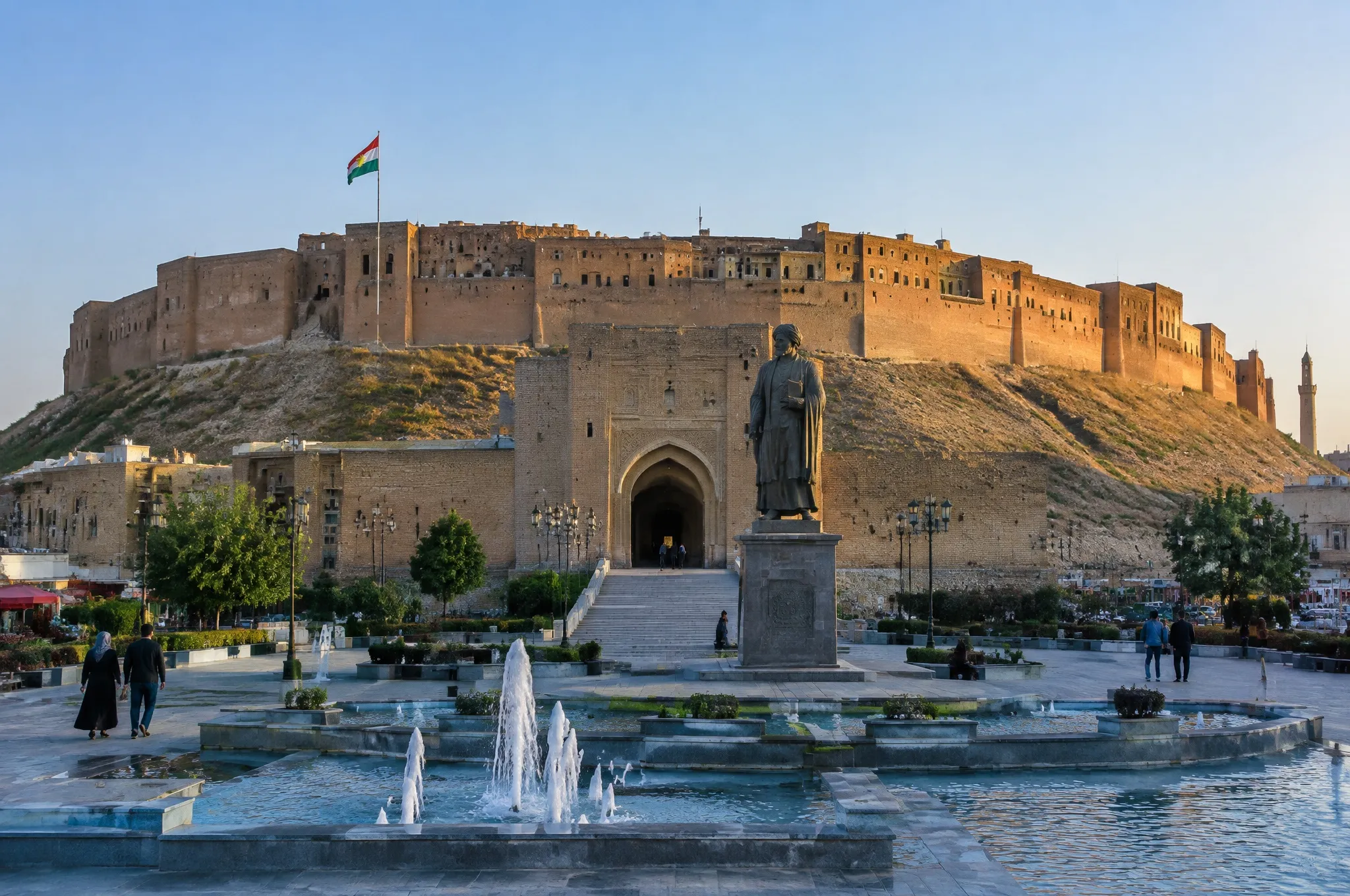
The Other Iraq
Say the word Iraq and most people picture headlines, not holidays. That reflex is the single biggest reason the Kurdistan Region stays off almost everyone's list, and it is also why the travelers who do come back talk about it for years. This is the mountainous north of the country, a self-governed region with its own parliament, its own flag, and its own security forces, and it has spent the past two decades quietly becoming one of the most welcoming corners of the Middle East.
We come here for a combination that is hard to find anywhere else. There is a citadel that has been lived in for six thousand years, a wall of green mountains rising toward Iran, and a Kurdish culture that treats a guest as something close to sacred. You can stand on the mound at Erbil in the morning and be deep in a mountain valley by lunch. This guide covers what the region actually holds, when to come, how the practical side works, and an honest read on safety, because that last part is the question everyone asks first.
Where Kurdistan Is, and What It Actually Is
The Kurdistan Region occupies the far north of Iraq, folded against the borders of Turkey to the north, Iran to the east, and Syria to the west. It is not a country, and it is not quite an ordinary province either. Since 1991, and formally under the Iraqi constitution since 2005, it has governed itself as an autonomous region under the Kurdistan Regional Government in Erbil. It has four governorates, Erbil, Sulaymaniyah, Duhok, and Halabja, and its own armed forces, the Peshmerga, a name that means those who face death.
Geographically the region is all about the Zagros. The land climbs from the hot plains around Erbil into ridge after ridge of mountains, topping out at Cheekha Dar and Halgurd, both above 3,600 meters and both on or near the Iranian frontier. Between the ridges sit river valleys, orchards, and villages older than most nations. The people are overwhelmingly Kurdish, alongside long-established Assyrian and Chaldean Christian towns, a Yazidi heartland around Sheikhan, and Turkmen communities in the cities. Two dialects of Kurdish dominate, Sorani around Erbil and Sulaymaniyah, and Kurmanji up around Duhok.
Erbil: The Citadel and the Bazaar
Most journeys begin in Erbil, or Hewler as Kurds call it. The city spreads in rings around its Citadel, a great oval mound rising above the modern streets. Archaeologists believe people have lived on that mound continuously for at least six thousand years, which places it among the oldest inhabited sites on earth, and UNESCO added it to the World Heritage list in 2014. You climb the ramp through the restored gate, wander lanes of old houses and a small textile museum, and look out over a city that has grown up around a single hill for millennia.
At the foot of the Citadel lies the Qaysari Bazaar, a warren of covered lanes selling gold, spices, tea, and sheepskins. Come down in the late afternoon, when the quarter fills with the smell of grilling meat and the clink of tea glasses, find a seat in one of the old chaikhanas, and order a glass of dark sweet chai. Erbil is also where you find the region's real comfort. There are proper hotels, good restaurants, and the Christian district of Ainkawa, with its churches and its easier evenings.
The Mountains: Rawanduz and the High Zagros
The mountains are the reason to head north, and the drama begins about two hours from Erbil. The road climbs toward Rawanduz through a deep gorge, past the Gali Ali Beg waterfall and along a route known as the Hamilton Road, cut through the cliffs in the early 1930s by a New Zealand engineer named Archibald Hamilton. It is still one of the great mountain drives in the Middle East. At Korek Mountain a cable car lifts you above the valley, and in winter there is even a little skiing.
Push further and the land only gets bigger. Around Choman rise Halgurd and Cheekha Dar, the highest ground in Iraq, walkable in early summer once the snow softens. To the west, toward Duhok, the town of Amadiya sits on top of a flat mesa reached by a single climbing road, exactly as it has been defended for centuries. And in the Bradost mountains lies Shanidar Cave, where Neanderthal skeletons were found buried among what may have been flowers, one of the quietly important archaeological sites anywhere in the world.
Sulaymaniyah and the Weight of Recent History
If Erbil is the region's ancient heart, Sulaymaniyah is its cultural one. It feels younger and more liberal, full of poets, bookshops, and a famously good bazaar. It also holds the region's most difficult and necessary sights. Amna Suraka, the Red Security building, was once a Baathist intelligence headquarters and prison. Its bullet-scarred halls are now a museum of what the Kurds endured under Saddam Hussein, and walking through it is not comfortable, nor should it be.
An hour to the southeast is Halabja. On the sixteenth of March 1988, the Iraqi government attacked the town with chemical weapons and killed around five thousand people in a single day, most of them women and children. The memorial there is one of the most sobering places in the country, and to travel in Kurdistan without stopping is to miss why the region guards its self-rule so fiercely. The mood lifts again nearby at places like Ahmed Awa, a waterfall and picnic valley near the Iranian border where Kurdish families gather to escape the summer heat.
When to Go
Kurdistan has real seasons, and timing matters. The best windows are spring, roughly April into early June, and autumn, September into October. Spring is the region at its most beautiful, when the mountains turn green, the waterfalls run hard, and wildflowers cover the hills. Autumn brings mild, clear days and the harvest coming in.
The most atmospheric moment of the year is Newroz, the Kurdish new year, around the twenty-first of March. Families climb into the hills to picnic, and towns like Akre stage torchlit processions up the mountainside that are genuinely spectacular. Summer, from June to August, is punishing in the lowlands, where Erbil regularly passes 45°C, though the high mountains stay pleasant. Winter is cold, with real snow in the ranges and the occasional ski day at Korek.
Getting There: Flights, the Visa, and Getting Around
Flights
Two international airports serve the region, Erbil and Sulaymaniyah. The simplest way in is through Istanbul, with onward flights on Turkish carriers, and there are also connections through Gulf hubs like Dubai and Doha, and through Amman and Vienna. Schedules shift with the regional weather, so keep your long-haul connection flexible and leave a buffer day at each end.
The KRG Visa
The visa situation is one of Kurdistan's underrated advantages. The Kurdistan Regional Government issues its own entry permit on arrival, usually thirty days, to most Western nationalities at the Erbil and Sulaymaniyah airports. This is separate from a federal Iraqi visa, and the difference matters. A KRG stamp lets you travel freely inside the Kurdistan Region, but it does not by itself allow you to cross into federal Iraq, toward Mosul, Baghdad, or the south. Trips that combine the two are possible, but they have to be arranged deliberately rather than improvised at a checkpoint.
Getting Around
Inside the region the roads are good and the distances are short. We travel by private vehicle with a local driver and guide, which turns the whole of Kurdistan into a series of comfortable day trips from two or three bases. There is no need for convoys or camping here. This is a place you can see in real depth without ever being far from a hot shower and a good dinner.
What a Kurdistan Expedition Looks Like
A good Kurdistan trip is a mix of city and mountain, comfort and depth, usually run over nine to eleven days. You base for a few nights in Erbil and use it to reach the Citadel, Shanidar Cave, and the Rawanduz gorge. You spend time in the north around Amadiya and Lalish, the cone-spired temple that is the holiest site of the Yazidi faith, where visitors are welcomed as long as they go barefoot and step carefully over the thresholds. Then you shift east to Sulaymaniyah for its museums, its bazaar, and Halabja.
Accommodation is a genuine strength here. Erbil and Sulaymaniyah have real hotels, and in the mountains there are simple guesthouses and family-run places where the welcome is the whole point. Because we cap our groups at five guests, the trip bends around you: a longer morning in the bazaar, an extra day walking a mountain valley, a dinner in a Kurdish home rather than a restaurant. Kurdish hospitality is not a slogan. Turn up in a village and you will be handed tea before you have finished saying hello.
Safety, Honestly
This is the question that matters, so here is a straight answer. The Kurdistan Region has been one of the safer places to travel in the Middle East for well over a decade. It runs its own security, its own checkpoints, and its own borders, and violent crime against visitors is rare. Tens of thousands of travelers, aid workers, and business people pass through Erbil every year without incident. That is the honest baseline, and it is very different from the picture most people carry of Iraq as a whole.
The caveats are real and specific. The far northern mountains along the Turkish border see periodic Turkish airstrikes against Kurdish militant positions, so the immediate frontier zones in northern Duhok are not places to wander. Erbil has occasionally been the target of Iranian missile strikes aimed at specific sites, most recently in 2024. The disputed territories to the south and west, around Kirkuk and toward Mosul, and any crossing into federal Iraq, carry a higher level of risk than the Kurdish heartland. Western governments still advise caution across Iraq, and most of them draw a clear distinction for the Kurdistan Region within that advice.
The practical answer is the same one we give everywhere we work. Go with a team that holds current local intelligence, that knows which valleys are fine this month and which to leave alone, that carries proper communications and medical cover, and that will change the plan without fuss when something shifts. Do that, and Kurdistan is not a gamble. It is one of the most rewarding and genuinely hospitable journeys left in the region.
Practical Information at a Glance
| Location | Northern Iraq, the Zagros mountains |
| Main cities | Erbil (Hewler), Sulaymaniyah, Duhok |
| Best time to visit | April to June, September and October |
| Avoid | July and August in the lowlands (extreme heat) |
| Getting there | Fly to Erbil (EBL) or Sulaymaniyah (ISU), usually via Istanbul or a Gulf hub |
| Visa | KRG entry permit on arrival for most Western nationalities, separate from a federal Iraqi visa |
| Currency | Iraqi dinar (IQD); US dollars widely accepted |
| Language | Kurdish (Sorani and Kurmanji); Arabic and English in the cities |
| Guides | Private local guide and driver recommended |
| Accommodation | City hotels and mountain guesthouses |
| Typical expedition length | 9–11 days |
| Group size | Capped at 5 guests |
Planning Your Iraqi Kurdistan Expedition
Kurdistan asks less of a traveler than most places we run, and gives back more than almost anyone expects. The flights are straightforward, the roads are good, and the welcome is extraordinary. What holds people back is not the logistics. It is the name on the map and the headlines attached to it, and getting past that is most of the journey.
We run Kurdistan as a private, small-group expedition, capped at five guests, shaped around your dates and how far into the mountains you want to go. Come for the Citadel and the bazaars, stay for the high Zagros and the Kurdish table, and leave understanding a corner of the world that almost no one you know has seen. When you are ready, so are we.
Ready to Start Planning?