A Country Invented From Scratch
Two hundred and fifty kilometres off the coast of Gabon, in the deepest corner of the Gulf of Guinea, two volcanoes push out of the Atlantic and carry rainforest all the way down to the waterline. Nobody lived on either of them before Portuguese ships came ashore in the 1470s. That single fact explains most of what you will see. São Tomé and Príncipe has no indigenous past, no pre-colonial ruins and no older name. It was built as a plantation, first for sugar and then for cocoa, worked by people brought here against their will, and it has been independent only since July 1975.
What the plantation century left behind is the reason to come. Enormous estates called roças stand half-swallowed by forest, their hospitals and chapels and colonnaded drying yards still lived in by the descendants of the workers. For a few years around 1910 these islands were the largest cocoa producer on Earth. Wrapped around all of it is a burst of endemic life with few rivals in the Atlantic: birds, plants and trees found on these two islands and nowhere else. Fewer than a quarter of a million people live here, and tourism is still small enough that you recognise faces at the airport on the way out. Here is how it actually works.
Where the Islands Are and How They Work
São Tomé is the larger island at around 850 square kilometres, with a spine that rises to 2,024 metres at Pico de São Tomé. Príncipe sits 150 kilometres to the northeast and is much smaller, greener and quieter, with roughly eight thousand residents. Both are the tops of volcanoes on the Cameroon line, which is why the rock behaves so strangely here: soft material erodes away and the hard plugs of old vents are left standing on their own.
The geography turns over as you drive. The north of São Tomé is dry savanna with baobabs and black lava coast. The south, twenty-odd kilometres away, gets several times the rain and grows forest so dense it closes over the road. One coast road runs down each side and neither of them is fast. Portuguese is the official language, and most people speak one of three creoles: Forro on São Tomé, Angolar in the far south, and Lung'ie on Príncipe. The country sits on GMT, so there is no jet lag from Europe, only the flight.
The South: Cão Grande, Boca do Inferno, Angolares
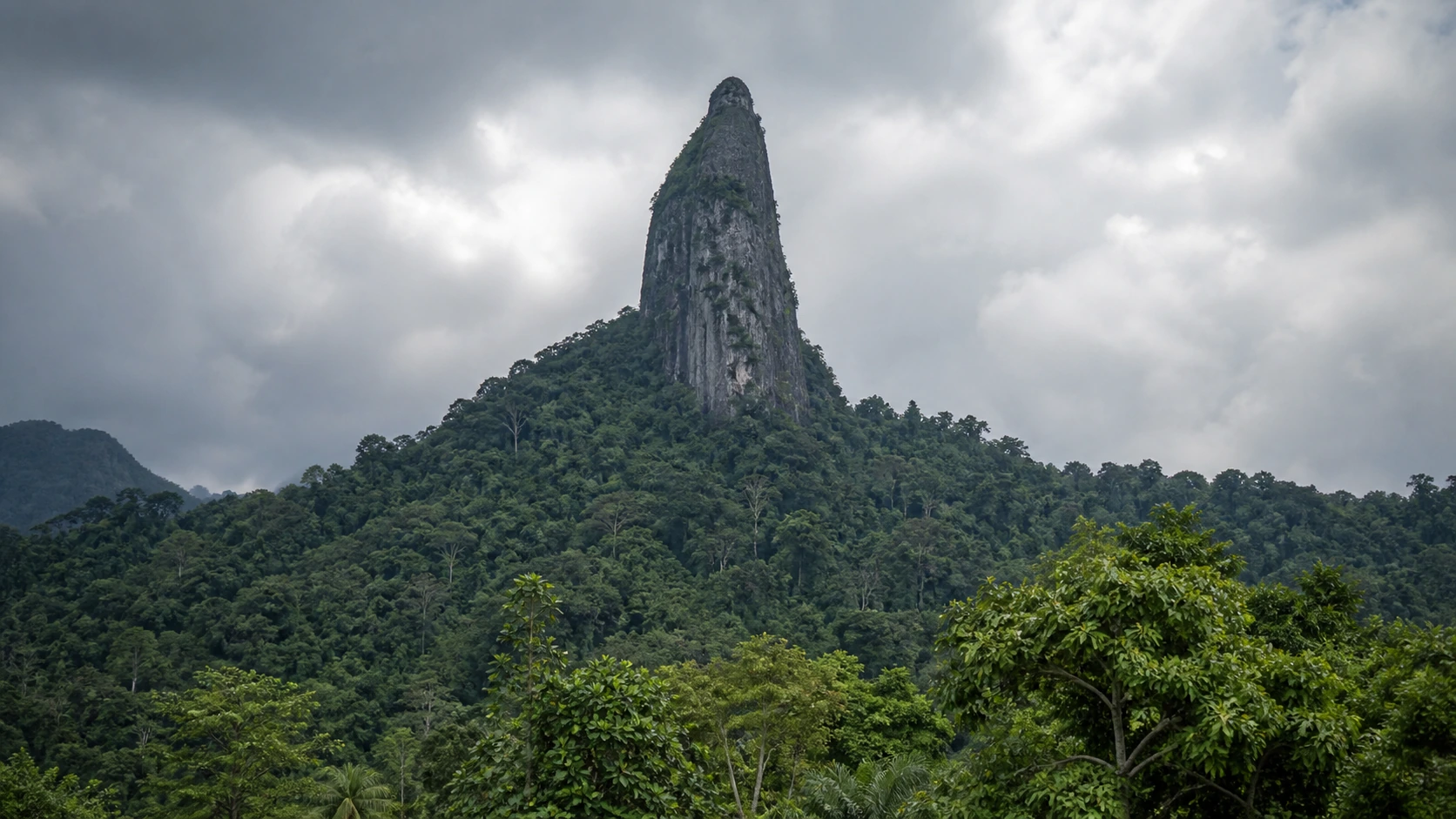
Pico Cão Grande is the image that brings most people here, and it does not disappoint in person. It is a phonolite needle, the hardened throat of a dead volcano with everything softer stripped away around it, standing 663 metres above sea level and roughly 370 metres clear of the forest floor. First-time visitors assume the photographs have been manipulated. They have not. The southern road passes beneath it, and on a clear morning the spire and its smaller twin, Pico Cão Pequeno, cut straight out of the canopy. Cloud usually wins by early afternoon, so go early or accept that you are looking at weather.
The drive down there is the best day on the island. You leave the capital along the coast, stop at the blowhole at Boca do Inferno where the swell fires through a lava tube, and climb into the interior as the forest closes in. Lunch belongs at São João dos Angolares, in a plantation house turned kitchen where people drive two hours for the cooking: breadfruit, jackfruit, palm oil, fish that was in the sea that morning, and the fierce local chilli called óssame. Further south are black sand beaches with nobody on them and, between October and February, the turtle nesting beach at Jalé. Off the southern tip sits Iléu das Rolas, a short boat crossing to a stone marker on the equator and the clearest snorkelling water on this side of the country.
The Roças, and the Lawn That Proved Einstein Right
A roça was not a farm. It was a closed world: a manor house, a hospital, a chapel, a railway, a prison, workers' quarters and hectares of drying yards, run as a private estate. Roça Agostinho Neto in the north was the grandest of them, and the scale of the ruin is genuinely hard to process. Families still live in the sanzala, the workers' terraces, and hang washing across the yards where cocoa once dried. This is not a museum and nobody has tidied it for visitors, which is exactly why it lands.
The history under it is ugly and worth knowing before you walk in. Slavery was formally abolished in Portuguese territory in the nineteenth century and replaced with contract labour, the serviçais, brought from Angola, Cabo Verde and Mozambique on terms almost nobody escaped. British chocolate firms, Cadbury among them, boycotted Santomean cocoa in 1909 over exactly that. After independence the estates were nationalised, then largely abandoned as the world stopped buying. Ask your guide about Batepá and the 1953 massacre; it is still the hinge of the national story, and Santomeans will talk about it openly.
On Príncipe, one roça earned a different kind of fame. On 29 May 1919 an expedition sent by Arthur Eddington set up on the lawn at Roça Sundy and photographed stars next to a totally eclipsed sun. The starlight had bent, and it had bent by Einstein's number rather than Newton's. General relativity stopped being a theory nobody could test. The plantation house is still standing, the lawn is still there, and the crescent of sand below it, Praia Banana, is still empty on most days.
Obô and the Birds Found Nowhere Else
About a third of São Tomé is protected inside the Obô Natural Park, and obô is simply the Forro word for the forest. The walk in from the old plantation edge takes you through tree ferns, begonias the size of dinner plates and a canopy you rarely see through. It is muddy rather than difficult, and it is matched to whoever is walking it. Nothing here requires a summit.
For anyone who pays attention to birds, this is one of the most concentrated pockets of endemism on the planet: something in the order of two dozen bird species live on these two islands and nowhere else. The giant sunbird and the São Tomé fiscal are the headline birds. The São Tomé grosbeak was described in 1888, then not seen again for a century, and was widely written off before it turned up in 1991. Príncipe has its own list, including the Príncipe thrush and the Príncipe kingfisher. You do not need to be a birder to get the point of the forest, but if you are one, budget an extra day and take a park guide who knows the calls.
Príncipe and the Baía das Agulhas
The thirty-five minute flight north is the best short hop in the Gulf of Guinea. The whole island arrives at once through the window: green towers, green sea, and a shoreline with almost nothing built on it. Príncipe has been a UNESCO Biosphere Reserve since 2012. Its capital, Santo António, is the smallest city in Africa and takes about ten minutes to walk end to end.
The reason to spend three nights rather than one is the south. There is no road down there. You reach the Baía das Agulhas by boat, rounding a coast where the same volcanic plumbing that built Cão Grande has left a whole skyline of forested spires dropping straight into the water. The boat noses into coves that cannot be reached any other way, stops over reef that sees a handful of snorkellers a year, and lands on a beach for lunch. Between July and October humpbacks are moving through that water and the crossing turns into a whale watch without anyone planning it.
Cocoa, from Pod to Bar
The crop never entirely left. Cocoa still grows on both islands, and a handful of small producers now grow, ferment, dry, roast and conche within a few kilometres of the trees. That full chain in one place is rare anywhere in the cocoa world, where beans usually leave the country in a sack and become chocolate on another continent. The best known operation here is Claudio Corallo's, with plantations on Príncipe and a workshop in the capital, and the tasting he runs is closer to a lecture than a gift shop.
Time it with a harvest and you get the whole sequence in an afternoon: pods cut from the trunk with a machete, the wet beans loaded into fermentation boxes, the smell coming off them at day three, and the drying yards raked flat in the sun. It is the one piece of this trip that changes how you buy chocolate afterwards, which is a small thing, and also not.
When to Go
There is no bad month here, which is unusual for the region, but the seasons matter. The gravana runs roughly June to September and is the cool dry spell: easier walking, clearer air, better light on Cão Grande, and humpbacks offshore from July. January usually brings a short second dry break that the islands call the gravanito. October to May is hotter and wetter, with heavy afternoon rain rather than all-day rain, and greener forest.
Pick by what you want to see. Turtles nest from October to February and Jalé is the reliable beach for it. Whales are July to October. Walkers and photographers should aim at the gravana. Note that Príncipe is wetter than northern São Tomé in every month, so pack for rain whenever you come, and expect the southern road to be slick.
Getting There: Lisbon, the Hop, the Visa, the Money
There are fewer doors in than you would expect. TAP Air Portugal flies Lisbon to São Tomé (TMS) several times a week and that is how most guests arrive; STP Airways runs a weekly Lisbon service using a EuroAtlantic aircraft. Regionally there are links from Accra, Libreville and Luanda, and those schedules move around, so treat them as useful rather than dependable. Nothing arrives by sea.
The internal flight to Príncipe (PCP) is the piece that catches people out. The aircraft are small, the schedule is thin, seats sell out, and weather can shift a departure. Most itineraries quote it separately and then collect it in cash at the counter. Book it well before you leave home, hold it against your international arrival, and build a buffer day at the end rather than connecting straight onto a long-haul.
The visa is refreshingly simple: citizens of the United States, the European Union and around fifty other nationalities enter visa free for up to fifteen days, as do holders of a valid Schengen or US visa or residence permit. Your passport needs twelve months of validity, which is stricter than the usual six, so check it early. Longer stays and other nationalities use the e-visa. A yellow fever certificate is required. Money is the dobra (STN), pegged to the euro at 24.5, and euros in cash are accepted almost everywhere. Cards work at a few hotels in the capital and essentially nowhere else, ATMs are a São Tomé city phenomenon, and you should land with cash for Príncipe.
What an Expedition Costs and How It Runs
We run São Tomé and Príncipe as an eight-day expedition, five nights on the main island and two on Príncipe, at $4,595 per person twin share with a $880 single supplement. That covers the return Príncipe flight, seven nights split between a hotel in the capital, a plantation house in the south and a beach lodge on Príncipe, private 4WD with a driver, every transfer, both boat days, Obô park entry, the chocolate tasting and a Santomean guide throughout. International flights are not included and Lisbon is the usual gateway.
Two things are worth saying plainly. The first is that including the inter-island flight is not a detail. It is the single most common line item that gets quoted separately, and it is also the one thing on the trip that cannot be improvised. The second is group size. A few good operators run these islands as set departures of a dozen or more, which changes what a plantation house lunch or a small boat feels like. We cap at five guests. On an island where the best days happen in one vehicle and one boat, that number is the whole design. Gabon and Angola both pair naturally on either end, and a longer stay on Príncipe is the easiest extension we sell.
Safety and Health: A Straight Answer
This is one of the calmest countries we operate anywhere. There is no insurgency, no meaningful street crime against visitors, and a national population smaller than a mid-sized town. Politics can be noisy at election time and it stays noisy rather than violent. The honest risks here are logistical and medical, not criminal, and anyone who tells you otherwise has not been.
Malaria is present on both islands year-round, so prophylaxis and repellent matter, and you should see a travel clinic well before you fly. Yellow fever proof is required at entry. Medical facilities are basic: the hospital in the capital handles minor problems and the nearest serious care is Libreville or Lisbon, which is why we make comprehensive insurance with evacuation cover a condition of travelling with us. The roads are narrow, wet and shared with pedestrians, dogs and children, so we drive them slowly, in daylight, with local drivers. Tap water is not for drinking. Beyond that, come with rain gear, shoes you do not mind ruining, and a tolerance for a schedule that occasionally bends around an aircraft.
Practical Information at a Glance
| Location | Gulf of Guinea, about 250 km off Gabon, straddling the equator |
| Main islands | São Tomé, Príncipe, Iléu das Rolas |
| Best time to visit | June to September (gravana): cool, dry, best walking, whales from July |
| Also good | October to February for nesting turtles; January for the short gravanito dry spell |
| Getting there | TAP from Lisbon to São Tomé (TMS); regional links from Accra, Libreville, Luanda; 35-minute flight to Príncipe (PCP) |
| Visa | Visa free for 15 days for US, EU and around 50 other nationalities; passport valid 12 months; yellow fever certificate required |
| Currency | Dobra (STN), pegged to the euro at 24.5; bring euros in cash, cards barely work outside the capital |
| Language | Portuguese, plus the Forro, Angolar and Lung'ie creoles; limited English |
| Health | Malaria year-round on both islands; basic hospitals; evacuation cover essential |
| Accommodation | Hotel in São Tomé city, plantation house in the south, beach lodge on Príncipe |
| Typical expedition length | 8 days; longer paired with Gabon or Angola |
| Group size | Capped at 5 guests |
Planning Your Expedition
São Tomé and Príncipe asks very little of you compared with most places we work. No permits, no escort, no visa for most passports, no security briefing. What it asks for instead is time and sequencing: the Príncipe seats booked early, the southern road driven in the morning, the forest walked before the cloud comes down, and a guide who can tell you what happened on the roça you are standing in.
Read the expedition page for the day-by-day, then write to us. Tell us whether you are coming for the forest, the chocolate, the birds or the quiet, and we will build the eight days around that answer.
Ready to Start Planning?