Three Plates, One Small Country
Djibouti is the smallest country in the Horn of Africa, about the size of New Jersey, and almost nobody on your flight in will be a tourist. Port logistics, military rotations, aid postings: that is the traffic. The country registers in most minds as a runway and a container terminal, if it registers at all. Staying past the layover puts you in rare company.
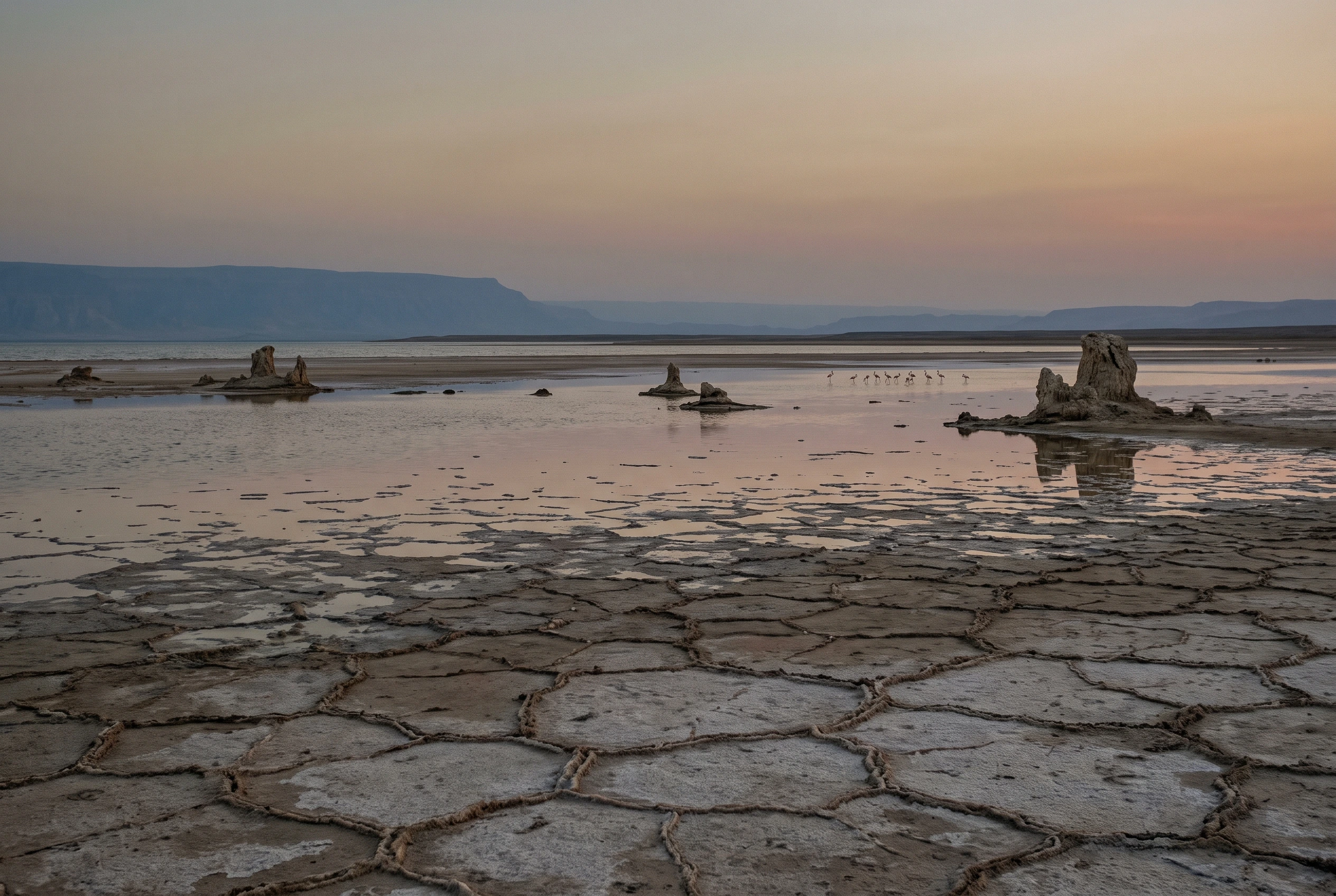
The reason to stay is under your feet. Djibouti sits on the Afar Triple Junction, where the Arabian, Nubian, and Somali tectonic plates are pulling away from one another. The land here is being stretched and torn, and in a few million years the sea will pour into the widening rift and give East Africa its own ocean. In the meantime, the stretching has produced a landscape that looks imported: salt lakes sunk below sea level, black basalt fields, hot springs, and limestone chimneys that smoke at dawn.
Better still, all of it is close. The lowest point in Africa sits two hours from the capital. The steam vents of Lake Abbe are five. From November to February, whale sharks feed in the gulf less than an hour from the city marina. We run our entire Djibouti expedition in four days, and none of those days feel padded.
This guide covers the practical side of a visit: seasons, flights, the e-visa, what the three headline sights actually involve, costs on the ground, and an honest read on safety.
When to Visit Djibouti
The season is October to April, and the heart of it is November through February. Those months give you Djibouti City in the low 30s C (high 80s F), cool desert nights for the Lake Abbe camp, and the whale shark aggregation at its most reliable. December and January book out first, and flights fill around the holidays.
Summer is not a compromise here, it is a mistake. From June through August the interior regularly clears 45 C (113 F), the khamsin wind hangs dust in the air, and the city slows to a crawl by noon. Shoulder weeks in October and April are workable, warm on the coast, and quieter everywhere.
Getting In: Flights and the E-Visa
Djibouti-Ambouli International is better connected than a country of a million people has any right to be, because the money moving through it is not tourist money. Four routes matter:
- Addis Ababa (Ethiopian Airlines): several departures a day and the workhorse connection; most arrivals come this way
- Dubai (flydubai): year-round service, the practical link from Asia
- Istanbul (Turkish Airlines): year-round, an easy one-stop from most of Europe and North America
- Paris (Air France): the only nonstop from Europe
Entry is by e-visa through the government portal, applied for before you fly. A single-entry tourist visa runs about $30, approvals usually land inside 72 hours, and we still tell guests to apply two weeks out. Print a copy. Arrival formalities are relaxed by regional standards, but the officer wants paper, and so does the checkpoint on the road west.
There is also an electric railway from Addis Ababa, the line that hauls most of Ethiopia's imports up from this coast. Passenger service has run intermittently for years. Treat it as a curiosity, not a plan.
Lake Assal: The Lowest Point in Africa
Two hours west of the capital, past black lava fields and a clifftop view over the Ghoubbet, the road drops and keeps dropping until it reaches Lake Assal, 155 meters below sea level. This is the lowest point on the African continent and the third lowest exposed land on Earth, after the Dead Sea and the Sea of Galilee. The water is roughly ten times saltier than the ocean, banded turquoise and white, and rimmed by a crust of salt that crunches like packed snow. You do not swim in Assal so much as sit on it.
Bring sandals you can wade in, because the crust cuts like coral, and rinse off with the fresh water your driver carries, because the brine finds every scratch you forgot you had. For centuries Afar caravans cut slabs from these pans and walked them by camel into the Ethiopian highlands to trade. A little of that traffic still moves, which tells you something about how little this place has changed.
Lake Abbe: Where the Ground Vents Steam
Lake Abbe is the image that sells the country, and it earns it. The lake is the dead end of the Awash River, straddling the Ethiopian border, and its shore is studded with hundreds of limestone chimneys, some fifty meters tall, built by hot springs when the water level stood far higher. The springs are still working. At first light the chimneys smoke, flamingos feed in the shallows, and Afar herders walk their goats through the steam columns as if this were the most ordinary place on Earth.
Count on four to five hours of driving from the city through Dikhil, the last stretch of it off-piste. You sleep at a simple Afar-run camp near the chimneys: mattress, mosquito net, grilled goat for dinner, and silence once the generator stops. The reason to stay is the half hour before sunrise, when gray-pink light comes up through the steam. Every guide will tell you Planet of the Apes was filmed here. It was not (the 1968 crew never left the American Southwest), but at dawn you understand why nobody argues with the story.
Whale Sharks of the Gulf of Tadjoura
From about November to February, juvenile whale sharks gather to feed on plankton blooms in the Bay of Ghoubbet, at the western end of the Gulf of Tadjoura. Most are four to eight meters long, young animals that cruise the surface with mouths open while you swim beside them. This is snorkeling, not scuba: no tanks, no cages, no baiting, just a mask and the largest fish on Earth a few meters away.
Boats leave the city marina in the morning, when the gulf is calmest, and reach the bay in under an hour. Some outings find a dozen animals, some find one. It is wildlife, not a show. Keep three or four meters off, stay clear of the tail, touch nothing. Divers with experience can push on to the Seven Brothers islands near the Bab el-Mandeb strait, strong-current reefs that see almost no one.
The Rest of the Country
Tadjoura, across the gulf, is the country's oldest town: whitewashed houses, a slow waterfront, a string of small mosques, and the white sand of Sable Blanc beach a short drive east. Behind it the Goda Mountains rise past 1,700 meters and hold the Day Forest, a relict stand of juniper left over from a wetter Africa and the only home of the Djibouti francolin, a partridge-like bird found nowhere else. Cool air and green shade make it feel like a different country from the coast below.
Twenty minutes off the capital by boat, the islands of Moucha and Maskali offer mangroves and easy snorkeling with almost nobody around midweek. In town, order poisson yemenite, a whole fish split and baked against the wall of a clay oven, served with sweet flatbread; in Tadjoura and Obock, look for moukbaza, fish worked into a puree of roasted banana. Do your errands in the morning. Khat lands from Ethiopia after midday, and half the country's commerce quietly stops for the afternoon.
Costs, Money and Ground Rules
Djibouti is expensive for what you get, because prices follow port and military money rather than tourism. A decent hotel in the capital runs $150 to $300 a night. A 4x4 with a driver-guide and fuel is $200 to $300 a day. A shared whale shark boat is about $100 a head, a private charter several times that, and the Lake Abbe overnight adds camp fees on top of the vehicle. A well-run private circuit of Assal, Abbe, and the whale sharks lands around $2,500 to $3,500 per person for four days, excluding international flights. It can be done for less, mostly by cutting the parts you came for.
The Djiboutian franc is pegged to the dollar at about 178, and dollars are accepted nearly everywhere; bring cash, because cards work at the big hotels and almost nowhere else. French and Arabic are official, Somali and Afar are what you hear on the street, and English thins out fast beyond the airport. Mobile data is fine in the city and absent in the desert. Two habits prevent most problems: ask before photographing people, and never point a camera at the port, the airport, or anyone in uniform. Five foreign militaries operate here, and somebody is always watching the person with the camera.
Is Djibouti Safe?
By the standards of the region, clearly yes. The reason the United States, France, Japan, Italy, and China all keep bases here is that Djibouti is the stable one. Violent crime against visitors is rare, and petty theft around the central market sits at watch-your-phone level rather than watch-your-back. Central Djibouti City in daylight feels unremarkable, which in this neighborhood is an achievement.
The risks that remain are unglamorous. Heat and dehydration cause more trouble than crime ever does. The truck corridor to Ethiopia is dangerous at night, shared with unlit lorries and wandering camels, so we do not drive after dark and neither should you. The far northern border zone with Eritrea remains a military area with an unresolved dispute; there is nothing for a traveler up there anyway. Western travel advisories generally hold Djibouti at their milder caution levels, a rarity for this corner of Africa.
Practical Information at a Glance
| Location | Horn of Africa, bordering Ethiopia, Eritrea, and Somaliland |
| Capital | Djibouti City |
| Best time to visit | November to February (October to April works) |
| Avoid | June to August (extreme heat) |
| Getting there | Via Addis Ababa, Dubai, or Istanbul; nonstop from Paris |
| Visa | Single-entry e-visa online, about $30 |
| Currency | Djiboutian franc, pegged near 178 to the USD (dollars accepted) |
| Languages | French, Arabic (official); Somali, Afar (everyday) |
| Accommodation | City hotels plus an Afar camp at Lake Abbe |
| Typical trip length | 4 to 6 days |
| Group size | Capped at 5 guests |
Plan Your Djibouti Expedition
Djibouti fits a specific kind of traveler: someone who wants the strangest geology on the continent without a two-week commitment, who would rather share a lake with flamingos than with a tour bus, and who reads "salt, steam, and whale sharks" as a promise rather than a warning. It pairs naturally with Ethiopia or Somaliland on a longer Horn itinerary, and it stands alone as the most concentrated four days of landscape we run anywhere.
Our Rift on Fire expedition covers all of it, whale sharks to Abbe, with a maximum of five guests and every logistic handled. If you want it shaped differently, that conversation starts the same place all our trips do, on WhatsApp or by email.
Ready to Start Planning?