The Permit Is the Trip
Most travel problems are solved with money. Tibet is not one of them. You cannot arrive at Lhasa Gonggar airport, hire a car and see where the day takes you. You cannot board the train from Xining without a piece of paper that a stranger in Lhasa applied for on your behalf three weeks earlier. There is no version of this trip where you improvise.
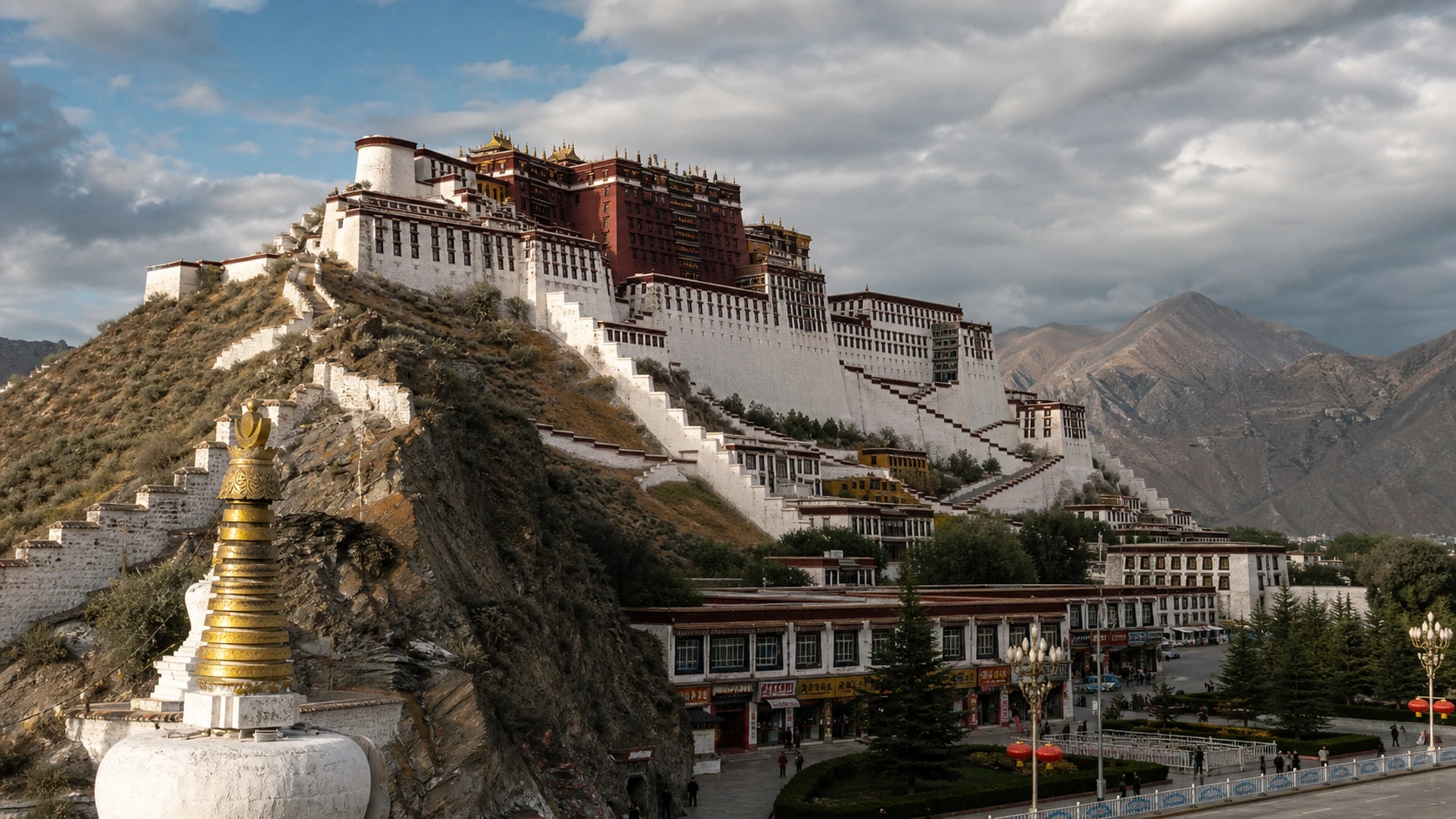
That frustrates people, and we understand why. But the paperwork is not an obstacle bolted onto the destination. It is the destination's operating system, and once you accept it, Tibet becomes one of the most rewarding places we work. The region receives a fraction of the foreign visitors Nepal handles, and almost all of them move through the same few sites in the same few weeks. Go in the shoulder of the season and you can stand on the Potala's roof in near silence.
What follows is what we have learned running the Lhasa to Shigatse circuit: how the permits work, how to arrive at 3,656 metres without losing your first three days, when to go, what it costs, and the etiquette that matters more here than almost anywhere else we work.
What You Are Actually Going To
The Tibetan Plateau averages above 4,000 metres across an area larger than Western Europe. Lhasa, the lowest place most visitors sleep, sits at 3,656 metres, higher than any inhabited valley in the Alps. The air holds roughly a third less oxygen than at sea level, and your body notices within twenty minutes of stepping off the plane.
Lhasa is not what people picture. It is a modern Chinese provincial capital of wide boulevards, malls and heavy security, wrapped around an old Tibetan quarter of a few dozen streets. You pass through ID checks and bag scanners daily. Arrive expecting a preserved medieval city and you will spend the first afternoon disappointed.
Then you walk the Barkhor at six in the morning and everything reorders itself. Pilgrims who have prostrated across hundreds of kilometres of plateau are still prostrating, full body to the flagstones, in front of the Jokhang. Khampa men from the eastern grasslands stride past with red cord braided into their hair. None of it is staged for you, because there are not enough of you to stage anything for.
The Permits, in Order
There are three documents in play, and most travellers only need the first two.
The Tibet Travel Permit
Issued by the Tibet Tourism Bureau and required of every non-Chinese passport holder entering the region. You cannot apply for it yourself. A registered Tibet agency files it using scans of your passport and Chinese visa, and it comes back as a paper document that has to physically reach you or your guide before you travel.
Budget two to three weeks for processing, and give your operator your documents a clear month out. Airlines and railway staff check for it at the gate. Without it you do not board, and no amount of standing at the counter changes that. Holders of Hong Kong and Macau SAR passports are exempt and travel on a Home Return Permit instead.
The Alien's Travel Permit
A Public Security Bureau document covering certain areas beyond Lhasa prefecture. Several mainstream routes have been relaxed, but the list moves, and it still applies to parts of the Everest region, the far west and the border zones. Your guide arranges it on the ground in Lhasa or Shigatse, which is one reason the itinerary cannot change on a whim.
The Military Permit
Needed for the far west, meaning Ngari and the Mount Kailash circuit, and for parts of eastern Tibet near the Chamdo road. It takes longer, gets refused more often, and effectively doubles the lead time on a Kailash trip. If Kailash is your goal, start the conversation six months out, not six weeks.
Two things people get wrong. A licensed guide and a pre-arranged vehicle are conditions of the permit, not an upsell, and you may not travel outside Lhasa unaccompanied. And if you work as a journalist, a diplomat or for a foreign government, you cannot enter on a tourist permit at all. That runs through a separate ministry channel, and declaring it late is far worse than declaring it early.
Getting In: Air, Rail, or Nepal
By air from mainland China. The simplest route. You need a standard Chinese tourist visa, then the Tibet permit on top of it. Lhasa Gonggar connects to Chengdu, Chongqing, Xining, Xi'an, Kunming, Beijing and Shanghai. Chengdu is the classic hop at a little over two hours, and it gives you a soft landing city on either end.
By rail. The Qinghai-Tibet Railway is the highest in the world, topping out at 5,072 metres on the Tanggula Pass, with oxygen-enriched cabins. Roughly 21 hours from Xining, closer to 40 from Beijing. We build it into trips when the schedule allows, but it is not an acclimatization strategy. The slow climb helps a little, and then you arrive at 3,656 metres anyway.
From Kathmandu. This one catches people out. Entering Tibet from Nepal requires a Chinese Group Visa issued by the embassy in Kathmandu, which takes about three working days and cancels any Chinese visa already sitting in your passport. If you were planning Shanghai before or after on a separate visa, that plan is now broken. You can cross overland at Gyirong, which took over from Zhangmu after the 2015 earthquake closed it, or fly Kathmandu to Lhasa directly.
Altitude, and Not Wasting Your First Three Days
This is the single biggest determinant of whether people enjoy Tibet. Fly in from sea level and you gain 3,650 metres in a morning. Almost everyone gets a headache, sleeps badly and loses their appetite for a day or two. That is normal. Worsening breathlessness at rest, confusion or a stumbling gait is not, and it ends the trip.
What works, in our experience: two full nights in Lhasa before you go anywhere higher, and a deliberately light first day. No Potala on day one, because the climb up is 300-odd steps and it will feel like a thousand. Drink far more water than you want to. Skip alcohol for the first 48 hours. Eat, even without appetite. Talk to your doctor about acetazolamide before you leave, because starting it the day you land is too late to be much use.
Good Lhasa hotels pipe oxygen into the rooms and every properly run vehicle carries bottles. Use it for a bad night, not as a way to skip the process. If you have significant heart or lung disease, uncontrolled hypertension or you are pregnant, get a physician's opinion before you book rather than after. Serious altitude illness up here means a long drive to a hospital, and the only real treatment is descent.
Lhasa, Then the High Road West
Three days in Lhasa is the right amount. The Potala runs on strict timed entry with roughly an hour inside, booked well in advance and not flexible. The Jokhang is older and, for most people, the more affecting building: the 1,300-year-old Jowo Buddha sits in a fog of yak butter smoke behind a queue that starts before dawn. Sera's debating courtyard runs on weekday afternoons, monks slapping their hands to punctuate each argument.
Then you drive west. The road climbs the Kamba La at around 4,700 metres and drops you onto Yamdrok Tso, a lake that holds a turquoise so saturated it looks corrected. Gyantse is next, with the Kumbum, a stepped chorten of 108 chapels that you climb through floor by floor, and it remains the most intact medieval Tibetan townscape on the route. Shigatse has Tashilhunpo, the seat of the Panchen Lamas, and a working monastic community of real scale.
From Shigatse the new railway runs back to Lhasa in under three hours, which spares you re-driving a road you have already seen. Our seven-day circuit does exactly this: three nights Lhasa, one Gyantse, one Shigatse, one back in Lhasa, with a thangka painting session with a working master in between.
Everest north side is the usual add-on. Rongbuk sits at about 4,980 metres and base camp at 5,150, and the north face on a clear October morning is worth the two hard days it costs. It is also a rough night at that altitude, and we will tell you honestly whether we think you are ready for it.
When to Go
The working season runs late April through October. Within it, May, June, early September and October are the best weeks. October gives the clearest air of the year and the most reliable Everest views.
July and August bring what passes for a monsoon here. Most rain falls overnight and the days stay usable, but this is peak Chinese domestic travel, so Potala slots are hardest to get and prices are at their worst. The trade is the Shoton Festival, when a vast appliqued thangka is unrolled down the hillside at Drepung at first light before thousands of people.
Winter is underrated. Lhasa is cold but dry and startlingly sunny, hotels are cheap, and the city fills with nomad families making their pilgrimage once the harvest is in. It is the most Tibetan Lhasa feels all year. The cost is that the Everest road and some passes shut without notice.
One warning that no honest operator should skip. Since the unrest of March 2008, the region has routinely stopped issuing permits to foreigners from late February through the end of March. In 2026 that closure did not happen and permits were issued straight through. Treat that as discretion exercised in one direction, not a rule that has been repealed. We do not put clients on non-refundable March flights.
What It Costs
Tibet has a price floor that nobody gets under, because the guide, the driver, the vehicle and the permits are compulsory whether you want them or not. Even the cheapest trip carries that overhead.
Joining a scheduled group of fifteen strangers runs somewhere around $150 to $250 per person per day. A private guide, private driver and solid hotels lands roughly $450 to $700. A properly comfortable private trip, with the St. Regis or a Songtsam lodge in Lhasa and the better rooms available in Gyantse and Shigatse, sits nearer $700 to $1,000 per person per day. Our Kingdom in the Sky circuit is seven days from $5,100, permits included, which is about $730 a day.
Two notes on money. Entry tickets are not trivial and are usually bundled into a quote, so compare like with like when you read someone else's number. And bring less cash than you think: ATMs work in Lhasa and Shigatse, but daily life runs on Alipay and WeChat Pay. Foreign cards link to both now, and you want that working before you fly.
Etiquette That Actually Matters
Walk every kora clockwise, without exception, and spin prayer wheels the same way. Remove your hat in chapels and do not step over offerings or a seated person's legs.
Photography inside chapels is usually prohibited or carries a fee, so ask every time. Do not photograph military installations, police posts or checkpoints, and there are a lot of all three. Ask before photographing pilgrims, and accept no as an answer.
Two things carry real consequences for other people. Do not carry in or hand out images of the Dalai Lama, however well meant. The risk of that lands on the Tibetan who accepts it, not on you. And go gently on political questions with your guide. They are licensed, they are recorded on your paperwork, and their family's income depends on that licence. A guide who trusts you will tell you a great deal over three days. Cornering them on day one gets you nothing and can cost them everything.
Is Tibet Right for You?
Come to Tibet if you want to stand beside devotion practised at a scale that has no equivalent anywhere else we travel, and if you can hold two facts at once: the monasteries are extraordinary, and the political situation around them is contested and uncomfortable. We will not pretend otherwise, and neither should anyone else selling you a trip here.
Do not come if you need a wilderness expedition, if a fixed itinerary makes you itch, or if altitude and you have a bad history. And do not come expecting to argue with the framework. The framework is the price of entry, and it buys you the Barkhor at dawn.
Practical Information at a Glance
| Location | Tibetan Autonomous Region, western China |
| Capital | Lhasa, 3,656 m |
| Best time to visit | May to June and September to October |
| Avoid | Late February to March (permits historically suspended) |
| Getting there | Fly to Lhasa via Chengdu; rail from Xining; or group visa from Kathmandu |
| Documents | Chinese visa plus Tibet Travel Permit; agency application only |
| Currency | Chinese yuan (Alipay and WeChat Pay dominate) |
| Language | Tibetan; Mandarin official |
| Guides | Mandatory, and a condition of the permit |
| Typical expedition length | 7–10 days |
| Group size | Capped at 5 guests |
Plan Your Tibet Expedition
Everything about Tibet rewards starting early. Permits take weeks, Potala slots are finite, the good rooms in Gyantse number in the dozens, and the clearest light of the year falls in a narrow October band that people book a season ahead.
We run this as a private circuit for a maximum of five guests, one guide, one driver, every document handled before you leave home. If you want to talk through dates, the Everest extension, or whether the altitude is a sensible idea for you, we are a message away.
Ready to Start Planning?