Skip to content

Waypoint Journeys Presents

West African Odyssey

Twelve Countries, Lagos to the Sahara

33 Days

Makoko, the Long Coast and the Iron Ore Train

33 DaysFrom $27,000 USDMax 5 guests

We reply within 24 hours

Lagos to the Sahara, in One Line

This is the longest journey we run in West Africa, and it is three of our expeditions joined at the seams. It opens in Lagos, the largest city on the continent, with four days on the lagoon and the mainland: Makoko by canoe, the markets and the Afrobeat quarter, and the Atlantic edge at Lekki. Then, instead of flying on, we drive: out of Lagos, over the Seme border into Benin, and along the coast road through Togo into Ghana.

From Accra the route follows the Long Coast: one short flight to Abidjan, then overland through Côte d'Ivoire, Liberia, Sierra Leone, Guinea and its Fouta Djalon highlands, Guinea-Bissau and the Casamance to Banjul, at the mouth of the Gambia River. From Banjul we fly north to Nouakchott, and the last week belongs to the Sahara: the dunes of Azoueiga, the caravan towns of Ouadane and Chinguetti, the Richat Structure, and a night in an open wagon on the iron ore train to the Atlantic.

Thirty-three days, twelve countries, nine land borders and two flights, both included. The travel days are part of the itinerary rather than left for you to arrange: the drive from Lagos to Cotonou is Day 5 and the flight from Banjul to Nouakchott is Day 26. It is a long expedition with a hard middle, and it is the only way we know to see the whole western bulge of Africa, from the Bight of Benin to the desert, in order.

"Twelve flags, one coast, and then the desert at the end of it."
The Civic Centre and Civic Tower on Victoria Island across Five Cowrie Creek in Lagos
Victoria Island across Five Cowrie Creek, the Lagos base for the first four nights

Twelve Countries, Nine Land Borders, One Line

Makoko by Canoe

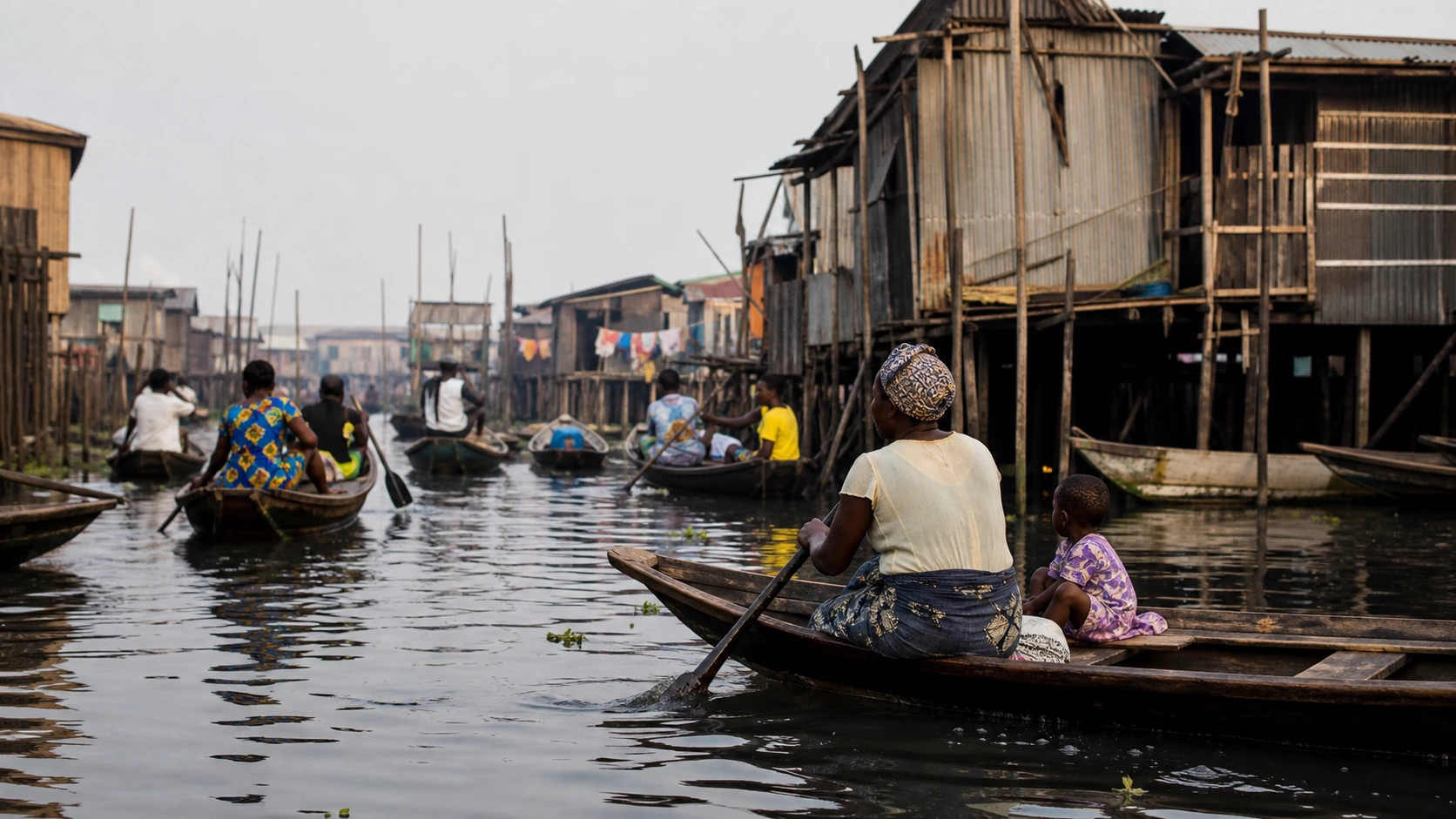
The floating settlement on the Lagos Lagoon, entered the only way it can be, by canoe, with community navigators who grew up on these channels. Waterways run between stilt houses like streets, a floating school rides at anchor, and the fishing and smokehouse economy moves hull to hull. Access is arranged with the community and led by its residents.

Ouidah and Abomey

The Slave Coast reads differently when you arrive along it rather than flying in. At Ouidah the road to the water is still marked, gate by gate, all the way to the beach, and inland at Abomey the palaces of the Dahomey kings show where the wealth of that trade went.

Freetown and Monrovia in One Journey

Two capitals founded as answers to slavery, one by freed people under Britain, one by freed people from America, their origins still legible in the street names. Few travellers reach either. The overland day between them is the hinge of the whole expedition.

The Fouta Djalon

Guinea's green interior, the plateau where the Gambia, Senegal and Niger rivers all begin. Waterfalls drop off the escarpment edges, the air cools by ten degrees as you climb, and the Fula herding country up there has an identity that owes nothing to the coast behind you.

The Eye of Africa

The Richat Structure: a set of concentric rings some forty kilometres across, so vast it serves as a landmark from orbit. We walk the desert floor inside one of the planet’s strangest geological formations.

The Iron Ore Train

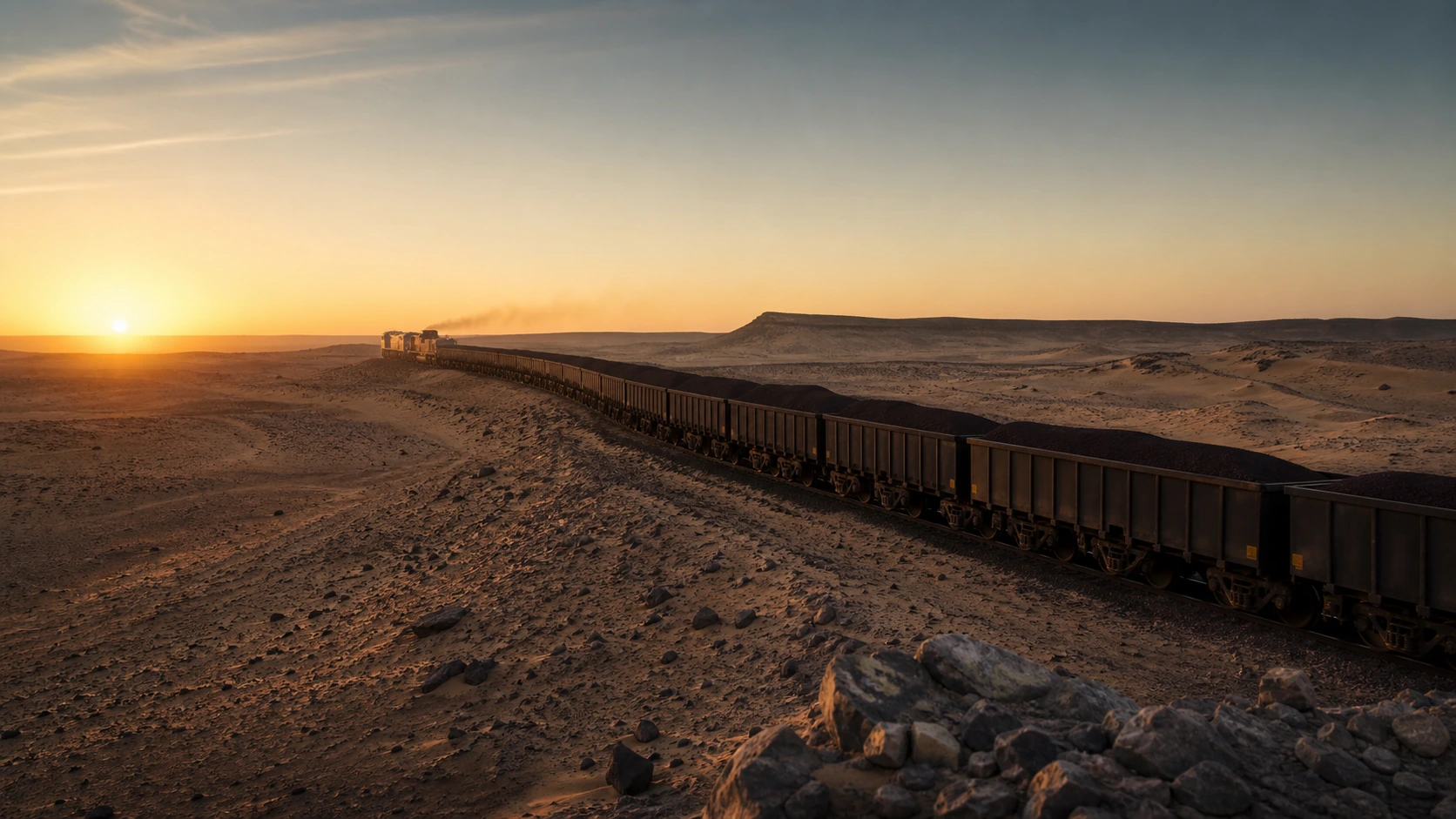
One of the longest trains on Earth, hauling ore across the Sahara. We join it near Ben Amera (the second-largest monolith on the planet) and ride overnight in an open wagon: bedrolls, a star map, and the whole Milky Way overhead.

The Expedition

Thirty-three days from the lagoon at Lagos to the Atlantic edge of the Sahara: twelve countries, nine land borders and two flights, Accra to Abidjan and Banjul to Nouakchott.

Route map of the Lagos to Nouakchott: Lagos, Cotonou, Ouidah, Lome, Accra, Abidjan, Yamoussoukro, Man, Monrovia, Freetown, Kindia, Labe, Gabu, Bissau, Cap Skirring, Ziguinchor, Banjul, Nouakchott, Azoueiga, Terjit, Ouadane, Chinguetti, Tmeimichat and Nouadhibou.
The Route

Lagos to Nouakchott

Thirty-three days: Lagos, then by road through Benin and Togo to Accra, a flight to Abidjan, overland through Liberia, Sierra Leone, Guinea and the Casamance to Banjul, then a flight to Nouakchott and a loop through the Adrar on the iron ore train.

  1. Days 1–4Lagos
  2. Day 5Cotonou
  3. Days 6–7Ouidah
  4. Day 8Lome
  5. Days 9–10Accra
  6. Day 11Abidjan
  7. Day 12Yamoussoukro
  8. Day 13Man
  9. Days 14–15Monrovia
  10. Days 16–17Freetown
  11. Day 18Kindia
  12. Days 19–20Labe
  13. Day 21Gabu
  14. Day 22Bissau
  15. Day 23Cap Skirring
  16. Day 24Ziguinchor
  17. Day 25Banjul
  18. Days 26 · 33Nouakchott
  19. Day 27Azoueiga
  20. Day 28Terjit
  21. Day 29Ouadane
  22. Day 30Chinguetti
  23. Day 31Tmeimichat
  24. Day 32Nouadhibou
Explore the route
The Lekki–Ikoyi Link Bridge crossing the lagoon in Lagos
Day 1
Arrival into Lagos · Victoria Island & Lekki orientation

Arrive at Murtala Muhammed International and meet your expedition leader for the private transfer to Victoria Island. The afternoon is an orientation drive through Victoria Island and Lekki (the bridges, toll gates, and lagoon crossings that structure the city's days) before the first briefing at sunset over the water: the geography of a metropolis built on a lagoon, and how the next three days move through it.

Day 1 · Nigeria
Makoko, the floating city
Day 2
Makoko, the floating city

The day the expedition is named for. By arrangement with the community, canoes and resident navigators carry us into Makoko, along waterways that work as streets, past stilt houses and smokehouses, the floating school, and the boat-builders' yards where the settlement's hulls are cut and caulked. The day runs inside the fisheries economy that keeps the city in fish, hosted by the people who run it. Back on Victoria Island, an evening debrief on the waterfront puts it in context: what Makoko is, what it is not, and what the city plans for it.

Day 2 · Nigeria
The mainland · markets, Afrobeat & the night food circuit
Day 3
The mainland · markets, Afrobeat & the night food circuit

Across the bridge and into the velocity of the mainland. The morning is market navigation with our fixers: the dense trade canyons where most of the city actually shops. The afternoon maps the creative city: street studios and galleries, and the Afrobeat lineage from Fela's Kalakuta Republic to today's scene, with a short, controlled stretch of the city's own transport (a danfo ride with the team) for those who want the full register. After dark, the night food circuit: suya, fresh fish, and jollof at the stalls our fixers rate highest.

Day 3 · Nigeria
The Atlantic edge · Lekki & the shoreline
Day 4
The Atlantic edge · Lekki & the shoreline

South-east down the Lekki peninsula to where the metropolis meets the ocean. A shoreline walk follows the Atlantic edge at the city's southern boundary, with time among the fishing communities that work it at dawn and dusk, and an optional boat circuit on the lagoon for the water-level view of the city. A coastal-expansion briefing closes the day: land reclamation, the engineered new coastline, and what it means to build a city into the sea.

Day 4 · Nigeria
The shore at Cotonou
Day 5
Lagos to Cotonou by road, over the Seme border

A last breakfast on Victoria Island, then west out of Lagos along the Badagry road and over the Seme border into Benin. It is only about 120 kilometres, but the Lagos traffic and the busiest crossing on this coast make it a full travel day, and we plan it as one, with our fixers waiting on both sides of the border. Cotonou by late afternoon, and the evening is yours to recover before the coast road west begins.

Day 5 · border 1 of 9
Ganvié by pirogue on Lake Nokoué
Day 6
Ganvié, then Ouidah and the Route des Esclaves

Out in the morning to Calavi and across Lake Nokoué by pirogue to Ganvié, thirty thousand people living on stilts in the lagoon, in a place founded because the Dahomey raiders would not follow anyone onto water. Then about an hour west to Ouidah for lunch. In the afternoon we walk the Route des Esclaves past the slave posts out to the Gate of No Return on the beach, marked at every stage of what was done along it, then the Sacred Forest, the Ouidah monument and the salt village.

Day 6 · Benin
Earthen palace courtyard and carved relief panels at Abomey, Benin
Day 7
Abomey and the Kingdom of Dahomey

About two and a half hours inland to the old heart of Dahomey. The Chameleon Temple first, then the underground village at Bohicon, dug as a refuge in the wars of the kingdom, and finally the Royal Palace Museum in Abomey, a UNESCO site and the seat of the Dahomey kings, whose wealth came largely from the trade you walked yesterday. Back to Ouidah for the night.

Day 7 · about 5 hours driving
Across Lake Togo to Togoville
Day 8
Ouidah, Togoville and Agbodrafo, into Lomé

The morning in Ouidah, at the Cathedral and the Temple of the Sacred Pythons, which face each other across the square. Then the border at Hillacondji, and into Togo. We take a pirogue across Lake Togo to Togoville, where the 1884 German protectorate treaty was signed and where the vodun shrines are still in daily use, and stop at the preserved slave house in Agbodrafo before the last stretch into Lomé.

Day 8 · border 2 of 9
Fishing boats in the harbour at Lomé
Day 9
Lomé, then over the Aflao border to Accra

A morning in Lomé: the fishing harbour, the fetish market, where healers and vodun practitioners buy their herbs and carved figures, Independence Square and the Grand Marché. After lunch, the Aflao crossing, minutes from the centre in the only capital in Africa that sits directly on its own border, and about three and a half hours along the coast road to Accra.

Day 9 · border 3 of 9
The Jamestown lighthouse in Accra
Day 10
Accra

A full day in Ghana's capital. Osu Castle, the old Danish fort that became the seat of government, then Makola Market, the Kwame Nkrumah Memorial Park, and Jamestown, the oldest neighbourhood in the city, where we climb the lighthouse above the fishing beach. We finish at Black Star Square, where the nation holds its parades.

Day 10 · Ghana
The Plateau skyline across the lagoon in Abidjan
Day 11
The flight to Abidjan

A slow last morning in Accra, then the short flight west to Abidjan, a little over an hour, where the Ivorian convoy is waiting. The language changes to French. Abidjan in the afternoon is towers, lagoon ferries, the Plateau skyline and traffic, and the evening is in Treichville.

Day 11 · flight 1 of 2, included
The Basilica of Our Lady of Peace, Yamoussoukro
Day 12
Yamoussoukro and the basilica

North out of Abidjan on good tar to the political capital that Félix Houphouët-Boigny built out of his home village, and to the Basilica of Our Lady of Peace standing in the bush at the end of it. We spend the afternoon there, under a dome that answers St Peter's, with room inside for eighteen thousand people and rarely more than a handful.

Day 12 · about 3 hours driving
The Zaouli in a Guro village
Day 13
The Zaouli, then west to Man

West into Guro country in the morning for the Zaouli, a masked dance performed at a speed the eye cannot resolve, the dancer's feet blurring under a carved face that never moves. We watch it in a village that keeps it rather than on a stage. Then on west through Daloa to Man, a town ringed by forested hills close to the Liberian border, for the night.

Day 13 · about 5 hours driving
A paved road through Liberia’s green interior on the overland journey toward Monrovia
Day 14
Into Liberia at Ganta, on to Monrovia

The day the flight used to take, now driven. Out of Man early, over the hills to Danané and the border into Liberia, then from Ganta south on the paved road through Gbarnga to Monrovia, arriving as the light goes. With the border it is ten to twelve hours, and we say so plainly. Monrovia is where the hard half of the expedition begins.

Day 14 · border 4 of 9
Monrovia
Day 15
Monrovia

Liberia's capital rewards a slow day. Providence Island, where the first settlers from America landed in 1822; the Waterside market; the burnt-out Ducor Hotel on its hill above the city; and street names that read like a road map of the American east coast. We also re-provision here, because the hardest week of the route starts tomorrow.

Day 15 · rest day
The road bridge at the Mano River crossing between Liberia and Sierra Leone
Day 16
Monrovia to Freetown, the long crossing

The defining overland day of the expedition. North-west from Monrovia to the Mano River, across into Sierra Leone, and on through the rice country to Freetown in the dark if the border is slow. It is a long, hot day, and the border sets its pace. It is also the reason the line on the map holds together.

Day 16 · border 5 of 9, 10 to 12 hours
Pale sand, tidal water and forested hills at River No. 2 Beach on Sierra Leone’s peninsula
Day 17
Freetown and the peninsula

A day in one place. Morning in the city: the Cotton Tree, the Krio board houses on the hillsides, the market streets that run straight downhill to the water. Afternoon on the peninsula beaches south of town, at Tokeh or River Number Two, which is where Freetown goes on a Sunday and where the convoy crews catch up on sleep.

Day 17 · rest day
Freetown to Kindia
Day 18
Freetown to Kindia

Out along the peninsula road, with the city on its steep green hills above one of the largest natural harbours in the world behind us, then north into Guinea. Past the border the road runs inland to Kindia, at the foot of the highlands, where we leave the coast for the next four nights.

Day 18 · border 6 of 9
Kindia to Labé
Day 19
Kindia to Labé

North onto the plateau on the long climb to Labé, through the mining towns and the mango belt, with the temperature dropping as the altitude rises. By the afternoon you are in the Fouta Djalon: plateau grassland, waterfalls off the escarpment edges, and air ten degrees cooler than the coast. Labé, the capital of the highlands, is where we sleep for two nights.

Day 19 · about 6 hours driving
The Fouta Djalon on foot
Day 20
The Fouta Djalon on foot

A day out of the vehicles. We walk a section of the escarpment with a local guide, down through terraced Fula smallholdings to one of the falls, and back up in the afternoon. The highlands are the reason to come to Guinea and the reason we do not simply drive through them, which is what almost every crossing of this region does.

Day 20 · walking, 3 to 5 hours
Down from Labé to the border and Gabú
Day 21
Down from Labé to the border and Gabú

The hardest border on the route, so we leave Labé early and give it the middle of the day. The road comes down off the plateau toward Guinea-Bissau, and on the far side Gabú, a Fula trading town at the edge of the plateau country, hot and busy and entirely unvisited, is where we sleep. We get the paperwork in order here for the rest of the run to the coast.

Day 21 · border 7 of 9
Gabú to Bissau
Day 22
Gabú to Bissau

West toward the Atlantic again, stopping en route at Bafatá, the colonial river town where Amílcar Cabral was born. Bissau at the end of it is a city of collapsing Portuguese facades, bougainvillea growing out of the plasterwork and a waterfront that has stopped pretending to be a port. It is one of the strangest capitals in Africa.

Day 22 · about 5 hours driving
Into Senegal, on to Cap Skirring
Day 23
Into Senegal, on to Cap Skirring

North through cashew country on a road that alternates without warning between tar and red earth, to the crossing at São Domingos. Senegal changes character below the Gambia River: the Casamance is green, slow and threaded with mangrove creeks, and it has spent decades feeling separate from Dakar. We finish on the Atlantic at Cap Skirring, in time for the sunset, which is the best on this stretch of the ocean.

Day 23 · border 8 of 9
Cap Skirring to Ziguinchor
Day 24
Cap Skirring to Ziguinchor

A light day on purpose, after the borders behind us. The morning is for the coast: the fishing beach, the palm line and whatever the tide has left. Then a short run east on back roads through Diola villages and stands of sacred forest to Ziguinchor, the old river port, on the waterfront at dusk.

Day 24 · short driving day
Ziguinchor to Banjul, the last border
Day 25
Ziguinchor to Banjul, the last border

North out of the Casamance on the last land crossing of the trip, a gentle one by the standards of what is behind you, and into The Gambia. Banjul, the smallest capital on the Atlantic coast of Africa, is where the convoy stops after three weeks on the road, and we spend the evening on the riverfront before the Sahara.

Day 25 · border 9 of 9
Painted pirogues on Nouakchott’s sandy Atlantic fishing shore
Day 26
Banjul to Nouakchott, the flight north

A last morning to walk Albert Market and the Banjul riverfront, then the transfer to the airport and the flight north to Nouakchott, connecting through Dakar on days without a direct service. Our Mauritanian team meets you on arrival, helps you through the e-visa formalities and takes you to the Semiramis Hotel. The evening is a welcome dinner and a briefing for the Sahara week ahead. Overnight in Nouakchott.

Day 26 · flight 2 of 2, included
Nouakchott to the Dunes of Azoueiga
Day 27
Nouakchott to the Dunes of Azoueiga

We leave the coast early and drive north into the Adrar, some seven hours across open desert, with photo stops along the way and lunch in the shade of an acacia. By late afternoon we reach Azoueiga and the tallest sand dunes in the country, a sea of gold rising hundreds of feet from the plain. We make camp at their foot, and the evening belongs to the fire, the silence, and a sky with no competition. Overnight in a private desert camp.

Day 27 · Mauritania
Azoueiga to the Terjit Oasis
Day 28
Azoueiga to the Terjit Oasis

A morning drive brings us to Terjit, one of the Sahara’s most beautiful oases (date palms and warm springs hidden inside a narrow canyon of red stone) with a picnic lunch at Tivougar along the way. We spend the afternoon in the greenery and cool water, a startling contrast to the dunes behind us. Overnight in camp at the oasis.

Day 28 · Mauritania
The Richat Structure and Ouadane
Day 29
The Richat Structure and Ouadane

We drive to the Richat Structure: the “Eye of Africa,” a vast set of concentric rings some forty kilometres across, so large it is used as a landmark from orbit. After exploring its rings and ridges, we continue to Ouadane, a ruined caravan city half-swallowed by sand and one of the oldest towns in the country. In the late afternoon we walk its stone lanes and the old UNESCO quarter. Overnight at an auberge in Ouadane.

Day 29 · Mauritania
Chinguetti’s square stone minaret above the old town’s sand-filled lanes
Day 30
Ouadane to Chinguetti

A desert drive brings us to Chinguetti, the seventh holy city of Islam and a UNESCO World Heritage site. We tour its ancient manuscript libraries, where scholarly families still care for handwritten Qur’ans and astronomical treatises nearly a thousand years old, walk the sandblown old town, and visit the Grand Mosque with its famous stone minaret. We climb the dunes above the town for sunset. Overnight at an auberge in Chinguetti.

Day 30 · Mauritania
Ben Amera’s rounded granite mass rising from the Mauritanian desert
Day 31
Ben Amera and the Iron Ore Train

The headline day, and the night of the whole expedition you'll remember longest. We drive out toward Tmeimichat, passing the Choum Tunnel and Ben Amera, the second-largest monolith on Earth after Uluru, before reaching the rail line to prepare for the crossing. The train keeps its own schedule, so we hold time in reserve and board the moment it arrives, an open ore wagon on a convoy that can run three kilometres long. We ride west across the Sahara as a desert sunset gives way to a sky of impossible clarity; wrapped in scarves against the dust and the cold, we bed down in the wagon beneath the full sweep of the Milky Way and sleep out on the train as it rolls through the night toward the coast.

Day 31 · Mauritania
Nouadhibou and Cap Blanc
Day 32
Nouadhibou and Cap Blanc

We roll into Nouadhibou soon after first light, dust-covered and quietly transformed. A hotel, a hot shower, and a warm meal are waiting, and the middle of the day is for rest. In the afternoon we drive out along the Cap Blanc peninsula, the windswept headland that shelters the largest surviving colony of Mediterranean monk seals on Earth, around 300 animals protected by a national reserve, for the sea air and a coastline that feels a century removed from anywhere. Overnight in Nouadhibou.

Day 32 · Mauritania
Nouadhibou to Nouakchott · Departure
Day 33
Nouadhibou to Nouakchott · Departure

We drive south along the Atlantic, stopping at Tiwilit, where the dunes run straight down into the ocean, for a last desert lunch on the shore. Continuing to Nouakchott, we visit the great camel market and watch the fishing fleet come in at the Port de Pêche as the sun goes down. A farewell dinner closes the expedition before your onward flight: most international departures from Nouakchott leave late in the evening. Thirty-three days and twelve countries, from the canoes of Makoko to the iron ore train, and a Sahara that will call you back.

Day 33 · Mauritania
Benin Ganvie Stilt Village Lake Nokoue

Small Group Expedition

Every Detail Arranged.
Every Moment Yours.

What's Included

Duration33 days / 32 nights, Lagos to Nouakchott (one way)
Group SizeSmall group expedition: maximum 5 guests
CountriesTwelve: Nigeria, Benin, Togo, Ghana, Côte d'Ivoire, Liberia, Sierra Leone, Guinea, Guinea-Bissau, Senegal, The Gambia and Mauritania
TransportPrivate vehicles in Lagos and on the Day 5 drive to Cotonou; supported 4WD convoys with a single expedition leader from Cotonou to Banjul; a private 4x4 with a Saharan driver-guide in Mauritania, and one night on the iron ore train
BordersNine land crossings, from Seme on Day 5 to The Gambia on Day 25: assistance, permits and paperwork handled at every one
FlightsTwo, both included: Accra to Abidjan on Day 11 and Banjul to Nouakchott on Day 26
AccommodationFour nights on Victoria Island; twenty-one nights in hotels from Cotonou to Banjul, comfortable along the Gulf of Guinea and genuinely basic between Monrovia and Gabú; then the Semiramis Hotel in Nouakchott, desert and oasis camps, auberges in Ouadane and Chinguetti, a night on the train and a hotel in Nouadhibou
Included ExperiencesMakoko by canoe; the Lagos mainland and night food circuit; Lekki and the Atlantic edge; Ganvié and Togoville by pirogue; Ouidah and the palaces of Abomey; a day in Accra; the Basilica of Yamoussoukro and the Zaouli dance; Monrovia and Freetown; a walking day in the Fouta Djalon; the Casamance; Azoueiga, Terjit, Ouadane, Chinguetti and the Richat Structure; the iron ore train; Cap Blanc
MealsDaily breakfast, and all meals on the Saharan camp and train nights, where a private cook travels with the expedition. Other lunches and dinners are at your own expense, apart from food that is part of a listed experience such as the Lagos night food circuit.
Not IncludedInternational flights (arrive Lagos, depart Nouakchott), visas for the twelve countries including the Mauritanian e-visa fee, travel insurance, other lunches and dinners, and alcohol

FREQUENTLY ASKED QUESTIONS

Common Questions About This Expedition

Yes, and the joins are where the work went. Run separately they would cost you extra departure and arrival days and a flight out of Lagos you do not need. Here the Lagos days run straight into a road day over the Seme border to Cotonou, where the Long Coast begins, and the morning after the convoy reaches Banjul we fly north to Nouakchott for the Sahara. Both connecting flights are included in the price.
Yes. Each of the three parts runs as its own expedition, so you can take Lagos, the Long Coast or the Sahara on its own, or any two of them back to back. What we would rather you did not do is book the whole route and plan to leave in the middle, because the convoy vehicles, the flights and the border paperwork are committed a long way in advance. Tell us at the enquiry stage and we will price the shape you actually want.
Twelve countries, and depending on your nationality up to ten or eleven visas, the largest administrative load of anything we run. Mauritania's e-visa is applied for online before you travel, with the fee paid in cash on arrival at Nouakchott, and most of the others must also be arranged before you fly. Confirmed travellers get a full dossier months ahead: which visa to apply for in which order, which are issued on arrival, where letters of invitation are needed, and which embassy is currently the slow one. We track every application and chase the ones that stall.
Days 16 to 21, between Monrovia and Gabú, with the long drive from Man to Monrovia on Day 14 as a foretaste. The roads stop being reliable, the borders are the least predictable on the route, and the hotels drop to basic for four or five nights. The Sahara week is hard in a different way: long desert drives, camp nights and a cold night in an open ore wagon on Day 31. Lagos and the Gulf of Guinea coast ease you in.

Expedition Investment

$27,000USD

per person, twin share

Fully inclusive of thirty-two nights' accommodation, the Lagos experiences and the road day to Cotonou, the supported 4WD convoy and a single expedition leader from Cotonou to Banjul, local fixer teams in twelve countries, nine land borders handled end to end, both flights (Accra to Abidjan and Banjul to Nouakchott), the Saharan 4x4, desert camps and the iron ore train crossing, daily breakfast, all meals on the desert nights and all listed experiences

Excludes international flights (into Lagos, out of Nouakchott), all visas including the Mauritanian e-visa fee, travel insurance, and other lunches and dinners. Runs in the November to February dry window; routing may adjust in real time with road, border and rail conditions. Each of the three sections can also be booked on its own

Reserve Your Spot
A Note on Safety & Logistics

Twelve countries means twelve separate plans, each made on its own terms and reviewed again as the departure approaches, and the expedition leader can reroute at any point. In Lagos we move in private vehicles with long-standing local fixers, and Makoko is entered only by community arrangement. The convoy runs daylight driving only, with vehicles in constant radio contact and a local fixer team ahead of us at every border post, and we cross into Liberia inland, by Man and Ganta. In Mauritania we keep to the Adrar, the Atlantic coast and the iron ore train corridor, with experienced driver-guides who know every community on the route. Across the whole region the main thing to manage is the road, and the pace is built around that. Every confirmed traveller gets a detailed country-by-country briefing before departure.