Armenia Beyond the Cascade
Armenia is small enough that you can drive from the Georgian border to the Iranian one in a long day, and dense enough that a week barely covers it. Most visitors fly into Yerevan for three nights, do Garni and Geghard on one day and Lake Sevan on another, and leave thinking they have seen the country. They have seen the front garden.
The Armenia worth the journey sits further out: monasteries built on cliff ledges and at the heads of gorges, a cave where people were pressing wine around 4100 BC, a canyon crossed by a cableway nearly six kilometres long, and a national symbol, Mount Ararat, that stands in another country across a border nobody can cross. It is a Christian kingdom older than most of Europe's, wedged between Turkey, Azerbaijan, Iran and Georgia, and it has learned to live with closed frontiers on two sides.
This guide covers how the country fits together, the places we think earn your time, when to go, entry and money, and a plain account of the one real risk, which is geographic rather than general.
How the Country Fits Together
Think of Armenia as a high plateau with Yerevan at its southwest corner. The capital sits at roughly 1,000 metres on the edge of the Ararat plain, and almost everything else is higher. Lake Sevan lies at about 1,900 metres an hour northeast of the city. The forested north, Dilijan and the Debed canyon in Lori, runs toward Georgia. The long tail of the south, Vayots Dzor and then Syunik, reaches down between Azerbaijan's Nakhchivan exclave and the eastern border to touch Iran on the Araks river.
There is essentially one road south. The M2 leaves the Ararat plain, climbs through Vayots Dzor past Areni and Yeghegnadzor, crosses the Vorotan pass at about 2,350 metres and drops toward Goris. That shape matters for planning, because the southern highlights sit in a line along it and the north is a separate loop. A sensible eight days goes Yerevan, south to Goris for two nights, back north over the Selim Pass to Sevan and Dilijan, and home.
Yerevan: Pink Stone and the Matenadaran
Yerevan was founded as the fortress of Erebuni in 782 BC, which makes it older than Rome, though most of what you see is Soviet planning in pink and ochre tufa from the 1920s onward. It is a pleasant, walkable city with excellent cheap food and a late wine bar culture around Saryan Street. Climb the Cascade at sunset for the view across the roofs to Ararat when the haze allows.
Two visits matter more than the rest. The Matenadaran holds roughly seventeen thousand manuscripts, some carried out of burning monasteries and later reassembled, and an hour there explains why this culture survived seventeen centuries of invasion: it wrote everything down and hid it. The second is Tsitsernakaberd, the memorial and museum to the 1915 genocide on the hill above the Hrazdan gorge. It is hard going and should not be skipped.
Give the city two full days. Day trips east to Garni and Geghard fit neatly into a third. Garni is the only standing Greco-Roman colonnaded temple in the former Soviet Union, and the gorge below it holds the Symphony of Stones, a cliff of hexagonal basalt columns. Geghard, a few kilometres up the valley, is half built and half carved down into the rock, with a spring running through one of its chambers.
South to Areni, Noravank and Tatev
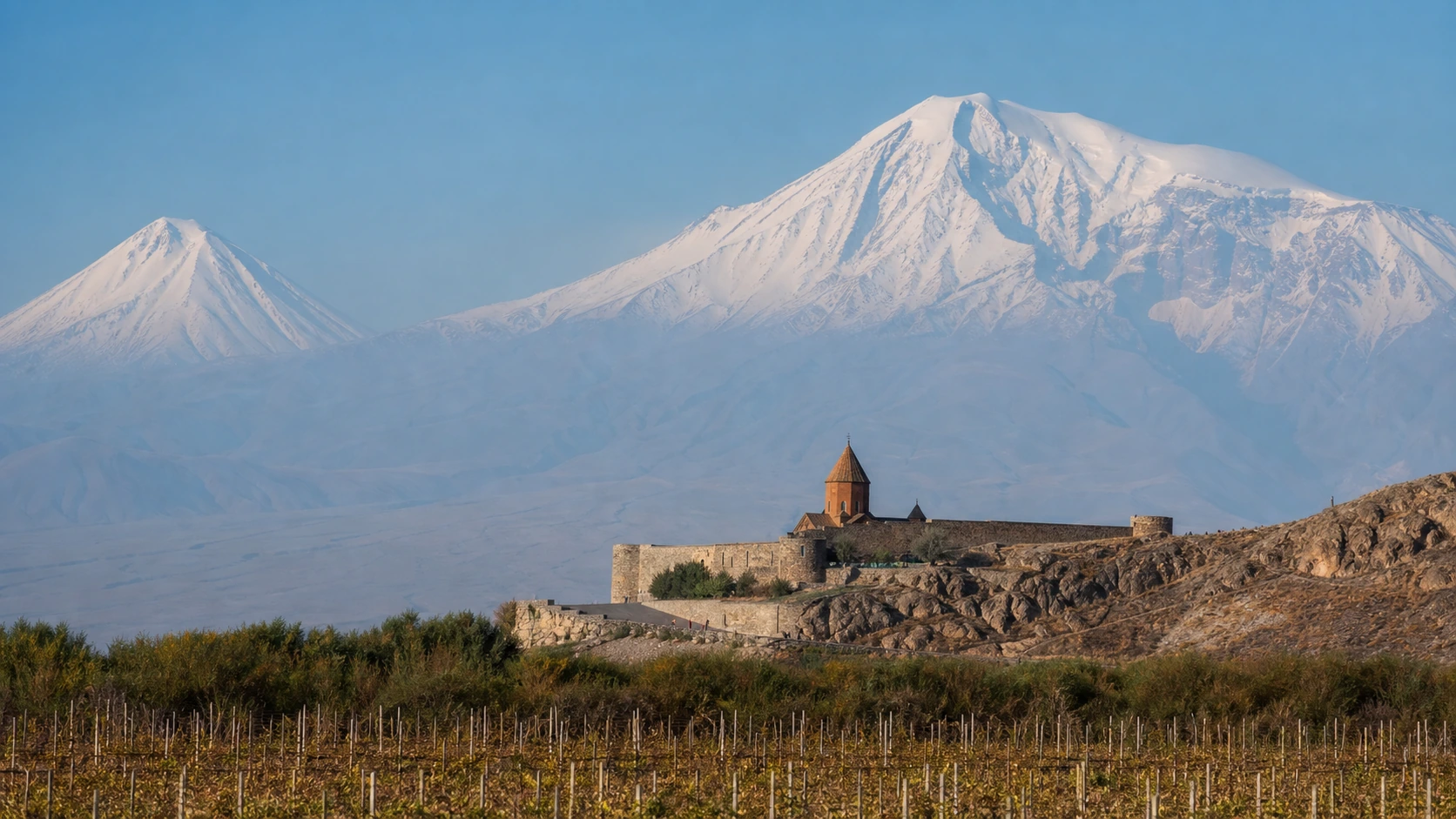
Leave Yerevan early for Khor Virap, the monastery on a low hill against the Turkish frontier where Gregory the Illuminator was held in a pit for thirteen years before converting the king in 301. Ararat stands about 30 kilometres behind it, and in the hour after dawn it is usually clear. By mid morning in summer it often hides.
From there the road climbs into Vayots Dzor. Noravank sits at the end of a narrow gorge of red cliffs, its thirteenth-century carvings the work of the sculptor Momik. Near the village of Areni, the Areni-1 cave produced a wine press, fermentation jars and grape seeds dated to roughly 6,100 years ago, along with a leather shoe about 5,500 years old. Small producers along the valley still make wine from the local Areni noir grape, and the village holds a wine festival in early October.
Syunik is the reason to keep going. Goris is a stone town in a bowl of eroded cliffs, and the right base for two nights. The Wings of Tatev cableway runs 5.7 kilometres across the Vorotan gorge to Tatev monastery, ninth century, a university in the medieval period and set on a spur with drops on three sides. The ride takes about twelve minutes and it holds a Guinness record as the longest reversible aerial tramway. It closes in high wind, so build a spare half day into the plan. Below Goris, Old Khndzoresk is an abandoned cave village reached across a swinging footbridge, inhabited into the 1950s.
Sevan, Dilijan and the Debed Canyon
Heading north, take the Selim Pass at 2,410 metres. Near the top a fourteenth-century Silk Road caravanserai stands intact by the road, stone stalls and all. The descent brings you to Lake Sevan, one of the largest high-altitude freshwater lakes in the world. The peninsula monastery of Sevanavank dates to 874, and the lakeside grills serve ishkhan, the Sevan trout.
Over the ridge, Dilijan is a different country again: beech and oak forest, timber balconies and cooler air. Haghartsin and Goshavank sit in side valleys nearby, and Goshavank holds one of the finest carved khachkars, the Armenian cross-stones, anywhere. If you have an extra day, continue north into Lori to the Debed canyon, where the UNESCO-listed monasteries of Haghpat and Sanahin face each other across a gorge lined with half-abandoned Soviet mining towns. It is the most atmospheric corner of the country and the least visited, and it sits on the road to the Georgian border.
When to Go
The core season runs from April to early November. May and June bring wildflowers, green gorges and snow still on Aragats, the country's highest mountain at about 4,090 metres. July and August are the weak months on the plain: Yerevan regularly passes 35 degrees Celsius, and Ararat sits behind heat haze for most of the day. The highlands stay comfortable, so a summer trip should lean toward Sevan, Dilijan and Syunik.
September and October are our favourite. It is harvest season, pomegranates and grapes are in the markets, Areni has its wine festival, the forests around Dilijan and Haghartsin turn, and the cold clear mornings give you Ararat over Khor Virap. Winter is real. The Selim and Vorotan passes see snow, Sevan freezes at the edges and Tatev's cableway can stop. Yerevan still works for a short city trip, and there is skiing at Tsaghkadzor, but it is not the season for the south.
Entry, Flights and Money
US citizens can enter Armenia without a visa and stay up to 180 days in a year, and EU and UK citizens are also visa-free. Your passport needs to be valid on entry and departure, though airlines on some connecting routes ask for six months, so carry that anyway. Dual Armenian nationals must enter and leave on their Armenian passport.
Zvartnots airport outside Yerevan has direct flights from Vienna, Warsaw, Istanbul, Dubai and Doha, among others, and a lot of them land between midnight and five in the morning. Plan the first day around that. The land borders with Turkey and Azerbaijan are closed, so the only practical overland route is from Georgia, through the Bagratashen crossing. Tbilisi to Yerevan by road takes around five to six hours, which is why we often run Armenia and Georgia back to back.
The currency is the dram. Cards are accepted across Yerevan and in most hotels, but carry cash for village guesthouses, monastery donations, market stalls and the cableway kiosk on a bad connectivity day. Armenia is still inexpensive by European standards: a very good dinner with local wine in Yerevan runs to perhaps 25 to 40 dollars a head.
Safety: The Eastern Border and the Rest
Inside the normal travel area, Armenia is one of the easiest countries in the region. Yerevan is safe to walk at night, violent crime against visitors is rare, and the main hazards are driving standards and mountain roads in poor weather.
The exception is the border with Azerbaijan. After the 2020 war and Azerbaijan's recapture of Nagorno-Karabakh in September 2023, when more than 100,000 Karabakh Armenians left for Armenia, the eastern frontier stayed tense. A peace agreement was initialled in Washington in August 2025, but the border remains closed. The US State Department rates Armenia Level 2, exercise increased caution (in an advisory issued September 2025), and lists the border region with Azerbaijan as Do Not Travel. It also restricts its own staff from non-essential travel to Gegharkunik east of Vardenis and Syunik east of Goris and south of Kapan, and warns of unexploded ordnance off-road near the eastern border.
In practice that means our routes stay on the main roads and well west of those lines. Tatev and Khndzoresk sit to the south and west of Goris, not east. We do not hike off trail in the east, we do not take the roads that briefly run along or across the frontier, and we check the advisory and local conditions before every departure. If the picture changes, the itinerary changes.
Travelling Here Well
Armenians are proud of their country and generous with it. A few things help. Dress modestly in working monasteries: shoulders covered, and women will be offered a scarf in some churches. Do not photograph military positions or the border posts around Khor Virap. Be thoughtful about politics, the genocide and Karabakh, which are personal subjects for almost every family you will meet, many of whom now include displaced relatives. Listen more than you ask.
Spend money locally where it counts: village guesthouses in Goris and Dilijan, small wineries in Areni and Yeghegnadzor, the women baking lavash in a tonir oven at Garni who will let you try to slap one onto the clay wall yourself. You will fail the first time. Everyone does.
How We Run It and What It Costs
Our Armenia expedition is eight days and seven nights out and back from Yerevan, from 2,950 dollars per person. It is private, with a licensed English-speaking guide and a private vehicle and driver for the whole route. We spend four nights in a central Yerevan boutique hotel, two in Goris so Tatev is never rushed, and one in the forests of Dilijan. The pace is easy to moderate: monastery steps, the Garni gorge path and the Khndzoresk footbridge, with nothing more than an hour on foot.
We plan around the light rather than the clock, Khor Virap at dawn, Tatev on the clearest day of the two, and we hold a spare afternoon for wind on the cableway. Most guests add the Debed canyon or pair Armenia with our Georgia expedition through Tbilisi for two to three weeks in the Caucasus. Bookings close over WhatsApp or email with a member of the team, not through a checkout page, so send us your dates and we will tell you honestly what the season will look like.
Ready to Start Planning?