Three Countries, Three Languages
On the northeastern shoulder of South America, between Venezuela and Brazil, three territories sit side by side along the Atlantic. Guyana speaks English and plays cricket. Suriname was Dutch until 1975 and still files its laws in Dutch, though the street language is Sranan Tongo. French Guiana is not a country at all but a department of France, so you pay in euros and post letters with French stamps five degrees north of the equator.
The Guianas get skipped because they do not fit the usual South America circuit. There is no road link to Venezuela and only a thin one to Brazil, the interior is almost all forest, and flights in come from the north rather than from Lima or Bogotá. For the curious traveller that is the appeal. Kaieteur Falls, the wooden old town of Paramaribo, the French penal colony and a working European spaceport are each worth the trip on their own. Here they sit within a few hundred kilometres of one another.
How the Route Fits Together
The geography decides the order. Georgetown and Paramaribo are linked by short flights, which saves a long drive and the Courantyne River ferry. From Paramaribo a paved road runs east to Albina on the Marowijne, the river the French call the Maroni, and on the far bank is Saint-Laurent-du-Maroni in French Guiana. From there the coast road continues to Kourou and Cayenne. The interior of all three countries is reached by small plane or by river, never by a quick drive.
So we open in Georgetown, fly Kaieteur, fly on to Paramaribo, cross into French Guiana by pirogue, and come back the same way to finish in Paramaribo. One fixed point shapes the calendar: the scheduled flights to Kaieteur run on Saturdays and Sundays, so trips begin with a Friday or Saturday arrival in Georgetown.
Georgetown and Kaieteur Falls
Georgetown is a Dutch-planned, British-built city that sits below the level of the sea at high tide, held back by a concrete seawall and a grid of old canals. The best of it is wooden. St George’s Anglican Cathedral, finished in 1899, is one of the tallest timber churches in the world,. The city is changing fast: oil was found offshore in 2015, production began in 2019, and Guyana has had one of the fastest-growing economies on earth since. You will see new hotels and traffic jams that were not there five years ago, and prices to match.
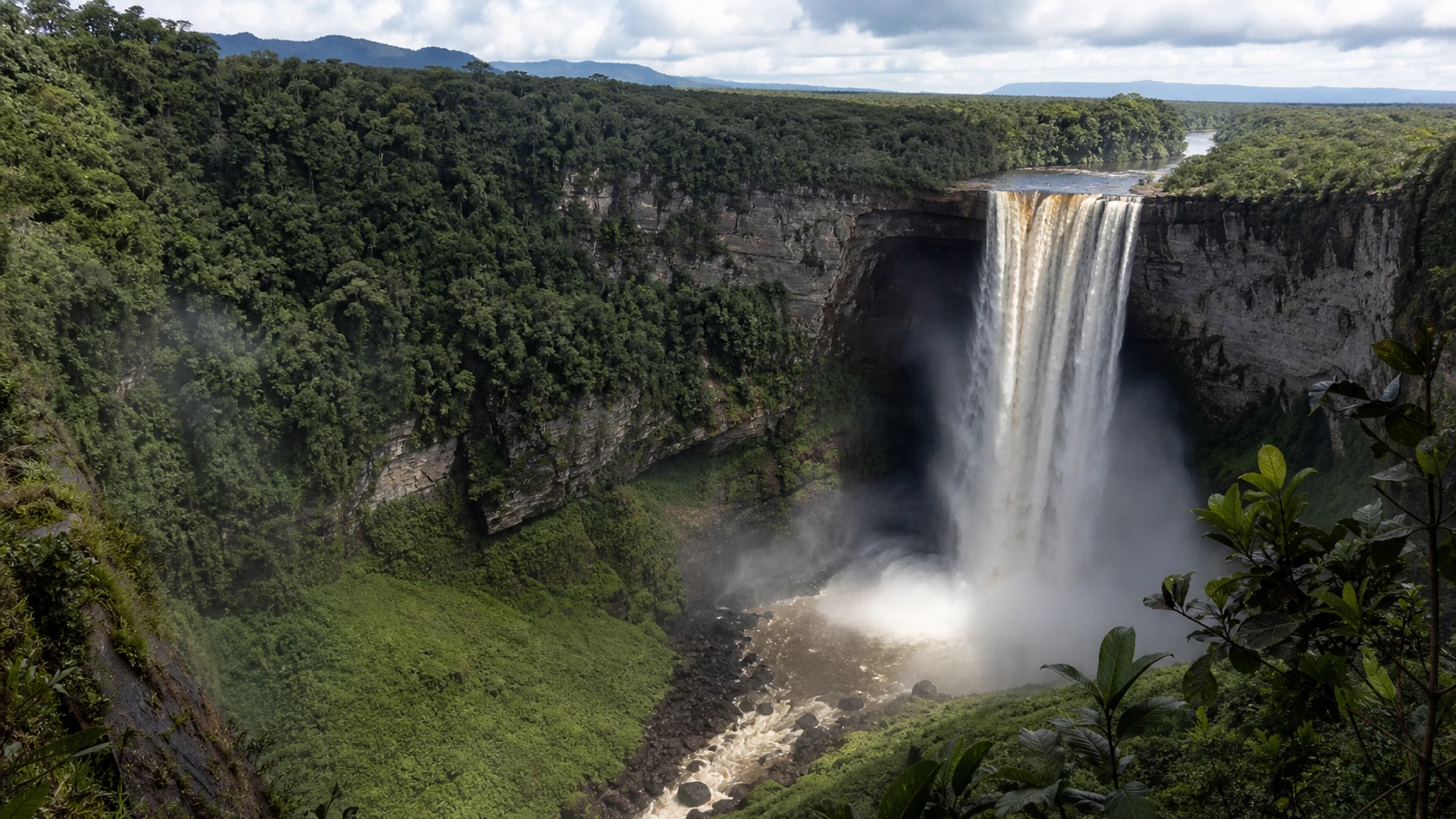
Kaieteur is the reason most people come. The flight from Ogle Airport takes about 50 minutes over forest with no roads, no clearings and almost no sign of people, then the plane banks and the Potaro River simply drops off a sandstone edge. The fall is 226 metres in a single plunge, about four and a half times the height of Niagara, and there is no railing, no viewing tower and no ticket queue. You get about two hours on the rim with a park ranger and your guide. Look in the giant tank bromeliads for the golden rocket frog, which spends its whole life in them, and watch the swifts that nest behind the curtain of water.
Paramaribo, the Wooden Capital
Paramaribo’s inner city has been on the UNESCO World Heritage list since 2002, and it earns it. The old town along the Waterkant is a grid of white timber houses with dark shutters and steep roofs, built by Dutch planters and the craftsmen they brought. The Cathedral of Saints Peter and Paul is one of the largest wooden buildings in the Americas,. On Keizerstraat, the Neveh Shalom synagogue and the city’s main mosque stand next to each other and share a car park, which tells you something about how this country of Hindustani, Creole, Javanese, Maroon, Chinese and Indigenous Surinamese has learned to live together.
Across the river, Peperpot is a former coffee and cocoa plantation that the forest has largely taken back. It is an easy afternoon for toucans, parrots, capuchin monkeys and the occasional sloth.
Crossing the Marowijne
This is the part people ask about most. The drive from Paramaribo to Albina takes about two and a half hours. At Albina you clear Surinamese exit formalities, step into a pirogue (a long, covered wooden canoe with an outboard), and cross a few kilometres of brown river to Saint-Laurent, where French border police check you in.
One detail matters. Your guide can handle everything on both banks but cannot pay the crossing for you, so you pay the boatman yourself, in cash. It is US$20 a person each way. Bring two clean US$20 bills, plus a spare. On the way back the process runs in reverse, and this is the reason Suriname needs a multiple-entry permit rather than the single-entry tourist card.
Saint-Laurent, Devil’s Island and the Spaceport
From 1852 to 1953, France shipped convicts to this coast, and some 70,000 of them passed through the Camp de la Transportation in Saint-Laurent. The barracks, the cell blocks and the guillotine yard are still there. Guides will show you the cell said to have held Henri Charrière, the author of Papillon. In Cayenne the market is worth an hour: Hmong farmers, who came here as refugees from Laos in 1977, sell vegetables beside Creole and Brazilian traders.
From Kourou a catamaran takes about an hour to reach the Îles du Salut. You land on Île Royale to walk the ruins of the prison, the hospital and the chapel under coconut palms, with agoutis on the paths and macaws overhead, then cross to Île Saint-Joseph for the solitary cells, slowly being swallowed by roots. Devil’s Island itself, where Alfred Dreyfus was held from 1895 to 1899, is closed to visitors because of the currents, so you see it from the boat. The islands sit under the launch path from the spaceport and are evacuated on launch days, which is one more reason we build some flexibility into this part of the trip.
The Guiana Space Centre is the strangest sight in the region: a working European spaceport carved out of the coastal forest, where Ariane 6 and Vega-C launch. It is here because a rocket launched this close to the equator gets a free push from the Earth’s rotation. The guided tour runs about three hours, in French with your guide translating, and takes in the control rooms and launch zones. Security wants passport details about two weeks ahead.
Up the Upper Suriname River
If you can give the Guianas nine days rather than seven, spend the extra time on the river. The road south from Paramaribo ends at Atjoni after three to four hours, and from there a motorised pirogue takes you upriver past Saamaka villages to a simple lodge beside a run of small rapids. The Saamaka are Maroons, descendants of Africans who escaped the Dutch plantations into the forest and fought until the colony signed a peace treaty with them in 1762. They have kept their own language, religion and system of chiefs ever since.
Expect screened cabins, shared meals and power for a few hours a day. In the morning a community guide walks you through Nieuw Aurora and tells the history in his own words. For those with more time, the 14-day version adds three nights at a fly-in rainforest resort in western Suriname, with no road in, a long trek to the granite top of Misty Mountain and a day at Jodensavanne, the ruins of a 17th-century Jewish plantation settlement on the Suriname River.
When to Go
The Guianas have two dry seasons and two wet ones. The long dry season runs roughly from February to April and the short dry season from August to November. Those are the best windows, for Kaieteur especially, since the flight depends on clear mornings. The main rains fall from about May to July, with a shorter wet spell around December and January.
The route runs all year. In the wet months you get heavy afternoon downpours, a fuller river and a louder, wider Kaieteur, which some people prefer. Temperatures barely move: around 30°C by day on the coast and humid in every month.
Entry, Health, Flights and Money
Three countries means three sets of rules. Americans, Britons and most EU citizens do not need a visa for Guyana, though rules vary by passport and we check each one. Suriname requires an online e-visa for Americans and many others, and for this route it has to be the multiple-entry kind. French Guiana follows French rules rather than Schengen ones: Americans can stay up to 90 days without a visa, but your passport needs at least three months of validity beyond departure. Suriname wants six months beyond arrival, so plan around the stricter rule.
French Guiana requires a yellow fever certificate from every traveller over one year old, and it can be checked at the border and at hotels. Carry it with your passport. Malaria is present in the interior of all three countries, so talk to a travel clinic about prophylaxis for the Kaieteur and river days, and expect dengue on the coast, which means repellent and long sleeves at dusk. Medical care is good in Cayenne, adequate in Georgetown and Paramaribo, and minimal anywhere else, so carry insurance that includes evacuation.
Georgetown has direct flights from New York and Miami and connections through Panama City and the Caribbean. Paramaribo links to Amsterdam, and Cayenne to Paris. Each place uses its own money: Guyanese dollars, Surinamese dollars and euros. US dollars go a long way in Guyana and Suriname, and cards work well in French Guiana and at the better hotels elsewhere, but carry small notes for markets and tips.
Safety: The Honest Version
The three Guianas sit at very different levels. The US State Department rates Suriname and French Guiana Level 1, exercise normal precautions. Guyana is Level 3, reconsider travel, because of violent crime, most of it in Georgetown. In practice that means armed robbery and street crime in parts of the capital, especially after dark, not risk to visitors on a guided programme. US embassy staff are barred from Stabroek Market, and the embassy advises avoiding the seawall and the National Park after dark. We follow the same rules: Stabroek’s iron clock tower is something you see from outside, by day, with the vehicle close.
In Suriname, the State Department flags robbery around Albina and along the East-West Highway between Paramaribo and the border. That is the road we drive to the Marowijne, so we do it in daylight, with our own driver, without stops on the way, and we cross in the morning. In French Guiana the concern is illegal gold mining in the deep interior near Brazil, far from anywhere this route goes.
Venezuela claims the whole of Guyana west of the Essequibo River, which includes Kaieteur. The dispute sits before the International Court of Justice and has no effect on the falls or the flight, but it is the sort of story that turns up in the news, so we mention it.
How We Run It and What It Costs
Our Guianas expedition runs Georgetown to Paramaribo in three lengths. Seven days covers all three countries, from 4,650 dollars. Nine days adds the Upper Suriname River and the Saamaka, from 5,350 dollars, and it is the one we recommend for a first visit. Fourteen days adds the fly-in rainforest resort and Jodensavanne, from 9,350 dollars. The Kaieteur flight, the Georgetown to Paramaribo flight, hotels, guides, the island catamaran, the space centre tour and every border handover are included. International flights, the Suriname permit and any visas, the river crossing fee, insurance, some meals, drinks and tips are not.
Guests often pair it with Venezuela’s Angel Falls for a tour of the great waterfalls of the Guiana Shield. We do not take bookings through a checkout page. Send us your dates over WhatsApp or email, and someone on the team who has made the Marowijne crossing will reply with what is possible.
Ready to Start Planning?