The Country Behind the Headline
Most people who write to us about Yemen mean Socotra. Fair enough. But the mainland has something the island does not: a civilisation still living in the buildings it raised five hundred years ago. In the east of the country a long dry canyon, Wadi Hadhramaut, cuts through a limestone plateau, and along its floor sit whole cities built from mud. Shibam with its walled block of tower houses. Tarim with its whitewashed minaret and manuscript libraries. Seiyun under the largest mudbrick palace in Arabia. A side canyon, Wadi Doan, holds villages that seem poured down the cliff face, and then the road climbs onto the plateau and drops to Mukalla and the Arabian Sea.
Yemen is at war, and has been for over a decade. We say that in the first paragraph rather than the last because it shapes every decision in this guide. The Hadhramaut lies far from the war's main front lines, and a route through it can be run properly, under government clearance with an armed escort, in small numbers, by people who know the valley. That is the only way we do it. Here is what the region holds, when to come, how the flights and visa work, what it costs, and a plain read on the risk.
Where the Hadhramaut Is, and Why It Is Different
On a map the Hadhramaut is the huge eastern governorate, roughly a third of Yemen, running from the sands of the Rub al Khali down to a long stretch of Arabian Sea coast. Its heart is the wadi itself, a canyon a few kilometres wide and well over a hundred long, cut into a stony plateau called the Jol. Rain is rare, but when it comes the wadi floods, and that water, banked behind date palms and earth dams, is what fed the towns.
The Hadhramis have always looked outward. For centuries their traders and scholars sailed to Java, Singapore, Zanzibar and the Malabar coast, and the money came home as palaces; walk through Tarim and you see Southeast Asian ornament on buildings made of Yemeni mud. That history matters today for a practical reason. The valley has its own identity, its own tribal structure and its own security arrangements, and it has stayed out of the Houthi war in the north and the fighting around Aden. The coast and the valley are held by different Saudi and Emirati backed formations, and both have kept the governorate quiet for years.
Shibam: The Manhattan of the Desert
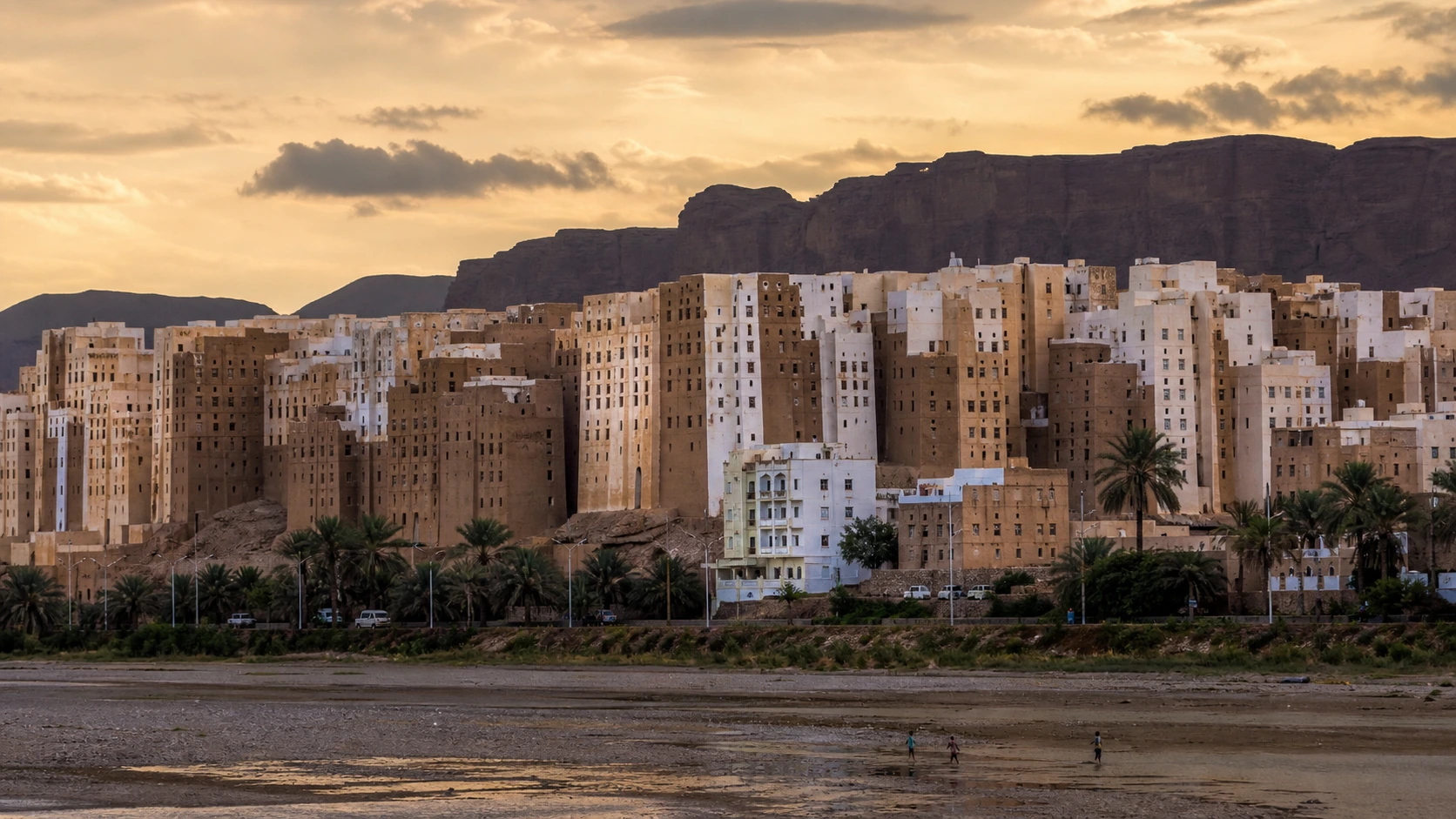
Freya Stark gave Shibam its nickname in the 1930s and it has stuck because it is accurate. Around five hundred tower houses stand shoulder to shoulder inside a single wall, most of them from the sixteenth century, some older at the base, rising eight, nine and in places eleven storeys straight out of the valley floor. The walls are sun-dried mudbrick, thick at the bottom and thinning as they climb, plastered with lime at the crown so that from a distance the whole city looks like it has been dipped white at the top. UNESCO listed it in 1982 and moved it onto the danger list in 2015, partly for the war, partly because mud needs constant maintenance and the money for it has thinned.
You enter on foot through the gate and the lanes close over you. Ground floors hold grain stores and animals, the family rooms sit in the middle, and the top floor is the mafraj, the sitting room with the best air. We arrange a climb through one of the houses to its roof, where the skyline stands around you in ranks and the palm groves run off to the cliffs. The best single view of the city is from the slope across the wadi to the south, at sunset, with a flask of tea.
Tarim, Seiyun and the Road to Prophet Hud
Seiyun is the valley's administrative town and the place you fly into. Its landmark is the Sultan Al Kathiri Palace, a seven-storey whitewashed block of mudbrick that floats above the souq like a ship. It has served as a museum for years; whether the doors are open on a given day depends on who has the key, which is a very Hadhrami answer.
Tarim, half an hour east, is the valley's city of scholars, a centre of Islamic learning for eight centuries that still draws students from Indonesia and Malaysia. The Al Muhdhar minaret, nearly fifty metres of mudbrick finished in 1914, is the tallest earthen structure of its kind anywhere, and the Al Ahqaf library holds thousands of manuscripts. Beyond Tarim the road runs to Aynat, where seven domes stand over the graves of saints, and on to the tomb of the prophet Hud, a hillside shrine ringed by a town of pilgrims' houses that sits empty most of the year and fills for the annual pilgrimage in the month of Shaban.
Wadi Doan and the Drop to Mukalla
Wadi Doan is the side canyon most people carry home as the image of Yemen. It runs south from the main valley, narrower and steeper, and its villages are built against the cliffs in the same earth as the rock behind them, so from the rim you have to look twice to separate the two. Al-Hajarayn is one of the oldest, stacked beneath a fortress. Haid al-Jazil stands on a freestanding block of rock above the palm groves and has been photographed more than anywhere else in the country. The Buqshan Palace at Khaila, painted in bands of blue, white and ochre, belongs to a family that made its fortune in Saudi Arabia and came home to build. Doan is also honey country; the sidr honey from these hives sells for well over a hundred dollars a kilo in the Gulf.
We sleep two nights on the canyon rim at the Hayd Al Jazeel Resort, simple and extraordinary in about equal measure, with the villages directly below the terrace. From there the road climbs onto the Jol and falls in switchbacks to Mukalla. Mukalla was the port of the Qu'aiti sultans and still feels like a working harbour: the sultan's palace with its balconies facing the sea, a fish market that is loud by six in the morning, the Al Ghwayzi fort on its crag above the coast road, and a corniche that fills after dark. A sunset dhow ride along the front is the right way to finish the valley.
When to Go
October through March. The valley sits at around seven hundred metres and in winter the days run in the mid twenties Celsius with cool, clear nights, which is what you want for walking in Shibam's lanes and trekking the floor of Wadi Doan. From May to September the wadi is a furnace, forty degrees and more by early afternoon, and Mukalla adds humidity to the heat. We do not run the mainland in summer.
Two things to plan around. Ramadan moves earlier every year (in 2027 it begins in early February) and the valley during the fast is muted: restaurants close by day and the pace slows. The pilgrimage to Prophet Hud in Shaban is the opposite, the only time the shrine town is alive, and remarkable if the dates line up. The wadi also floods occasionally after heavy rain, usually in spring or autumn, and a road can close for a day. Our itineraries carry slack for it.
Getting There: Cairo, the Visa, Money and Escort
Everything runs through Cairo. Yemenia flies from Cairo to Seiyun, in the middle of the valley, and back to Cairo from Riyan airport outside Mukalla, so you fly in at one end of the route and out at the other and never cross Yemen by road. Budget roughly 700 to 900 dollars for the pair. Schedules shift and a day of slack either side in Cairo is not optional. There are no useful connections through Sanaa, which is Houthi held, and we do not route anyone through Aden.
The tourist visa is issued by the internationally recognised government and processed by our partners in Yemen: you send passport details and a photo, we submit, and you fly with the approved digital copy. The fee is 200 dollars and it takes a few weeks. A passport showing an Israeli stamp or visa will be refused. Alongside the visa comes the security clearance, a document naming the travellers, route and dates, and a mandatory armed escort that meets you at the aircraft steps in Seiyun and stays with the vehicles to Riyan. None of it can be arranged on arrival.
Bring cash. Yemen runs two rial exchange rates, one in the Houthi north and a far weaker one in the government south, and cards and ATMs are not an option for visitors. Clean US dollar notes exchange easily in Seiyun and Mukalla; Saudi riyals also circulate. A local SIM is easy to buy and data works in the towns, slowly. We carry our own communications for the stretches where it does not.
What a Hadhramaut Expedition Looks Like
Our mainland Yemen expedition is six days, Seiyun to Mukalla, deliberately compact because the valley is compact and because escort arrangements work best on a fixed, cleared route. Two nights at the Hawta Palace Hotel beside Shibam, a day out to Seiyun, Tarim, Aynat and Prophet Hud, a morning inside the walls of Shibam with a tower-house climb, two nights on the rim of Wadi Doan with a trek to the valley floor, then the plateau road to Mukalla and a last night by the sea. Everything on the ground is included: clearance and escort, hotels with breakfast, an English-speaking Hadhrami guide, vehicles. The land price is 2,950 dollars per person; with flights from Cairo and the visa most guests are all-in around 4,000 to 4,300 dollars.
Those are honest numbers for a place with almost no tourism infrastructure. The hotels are the best available, which in the valley means clean, air-conditioned and mudbrick rather than luxurious. The food is good and repetitive: grilled fish and rice on the coast, mandi and flatbread in the valley, dates and sweet tea everywhere. A handful of specialist operators run the same valley as set-departure group tours. We cap at five, which is the difference between a visit and a convoy. The natural pairing is Socotra, and the contrast between the mud cities and the dragon blood trees makes one of the strangest two-week journeys in the region.
Safety, Health and Insurance: A Straight Answer
The United States lists Yemen at its highest warning level and the British government advises against all travel to the country. There is no functioning Western embassy, so the people who get you out are the people who brought you in. Al Qaeda held Mukalla for a year in 2015 and 2016 before it was pushed out, and the group still exists in the interior. The Hadhramaut has been calm since, and the route between Seiyun and Mukalla has carried aid workers, diaspora families and a growing trickle of tourists without serious incident for years. Both things are true. We travel the valley because the second one holds, and we would stop the moment it did not.
In practice: we do not move after dark, we do not deviate from the cleared route, we do not photograph checkpoints or soldiers, and the escort's judgement about a road on a given morning is final. Our partners are Hadhrami and have run this valley for a long time. We watch conditions in the weeks before departure and will postpone rather than go in on a bad week. We would rather lose the booking than talk anyone into it.
Health is the quieter risk. Cholera has circulated in Yemen since 2016, so drink only bottled water and eat hot food; routine vaccinations plus hepatitis A and typhoid are sensible, and yellow fever proof is only needed if you arrive from an endemic country. Malaria risk in the valley is low but not zero on the coast. Hospitals in Seiyun and Mukalla handle minor problems and nothing more, which is why we insist on medical evacuation cover and recommend a Global Rescue membership to every guest. Ordinary travel insurance is void under an advise-against-all-travel warning, so you need a specialist high-risk policy; we will point you to the ones that pay out. Dress conservatively, women should carry a headscarf, and expect no alcohol anywhere. In return you get a welcome that is almost embarrassing in its generosity.
Practical Information at a Glance
| Location | Eastern Yemen, Wadi Hadhramaut and the Arabian Sea coast |
| Main towns | Seiyun, Shibam, Tarim, Mukalla |
| Best time to visit | October to March |
| Avoid | May to September (extreme heat); Ramadan if you want the towns at full pace |
| Getting there | Yemenia from Cairo to Seiyun (GXF); out from Mukalla/Riyan (RIY) to Cairo |
| Visa | Tourist visa arranged in advance through an operator, about $200; security clearance and escort mandatory; no Israeli stamps |
| Currency | Yemeni rial (YER); bring clean US dollars in cash, no cards or ATMs |
| Language | Arabic (Hadhrami dialect); some English in Mukalla and among returnees |
| Guides | Local Hadhrami guide, driver and government escort, all required |
| Accommodation | Mudbrick palace hotel at Hawta, cliff-rim lodge in Wadi Doan, business hotel in Mukalla |
| Typical expedition length | 6 days, Seiyun to Mukalla; 13–14 days paired with Socotra |
| Group size | Capped at 5 guests |
Planning Your Hadhramaut Expedition
The Hadhramaut is not a place you add to a trip. It is the trip, and it asks for a few weeks of paperwork, a clear head about the risk, and a willingness to be looked after by people whose judgement you have to trust. In return: Shibam at sunset from a rooftop, the villages of Wadi Doan lit from below, and a valley where almost nothing has been arranged for visitors because almost no visitors come.
We run mainland Yemen as a private expedition capped at five guests, on fixed cleared dates between October and March, and we pair it with Socotra for those who want the whole country. Read the expedition page for the day-by-day, then write to us. We will tell you plainly whether the coming season looks right, and we will not run it if it does not.
Ready to Start Planning?